Health Care > EXAM > ATLS Pre-Test Examination (All)
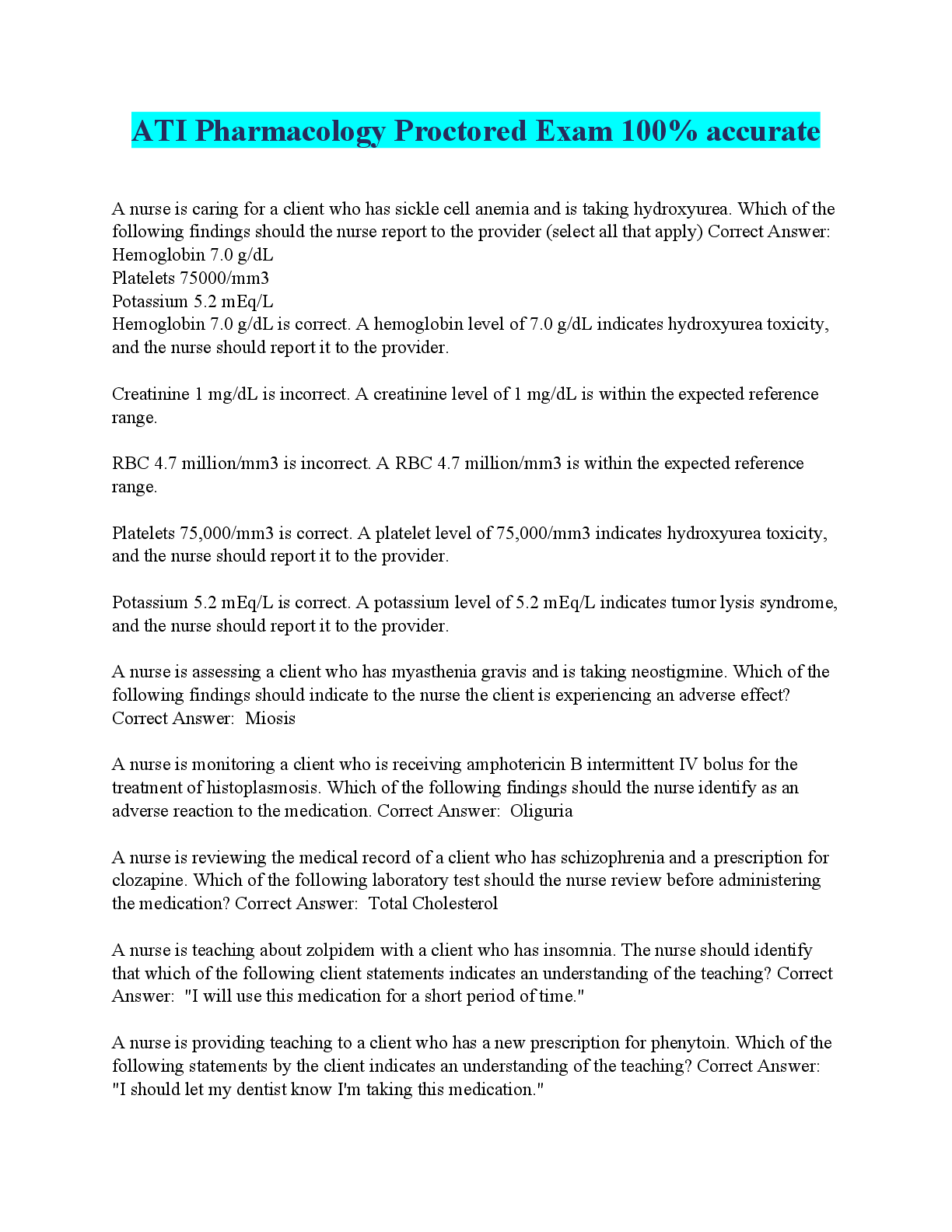
hese test items are undergoing psychometric analysis. Note: It is understood that medical practices vary with institutional policies and individual preferences. This test is designed in conjunction ... with the material presented in the 9th edition of the ATLS® Course. Please answer the questions accordingly. Important directions before you begin this test: This test consists of 40 multiple-choice questions. Read each question thoroughly and select the one best answer. Please note: Questions and/or concerns about test items are referred to the ACS ATLS® Program Office. The course director or coordinator cannot give credit for a response that you mark incorrectly according to the answer key. Prepared by the American College of Surgeons Committee on Trauma for sole use in an approved ACS ATLS® Course. This study source was download Please select the appropriate answer for each question. Once finished, please click the Submit Button. Question:1 A 22-year-old man is hypotensive and tachycardic after a shotgun wound to the left shoulder. His blood pressure is initially 80/40 mm Hg. After 2 liters of crystalloid solution his blood pressure increases to 122/84 mm Hg. His heart rate is now 100 beats per minute and his respiratory rate is 28 breaths per minute. His breath sounds are decreased in the left hemithorax, and after initial IV fluid resuscitation, a closed tube thoracostomy is performed for decreased left breath sounds with the return of a small amount of blood and no air leak. After chest tube insertion, the most appropriate next step is A) reexamine the chest. B) perform an aortogram. C) obtain a CT scan of the chest. D) obtain arterial blood gas analyses E) perform transesophageal echocardiography. Question:2 A construction worker falls two stories from a building and sustains bilateral calcaneal fractures.In the emergency department, he is alert, vital signs are normal, and he is complaining of severe pain in both heels and his lower back. Lower extremity pulses are strong and there is no other deformity. The suspected diagnosis is most likely to be confirmed by A) angiography. B) compartment pressures C) retrograde urethrogram D) Doppler-ultrasound studies. E) complete spine x-ray series. Question:3 The principle of balanced resuscitation is: A) Permissive hypotension and early plasma infusion B) Equal amounts of crystalloid and colloids C) Simultaneous management of breathing and circulation D) Maintenance of a normal acid base balance E) Achieving a pulse rate <90 Question:4 In managing the head- [Show More]
Last updated: 2 years ago
Preview 1 out of 8 pages
Buy this document to get the full access instantly
Instant Download Access after purchase
Buy NowInstant download
We Accept:
Can't find what you want? Try our AI powered Search
Connected school, study & course
About the document
Uploaded On
May 03, 2023
Number of pages
8
Written in
All
This document has been written for:
Uploaded
May 03, 2023
Downloads
0
Views
88
Scholarfriends.com Online Platform by Browsegrades Inc. 651N South Broad St, Middletown DE. United States.
We're available through e-mail, Twitter, and live chat.
FAQ
Questions? Leave a message!
Copyright © Scholarfriends · High quality services·