Title: Test Bank for Information Technology Project Management 9th Edition by Kathy Schwalbe - Complete, Elaborated & Latest Test Bank. ALL Chapters (1-13) Included and Updated.
#InformationTechnology
#TestBank
#K
...
Title: Test Bank for Information Technology Project Management 9th Edition by Kathy Schwalbe - Complete, Elaborated & Latest Test Bank. ALL Chapters (1-13) Included and Updated.
#InformationTechnology
#TestBank
#KathySchwalbe
#ProjectManagement
#CompleteTestBank
#LatestEdition
#ChapterIncluded
#UpdatedContent
#ITProjectManagement
#CaseStudy
#IntegrationManagement
#ScopeManagement
#TimeManagement
#CostManagement
#QualityManagement
#HumanResourceManagement
#CommunicationsManagement
#RiskManagement
#ProcurementManagement
#StakeholderManagement
#OnlineLearning
Chapter 1: Introduction to Project Management
Chapter 2: The Project Management and Information Technology Context
Chapter 3: The Project Management Process Groups: A Case Study
Chapter 4: Project Integration Management
Chapter 5: Project Scope Management
Chapter 6: Project Time Management
Chapter 7: Project Cost Management
Chapter 8: Project Quality Management
Chapter 9: Project Human Resource Management
Chapter 10: Project Communications Management
Chapter 11: Project Risk Management
Chapter 12: Project Procurement Management
Chapter 13: Project Stakeholder Management
Title: Test Bank for Information Technology Project Management 9th Edition by Kathy Schwalbe - Complete, Elaborated & Latest Test Bank. ALL Chapters (1-13) Included and Updated.
COMPLETE - Elaborated Test bank for Information Technology Project Management 9Ed. by Kathy Schwalbe. ALL Chapters(1-13) Included |365| Pages - Questions & Answers
Pass Information Technology Project Management 9Ed. by Kathy Schwalbe in First Attempt Guaranteed!Get 100% Latest Exam Questions, Accurate & Verified Answers to Pass the Actual Exam! Instant Download!
Information Technology Project Management 9Ed. by Kathy Schwalbe
ISBN-10 9781337101356
ISBN-13 978-1337101356
Ch 1: Introduction to Project Management
1.1 Introduction
1.2 What is a Project?
1.3 What is Project Management?
1.4 Program and Project Portfolio Management
1.5 The Role of the Project Manager
1.6 The Project Management Profession
Chapter Summary
Ch 2: The Project Management and Information Technology Context
2.1 A Systems View of Project Management
2.2 Understanding Organizations
2.3 Focusing on Stakeholder Needs
2.4 Project Phases and the Project Life Cycle
2.5 The Context of Information Technology Projects
2.6 Recent Trends Affecting Information Technology Project Management
Chapter Summary
Ch 3: The Project Management Process Groups: A Case Study
3.1 Project Management Process Groups
3.2 Mapping the Process Groups to the Knowledge Areas
3.3 Developing an IT Project Management Methodology
3.4 Case Study 1: JWD Consulting's Project Management Intranet Site Project (Predictive Approach)
3.5 Case Study 2: JWD Consulting's Project Management Intranet Site Project (Agile Approach)
3.6 Templates by Process Group
Chapter Summary
Ch 4: Project Integration Management
4.1 What is Project Integration Management?
4.2 Strategic Planning and Project Selection
4.3 Methods for Selecting Projects
4.4 Developing a Project Charter
4.5 Developing a Project Management Plan
4.6 Directing and Managing Project Work
4.7 Monitoring and Controlling Project Work
4.8 Performing Integrated Change Control
4.9 Closing Projects or Phases
4.10 Using Software to Assist in Project Integration Management
Chapter Summary
Ch 5: Project Scope Management
5.1 What is Project Scope Management?
5.2 Planning Scope Management
5.3 Collecting Requirements
5.4 Defining Scope
5.5 Creating the Work Breakdown Structure
5.6 Validating Scope
5.7 Controlling Scope
5.8 Using Software to Assist in Project Scope Management
Chapter Summary
Ch 6: Project Time Management
6.1 The Importance of Project Schedules
6.2 Planning Schedule Management
6.3 Defining Activities
6.4 Sequencing Activities
6.5 Estimating Activity Resources
6.6 Estimating Activity Durations
6.7 Developing the Schedule
6.8 Controlling the Schedule
6.9 Using Software to Assist in Project Time Management
Chapter Summary
Ch 7: Project Cost Management
7.1 The Importance of Project Cost Management
7.2 Basic Principles of Cost Management
7.3 Planning Cost Management
7.4 Estimating Costs
7.5 Determining the Budget
7.6 Controlling Costs
7.7 Using Project Management Software to Assist in Project Cost Management
Chapter Summary
Ch 8: Project Quality Management
8.1 The Importance of Project Quality Management
8.2 What is Project Quality Management?
8.3 Planning Quality Management
8.4 Performing Quality Assurance
8.5 Controlling Quality
8.6 Tools and Techniques for Quality Control
8.7 Modern Quality Management
8.8 Improving IT Project Quality
8.9 Using Software to Assist in Project Quality Management
Chapter Summary
Ch 9: Project Human Resource Management
9.1 The Importance of Human Resource Management
9.2 What is Project Human Resource Management?
9.3 Keys to Managing and Leading People
9.4 Developing the Human Resource Plan
9.5 Acquiring the Project Team
9.6 Developing the Project Team
9.7 Managing the Project Team
9.8 Using Software to Assist in Human Resource Management
Chapter Summary
Ch 10: Project Communications Management
10.1 The Importance of Project Communications Management
10.2 Keys to Good Communications
10.3 Planning Communications Management
10.4 Managing Communications
10.5 Controlling Communications
10.6 Suggestions for Improving Project Communications
10.7 Using Software to Assist in Project Communications
Chapter Summary
Ch 11: Project Risk Management
11.1 The Importance of Project Risk Management
11.2 Planning Risk Management
11.3 Common Sources of Risk on IT Projects
11.4 Identifying Risks
11.5 Performing Qualitative Risk Analysis
11.6 Performing Quantitative Risk Analysis
11.7 Planning Risk Responses
11.8 Controlling Risks
11.9 Using Software to Assist in Project Risk Management
Chapter Summary
Ch 12: Project Procurement Management
12.1 The Importance of Project Procurement Management
12.2 Planning Procurement Management
12.3 Conducting Procurements
12.4 Controlling Procurements
12.5 Closing Procurements
12.6 Using Software to Assist in Project Procurement Management
Chapter Summary
Ch 13: Project Stakeholder Management
13.1 The Importance of Project Stakeholder Management
13.2 Identifying Stakeholders
13.3 Planning Stakeholder Management
13.4 Managing Stakeholder Engagement
13.5 Controlling Stakeholder Engagement
13.6 Using Software to Assist in Project Stakeholder Management
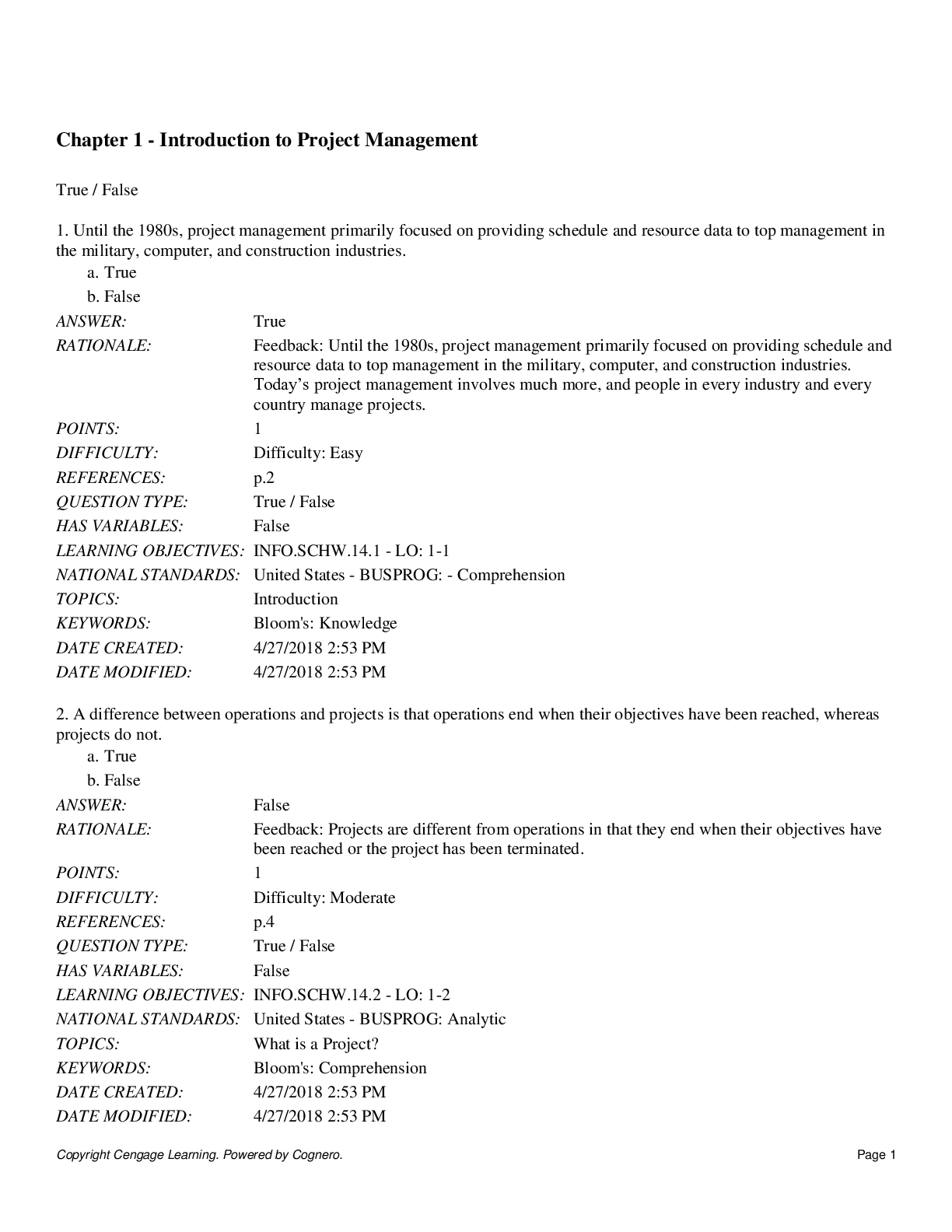
Chapter 1: Introduction to Project Management
Cengage Learning Testing, Powered by Cognero Page 1
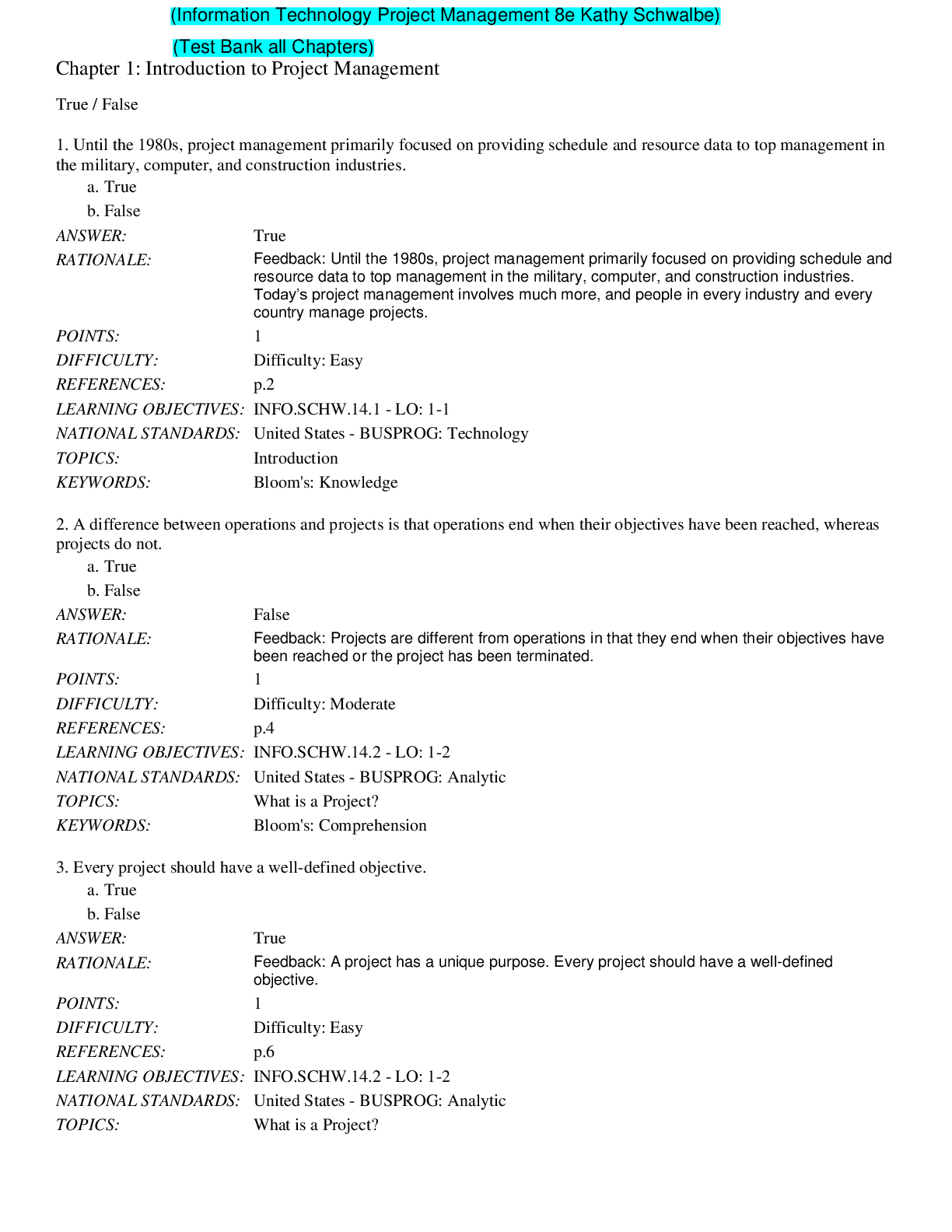
True / False
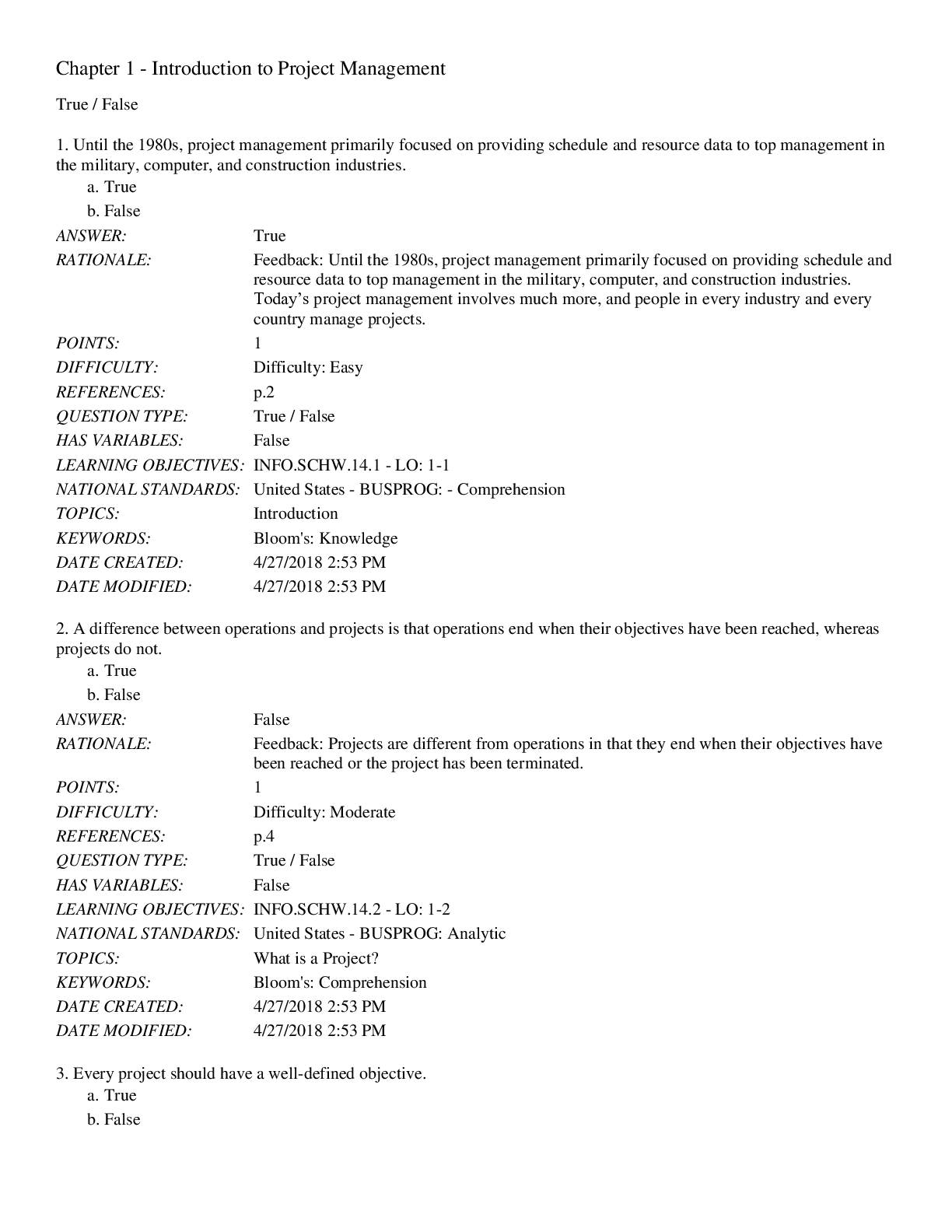
1. Until the 1980s, project management primarily focused on providing schedule and resource data to top management in
the military, computer, and construction industries.
a. True
b. False
ANSWER: True
RATIONALE: Feedback: Until the 1980s, project management primarily focused on providing schedule and
resource data to top management in the military, computer, and construction industries.
Today’s project management involves much more, and people in every industry and every
country manage projects.
POINTS: 1
DIFFICULTY: Difficulty: Easy
REFERENCES: p.2
LEARNING OBJECTIVES: INFO.SCHW.14.1 - LO: 1-1
NATIONAL STANDARDS: United States - BUSPROG: Technology
TOPICS: Introduction
KEYWORDS: Bloom's: Knowledge
2. A difference between operations and projects is that operations end when their objectives have been reached, whereas
projects do not.
a. True
b. False
ANSWER: False
RATIONALE: Feedback: Projects are different from operations in that they end when their objectives have
been reached or the project has been terminated.
POINTS: 1
DIFFICULTY: Difficulty: Moderate
REFERENCES: p.4
LEARNING OBJECTIVES: INFO.SCHW.14.2 - LO: 1-2
NATIONAL STANDARDS: United States - BUSPROG: Analytic
TOPICS: What is a Project?
KEYWORDS: Bloom's: Comprehension
3. Every project should have a well-defined objective.
a. True
b. False
ANSWER: True
RATIONALE: Feedback: A project has a unique purpose. Every project should have a well-defined
objective.
POINTS: 1
DIFFICULTY: Difficulty: Easy
REFERENCES: p.6
LEARNING OBJECTIVES: INFO.SCHW.14.2 - LO: 1-2
NATIONAL STANDARDS: United States - BUSPROG: Analytic
TOPICS: What is a Project?
Chapter 1: Introduction to Project Management
Cengage Learning Testing, Powered by Cognero Page 2
KEYWORDS: Bloom's: Knowledge
4. Projects should be developed in increments.
a. True
b. False
ANSWER: True
RATIONALE: Feedback: A project is developed using progressive elaboration. Projects are often defined
broadly when they begin, and as time passes, the specific details of the project become
clearer. Therefore, projects should be developed in increments.
POINTS: 1
DIFFICULTY: Difficulty: Moderate
REFERENCES: p.6
LEARNING OBJECTIVES: INFO.SCHW.14.2 - LO: 1-2
NATIONAL STANDARDS: United States - BUSPROG: Analytic
TOPICS: What is a Project?
KEYWORDS: Bloom's: Comprehension
5. Resources in a project should be used effectively because they are limited.
a. True
b. False
ANSWER: True
RATIONALE: Feedback: A project requires resources, often from various areas. Resources, however, are
limited and must be used effectively to meet project and other corporate goals.
POINTS: 1
DIFFICULTY: Difficulty: Moderate
REFERENCES: p. 7
LEARNING OBJECTIVES: INFO.SCHW.14.2 - LO: 1-2
NATIONAL STANDARDS: United States - BUSPROG: Analytic
TOPICS: What is a Project?
KEYWORDS: Bloom's: Comprehension
6. A project manager’s primary role is to provide the funding for a project.
a. True
b. False
ANSWER: False
RATIONALE: Feedback: A project sponsor usually provides the direction and funding for a project.
POINTS: 1
DIFFICULTY: Difficulty: Easy
REFERENCES: p.7
LEARNING OBJECTIVES: INFO.SCHW.14.2 - LO: 1-2
NATIONAL STANDARDS: United States - BUSPROG: Analytic
TOPICS: What is a Project?
KEYWORDS: Bloom's: Knowledge
7. One of the main reasons why project management is challenging is because of the factor of uncertainty..
[Show More]