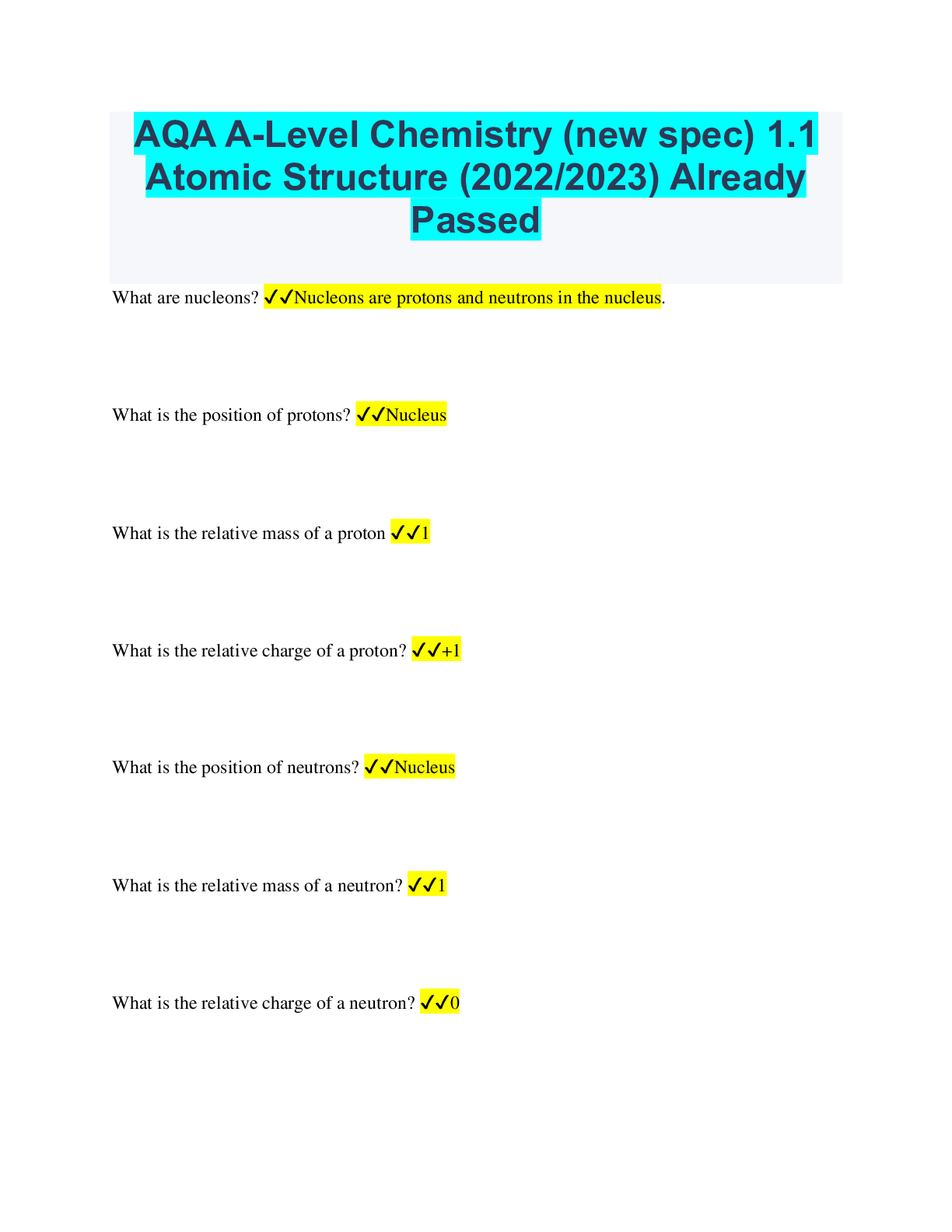
AQA A-Level Chemistry (new spec) 1.1
Atomic Structure (2022/2023) Already
Passed
What are nucleons? ✔✔Nucleons are protons and neutrons in the nucleus.
What is the position of protons? ✔✔Nucleus
What is the relative
...
AQA A-Level Chemistry (new spec) 1.1
Atomic Structure (2022/2023) Already
Passed
What are nucleons? ✔✔Nucleons are protons and neutrons in the nucleus.
What is the position of protons? ✔✔Nucleus
What is the relative mass of a proton ✔✔1
What is the relative charge of a proton? ✔✔+1
What is the position of neutrons? ✔✔Nucleus
What is the relative mass of a neutron? ✔✔1
What is the relative charge of a neutron? ✔✔0
What is the position of electrons? ✔✔Orbitals
What is the relative mass of an electron? ✔✔1/1800
What is the relative charge of an electron? ✔✔-1
Define mass number ✔✔Sum of protons and neutrons
Define atomic number ✔✔The amount of protons in the nucleus
Number of neutrons is worked out by... ✔✔Subtracting the atomic number from the mass
number
Define isotopes ✔✔Atoms of the same element with the same number of protons but a different
amount of neutrons
Isotopes have similar chemical properties because... ✔✔they have the same electron
configuration
Isotopes have varying physical properties because... ✔✔they have different masses
Define ions ✔✔A charged particle formed when an atom or molecule gains or loses one or more
electrons
Define Relative Isotopic Mass ✔✔The mass of an atom of a particular isotope compared to 1/12
the mass of an atom of carbon-12
Define Relative Atomic Mass (Ar) ✔✔The average mass of an atom compared to 1/12 the mass
of an atom of carbon-12
Define Relative Molecular Mass (Mr) ✔✔The average mass of a molecule compared to 1/12 the
mass of an atom of carbon-12
Mass Spectrometer: Why is it kept in vacuum conditions? ✔✔To prevents the ions produced
colliding with molecules of air
Mass Spectrometer: What happens during ionisation? ✔✔The sample is dissolved in a volatile
solvent and forced through a fine, hollow needle which is connected to a positive terminal of a
high voltage supply. The sample is shot with an electron gun, which knocks off an electron,
producing positively charged ions.
Mass Spectrometer: What happens during acceleration? ✔✔Positive ions are attracted to a
negatively charged plate, causing them to accelerate. Lighter ions with a higher charge move
faster
Mass Spectrometer: What happens during ion drift? ✔✔The ions pass through a hole in the
negatively charged plate, forming a beam, which drift towards the detector
Mass Spectrometer: What happens during detection? ✔✔The lighter ions which have the fastest
velocities arrive at the detector first. The positive ions pick up an electron, causing a current to
flow
Mass Spectrometer: What happens during data analysis? ✔✔Signals from the detector are passed
to a computer which generates a mass spectrum
Mass Spectrometer: What is the mass spectrometer measuring? ✔✔M:Z ratio and abundance
How do you calculate R.A.M from a mass spectrum? ✔✔You multiply the m:z ratio and
abundance together for each peak. You then add the totals together and divide by the total
relative abundance.
What sub-level can principle level 1 hold? ✔✔1s
What sub-levels can principle level 2 hold? ✔✔2s, 2p
What sub-levels can principle level 3 hold? ✔✔3s, 3p, 3d
What sub-levels can principle level 4 hold? ✔✔4s, 4p, 4d, 4f
How many electrons can sub-level S hold? ✔✔2
How many electrons can sub-level P hold? ✔✔6
How many electrons can sub-level D hold? ✔✔10
How many electrons can sub-level F hold? ✔✔14
What shape are S sub-levels? ✔✔Spherical
What shape are P sub-levels? ✔✔Dumbbells
Why is the 3d sub-level filled after the 4s sub-level? ✔✔Because 3d is higher in energy, so 4s is
filled first and then when 3d is filled, the energy level drops to below 4s
First Ionisation Energy ✔✔The enthalpy change when one mole of gaseous atoms forms one
mole of gaseous atoms with a singe positive charge by losing one electron
Second Ionisation Energy ✔✔The enthalpy change when one mole of gaseous ions with a single
positive charge forms one mole of gaseous ions with a 2+ charge by losing one electron
Factors affect ionisation energy: Nuclear Charge ✔✔The higher the nuclear charge (the more
protons there are) the greater the attraction of the outer electrons to the nucleus
Factors affect ionisation energy: The distance of the outer electrons to the nucleus ✔✔The larger
the atom, the further the outer electrons are away from the nucleus, making the attraction weaker
Factors affect ionisation energy: Shielding ✔✔Electrons in the outer shell are repelled by
electrons in complete inner shells, weakening the attraction of the nucleus
Factors affect ionisation energy: In-orbital Repulsion ✔✔Once the electrons are paired, they start
repelling each other, the degree of repulsion affects how easy it is to remove electrons
Why are the successive ionisation energies always higher? ✔✔Because a positive ion is formed
from the first ionisation energy, meaning the nuclear attraction increases, making it harder for the
second electron to be removed
Why is He's ionisation energy bigger than H's? ✔✔-Increased nuclear charge (gone from + to
+2)
-Same shielding
-Same distance from nucleus to outer electron
Why is there such a large drop of ionisation energy between He and Li? ✔✔-Increased shielding
(Li enters 2s orbital, He still on 1s)
-Increased nuclear charge
-Outer electrons are further away from the nucleus
Why is Be's ionisation energy greater than Li? ✔✔-Increased nuclear charge
-Shielding same as Li
-Outer electrons are the same distance away from the nucleus in both
Why is B's ionisation energy higher than Be? ✔✔-Increased nuclear charge
-Increased shielding (B enters 2p orbital) so is shielded by 1s and 2s orbitals
-Outer electrons are further away in B
Why is there a drop of ionisation energy between N and O? ✔✔-Increased nuclear charge
-Shielding same (still in 2p orbital)
-Same amount of shielding
-In orbital repulsion as the electron is entering a partially filled p sub-level
[Show More]



 AC V1.png)
.png)
 V1.png)