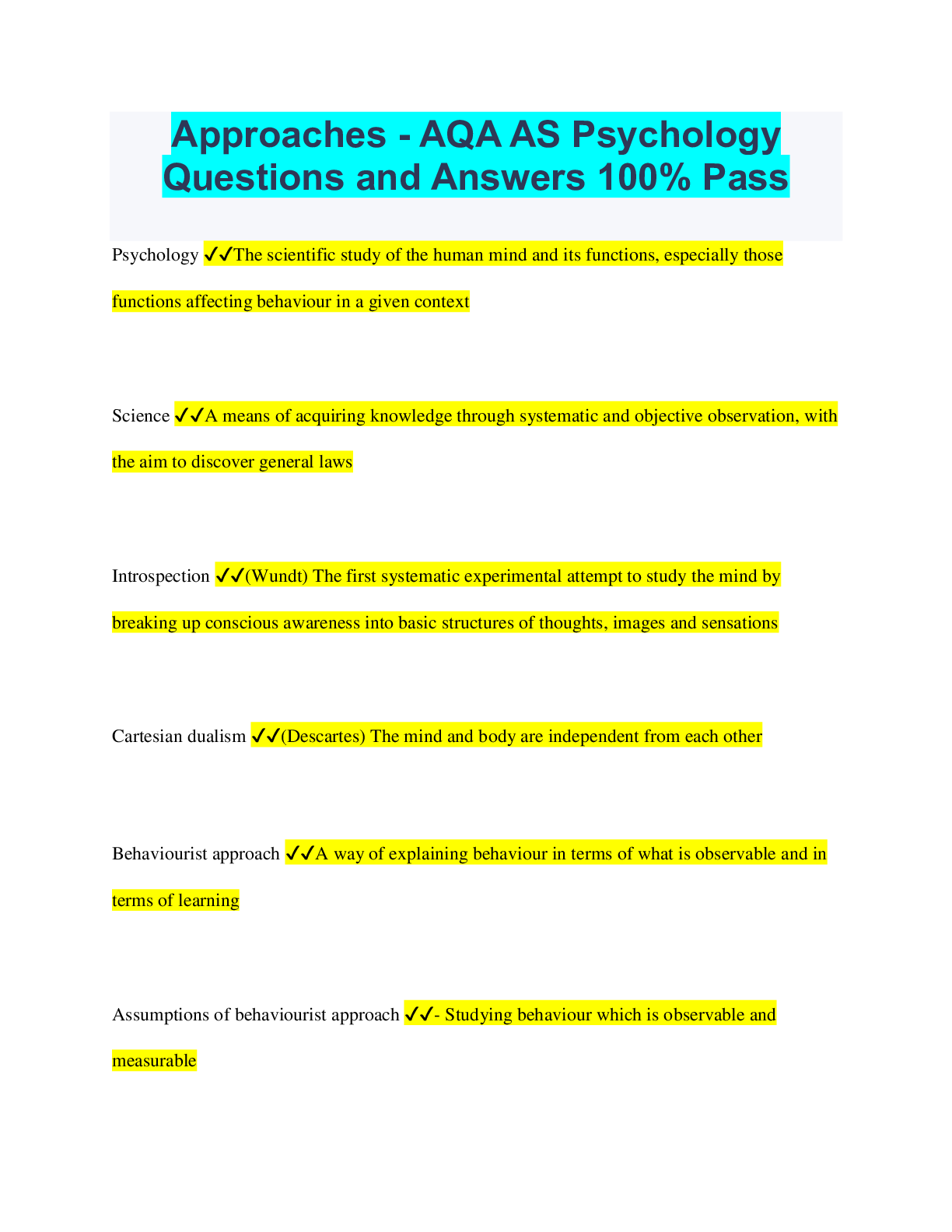
Approaches - AQA AS Psychology Questions and Answers 100% Pass
Document Content and Description Below
Approaches - AQA AS Psychology
Questions and Answers 100% Pass
Psychology ✔✔The scientific study of the human mind and its functions, especially those
functions affecting behaviour in a given c
...
ontext
Science ✔✔A means of acquiring knowledge through systematic and objective observation, with
the aim to discover general laws
Introspection ✔✔(Wundt) The first systematic experimental attempt to study the mind by
breaking up conscious awareness into basic structures of thoughts, images and sensations
Cartesian dualism ✔✔(Descartes) The mind and body are independent from each other
Behaviourist approach ✔✔A way of explaining behaviour in terms of what is observable and in
terms of learning
Assumptions of behaviourist approach ✔✔- Studying behaviour which is observable and
measurable
- Not concerned about internal mental processes
- Watson rejected introspection
- Lab experiments
- Basic processes that govern learning are the same for all species
Classical conditioning ✔✔(Pavlov) Learning by association: occurs when 2 stimuli are
repeatedly paired together (UCS and neutral stimulus). The neutral stimulus eventually produce
the same response that was first produced by the unlearned stimulus alone
Operant conditioning ✔✔(Skinner) Behaviour is shaped and maintained through its
consequences (positive reinforcement, negative reinforcement, punishment)
Behaviourist approach evaluation ✔✔+ Scientific credibility: emphasising replications and
objectivity, influential in developing psychology as a science = INC CREDIBILITY
+ Real life application: token economy systems, phobias = valid + USEFUL
- Mechanistic view of behaviour: animals seen as machine-like responders, little to no conscious
insight, opposed by SLT & cognitive = less application to humans, LESS VALID
- Unethical
Social learning theory ✔✔A way of explaining behaviour that includes both direct and indirect
reinforcement, combining learning theory with the role of cognitive factors
SLT assumptions ✔✔Behaviour is learned through observation and imitation of others within a
social context
Imitation ✔✔Copying the behaviour of others
Identification ✔✔When an observer associates themselves with a role model and wants to be like
the role model
Modelling ✔✔Imitating the behaviour of a role model, which the model precisely demonstrates
Vicarious reinforcement ✔✔Reinforcement which is not directly experienced but occurs through
observing someone else being reinforced for a behaviour
Mediational processes ✔✔Cognitive factors which influence learning and come between
stimulus and response: Attention, Retention, Motor reproduction & Motivation
SLT evaluation ✔✔+ Importance of cognitive factors: comprehensive explanation of human
learning (mediational processes)
- Lab experiments: (Bandura) demand characteristics, artificial = tell us little about learning IRL,
LESS GENERALISABLE, LESS ECOLOGICALLY VALID
- Underestimates biology: boys more aggressive than girls in bobo doll experiment, may be due
to hormonal factors = REDUCES VALIDITY OF THEORY
+ Explains cultural differences
+ Less deterministic: some free will, reciprocal determinism
Cognitive approach ✔✔How our mental processes affect behaviour
Assumptions of cognitive approach ✔✔Argues internal mental processes can, and should, be
scientifically studies. It investigates areas of human behaviour that are normally neglected -
memory, perception and thinking. The processes are 'private' so are studies by making
inferences.
Internal mental processes ✔✔'Private' operations of the mind such as perception and attention
that mediate between stimulus and response
Computer models ✔✔Mind is compared to a computer by suggesting that there are similarities in
the way that information is processed
Schema ✔✔A mental framework of beliefs and expectations that influence cognitive processing,
which are developed from experience
Inference ✔✔The process whereby cognitive psychologists draw conclusions about the way
mental processes operate on the basis of observed behaviour
Cognitive neuroscience ✔✔The scientific study of biological structures that underpin cognitive
processes
Evaluation of cognitive approach ✔✔+ Scientific and objective methods: highly controlled and
rigorous lab experiments
- Machine reductionism: comparing to a computer, ignores influence of human emotion and
motivation on the cognitive system, and how this may affect out ability to process information
- Application to everyday life: artificial, abstract, only inferences, may not represent everyday
memory experiences = LACK EXTERNAL VALIDITY
+ Soft determinism: recognises that our cognitive system can only operate within the limits that
we know, but free to think = more reasonable middle ground
Biological approach ✔✔A perspective that emphasises the importance of physical processes in
the body such as genetic inheritance and neural function
Biological assumptions ✔✔Everything psychological is first biological so we must look at
biological structures and processes within the body (genes, neurochemistry and nervous system),
biological psychologist believe that the mind lives in the brain
Genes ✔✔Make up chromosomes, made up of DNA which code for physical features and
psychological features and are transmitted from parents to offspring
Biological structure ✔✔An arrangement or organisation of parts to form an organ, system or
living thing
Concordance rate ✔✔The extent to which both twins share the same characteristics
Monozygotic twins ✔✔Identical twins (100% same DNA)
Dizygotic twins ✔✔Non-identical twins (50% same DNA)
Genotype ✔✔The particular set of genes that a person posseses
Phenotype ✔✔The characteristics of an individual determined by their genes and environment
Evolution ✔✔The changes in inherited characteristics in a biological population over successive
generations
Evaluation of biological approach ✔✔+ Scientific methods: fMRI's, EEG's, family & twin
studies - more accurate = MORE REPRODUCIBLE, RELIABLE
+ Real application: development of psychoactive drugs that treat serious mental illnesses e.g.
depression = USEFUL
- Associations rather than causations: a drug reduces symptoms of a mental disorder and thus it
assumed that the neurochemical in the drug causes the disorder = NOT 100% VALID
- Deterministic: sees behaviour as being governed by internal, biological causes, no free will,
problems in legal system (e.g. criminal gene) = LESS USEFUL
-Difficult to separate nature and nurture
[Show More]
Last updated: 2 years ago
Preview 1 out of 7 pages






.png)