AQA A Level Psychology: Research
Methods Latest 2023 with Certified
Answers
Abstract
A self-contained, clear and concise summary of the research including the aim, hypothesis,
method/procedure, results and conclusio
...
AQA A Level Psychology: Research
Methods Latest 2023 with Certified
Answers
Abstract
A self-contained, clear and concise summary of the research including the aim, hypothesis,
method/procedure, results and conclusions.
Explain the the difference between an aim and a hypothesis.
An aim is a general statement of what the researcher intends to investigate. The aim is the
purpose of the study, while the hypothesis is a clear, precise, testable statement that states the
relationship between the variables to be investigated and is stated at the outset of any study.
State one occasion where a psychologist may choose to use a directional hypothesis.
When the findings of previous research suggest a particular outcome.
State two occasions where a psychologist may choose to use a directional hypothesis.
Where there's no previous research, or the findings from earlier studies are contradictory.
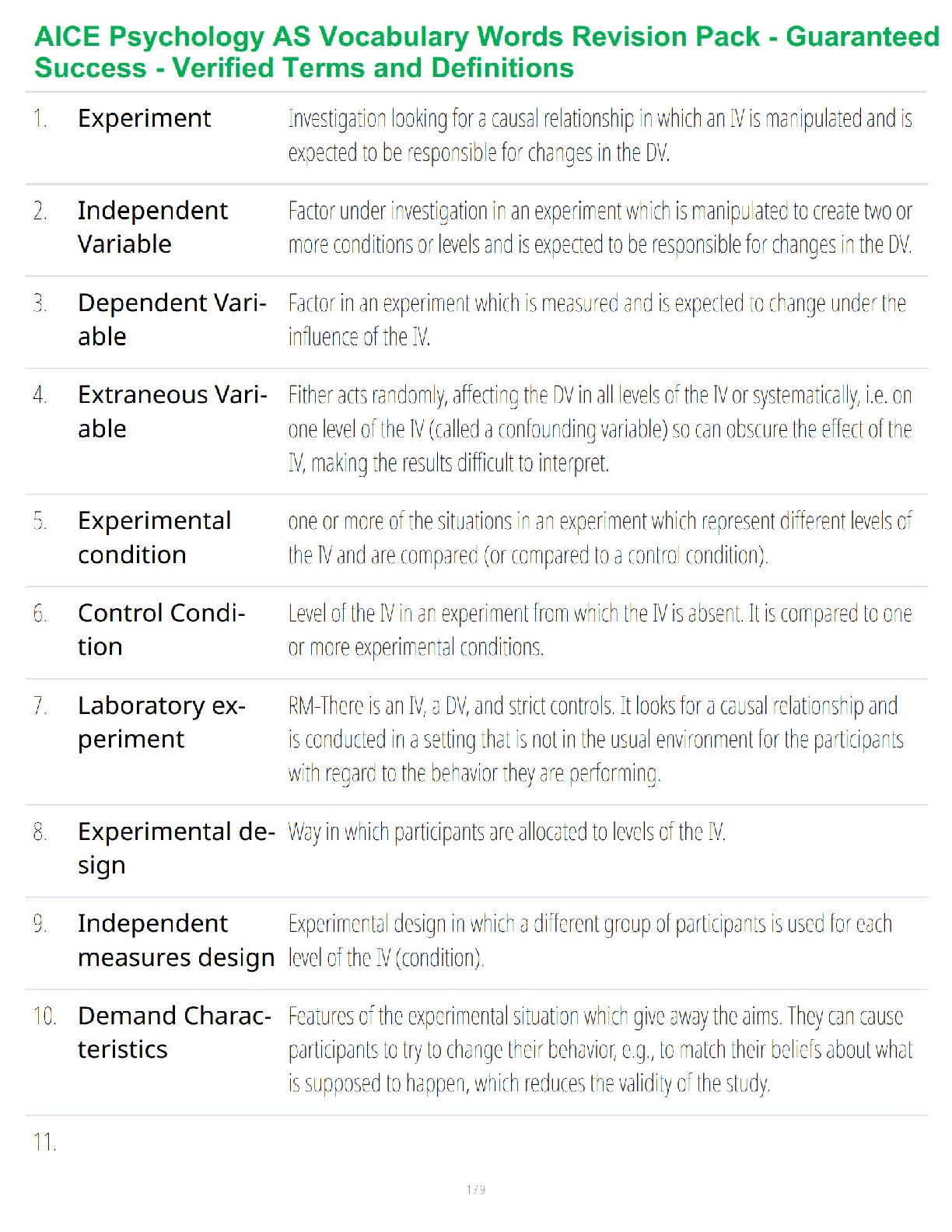
Explain the difference between an extraneous variable and a confounding variable.
Demand characteristics are any cues from the researcher or from the research situation that may
be interpreted by participants as revealing the study's purpose and may lead to participants
altering their behaviour, whereas an extraneous variable is any variable other than the IV that
may affect the DV if uncontrolled.
What are the strengths of a lab experiment?
High control over extraneous variables so researcher can ensure that any effect on the DV is
likely because of the manipulation of the IV. Therefore, lab studies tend to have high internal
validity and are replicable.
What are the limitations of lab studies?
May lack generalisability and external validity. Lab environment may be artificial and not reflect
everyday life. May be subject to demand characteristics and lack mundane realism.
What are the strengths of field studies?
Higher mundane realism than lab studies as the environment is more natural. May produce
behaviour that is more valid and authentic, especially if Ps are unaware that they're being
studied. High external validity.
What are the limitations of field experiments?
Reduced control over extraneous variables due to increased realism so precise replication may
not be possible. Ethical issues arise when Ps are unaware that they're being studies. Can't consent
and privacy may be invaded.
What are the strengths of natural experiments?
Provide opportunities for research that may not have otherwise be undertaken for practical or
ethical reasons. High external validity as they involve the study of real-life issues as they happen.
What are the limitations of natural experiments?
Can't be precisely replicated. Naturally occurring event may happen rarely and limit
generalisation of findings to similar situations. Ps may not be randomly allocated to experimental
conditions, so less sure whether it was IV that affected DV.
Strengths of quasi-experiments.
Soften excited in controlled conditions so share same strengths as lab studies.
Limitations of quasi-experiments.
Can't randomly allocate Ps to conditions and therefore there may be a confounding variable.
Identify and outline two sections of a scientific report.
Any of the following:
1. Title (determines who reads full report; must be as concise and simultaneously informative,
telling the reader what the report's about).
2. Abstract (provides brief summary of study, including details of each sections).
3. Introduction (introduces background info on background research, leading to aims and
hypothesis).
Correlation
An association between co-variables.
Case studies are what kind of research?
Idiographic.
Case study
Involves an in-depth investigation, description, and analysi
[Show More]