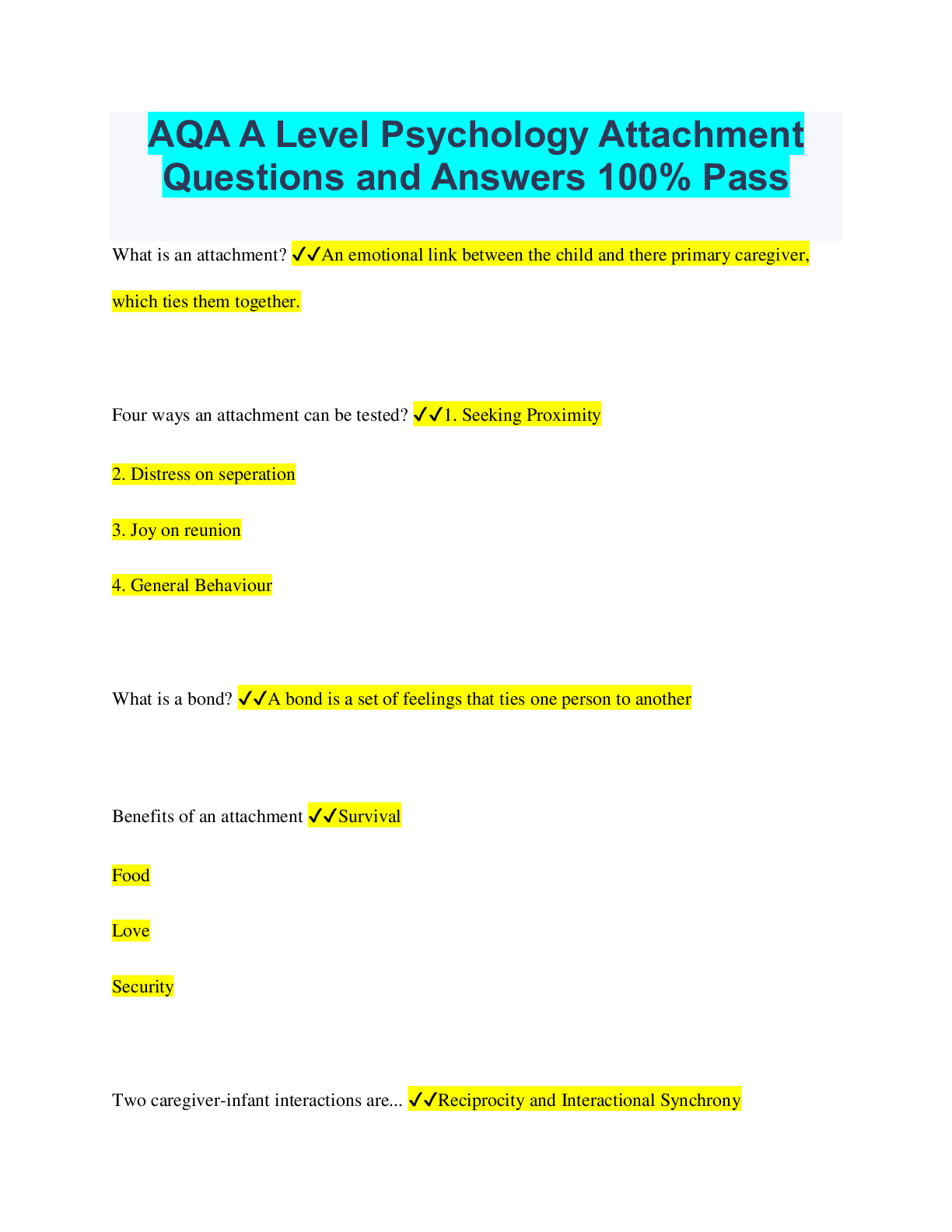
AQA A Level Psychology - Attachment -
Key terms 100% Pass
Attachment ✔✔A close, loving/emotional two way bond between two individuals in which each
individual sees the other as essential for their emotional security
...
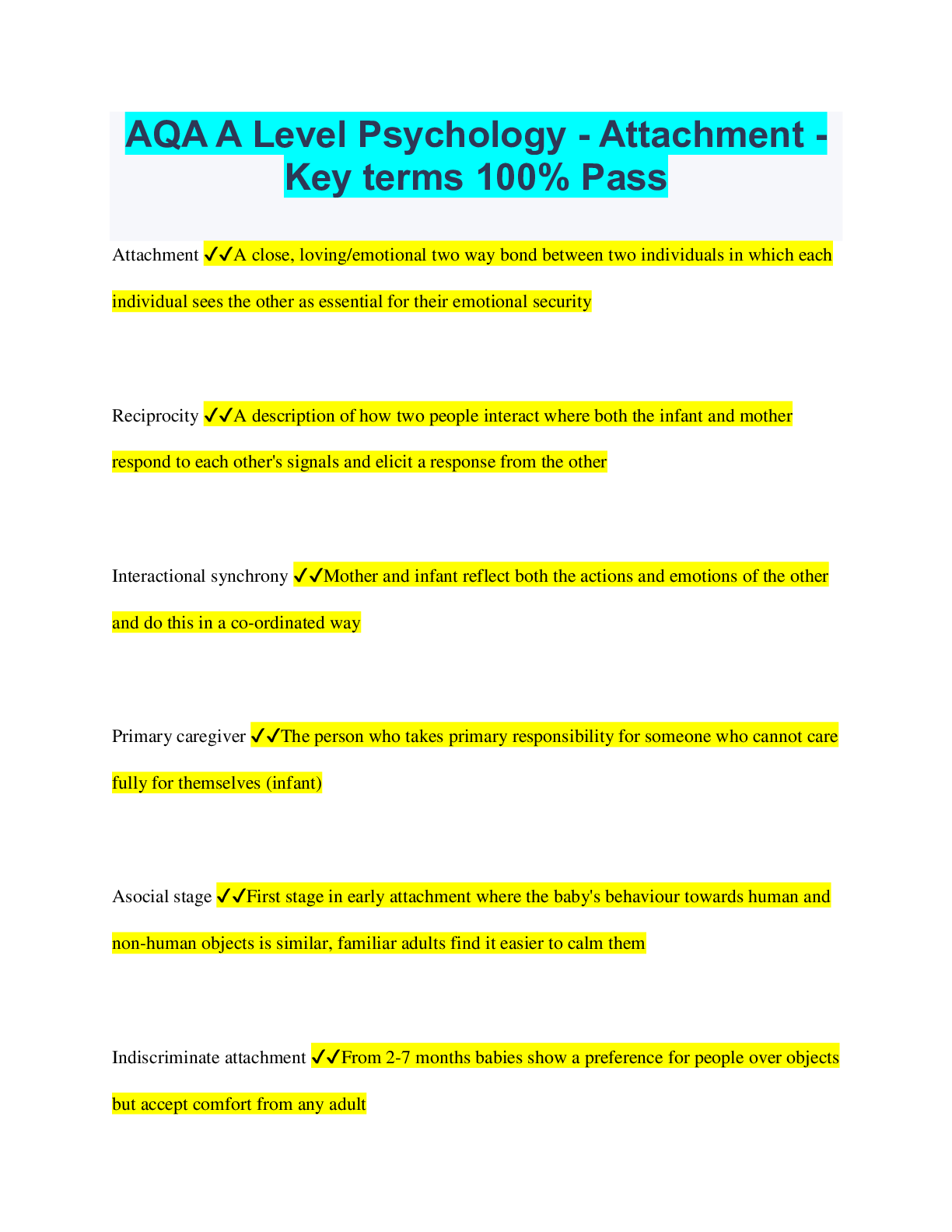
AQA A Level Psychology - Attachment -
Key terms 100% Pass
Attachment ✔✔A close, loving/emotional two way bond between two individuals in which each
individual sees the other as essential for their emotional security
Reciprocity ✔✔A description of how two people interact where both the infant and mother
respond to each other's signals and elicit a response from the other
Interactional synchrony ✔✔Mother and infant reflect both the actions and emotions of the other
and do this in a co-ordinated way
Primary caregiver ✔✔The person who takes primary responsibility for someone who cannot care
fully for themselves (infant)
Asocial stage ✔✔First stage in early attachment where the baby's behaviour towards human and
non-human objects is similar, familiar adults find it easier to calm them
Indiscriminate attachment ✔✔From 2-7 months babies show a preference for people over objects
but accept comfort from any adult
Specific attachment ✔✔From around 7 months the baby becomes anxious when separated from
one particular adult
Multiple attachments ✔✔Attachments to two or more people. Most babies develop them once
they have formed one true attachment to their primary attachment figure
Stranger anxiety ✔✔Response to unfamiliar adults
Separation anxiety ✔✔Level of distress shown when separated from a particular adult
Imprinting ✔✔Bird species that are mobile from birth follow the first moving thing they see
Ethology ✔✔Study of animal behaviour
Sexual imprinting ✔✔Directing courtship behaviour towards the first moving objects an animal
sees
Critical period ✔✔Time within which an attachment MUST form if it is to form at all
Contact comfort ✔✔Contact with something soft (e.g. a cloth) is important for baby monkeys
Learning theory ✔✔A set of theories from the behaviourist approach to psychology that
emphasise the role of learning in the acquisition of behaviour
Cupboard love ✔✔Babies develop an attachment with their caregiver because they provide food
Primary drive ✔✔An innate, biological motivator e.g. hunger
Secondary drive ✔✔Learned by an association between the caregiver and the satisfaction of a
primary drive
Monotropic (theory) ✔✔Child's attachment to one caregiver is different and more important
Law of continuity ✔✔The more consistent and predictable care is, the better the quality of the
attachment
Law of accumulated separation ✔✔Effects of separation add up and the 'safest dose is zero dose'
Social releasers ✔✔Innate sense of cute behaviours designed to activate the adult attachment
system
Sensitive period ✔✔Time within which an attachment SHOULD form because it will be more
difficult to form one later
Internal working model ✔✔Mental representations of relationship to your primary caregiver
which affects future relationships
Temperament ✔✔Child's genetically influenced personality
Strange Situation ✔✔A controlled observation design to test attachment security in an unfamiliar
playroom
Secure base (behaviour) ✔✔Using caregiver as a point of contact during exploration to make
them feel safe
Proximity (seeking) ✔✔An infant with a good attachment will stay fairly close to their caregiver
Secure (attachment) ✔✔Most desirable attachment type, moderate stranger and separation
anxiety, happy to explore but returns regularly, comfort is required and accepted on reunion
Insecure avoidant (attachment) ✔✔Attachment type with little stranger and separation anxiety,
no secure base or proximity seeking and little response on reunion
Insecure resistant (attachment) ✔✔Attachment type with high stranger and separation anxiety
but resists comfort at reunion
Disorganised (attachment) ✔✔Attachment type showing a mix of insecure resistant and insecure
avoidant characteristics
Imposed etic ✔✔Trying to apply a theory or technique designed for one culture to another
culture
Maternal deprivation ✔✔The emotional and intellectual consequences of separation between a
child and their mother or mother substitute
Deprivation ✔✔Child is not in the presence of the primary attachment figure and loses an
element of care
Separation ✔✔Child is not in the presence of the primary attachment figure
Affectionless psychopathy ✔✔The inability to feel guilt or strong emotion for others, no
empathy, no remorse
Privation ✔✔Failure to form any attachment in the first place
Institutionalisation ✔✔Living in an institutional setting such as a hospital or orphanage for long,
continuous period of time
Orphan ✔✔Child whose parents have died or abandoned them permanently
Disinhibited attachment ✔✔Attachment type characterised by attention seeking, clinginess and
social behaviour direction indiscriminately towards all adults even if unfamiliar
Secondary attachment figure ✔✔A person other than the primary caregiver with whom the child
has formed a close emotional bond
Classical conditioning ✔✔Learning by association when an unconditioned stimulus is paired
with a neutral stimulus
Operant conditioning ✔✔A form of learning in which behaviour is shaped and maintained by its
consequences
Mutual reinforcement ✔✔Reinforcement is a two way process - crying and comfort is positive
reinforcement for the baby and negative reinforcement for the caregiver
[Show More]


.png)