Early Intervention & Transitioning Test
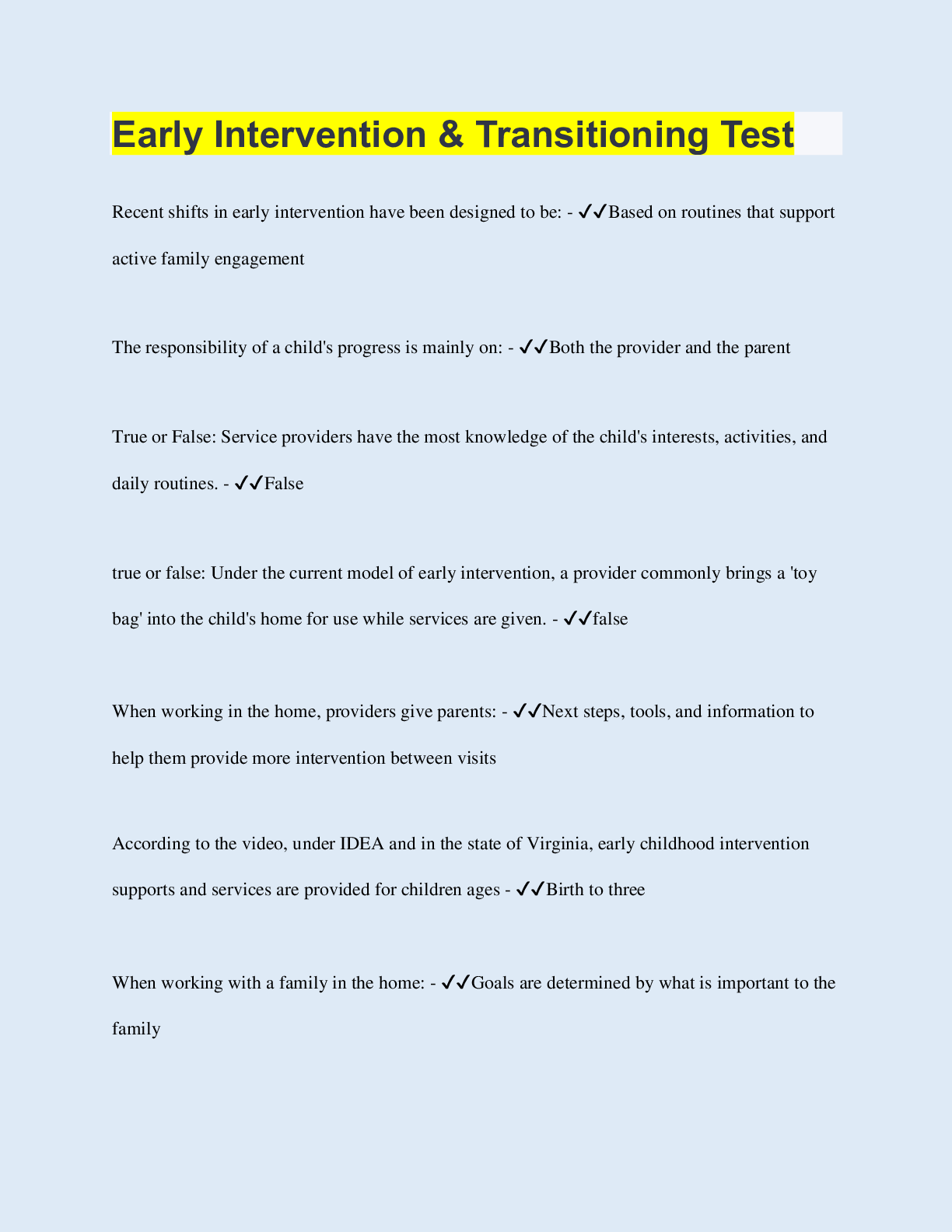
Recent shifts in early intervention have been designed to be: - ✔✔Based on routines that support
active family engagement
The responsibility of a child's progress is mainly on:
...
Early Intervention & Transitioning Test
Recent shifts in early intervention have been designed to be: - ✔✔Based on routines that support
active family engagement
The responsibility of a child's progress is mainly on: - ✔✔Both the provider and the parent
True or False: Service providers have the most knowledge of the child's interests, activities, and
daily routines. - ✔✔False
true or false: Under the current model of early intervention, a provider commonly brings a 'toy
bag' into the child's home for use while services are given. - ✔✔false
When working in the home, providers give parents: - ✔✔Next steps, tools, and information to
help them provide more intervention between visits
According to the video, under IDEA and in the state of Virginia, early childhood intervention
supports and services are provided for children ages - ✔✔Birth to three
When working with a family in the home: - ✔✔Goals are determined by what is important to the
family
True or False: Caregivers learn how to provide intervention in frequent classes given by the
community's early intervention providers. - ✔✔False
True or False: The shift in mindset in early intervention has largely been from a medical model
to family centered model. - ✔✔True
Under the current model of early intervention, interventions are most commonly provided: -
✔✔While embedded in natural family routines
How often should outcomes be reviewed? - ✔✔Atleast every 6 months
Which is not an example of a good interview strategy?
Question options:
A. Be natural and informal/put the parent at ease
B. Use professional terminology to demonstrate knowledge
C. Express understanding for how the parent might feel
D. Place papers flat/allow the parent to see what is being written - ✔✔B. Use professional
terminology to demonstrate knowledge
In early intervention, RBI stands for - ✔✔Response-based interview
The RBI: - ✔✔is a semi-structured interview
Put the 8 critical features of the RBI in order: - ✔✔1. Main concerns
2. Go through the day
3. Star concerns
4. Satisfaction ratings
5. Worry and change questions
6. Recap
7. Family chooses outcomes
8. Priority order
In the context of RBI, routines are: - ✔✔What the family naturally does in a typical day
The worry and change question..
Question options:
A. Are too intrusive to ask most families
B. Should not be asked by professionals who are uncomfortable dealing with emotions
C. Can produce very important information related to families' desires
D. Are usually conducted by a nosy interviewer - ✔✔C. Can produce very important information
related to families' desires
With the RBI, outcomes and goals - ✔✔Are chosen by the family
True or False: That families will not choose relevant outcomes is a concern that professionals
may have regarding the RBI. - ✔✔True
In the context of the RBI, routines are - ✔✔Activities that happen with some regularity
Which of the following is a legitimate challenge to implementing the RBI?
A. Transferring the information from the interviewer to interventionists
B. Interviewing extremely verbose family members
C. Interviewing family members who do not speak very much
D. All of the above - ✔✔D. All the above
Which of the following types of children are automatically eligible (i.e. do not need testing to be
enrolled) for Part C services under IDEA in all states? - ✔✔Children who have established
conditions
Target child behaviors on the intervention plan should be - ✔✔Necessary for functioning in
current routines
The purpose for each outcome/goal should be - ✔✔Stated explicitly
Purposes of outcomes/goals (and therefore criteria) include which of the following?
A. Acquisition
B. Generalization
C. Maintenance
D. All of the above plus fluency - ✔✔D. All of the above plus fluency
Which of the following is not true about the definition of functionality?
A. The outcome/goal is important to the primary caregivers
B. The outcome/goal specifies what the child or family will do
C. The outcome/goal must be able to be addressed during therapy or instruction
D. The contextual need for the outcome/goal is specified - ✔✔C. The outcome/goal must be able
to be addressed during therapy or instruction
Which of the following is not included in the list of functional domains in this model?
A. Independence
B. Engagement
C. Motor
D. Social relationships - ✔✔C. Motor
Interventions and outcomes/goals should be - ✔✔Routines-based
Which of the following statements are true about challenging behavior?
A. Any repeated behavior that interferes with learning or engagement in pro-social interactions
with peers and adults
B. Behaviors that are not responsive to the use of developmentally appropriate guidance
procedures
C. Prolonged tantrums, physical and verbal aggression, disruptive vocal and motor behavior,
property destruction, self-injury, noncompliance, and withdrawal
D. All of the above - ✔✔D. All of the above
The Prevent-Teach-Reinforce functional behavior assessment process is appropriate for which
group of students? - ✔✔Tier 3/"top of the pyramid' students
True or False: For every redirection or correction, students evidencing Tier 3 behaviors need to
receive five positive statements, praise, etc. to 'break even.' - ✔✔True
True or False: If students in your classroom are demonstrating difficult behaviors, it is
recommended that you start with Tier 3 interventions such as the PTR process to ensure the
behaviors are appropriately addressed right away. - ✔✔False
Put the steps of PTR-YC in order: - ✔✔__2__Establishing Practical Data Collection
__3__Functional Behavioral Assessment
__1__Teaming and Goal Setting
__4__Developing and Implementing the Behavior Intervention Plan (BIP)
__5__Follow up: Data-based Decision Making: Next Steps
A transition profile is: - ✔✔A comprehensive synthesis of the student's strengths, preferences,
interests, and needs.
Assessments of needs and preferences i
[Show More]