Palo Alto Firewalls Test
Which protocol used to exchange heartbeat between HA? - ✔✔ICMP
The Management Network Port on a Firewall can be Configured as which type of Interface? -
✔✔Layer 3
Why Paloalto is being called
...
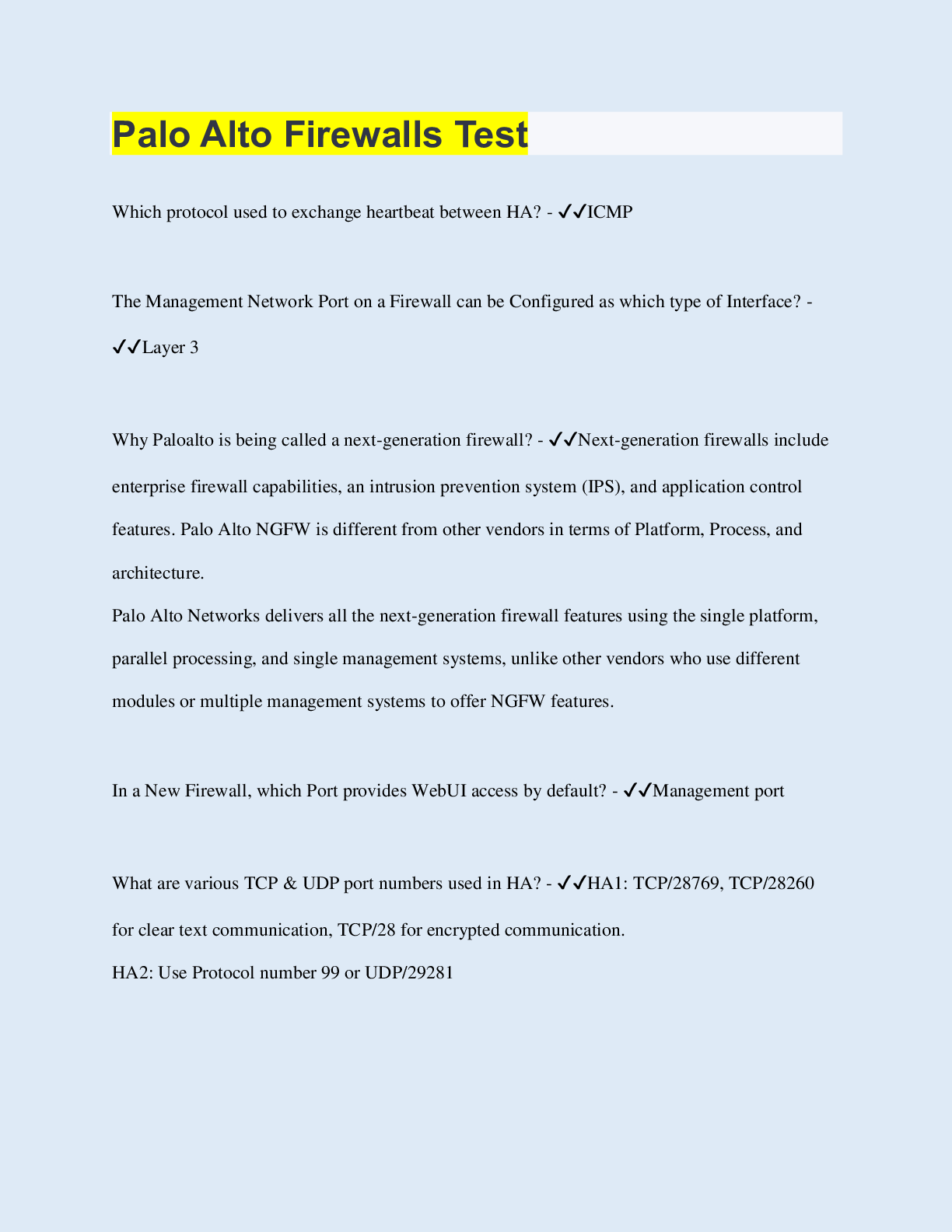
Palo Alto Firewalls Test
Which protocol used to exchange heartbeat between HA? - ✔✔ICMP
The Management Network Port on a Firewall can be Configured as which type of Interface? -
✔✔Layer 3
Why Paloalto is being called a next-generation firewall? - ✔✔Next-generation firewalls include
enterprise firewall capabilities, an intrusion prevention system (IPS), and application control
features. Palo Alto NGFW is different from other vendors in terms of Platform, Process, and
architecture.
Palo Alto Networks delivers all the next-generation firewall features using the single platform,
parallel processing, and single management systems, unlike other vendors who use different
modules or multiple management systems to offer NGFW features.
In a New Firewall, which Port provides WebUI access by default? - ✔✔Management port
What are various TCP & UDP port numbers used in HA? - ✔✔HA1: TCP/28769, TCP/28260
for clear text communication, TCP/28 for encrypted communication.
HA2: Use Protocol number 99 or UDP/29281
A Network Design Change Requires An Existing Firewall To Start Accessing Palo Alto Updates
From a Data-Plane Interface Address Instead Of The Management Interface. Which
Configuration Setting needs To Be Modified? - ✔✔Service route
What are the various links used to establish HA? - ✔✔Control Link
Data Link
Backup Links
Packet-Forwarding Link
What is DMZ (Demilitarized Zone)? - ✔✔Servers that are accessed by the Internet are usually
located in a DMZ (demilitarized zone). The DMZ makes sure that these servers cannot connect
to the internal network. Make sure that the Rule Base contains rules for DMZ traffic. For
example, these are rules for a web server in the DMZ
What is the command to check the NAT rule? - ✔✔test nat-policy-match
which command to check the firewall policy matching for a particular destination? - ✔✔test
security-policy-match from trust to untrust destination.
When A Malware-infected Host Attempts To Resolve A Known Command-and-control Server,
The Traffic Matches A Security Policy With DNS Sinkhole Enabled, generating a Traffic Log.
What Will Be The Destination IP Address In That Log Entry? - ✔✔The IP Address specified in
the sinkhole configuration.
What is the difference between traditional firewall and next generation firewall - ✔✔NGFW are
traditional firewalls + IPS (Intrusion Prevention System) + AMP (Adavanced Malware
Protection) + AV (Anti-Virus) + URL Proxy
NGFW can inspect SSL/SSH encrypted traffic by doing SSL/SSH decryption
NGFW also does Intrusion Prevention / Intrusion Detection Services
NGFW can also detect Malware and Viruses in the network
URL filtering
Policies based on username/user id
What is the difference between Paloalto NGFW and Checkpoint UTM? - ✔✔PA NGFW follows
Single-pass parallel processing while CP UTM follows the Multi-pass architecture process.
In An Enterprise Deployment, A Network Security Engineer Wants To Assign To A Group Of
Administrators Without Creating Local Administrator Accounts On The Firewall. Which
Authentication Method Must Be Used? - ✔✔RADIUS with Vendor-Specific Attributes.
The Configuration Of a DoS Protection Profile Can Defend Nodes From which Attacks? -
✔✔Floods
Describe about Palo Alto architecture and advantage ? - ✔✔Ans: Architecture- Single Pass
Parallel Processing (SP3) architecture
Advantage: This Single Pass traffic processing enables very high throughput and low latency -
with all security functions active. It also offers a single, fully integrated policy that helps
simplify and easier management of firewall policy.
What must be Used In Security Policy Rule That Contains Addresses where Nat Policy Applies?
- ✔✔Pre-NAT address and Post-Nat zones.
Explain about virtual system ? - ✔✔Ans: A virtual system specifies a collection of physical and
logical firewall interfaces and security zones. The virtual system allows to segmentation of
security policy functionalities like ACL, NAT, and QoS. Networking functions including static
and dynamic routing are not controlled by virtual systems. If routing segmentation is desired for
each virtual system, we should have an additional virtual router.
What you mean by Device Group and Device Template.? - ✔✔Ans: Device group allows you to
group firewalls that require a similar set of policies, such as firewalls that manage a group of
branch offices or individual departments in a company. Panorama treats each group as a single
unit when applying policies. A firewall can belong to only one device group. The Objects and
Policies are only part of Device Group.
Device Templates enable you to deploy a common base configuration like Network and devicespecific settings to multiple firewalls that require similar settings. This is available in Device and
Network tabs on Panorama.
How Does Panorama Handle Incoming Logs When it reaches Maximum Storage Capacity? -
✔✔Panorama automatically delete older logs to create space for new ones.
What is Global Protect? - ✔✔Ans: GlobalProtect provides a transparent agent that extends
enterprise security policy to all users regardless of their location. The agent also can act as a
Remote Access VPN client. The following are the component.
Gateway: This can be or more interface on the Palo Alto firewall which provides access and
security enforcement for traffic from Global Protect Agent.
Portal: Centralized control which manages gateway, certificate, user authentication, and end-host
checklist.
Agent: software on the laptop that is configured to connect to the GlobalProtect deployment.
What is the use of Security Profile? - ✔✔Ans: Security Profile used to scans allowed
applications for threats, such as viruses, malware, spyware, and DDOS attacks. Security profiles
are not used in the match criteria of traffic flow. The security profile is applied to scan traffic
after the application or category is allowed by the security policy.
You can add security profiles that are commonly applied together to a Security Profile Group.
Following are the Security Profiles available:
Antivirus Profiles
Anti-Spyware Profiles
Vulnerability Protection Profiles
URL Filtering Profiles
Data Filtering Profiles
File Blocking Profiles
WildFire Analysis Profiles
DoS Protection Profiles
What are the four deployment modes and explain ? - ✔✔Tap Mode: Tap mode allows you to
passively monitor traffic flow across the network by way of tap or switch SPAN/mirror port
Virtual wire: In a virtual wire deployment, the firewall is installed transparently on a network
segment by binding two interfaces together
Layer 2 mode: multiple interfaces can be configured into a "virtual-switch" or VLAN in L2
mode.
Layer 3 Deployment: In a Layer 3 deployment, the firewall routes traffic between multiple
interfaces. An IP address must be assigned to each interface and a virtual router must be defined
to route the traffic.
What you mean by Zone Protection profile ? - ✔✔Ans: Zone Protection Profiles offer protection
against most common flood, reconnaissance, and other packet-based attacks. For each security
zone, you can define a zone protection profile that specifies how the security gateway responds
to attacks from that zone. The following types of protection are supported:
Flood protection: Protects against SYN, ICMP, UDP, and other IP-based flooding attacks.
Reconnaissance detection: Allows you to detect and block commonly used port scans and IP
address sweeps that attackers run to find potential attack targets.
Packet-based attack protection: Protects against large ICMP packets and ICMP fragment attacks.
Explain about Single Pass and Parallel processing architecture ? - ✔✔Ans: Single Pass: The
single-pass software performs operations once per packet. As a packet is processed, networking
functions, policy lookup, application identification, and decoding, and signature matching for
any and all threats and content are all performed just once.
Instead of using separate engines and signature sets (requiring multi-pass scanning) and instead
of using file proxies (requiring file download prior to scanning), the single-pass software in next-
generation firewalls scans content once and in a stream-based fashion to avoid latency
introduction.
Parallel Processing: PA designed with separate data and control planes to support parallel
processing. The second important element of the Parallel Processing hardware is the use of
discrete, specialized processing groups to perform several critical functions.
What is the role of Content-ID? - ✔✔Ans: Content-ID content analysis uses dedicated,
specialized content scanning engine On the control plane, a dedicated management processor
(with dedicated disk and RAM) drives the configuration management, logging, and reporting
without touching data processing hardware.
What functions does a decryption profile server - ✔✔-allows you to perform checks on both
decrypted traffic and SSL traffic that you choose to exclude from decryption
-Block sessions based on certificate status, including blocking sessions with expired certificates,
untrusted issuers, unknown certificate status, certificate status check timeouts, and certificate
extensions.
-Block sessions with unsupported versions and cipher suites, and that require using client
authentication.
-Block sessions if the resources to perform decryption are not available or if a hardware security
module is not available to sign certificates.
-Define the protocol versions and key exchange, encryption, and authentication algorithms
allowed for SSL Forward Proxy and SSL Inbound Inspection traffic in the SSL Protocol
Settings.
[Show More]

.png)


.png)
.png)
.png)
.png)
.png)




, 1e by Richard Busulwa.png)