BIO 1011 WEEK 6 QUIZ Graded A - SOUTH UNIVERSITY
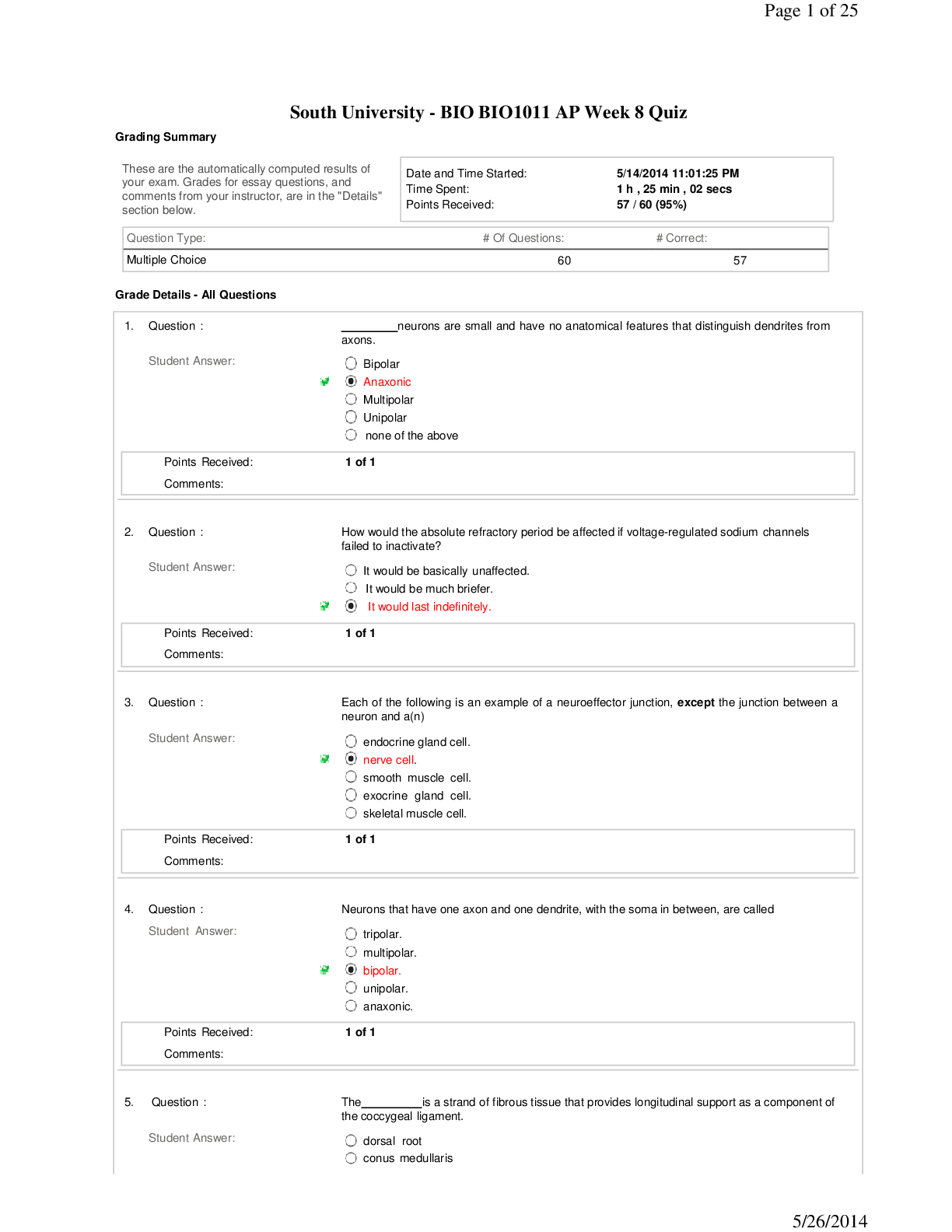
Grading Summary
Grade Details - All Questions
1. Question : Muscle fibers differ from "typical cells" in that muscle fibers
Student Answer: lack a plasma membra
...
BIO 1011 WEEK 6 QUIZ Graded A - SOUTH UNIVERSITY
Grading Summary
Grade Details - All Questions
1. Question : Muscle fibers differ from "typical cells" in that muscle fibers
Student Answer: lack a plasma membrane. lack mitochondria.
are very small. have many nuclei. both B and C
Points Received: 1 of 1
Comments:
2. Question : Which of the following best describes the term sarcoplasmic reticulum?
Student Answer: thin filaments are anchored here
protein that accounts for elasticity of resting muscle repeating unit of striated myofibrils
storage and release site for calcium ions largely made of myosin molecules
Points Received: 1 of 1
Comments:
3. Question : Which of the following best describes the term muscle origin?
Student Answer: connective tissue that surrounds an entire muscle connective tissue that surrounds a single muscle fiber broad tendon sheet
tendon attachment that moves tendon attachment that doesn't move
Points Received: 1 of 1
Comments:
4. Question : The increase in muscle tension that is produced by increasing the number of
active motor units is called
Student Answer: complete tetanus. treppe.
incomplete tetanus.
recruitment. wave summation.
5. Question : The plasma membrane of skeletal muscle is called the Student Answer: sarcoplasm.
sarcomere. sarcolemma. sarcoplasmic reticulum. sarcosome.
6. Question : Since each myofibril is attached at either end of the muscle fiber, when sarcomeres shorten, the muscle fiber
Student Answer: strengthens. shortens. weakens. lengthens.
not enough information to say
7. Question : At rest, the tropomyosin molecule is held in place by
Student Answer: myosin molecules. calcium ions. troponin molecules. ATP molecules. actin molecules.
8. Question : Triggering of the muscle action potential occurs after
Student Answer: the nerve action potential jumps across the neuromuscular junction.
acetylcholine binds to chemically gated channels in the end plate membrane.
acetylcholinesterase binds to receptors on the end plate. calcium ion binds to channels on the end plate.
Any of the above can produce an action potential in the muscle cell.
9. Question : Which of the following statements is (are) true regarding human muscles?
Student Answer: Most have both slow and fast fibers.
Eye muscles are composed entirely of fast fibers. Slow fibers are abundant in the calf muscles.
Slow fibers are abundant in the back muscles. All of the above.
10. Question : Fast fibers
Student Answer: have low resistance to fatigue. have many mitochondria.
rely on aerobic metabolism.
have twitches with a very brief contraction phase. both A and D
11. Question : Which of the following best describes the term Z line?
Student Answer: largely made of myosin molecules
protein that accounts for elasticity of resting muscle repeating unit of striated myofibrils
storage site for calcium ions
thin filaments are anchored here
12. Question : Which of the following is greater?
Student Answer: the concentration of calcium ion in the sarcoplasm of a resting muscle
the concentration of calcium ion in the sarcoplasmic reticulum of a resting muscle
13. Question : Which of the following motor units would produce the greatest tension?
Student Answer: a motor unit in a back muscle a motor unit in an eye muscle a motor unit in a hand muscle
14. Question : Synaptic vesicles containing neurotransmitters are released by when the action potential arrives.
Student Answer: sodium apoptosis endocytosis exocytosis hydrolysis
15. Question : During activities requiring aerobic endurance
Student Answer: glycogen and glycolysis are the primary sources of reserve energy.
oxygen debts are common. oxygen is not required.
fatigue occurs in a few minutes.
most of the muscle's energy is produced in mitochondria.
16. Question :
Figure 10-1 Skeletal Muscle Fiber
Use Figure 10-1 to answer the following questions:
What is released from the structure labeled "9"?
Student Answer: sarcoplasm calcium ions acetylcholine
acetylcholinesterase protein
Points Received: 1 of 1
Comments:
17. Question : Receptors for acetylcholine are located on the Student Answer: transverse tubule.
motor end plate. sarcomere. synaptic cleft. synaptic knob.
18. Question : Which of the following is not characteristic of smooth muscle?
Student Answer: Smooth muscles are uninucleate.
Smooth muscle connective tissue forms tendons and aponeuroses.
The thin filaments of smooth muscle fibers are attached to dense bodies. Smooth muscles do not contain sarcomeres.
Neurons that innervate smooth muscles are under involuntary control.
19. Question :
Figure 10-1 Skeletal Muscle Fiber
Use Figure 10-1 to answer the following questions:
Which structure actively pumps calcium ions out of the sarcoplasm to produce relaxation?
Student Answer: 7
2
3
6
1
20. Question : Decreased blood flow to a muscle could result in all of the following, except
Student Answer: an increase in intracellular glycogen. an oxygen debt.
muscle fatigue.
a shift to anaerobic glycolysis.
an increase in intracellular lactate.
21. Question : After heavy exercise, if energy reserves in a muscle are depleted, _
occurs.
Student Answer: an oxygen debt treppe paralysis atrophy tetanus
22. Question : When a muscle is stimulated repeatedly at a high rate, the amount of tension
gradually increases to a steady maximum tension. This is called
Student Answer: wave summation. a twitch.
incomplete tetanus. recruitment. complete tetanus.
23. Question : Each thin filament consists of
Student Answer: six molecules coiled into a helical structure.
a rod-shaped structure with "heads" projecting from each end. chains of myosin molecules.
two protein strands coiled helically around each other. a double strand of myosin molecules.
24. Question :
Figure 10-1 Skeletal Muscle Fiber
Use Figure 10-1 to answer the following questions:
Where would calcium ion be predominately found?
Student Answer: 1
2
4
8
9
25. Question : A thin filament is constructed from actin, tropomyosin, troponin, and nebulin. Student Answer: True
False
26. Question : When comparing slow motor units to fast motor units, slow units
Student Answer: generate much less tension.
have much smaller fiber diameters.
take about three times as long to reach peak tension. are rich in the red protein myoglobin.
all of the above
27. Question : In which of the following would the motor units have the fewest muscle fibers?
Student Answer: postural muscles of the back thigh muscles
muscles of the neck
muscles that control the eyes calf muscles
28. Question : Physical evidence that supports the sliding filament theory of muscle contraction includes
Student Answer: decreased width of the H band during contraction.
the I band + H band distance is constant during contraction. decreased width of the A band during contraction.
constant distance between Z lines during contraction. increased width of the I band during contraction.
29. Question :
Figure 10-2 Muscle Contractions Use Figure 10-2 to answer the following questions: What is the contraction in graph (d) called?
Student Answer: incomplete tetanus wave summation treppe
twitch
complete tetanus
30. Question : During the Cori cycle, in the liver
Student Answer: lactic acid is shuffled to muscle cells. glucose is produced from lactic acid. glucose is released from glycogen. lactic acid is produced from glucose.
lactic acid is produced from pyruvic acid.
31. Question : The following is a list of the events that occur during a muscle contraction.
1. Myosin cross-bridges bind to the actin.
2. The free myosin head splits ATP.
3. Calcium ion is released from the sarcoplasmic reticulum.
4. The myosin head pivots toward the center of the sarcomere.
5. Calcium ion binds to troponin.
6. The myosin head binds an ATP molecule and detaches from the actin.
The correct sequence of these events is
Student Answer: 3, 5, 1, 4, 6, 2.
3, 5, 1, 2, 4, 6.
1, 3, 5, 4, 6, 2.
5, 1, 4, 6, 2, 3.
1, 4, 6, 2, 3, 5.
32. Question :
Figure 10-1 Skeletal Muscle Fiber
Use Figure 10-1 to answer the following questions:
What physiological process occurs in the structure labeled "7"?
Student Answer: activity of acetylcholinesterase release of protein into the muscle fiber the sliding filament theory
release of neurotransmitter
conduction of the action potential into the cell interior
33. Question : During the recovery period following exercise, all of the following are true,
except
Student Answer: lactic acid is removed from muscle cells. muscle fibers are unable to contract. heat is generated.
oxygen is consumed at above the resting rate. the muscle actively produces ATP.
34. Question : Which of the following hormones directly stimulates growth of muscle tissue,
leading to increased muscle mass?
Student Answer: parathyroid hormone calcitonin testosterone
thyroid hormone epinephrine
Points Received: 1 of 1
Comments:
35. Question : The narrow space between the synaptic terminal and the muscle fiber is the Student Answer: motor end plate.
synaptic cleft. M line.
motor unit. synaptic knob.
36. Question : Aerobic metabolism normally provides percent of the ATP demands
of a resting muscle cell.
Student Answer: 25
95
50
100
70
37. Question : The thin filaments of striated muscle are made of which protein(s)?
Student Answer: troponin tropomyosin actin nebulin
all of the above
38. Question : After death, muscle fibers run out of ATP and calcium begins to leak from the
sarcoplasmic reticulum into the sarcoplasm. This results in a condition known as
Student Answer: oxygen debt. depolarization. rigor mortis. treppe.
tetany.
39. Question : During anaerobic glycolysis Student Answer:
ATP is produced. oxygen is not consumed. pyruvic acid is produced. all of the above
B and C only
40. Question : Active sites on the actin become available for binding after
Student Answer: troponin binds to tropomyosin. calcium binds to tropomyosin. myosin binds to troponin. actin binds to troponin. calcium binds to troponin.
41. Question : The delicate connective tissue that surrounds the skeletal muscle fibers and ties adjacent muscle fibers together is the
Student Answer: epimysium. periosteum. superficial fascia. endomysium. perimysium.
42. Question : At rest, active sites on the actin are blocked by Student Answer: ATP molecules.
tropomyosin molecules. troponin molecules. calcium ions.
myosin molecules.
43. Question :
Figure 10-2 Muscle Contractions
Use Figure 10-2 to answer the following questions:
To produce a contraction similar to the one in graph (b), the muscle
Student Answer: is excited by a stimulus of increasing intensity.
must be stimulated again before it has relaxed from the previous stimulation.
is caused to produce isolated twitches. must be stimulated to the point of fatigue. gradually warms up.
44. Question : When calcium ion binds to troponin, Student Answer: myosin shortens.
tropomyosin moves into the groove between the helical actin strands.
active sites on the myosin are exposed. muscle relaxation occurs.
actin heads will bind to myosin.
45. Question : The type of muscle fiber that is most resistant to fatigue is the fiber.
Student Answer: slow intermediate anaerobic fast
high-density
46. Question : Skeletal muscle fibers are formed from embryonic cells called Student Answer: myofibrils.
sarcomeres. myomeres. fascicles. myoblasts.
47. Question : Which of the following best describes the term sarcomere?
Student Answer: thin filaments are anchored here storage site for calcium ions
protein that accounts for elasticity of resting muscle largely made of myosin molecules
repeating unit of striated myofibrils
48. Question : A resting muscle generates most of its ATP by
Student Answer: the tricarboxylic acid cycle. anaerobic respiration. glycogenolysis.
hydrolysis of creatine phosphate. aerobic metabolism of fatty acids.
49. Question :
Figure 10-1 Skeletal Muscle Fiber
Use Figure 10-1 to answer the following questions:
Where are the myosin molecules located?
Student Answer: 4
5
6
7
8
50. Question : At peak levels of muscle exertion the mitochondria can supply
Student Answer: only about one-third of the energy required by the muscle.
all of the energy required by the muscle.
80 percent of the energy required by the muscle.
only about 10 percent of the energy required by the muscle. more than half of the energy required by the muscle.
51. Question :
Figure 10-1 Skeletal Muscle Fiber
Use Figure 10-1 to answer the following questions:
Identify the structure labeled "1."
Student Answer: myofibril synaptic vesicle glycogen
ATP
mitochondria
52. Question : Which of the following statements is false?
Student Answer: Cardiac muscle stimulation is neural.
Cardiocytes are interconnected through intercalated discs. Skeletal muscle stimulation is neural.
Skeletal muscle contractions may be summated. Cardiac muscle contractions cannot be summated.
53. Question : The cytoplasm of the neuromuscular terminal contains vesicles filled with
molecules of the neurotransmitter
Student Answer: norepinephrine. epinephrine. acetylcholine. antidiuretic hormone. all of the above
Points Received: 1 of 1
Comments:
54. Question : The dense layer of connective tissue that surrounds an entire skeletal muscle is the
Student Answer: endomysium. tendon. epimysium. perimysium. fascicle.
55. Question : Compared to a "typical" body cell, skeletal muscle cells are
Student Answer: filled with crystalline 3-D arrays of fibrous proteins. larger than normal cells.
multinucleate.
capable of rapid shortening against a load. all of the above
56. Question : The type of contraction in which the muscle fibers do not shorten is called Student Answer: isometric.
isotonic. concentric. treppe. tetany.
57. Question :
Figure 10-1 Skeletal Muscle Fiber
Use Figure 10-1 to answer the following questions:
Which of the following are found in the structure labeled "3"?
Student Answer: tropomyosin myosin
titin actin
all of the above
58. Question : During the recovery period the body's need for oxygen is increased because Student Answer: muscle cells are producing energy anaerobically.
the individual is panting.
the liver requires more oxygen to produce lactic acid.
additional oxygen is required to restore energy reserves consumed during exercise.
the muscles are not producing ATP.
59. Question : Which of the following best describes the term titin?
Student Answer: storage site for calcium ions largely made of myosin molecules
protein that accounts for elasticity of resting muscle repeating unit of striated myofibrils
thin filaments are anchored here
60. Question : Which of these would lead to increased oxygen consumption?
Student Answer: increased aerobic respiration by muscle cells increased conversion of lactic acid to glucose increased muscle activity
increased heat production all of the above
* Times are displayed in (GMT-07:00) Mountain Time (US & Canada)
[Show More]