ANP I Final
Abdominal Aneurysm
1. Causes: Know the causes of an abdominal aortic aneurysm.(493)
a. The proposed cause of AAA includes atherosclerosis, inflammation, mycotic infection, inheritable connective tissue di
...
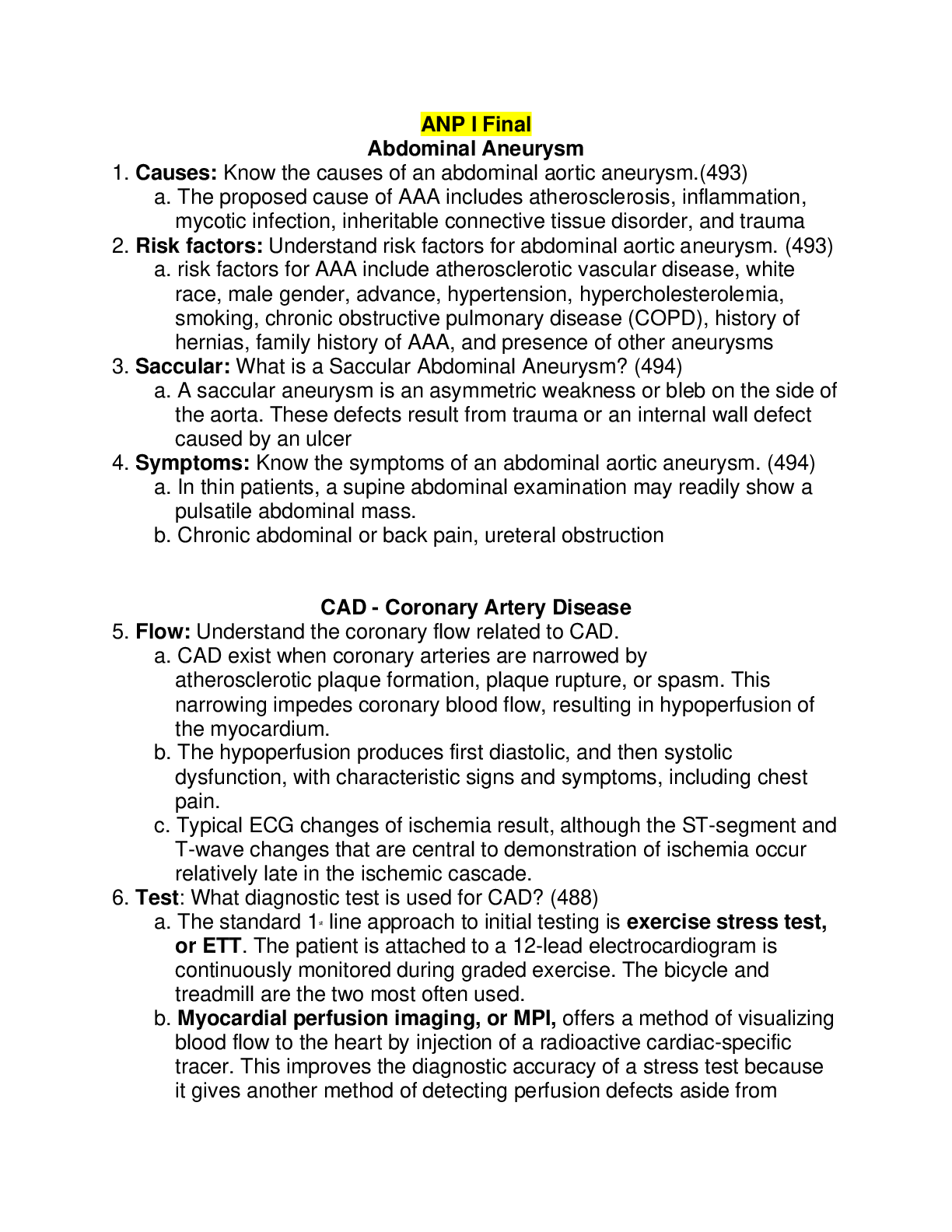
ANP I Final
Abdominal Aneurysm
1. Causes: Know the causes of an abdominal aortic aneurysm.(493)
a. The proposed cause of AAA includes atherosclerosis, inflammation, mycotic infection, inheritable connective tissue disorder, and trauma
2. Risk factors: Understand risk factors for abdominal aortic aneurysm. (493)
a. risk factors for AAA include atherosclerotic vascular disease, white race, male gender, advance, hypertension, hypercholesterolemia, smoking, chronic obstructive pulmonary disease (COPD), history of hernias, family history of AAA, and presence of other aneurysms
3. Saccular: What is a Saccular Abdominal Aneurysm? (494)
a. A saccular aneurysm is an asymmetric weakness or bleb on the side of the aorta. These defects result from trauma or an internal wall defect caused by an ulcer
4. Symptoms: Know the symptoms of an abdominal aortic aneurysm. (494)
a. In thin patients, a supine abdominal examination may readily show a pulsatile abdominal mass.
b. Chronic abdominal or back pain, ureteral obstruction
CAD - Coronary Artery Disease
5. Flow: Understand the coronary flow related to CAD.
a. CAD exist when coronary arteries are narrowed by atherosclerotic plaque formation, plaque rupture, or spasm. This narrowing impedes coronary blood flow, resulting in hypoperfusion of the myocardium.
b. The hypoperfusion produces first diastolic, and then systolic dysfunction, with characteristic signs and symptoms, including chest pain.
c. Typical ECG changes of ischemia result, although the ST-segment and T-wave changes that are central to demonstration of ischemia occur relatively late in the ischemic cascade.
6. Test: What diagnostic test is used for CAD? (488)
a. The standard 1st line approach to initial testing is exercise stress test, or ETT. The patient is attached to a 12-lead electrocardiogram is continuously monitored during graded exercise. The bicycle and treadmill are the two most often used.
b. Myocardial perfusion imaging, or MPI, offers a method of visualizing blood flow to the heart by injection of a radioactive cardiac-specific tracer. This improves the diagnostic accuracy of a stress test because it gives another method of detecting perfusion defects aside from measuring ST depression on the electrocardiogram. It is used when baseline ECG abnormality that would interfere with measurement of stress-induced ST-segment changes, such as left ventricular hypertrophy, bundle branch blocks, and digoxin use. MPI is also a useful tool for use with high-risk diabetic patients. Thallium chloride T1 01 and technetium Rc 99m sestamibi are the radiopharmaceutical agents used for the detection of CAD in MPI
c. Cardiac Magnetic Resonance Imaging (MRI) with further technologic refinement, anticipated to provide accurate data to distinguish between stable and unstable plague and to assist with quantifying CAD, replacing the diagnostic cardiac catherization
d. Exercise echocardiography images enhance the sensitivity and specificity of CAD detection to an extent comparable to the provided by nuclear techniques. The 2DE evidence for ischemia includes an abnormal left ventricular ejection fraction (LVEF) response to exercise or the development of regional wall motion abnormalities. The exercise is performed with bicycle or treadmill, and dobutamine is the most common pharmacologic agent used simultaneously with the echocardiography imaging. The image quality may be enhanced by the injection of echogenic microbubbles.
7. Values: What predictive value does a significant ST-segment elevation have for CAD? (488)
a. Significant elevation on the ST-segment has minimal predictive valve for CAD
Cardiovascular
8. Afib: Study atrial fibrillation and at what age is it more common.
a. A-fib is the most common sustained cardiac rhythm disturbance, more common in men and increasing in prevalence with age. It is estimated that 2.3 million Americans have a-fib, and more commonly occurs after the age of 60.
9. Arrhythmias: Where do most arrhythmias occur in the heart?
a. More than 50% of all cardiac arrhythmias arise from or involve the atria
10. Atrial: Atrial arrhythmia treatment
a. Sotalol to manage a-fib
b. Digoxin assist in rate control
c. Electrical and pharmacologic cardioversion
d. Anticoagulation therapy to reduce thromboembolism risk associated with cardioversion
e. AV nodal ablation or modification, and pacemaker implantation
f. Pulmonary vein isolation
11. Bradycardia: Symptomatic bradycardia
a. Symptomatic bradycardia is defined as a documented bradyarrhythmia that is directly responsible for the development of frank syncope, or near-syncope, transient dizziness, or lightheadedness and confusion states resulting from cerebral hypoprofusion attributable to a slow ventricular rate. Other symptoms include fatigue, exercise intolerance, and heart failure. Symptoms may occur at rest or with exertion.
12. Cardiac cells: What property is common to all cardiac cells?
a. Automaticity, or the ability to depolarize spontaneously is a property common to all cardiac cells
13. CV: Should a patient presenting with symptomatic bradycardia be referred to a cardiologist?
a. Yes. Patients with symptomatic bradycardia should be referred to a cardiologist unless a reversal cause can be identified and corrected. Patients with asymptomatic bradycardia may or may not require further intervention. This is determined in large part by the type of block.
14. CV: What condition does narrow coronary arteries or plague rupture cause?
a. CAD exist when coronary arteries are narrowed by atherosclerotic plaque formation, plaque rupture, or spasm. This narrowing impedes coronary blood flow, resulting in hypoperfusion or myocardium.
15. CVA: Understand the different types of stroke and their prevalence.
a. Most strokes, 87% of strokes, are ischemic strokes. Approximately 20% of ischemic strokes result from carotid artery disease, which is defined as atherosclerotic narrowing of the extracranial arteries, most often at the bifurcation of the carotid artery, with involvement of the proximal internal carotid artery. Carotid stenosis increases from the fifth decade of life onward. In the Framingham heart study, the prevalence of moderate carotid stenosis (i. e. >50%) was 7% in women and 9% in men between the ages of 66 and 93 years
b. In the cardiovascular health study of subjects older than 65 years, 7% of men and 5% of women had moderate carotid stenosis (50% to 74%); 2.3% of men and 1.1% of women had severe stenosis (75 to 100%). Carotid stenosis is more common among persons of European heritage; intracranial arterial stenosis is more common in persons of Asian and other heritage.
16. ECG: Where would you measure the J point located on an ECG in relation to the QRS and ST segment depression after an exercise stress test?
a. The junction between the QRS complex and the ST segment. A positive test result from CAD is defined by the development of horizontal or down-sloping ST-segment depression of 1mm measured 80 msec after the J point of the QRS complex.
17. Heart dx: Where could you find supporting data for guidelines for prevention of future heart disease?
a. The American College of Cardiology (ACC) and the American Heart Association (AHA) have devised a classification system that grades heart failure by stage (Box 120-3) to include patients at risk for development of heart failure (stage A) and hose with end-stage, advance disease (stage D). And guidelines to prevent heart failure and treatment.
b. Prevention of heart failure is linked to prevention of ischemic heart disease as well as to control of hypertension in primary care setting.
c. All patients should be screened for heart disease risk and encouraged to reduce their risk by adopting a healthylifestyle, including normalization of weight, low-fat diet, smoke exposure avoidance, and exercise
d. Interventions to screen for heart disease risk and encouraged to reduce their risk by adopting a healthy lifestyle, including normalization of weight, low-fat diet, smoke exposure avoidance, and exercise.
e. RISK FACTORS: Most individuals with heart failure have antecedent hypertension or myocardial infarction. Other risk factors include coronary artery disease, diabetes, renal disease, and increasing age. African Americans have a higher prevalence of heart failure than other ethnicities and with a greater 5-year fatality than for whites.
f. CAUSES: coronary artery disease is the most common cause of systolic heart failure, hypertension, a-fib, and diabetes are common antecedents of diastolic dysfunction
g. Hypertension and valvular heart disease were considered the most common causes of heart failure 30 to 50 years ago.
18. HF: Know the types of heart failure.
a. Heart failure can be divided into two main types, systolic and diastolic. It is also called heard failure with preserved systolic function. Systolic heart failure is reduction in contractility of the ventricle. Diastolic heart failure is impairment of ventricular filling and relaxation.
19. HF: What are the signs of heart failure?
a. Pressure is increased in the pulmonary veins because the heart. Which leads to left ventricular overload and worsening symptoms of failure cannot keep up with the supply. This can cause pulmonary congestion or pulmonary edema (interstitial and alveolar congestion).
b. PATIENTS DESCRIBE: Breathlessness during activity, at rest, or while sleeping (called paroxysmal nocturnal dyspnea); these symptoms worsen with severity of heart failure; difficulty breathing while lying flat (orthopnea) or complaints of waking up tired or feeling anxious and restless. PERSISTENT COUGHING, BRONCHOSPASM, OR WHEEZING- persistent pulmonary interstitial or alveolar edema (sometimes called cardiac asthma), worse when recumbent.
c. PATIENTS DESCRIBE: edema (sometimes called cardiac asthma) worse when recumbent. Coughing that produces white or pink blood- tinged mucus may not always be present. Edema- as blood flow out of the heart is impeded, blood returning to the heart through the veins back up, causing fluid to build up in the tissues. The kidneys are less able to dispose of sodium and water, also causing fluid retention. This is evidence of right-sided heart failure. PATIENTS DESCRIBE: swelling in the feet, ankles, legs, or abdomen or weight gain patients may find their pants or shoes feeling tight.
d. Clinical presentation is wide ranging, from mild, exertional related dyspnea resulting from fluid retention to cardiogenic shock, and lethal arrhythmias.
e. Fatigue, dyspnea, and peripheral edema, are often nonspecific; JVD; crackles, frothy or pink sputum, pleural effusions; 3rd heart sound; 4th heart sound; aortic stenosis; mitral regurgitation; tricuspid regurgitation; hepatomegaly, right upper quadrant tenderness; ascites, anasarca, or edema; tachycardia; altered hemodynamics; displaced point of maximal impulse; hypotension, cool extremities
20. HF: What is the most common cause of systolic heart failure?
a. CAD is the most common cause of systolic heart failure. Systolic heart failure is a reduction in the contractility of ventricle.
...........continued
[Show More]