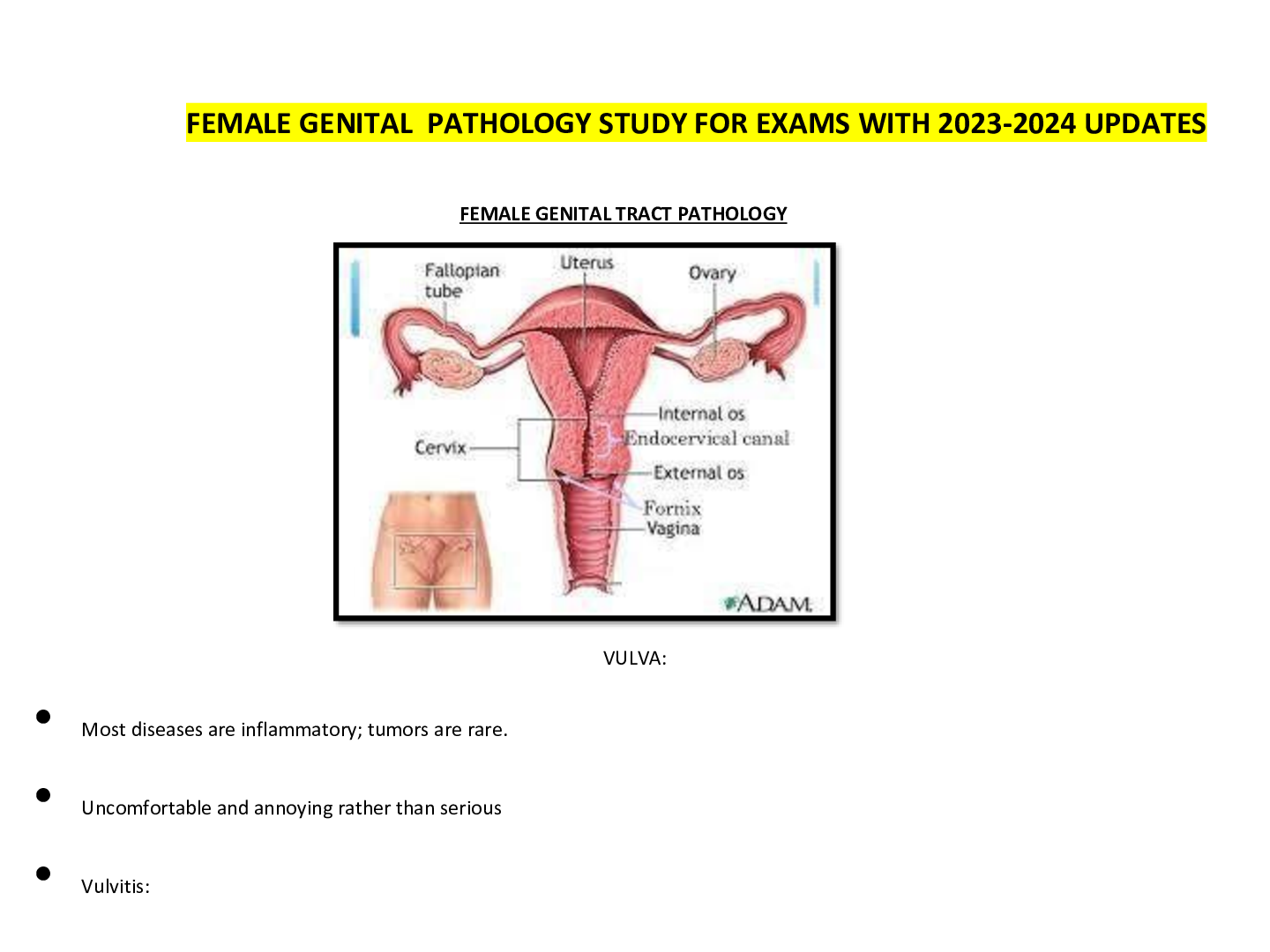
FEMALE GENITAL TRACT PATHOLOGY
VULVA:
• Most diseases are inflammatory; tumors are rare.
• Uncomfortable and annoying rather than serious
• Vulvitis:
– Dermatitis, contact and allergic
– Infections: STDs such as
...
FEMALE GENITAL TRACT PATHOLOGY
VULVA:
• Most diseases are inflammatory; tumors are rare.
• Uncomfortable and annoying rather than serious
• Vulvitis:
– Dermatitis, contact and allergic
– Infections: STDs such as HPV (condyloma accuminatum & VIN); HSV, N. Gonorrhoea, Treponema pallidum. Candida (not STD)
– Infection may obstruct glands and cause “Bartholin cyst”
CONDYLOMA ACCUMINATUM:
• Wart
• HPV 6 & 11
• Elevated white plaques
• “Koilocytosis”
• No progression to cancer
CARCINOMA OF VULVA: 90% SQUAMOUS CELL CARCINOMA
VAGINAL PATHOLOGY:
• Rarely involved by primary disease; more secondary (infections and tumors)
• Congenital anomalies are rare: septate or double vagina part of septate uterus; congenital lateral Gartner duct cyst
(persistent Wollfian duct rests)
VAGINITIS:
• Common transient infections
• Candida infections (monilial) vaginitis:
common in DM, pregnancy, with AB use and immunodeficiency. “White thrush”
• Trichomonas vaginalis: parasitic infection, STD, watery , copious gray-green discharge, can be seen on vaginal (& cervical Pap smears)
CERVIX PATHOLOGY:
• Cervicitis, cervical polyps and cervical cancer
• Cervicitis: common, infectious and noninfectious
• Infectious: STDs; Chlamydia Trachomatis (most common), Ureaplasma urealyticum, T. vaginalis, N. gonorrhoea, HSV2 and HPV
• Pap smear detection after discharge
• HSV infection may affect babies if vaginal delivery
CERVICAL NEOPLASIA:
• Transformation zone (squamocolumnar junction); most common area
• Mostly are HPV associated squamous cell carcinoma
• HPV tropism for immature sq epithelium
• Cervical intraepithelial neoplasia or squamous intraepithelial neoplasia (old name: dysplasia)
RISK FOR CERVICAL CANCER:
• Early age of first intercourse
• Multiple sexual partners
• Male partner with multiple partners
• Persistent infection with high risk HPV serotypes (HPV 16 & 18)
• HPV resides in the DNA of squamous epithelium and replicates
EARLY DETECTION AND THE PAP TEST:
• The pap smear remains the most successful cancer-screening test ever developed
• Now, cancer death from cervix dropped dramatically (not of top ten)
• Smear (specific) morphology and HPV DNA
(sensitive) testing are now used (co-testing)
• HPV vaccines: quadrivalent (HPV 6, 11, 16, 18) and more (divalent and 9 valent); are promising preventive measures
INVASIVE CERVICAL CARCINOMA:
• Squamous (75%), adenocarcinoma & adenosquamous (20%), and small cell NEC
• All are HPV associated
• Increase incidence of adenocarcinoma (better screening and early detection of squamous)
• SqCC peak at age 45 (10-15 years after HPV infection)
• Risk factors for invasion: smoking and HIV
INVASIVE CERVICAL CANCER:
• Often seen in unscreened women: vaginal bleeding, leukorrhea, and dyspareunia
• Biopsy dx needed before planning trx.
• Grading and depth of invasion are important predictors of stage and prognosis
• Depth of invasion 3 mm or more
• Spread: pelvic lymph nodes and surrounding structures
• Trx: radical hysterectomy + lymph node dissection, RT and CT
UTERINE PATHOLOGY:
• Endometritis: acute (neutrophilic) or chronic (plasma cells)
• Can be part of pelvic inflammatory disease (N. gonorrhoeae or C. trachomatis)
• TB: granulomatous endometritis in endemic countries
(+ TB salpingitis) or immunocompromised patients
• Retained POC and IOUCD associated
• Fever, abdominal pain and menstrual abnormalities
• Dx and trx: biopsy and antibiotics (removal of IUCD and POC)
ADENOMYOSIS:
[Show More]