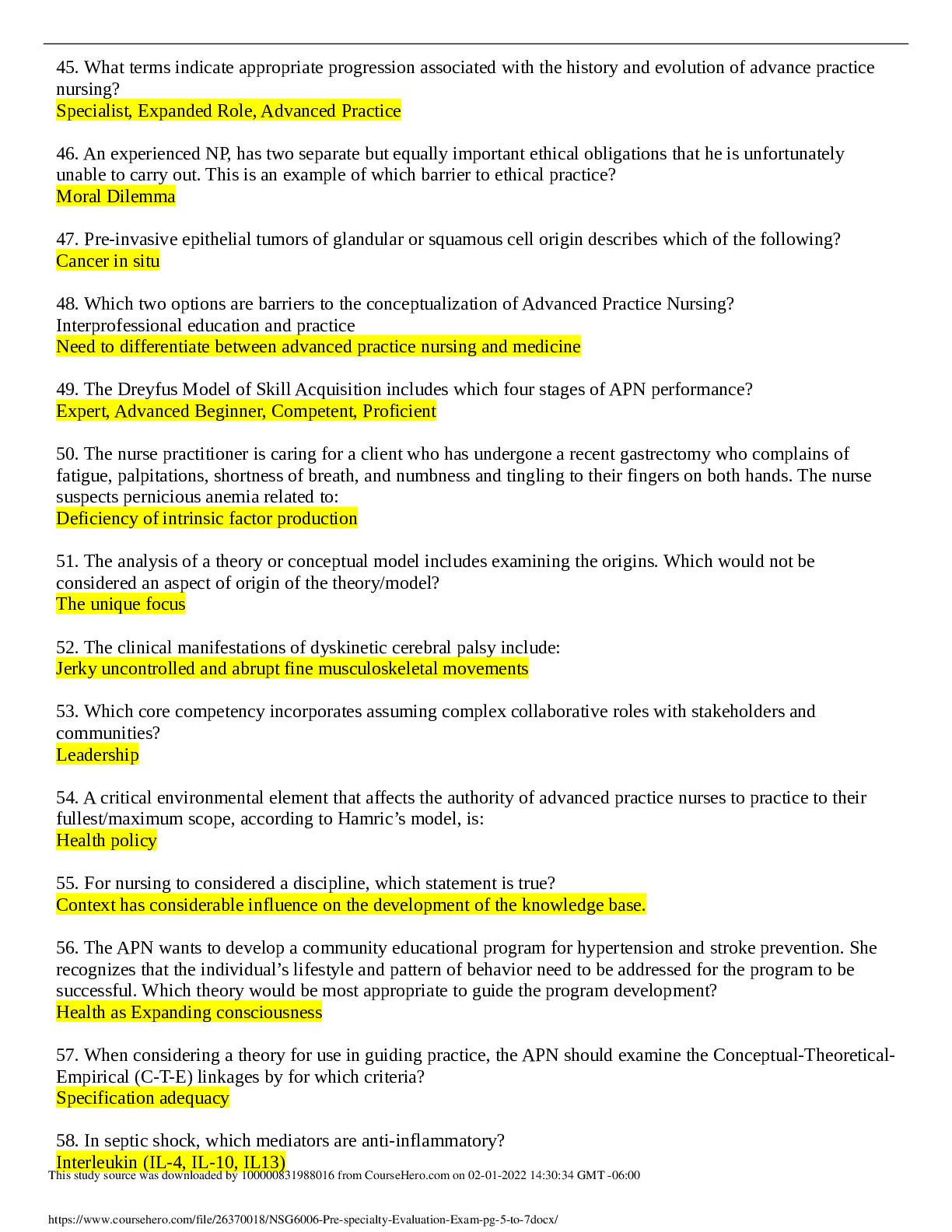
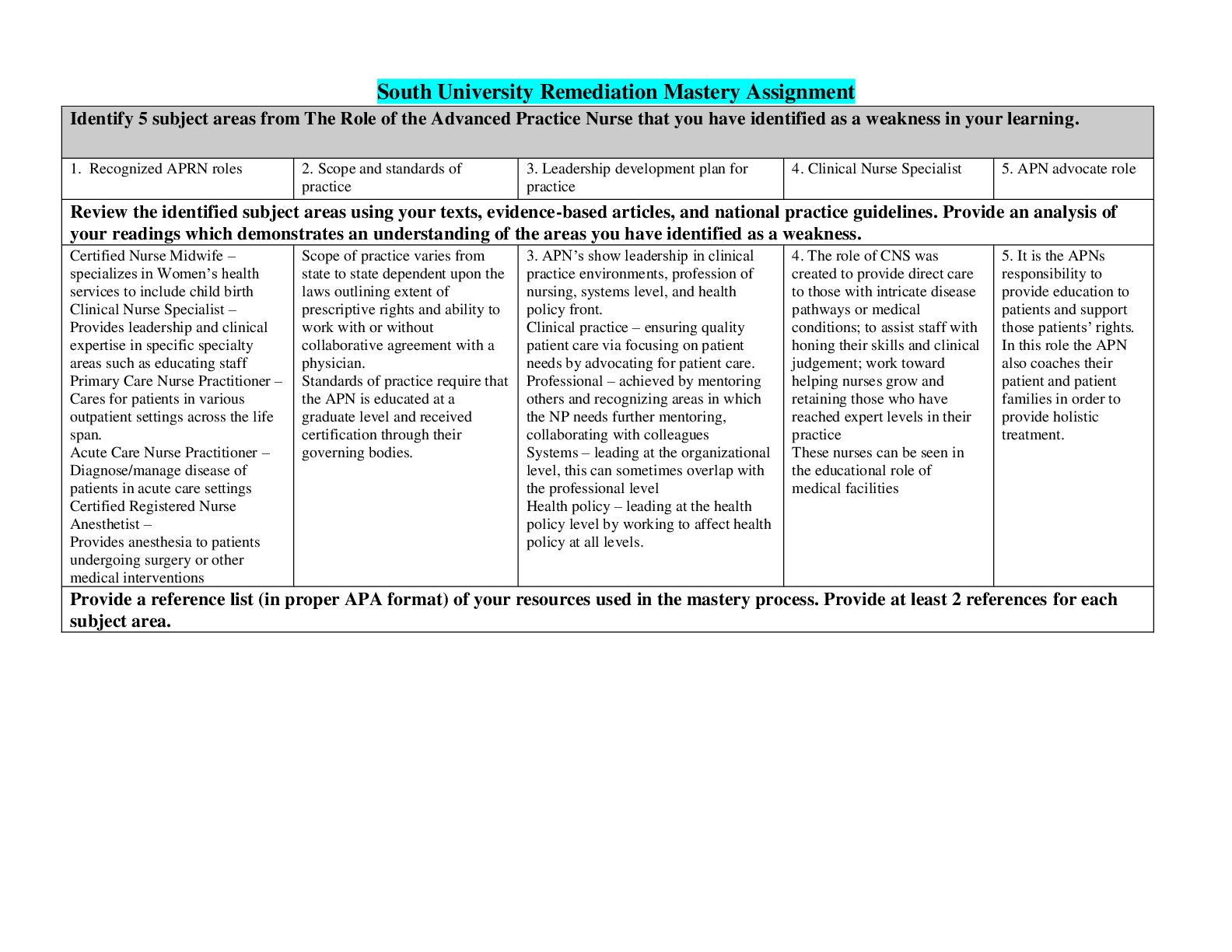
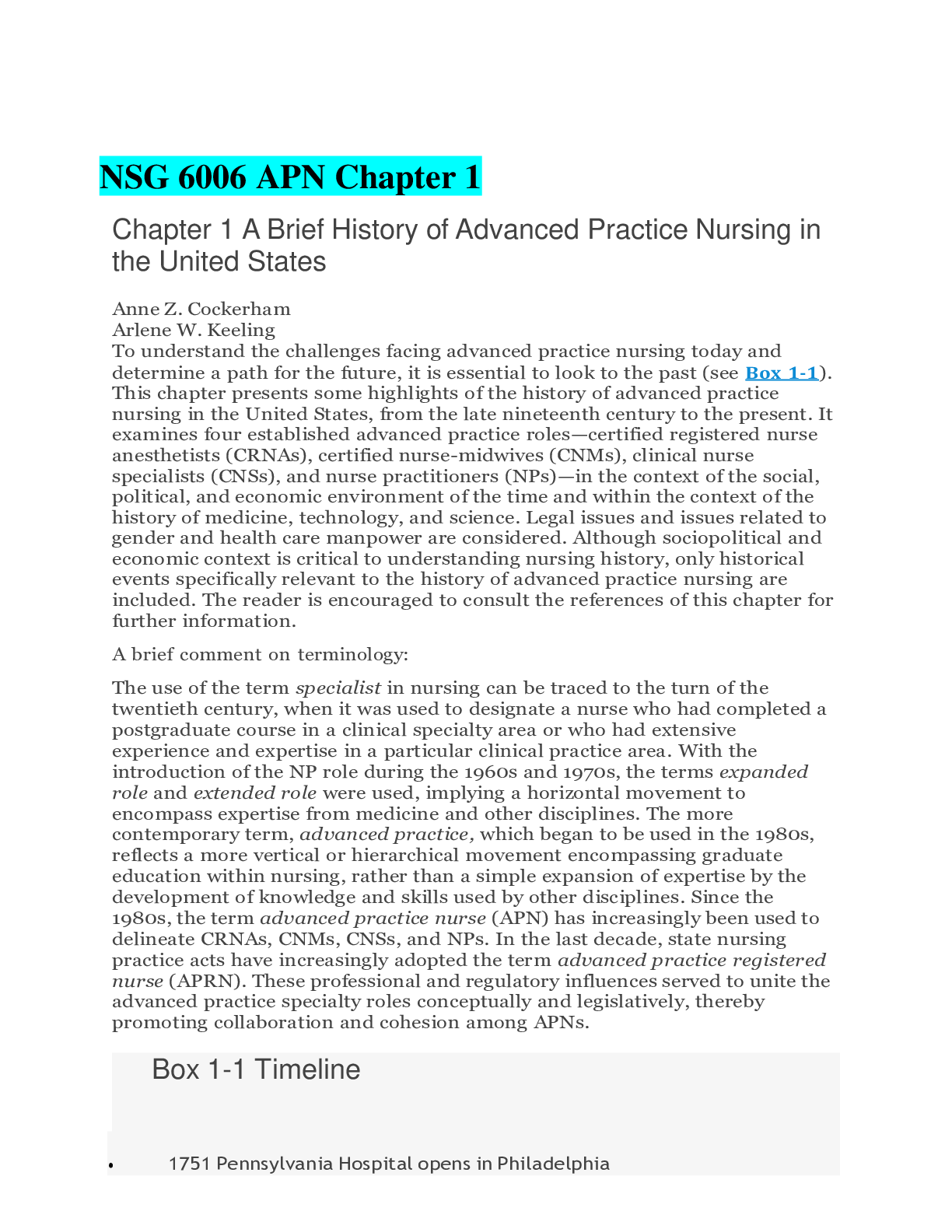
NSG 6006 Pre-Specialty Evaluation Exam
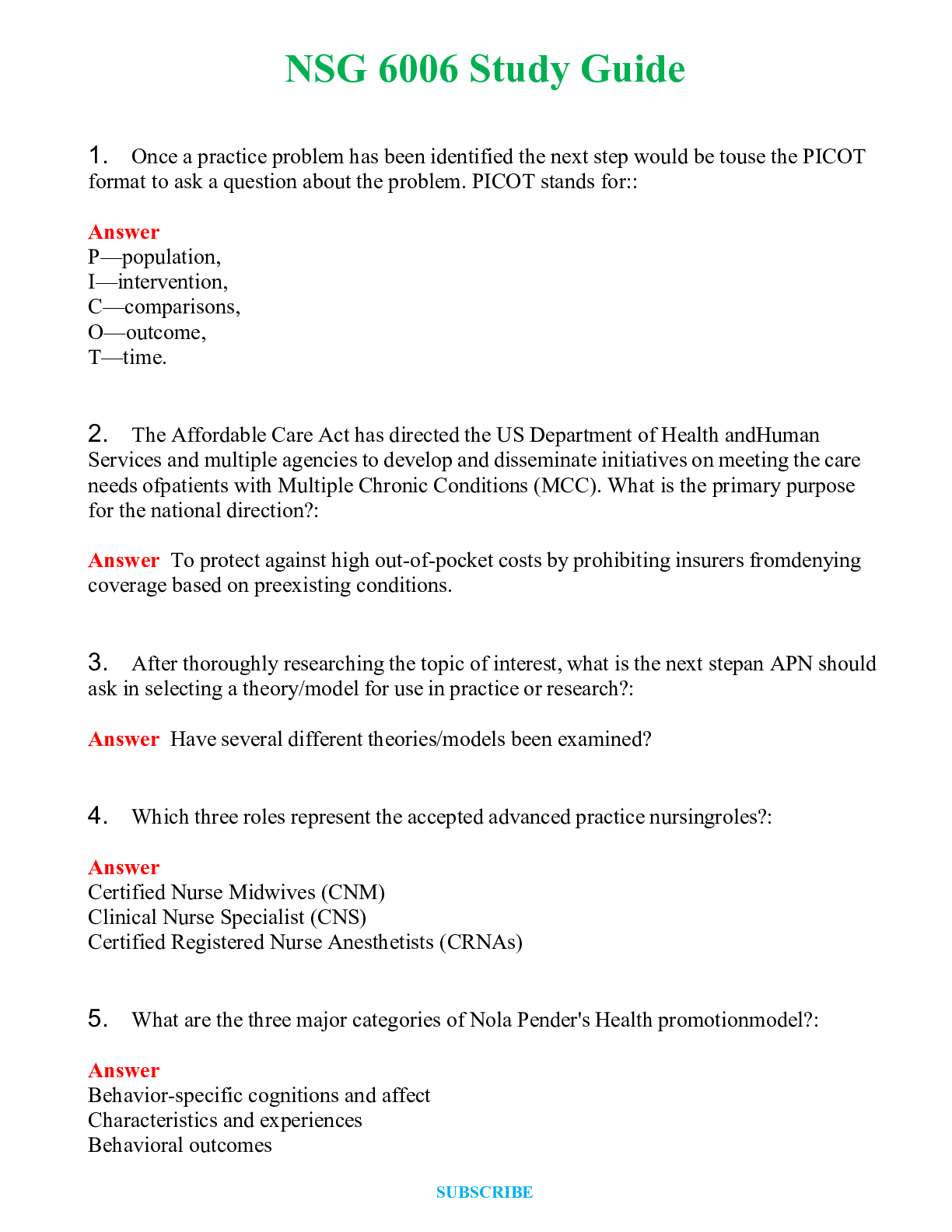
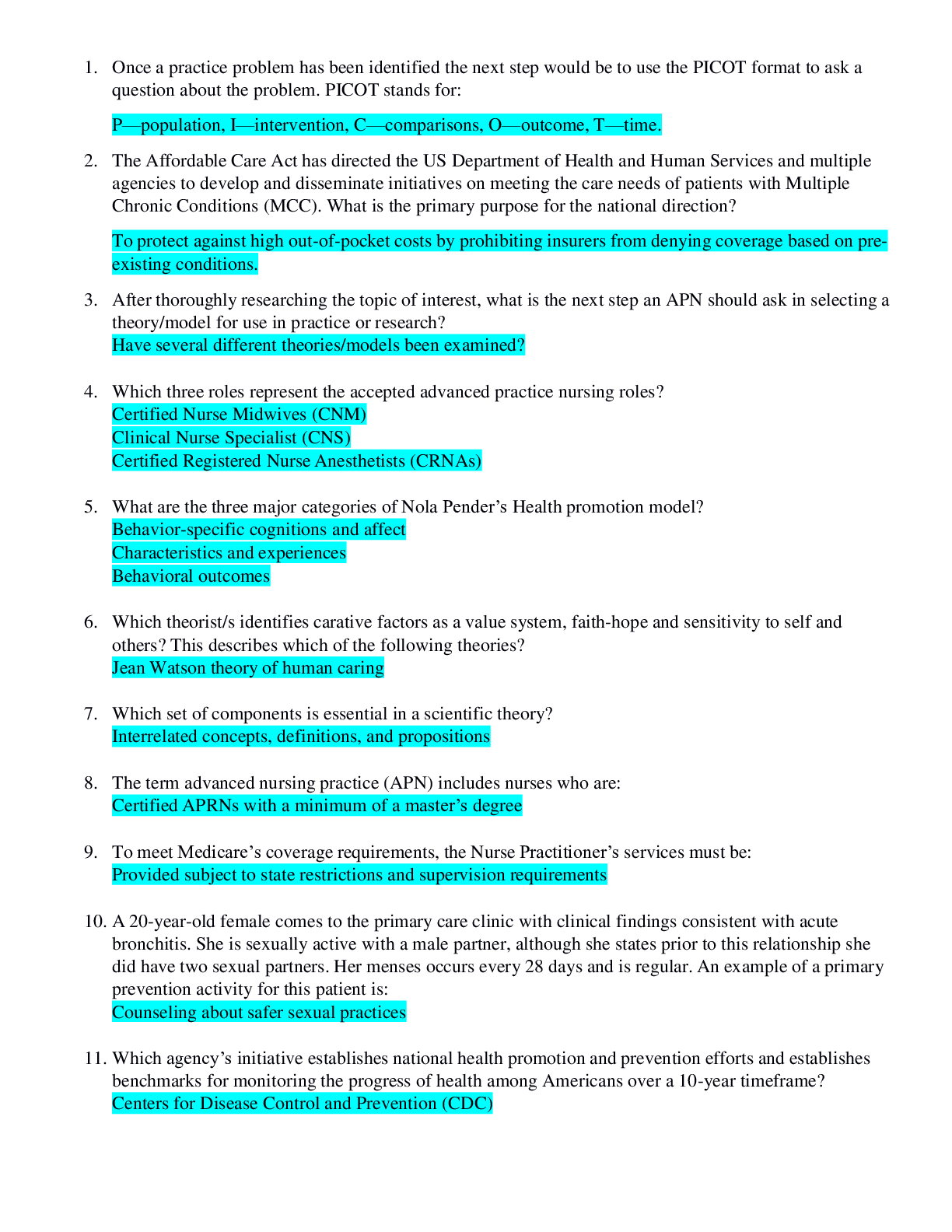
Question 1. Question : Once a practice problem has been identified the next step would be to use the PICOT format to ask a question about the problem. PICOT stands for:
Studen
...
NSG 6006 Pre-Specialty Evaluation Exam
Question 1. Question : Once a practice problem has been identified the next step would be to use the PICOT format to ask a question about the problem. PICOT stands for:
Student Answer: P --population, I-- intervention, C-- Concepts, O--operational definitions, T –Time (Incorrect! Population, intervention, comparison, outcome and time)
P—precision instrument, I—intervention, C—control, O—operational definitions, T—Time (Incorrect! Population, intervention, comparison, outcome and time)
P—population, I – internal validity, C –Comparisons, O –outcome, T – time (Incorrect! Population, intervention, comparison, outcome and time)
P—population, I – intervention, C – comparisons, O – outcome, T – time (Correct! Population, intervention, comparison, outcome and time)
Points Received: 1.25 of 1.25
Comments:
Question 2. Question : The Affordable Care Act has directed the US Department of Health and Human Services and multiple agencies to develop and disseminate initiatives on meeting the care needs of patients with Multiple Chronic Conditions (MCC). What is the primary purpose for this national direction?
Student Answer: To improve the health and health care of all Americans through targeted portfolio focused programs.(Incorrect! Answer C describes the purpose of the Affordable Care Act. Answer A is the purposes of the Robert Wood Johnson foundation. Answer B is the purpose of Schneider Institute for Health Policy. Answer D describes the purpose of the Rockefeller Foundation.)
To conduct health services research and engage in policy efforts focusing on healthcare financing and service delivery. (Incorrect! Answer C describes the purpose of the Affordable Care Act. Answer A is the purposes of the Robert Wood Johnson foundation. Answer B is the purpose of Schneider Institute for Health Policy. Answer D describes the purpose of the Rockefeller Foundation.)
To protect against high out-of-pocket costs by prohibiting insurers from denying coverage based on pre-existing conditions. (Correct! Answer C describes the purpose of the Affordable Care Act. Answer A is the purposes of the Robert Wood Johnson foundation. Answer B is the purpose of Schneider Institute for Health Policy. Answer D describes the purpose of the Rockefeller Foundation.)
To support the goal of improving the well-being of humanity through smart globalization. (Incorrect! Answer C describes the purpose of the Affordable Care Act. Answer A is the purposes of the Robert Wood Johnson foundation. Answer B is the purpose of Schneider Institute for Health Policy. Answer D describes the purpose of the Rockefeller Foundation.)
Points Received: 0 of 1.25
Comments:
Question 3. Question : After thoroughly researching the topic of interest, what is the next step an APN should ask in selecting a theory/ model for use in practice or research?
Student Answer: Does the theory/model fit with the purpose/ topic of interest? (Incorrect! Consider several theories and models and then begin to the analysis with the fit, relationships and assumptions, rationale and suppositions.)
Are the relationships of the major concepts delineated? (Incorrect! Consider several theories and models and then begin to the analysis with the fit, relationships and assumptions, rationale and suppositions.)
Have several different theories/models been examined? (Correct! Consider several theories and models and then begin to the analysis with the fit, relationships and assumptions, rationale and suppositions.)
Are the assumptions, rationale and suppositions accepted by the APN? (Incorrect! Consider several theories and models and then begin to the analysis with the fit, relationships and assumptions, rationale and suppositions.)
Points Received: 0 of 1.25
Comments:
Question 4. Question : Which three roles represent the accepted advanced practice nursing roles?
Student Answer: Certified Nurse Midwives (CNMs) (Correct! The four accepted advanced practice roles are CNM, CNS, CRNA, NP.)
Clinical Nurse Specialists (CNSs) (Correct! The four accepted advanced practice roles are CNM, CNS, CRNA, NP.)
Critical Care Registered Nurses (CCRNs) (Incorrect! The four accepted advanced practice roles are CNM, CNS, CRNA, NP.)
Certified Registered Nurse Anesthetists (CRNAs) (Correct! The four accepted advanced practice roles are CNM, CNS, CRNA, NP.)
Points Received: 1.25 of 1.25
Comments:
Question 5. Question : What are the three major categories of Nola Pender’s Health promotion model?
Student Answer: Behavior-specific cognitions and affect (Correct!)
Characteristics and experiences (Correct!)
Individual health measures (Incorrect!)
Behavioral outcomes (Correct!)
Points Received: 1.25 of 1.25
Comments:
Question 6. Question : Which theorist/s identifies carative factors as a value system, faith-hope and sensitivity to self and others? This describes which of the following theories?
Student Answer: Dorothea Orem (Incorrect! Jean Watson theory of human caring.)
Paterson and Zderad (Incorrect! Jean Watson theory of human caring.)
Jean Watson (Correct! Jean Watson theory of human caring.)
Margaret Newman (Incorrect! Jean Watson theory of human caring.)
Points Received: 1.25 of 1.25
Comments:
Question 7. Question : What set of components is essential in a scientific theory?
Student Answer: Interrelated concepts, definitions, and propositions. (Correct! In a scientific theory, some of the relationships are assumed to be true, not all, the statements are based on experience, research and observation. The propositions and constructs are tied together to explain and predict events or situations.)
Interrelated statements which assume all the relationships to be true. (Incorrect! In a scientific theory, some of the relationships are assumed to be true, not all, the statements are based on experience, research and observation. The propositions and constructs are tied together to explain and predict events or situations.)
Statements that are based on the author’s opinions and experience only. (Incorrect! In a scientific theory, some of the relationships are assumed to be true, not all, the statements are based on experience, research and observation. The propositions and constructs are tied together to explain and predict events or situations.)
Propositions and constructs that are not necessarily tied together. (Incorrect! In a scientific theory, some of the relationships are assumed to be true, not all, the statements are based on experience, research and observation. The propositions and constructs are tied together to explain and predict events or situations.)
Points Received: 1.25 of 1.25
Comments:
Question 8. Question : The term advanced nursing practice (APN) includes nurses who are:
Student Answer: Certified APRNs with a minimum of a master’s degree (Correct! According to the consensus model, APNs must obtain graduate education in one of the advanced practice specialties, certification, and licensure.)
Graduates of programs in nursing education or a health related field (Incorrect! According to the consensus model, APNs must obtain graduate education in one of the advanced practice specialties, certification, and licensure.)
Nurses certified in nursing informatics, nurse administration, policy or public health (Incorrect! According to the consensus model, APNs must obtain graduate education in one of the advanced practice specialties, certification, and licensure.)
Registered nurses with specialized post-baccalaureate training (Incorrect! According to the consensus model, APNs must obtain graduate education in one of the advanced practice specialties, certification, and licensure.)
Points Received: 1.25 of 1.25
Comments:
Question 9. Question : To meet Medicare’s coverage requirements, the Nurse Practitioner’s services must be:
Student Answer: Provided subject to state restrictions and supervision requirements (Correct! Although Medicare is a federal program, it is governed by state regulations. Nurse practitioner can be independent providers, can be in any clinic setting, and can bill independently.)
Provided under direct supervision (Incorrect! Although Medicare is a federal program, it is governed by state regulations. Nurse practitioner can be independent providers, can be in any clinic setting, and can bill independently.)
Provided in a rural health clinic or federally qualified health center (Incorrect! Although Medicare is a federal program, it is governed by state regulations. Nurse practitioner can be independent providers, can be in any clinic setting, and can bill independently.)
Billed through a physician-directed clinic, heath agency or hospital (Incorrect! Although Medicare is a federal program, it is governed by state regulations. Nurse practitioner can be independent providers, can be in any clinic setting, and can bill independently.)
Points Received: 0 of 1.25
Comments:
Question 10. Question : A 20-year-old female comes to the primary care clinic with clinical findings consistent with acute bronchitis. She is sexually active with a male partner, although she states prior to this relationship she did have two sexual partners. Her menses occurs every 28 days and is regular. An example of a primary prevention activity for this patient is:
Student Answer: Screening for a sexually transmitted disease (Incorrect! Primary prevention is defined as an intervention that prevents a disease or injury before it occurs. Therefore, counseling about safer sexual practices prevents the occurrence of STIs. Choice A and C are secondary, while B is tertiary.)
Prescribing therapies to decrease a cough (Incorrect! Primary prevention is defined as an intervention that prevents a disease or injury before it occurs. Therefore, counseling about safer sexual practices prevents the occurrence of STIs. Choice A and C are secondary, while B is tertiary.)
Obtaining a Papanicolaou (PAP) test (Incorrect! Primary prevention is defined as an intervention that prevents a disease or injury before it occurs. Therefore, counseling about safer sexual practices prevents the occurrence of STIs. Choice A and C are secondary, while B is tertiary.)
Counseling about safer sexual practices (Correct! Primary prevention is defined as an intervention that prevents a disease or injury before it occurs. Therefore, counseling about safer sexual practices prevents the occurrence of STIs. Choice A and C are secondary, while B is tertiary.)
Points Received: 1.25 of 1.25
Comments:
Question 11. Question : Which agency’s initiative establishes national health promotion and prevention efforts and establishes benchmarks for monitoring the progress of health among Americans over a 10-year timeframe?
Student Answer: Agency for Health Care Research and Quality (Incorrect!)
National Institutes of Health (Incorrect!)
Centers for Disease Control and Prevention (Correct!)
Institute of Medicine (Incorrect!)
Points Received: 0 of 1.25
Comments:
Question 12. Question : Development of the first pediatric nurse practitioner program at the University of Colorado in 1965 is credited to which two individuals?
Student Answer: Harry Fox, MD (Incorrect! Henry Silver, MD and Loretta Ford, RN, PhD initiated the first pediatric nurse practitioner program.)
Henry Silver, MD (Correct! Henry Silver, MD and Loretta Ford, RN, PhD initiated the first pediatric nurse practitioner program.)
Luella Jackson, RN (Incorrect! Henry Silver, MD and Loretta Ford, RN, PhD initiated the first pediatric nurse practitioner program.)
Loretta Ford, RN (Correct! Henry Silver, MD and Loretta Ford, RN, PhD initiated the first pediatric nurse practitioner program.)
Carla Brown, ARNP (Incorrect! Henry Silver, MD and Loretta Ford, RN, PhD initiated the first pediatric nurse practitioner program.)
Points Received: 1.25 of 1.25
Comments:
Question 13. Question : Raynaud phenomenon is classified as a type III hypersensitivity reaction and is due to:
Student Answer: Immune complexes that are deposited in capillary beds, blocking circulation. (Correct! Circulation is obstructed by immune complexes which cause the characteristic symptoms.)
Mast cells that are bound to specific endothelial receptors, causing them to degranulate and creating a localized inflammatory reaction that occludes capillary circulation. (Incorrect! Circulation is obstructed by immune complexes which cause the characteristic symptoms.)
Cytotoxic T cells that attack and destroy the capillaries so that they are unable to perfuse local tissues.(Incorrect! Circulation is obstructed by immune complexes which cause the characteristic symptoms.)
Antibodies that detect the capillaries as foreign protein and destroy them using lysosomal enzymes and toxic oxygen species. (Incorrect! Circulation is obstructed by immune complexes which cause the characteristic symptoms.)
Points Received: 1.25 of 1.25
Comments:
Question 14. Question : The nurse practitioner is caring for a 21 year old female who presents with a pruritic, erythematous rash matching pattern of her sandal straps. The nurse practitioner advises the patient to avoid scratching the area due to the risk of the developing a secondary infection. The nurse practitioner understands that the most likely etiology of secondary skin infections are caused by which organism?
Student Answer: Streptococcus pneumoniae (Incorrect! Staphylococcus aureus is a common causative organism of secondary skin infections.)
Proteus (Incorrect! Staphylococcus aureus is a common causative organism of secondary skin infections.)
Candida albicans (Incorrect! Staphylococcus aureus is a common causative organism of secondary skin infections.)
Staphylococcus aureus (Correct! Staphylococcus aureus is a common causative organism of secondary skin infections.)
Points Received: 0 of 1.25
Comments:
Question 15. Question : How can the APN best influence development and passage of a specific health policy agenda?
Student Answer: Develop a health policy proposal and independently present it to the House of Representatives (Incorrect!)
Partner with a legislator to sponsor a bill despite unrelated committee assignment. (Incorrect!)
Determine the best fit between legislative agenda, supporting organizations, and health policy issue(Correct!)
Join a national committee to advocate for issues that impact APRNs (Incorrect!)
Points Received: 0 of 1.25
Comments:
Question 16. Question : Which is the gold standard research design for generating evidence?
Student Answer: Randomized Control Trial (Correct! RCTs are the gold standard for highest quality research design and their purpose is to generate evidence.)
Non-randomized Comparison Cohort Trial (Incorrect! RCTs are the gold standard for highest quality research design and their purpose is to generate evidence.)
Case Study (Incorrect! RCTs are the gold standard for highest quality research design and their purpose is to generate evidence.)
Systematic Review (Incorrect! RCTs are the gold standard for highest quality research design and their purpose is to generate evidence.)
Points Received: 1.25 of 1.25
Comments:
Question 17. Question : The advanced practice nurse is examining a client with new onset hypertension. The nurse practitioner recognizes that hypertension may result in significant complications associated with which of following three organs:
Student Answer: kidneys (Correct! Hypertension can affect multiple organ systems in the body with significant complications related to the brain, kidneys, and eyes.)
liver (Incorrect! Hypertension can affect multiple organ systems in the body with significant complications related to the brain, kidneys, and eyes.)
eyes (Correct! Hypertension can affect multiple organ systems in the body with significant complications related to the brain, kidneys, and eyes.)
skin (Incorrect! Hypertension can affect multiple organ systems in the body with significant complications related to the brain, kidneys, and eyes.)
brain (Correct! Hypertension can affect multiple organ systems in the body with significant complications related to the brain, kidneys, and eyes.)
Points Received: 1.25 of 1.25
Comments:
Question 18. Question : Which organization allows the use of the “BC” credential (e.g., FNP-BC)?
Student Answer: Commission on Collegiate Nursing Education (CCNE) (Incorrect! another certification organization, ANCC offers FNP-BC credential.)
National Council of State Boards of Nursing (NCSBN) (Incorrect! another certification organization, ANCC offers FNP-BC credential.)
American Nurses Credentialing Center (ANCC) (Correct! another certification organization, ANCC offers FNP-BC credential.)
National Association of Pediatric Nurse Practitioners (NAPNAP) (Incorrect! another certification organization, ANCC offers FNP-BC credential.)
Points Received: 1.25 of 1.25
Comments:
Question 19. Question : Which agency houses the United States Protective and Safety Task Force (USPSTF)?
Student Answer: The US Department of Health and Human Services (Incorrect! The Agency for Health, Research and Quality houses the USPSTF.)
Centers for Disease Control and Prevention (Incorrect! The Agency for Health, Research and Quality houses the USPSTF.)
Agency for Health, Research and Quality (Correct! The Agency for Health, Research and Quality houses the USPSTF.)
National Clearing House Guidelines (Incorrect! The Agency for Health, Research and Quality houses the USPSTF.)
Points Received: 1.25 of 1.25
Comments:
Question 20. Question : Which two organizations administer nurse practitioner certification programs?
Student Answer: State boards of nursing (Incorrect! AANP and ANCC offers NP certification with the designation FNP-C. State boards of nursing grant licensure, not certification. American Nurses Association is a professional organization for all nurses and do not grant certification or licensure. They serve as advocates for our profession. National Organization of Nurse Practitioner Faculties.)
American Nurses Association (Incorrect! AANP and ANCC offers NP certification with the designation FNP-C. State boards of nursing grant licensure, not certification. American Nurses Association is a professional organization for all nurses and do not grant certification or licensure. They serve as advocates for our profession. National Organization of Nurse Practitioner Faculties.)
National Organization of Nurse Practitioner Faculties (Incorrect! AANP and ANCC offers NP certification with the designation FNP-C. State boards of nursing grant licensure, not certification. American Nurses Association is a professional organization for all nurses and do not grant certification or licensure. They serve as advocates for our profession. National Organization of Nurse Practitioner Faculties.)
American Association of Nurse Practitioners (Correct! AANP and ANCC offers NP certification with the designation FNP-C. State boards of nursing grant licensure, not certification. American Nurses Association is a professional organization for all nurses and do not grant certification or licensure. They serve as advocates for our profession. National Organization of Nurse Practitioner Faculties.)
American Nurses Credentialing Center (Correct! AANP and ANCC offers NP certification with the designation FNP-C. State boards of nursing grant licensure, not certification. American Nurses Association is a professional organization for all nurses and do not grant certification or licensure. They serve as advocates for our profession. National Organization of Nurse Practitioner Faculties.)
.......Continued
[Show More]


 (1).png)