NES Physical Education Test Questions
and Answers Already Passed
Which stage of development is typically characterized by slow and steady physical growth,
refinement of fundamental motor skills, and the ability to thi
...
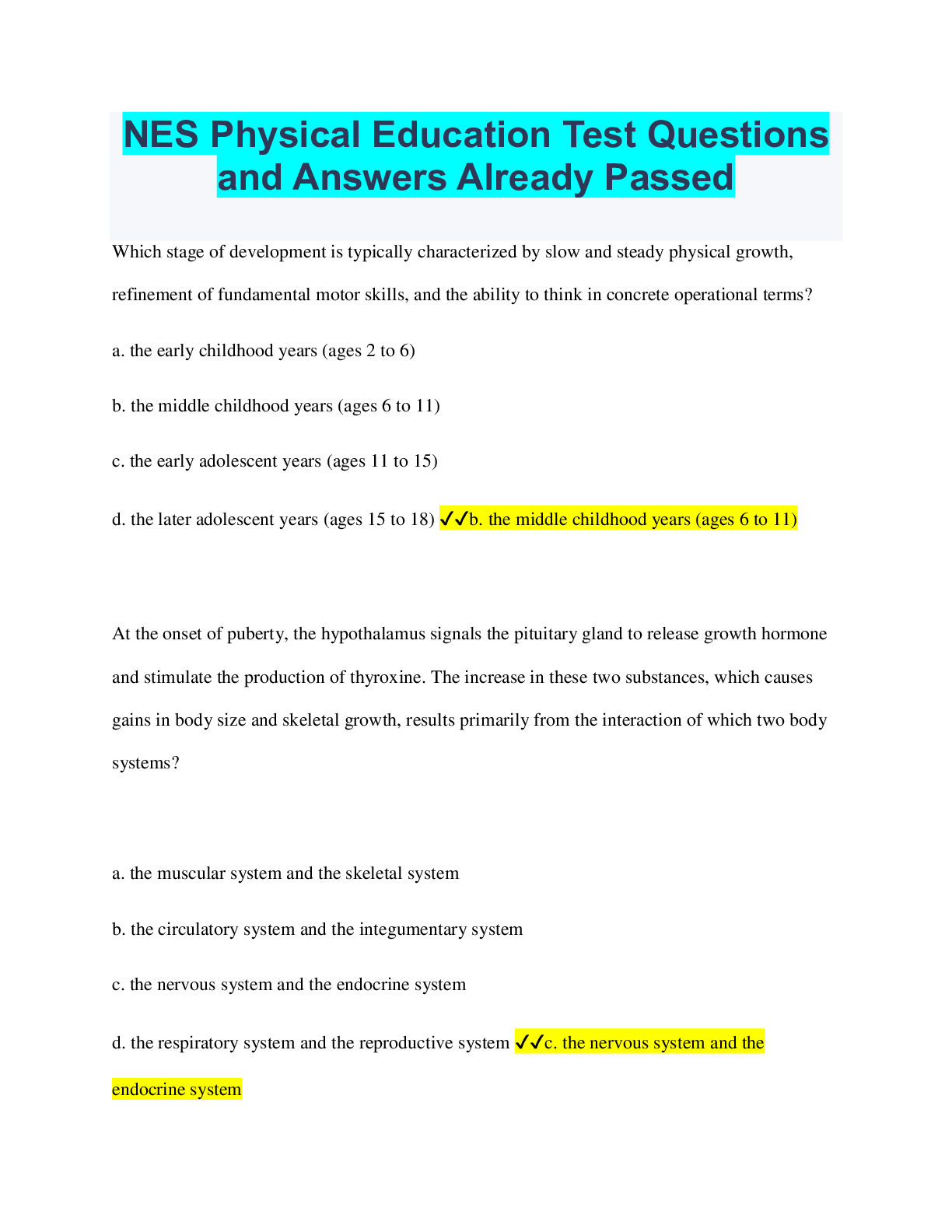
NES Physical Education Test Questions
and Answers Already Passed
Which stage of development is typically characterized by slow and steady physical growth,
refinement of fundamental motor skills, and the ability to think in concrete operational terms?
a. the early childhood years (ages 2 to 6)
b. the middle childhood years (ages 6 to 11)
c. the early adolescent years (ages 11 to 15)
d. the later adolescent years (ages 15 to 18) ✔✔b. the middle childhood years (ages 6 to 11)
At the onset of puberty, the hypothalamus signals the pituitary gland to release growth hormone
and stimulate the production of thyroxine. The increase in these two substances, which causes
gains in body size and skeletal growth, results primarily from the interaction of which two body
systems?
a. the muscular system and the skeletal system
b. the circulatory system and the integumentary system
c. the nervous system and the endocrine system
d. the respiratory system and the reproductive system ✔✔c. the nervous system and the
endocrine system
In the context of motor learning, the concept of readiness refers to the:
a. combination of maturation and experience that allows an individual to learn and acquire a new
motor skill.
b. ability of an individual to alter motor behaviors in order to adjust to changing demands in a
learning environment.
c. capacity of human biology, as in neural and bone development, to reorganize and respond to a
motor challenge or injury.
d. interplay of environmental factors that results in favorable or ideal conditions in which to learn
a new motor skill. ✔✔a. combination of maturation and experience that allows an individual to
learn and acquire a new motor skill.
During a soccer unit, a physical education teacher provides cues to promote students' efficiency
in skill execution. For example, for passes, the teacher reminds students to place their nonkicking foot alongside the ball with toes pointed at the target to help create velocity in the
kicking foot and improve accuracy. To increase the distance of throw-ins, the teacher tells
students to bring the ball back behind their heads with elbows bent, and then flex their trunk and
extend their arms forcefully and directly overhead on the release. This approach is most closely
aligned with which of the following national standards for physical education?
a. Achieves and maintains a health-enhancing level of physical fitness.
b. Demonstrates competency in motor skills and movement patterns needed to perform a variety
of physical activities.
c. Demonstrates understanding of movement concepts, principles, strategies, and tactics as they
apply to the learning and performance of physical activities.
d. Exhibits responsible personal and social behavior that respects self and others in physical
activity settings. ✔✔c. Demonstrates understanding of movement concepts, principles,
strategies, and tactics as they apply to the learning and performance of physical activities.
In a game of volleyball, a "bump" or forearm pass is the most appropriate technique to use to:
a. spike the ball over the net.
b. play a ball that arrives low and with force.
c. receive a ball off of the net.
d. return a ball that arrives at chest height or higher. ✔✔b. play a ball that arrives low and with
force.
Parachute play contributes to the development of skills important for dance by encouraging
students to focus on:
a. visual clues for recognizing a rhythm.
b. shaping movement to mirror shapes created by others.
[Show More]

.png)