NES Professional Knowledge
Elementary Education Already Passed
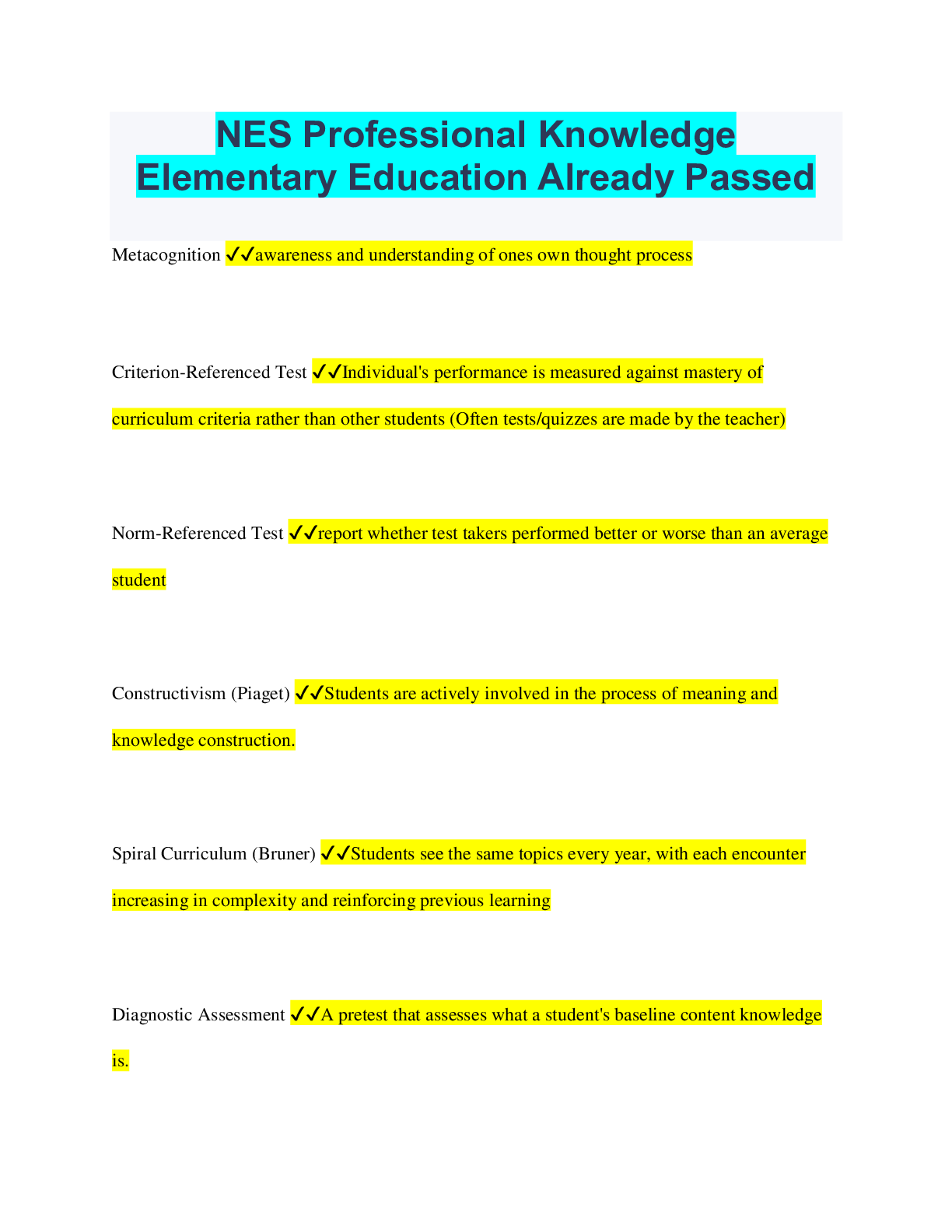
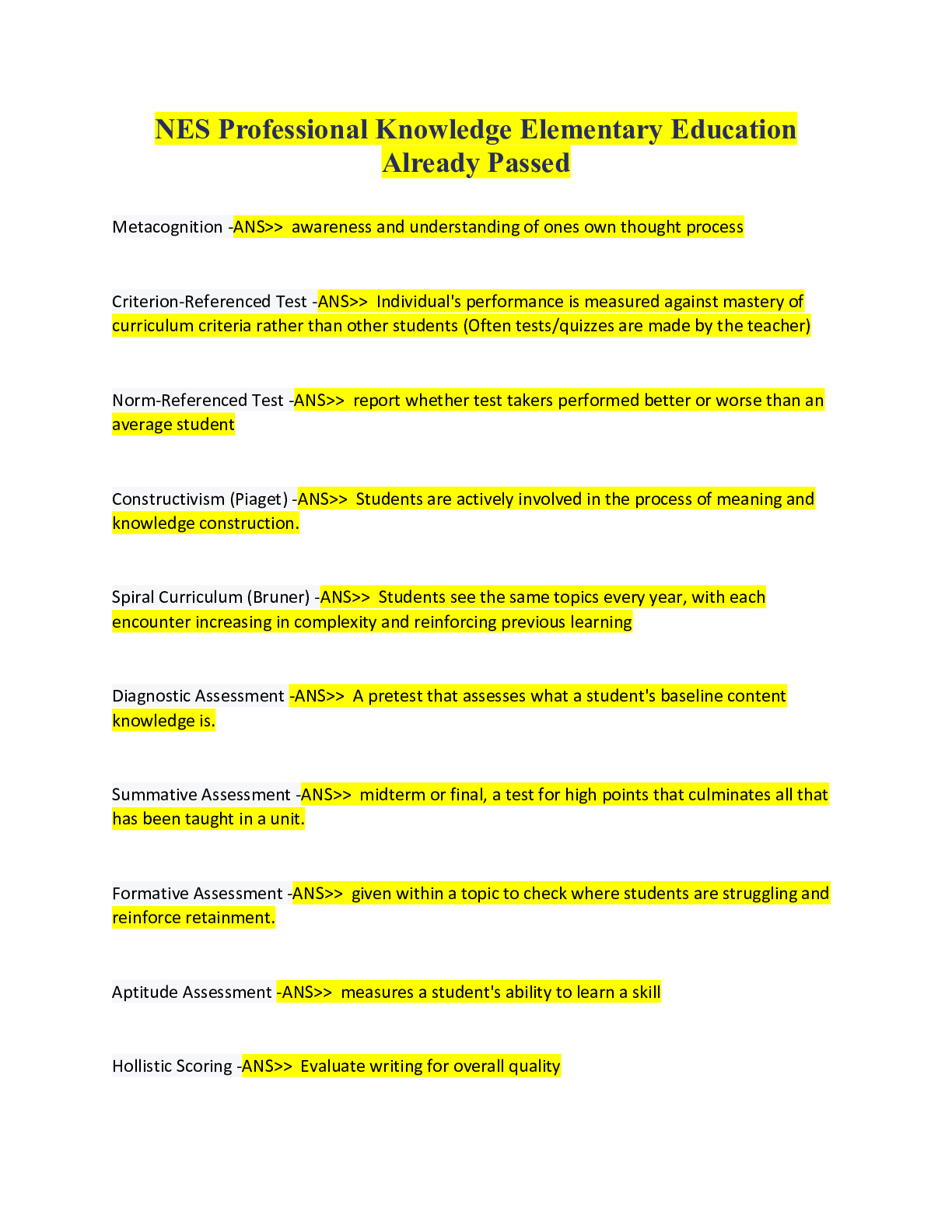
Metacognition ✔✔awareness and understanding of ones own thought process
Criterion-Referenced Test ✔✔Individual's performance is measured against mastery o
...
NES Professional Knowledge
Elementary Education Already Passed
Metacognition ✔✔awareness and understanding of ones own thought process
Criterion-Referenced Test ✔✔Individual's performance is measured against mastery of
curriculum criteria rather than other students (Often tests/quizzes are made by the teacher)
Norm-Referenced Test ✔✔report whether test takers performed better or worse than an average
student
Constructivism (Piaget) ✔✔Students are actively involved in the process of meaning and
knowledge construction.
Spiral Curriculum (Bruner) ✔✔Students see the same topics every year, with each encounter
increasing in complexity and reinforcing previous learning
Diagnostic Assessment ✔✔A pretest that assesses what a student's baseline content knowledge
is.
Summative Assessment ✔✔midterm or final, a test for high points that culminates all that has
been taught in a unit.
Formative Assessment ✔✔given within a topic to check where students are struggling and
reinforce retainment.
Aptitude Assessment ✔✔measures a student's ability to learn a skill
Hollistic Scoring ✔✔Evaluate writing for overall quality
ESSA-Every Student Succeeds Act ✔✔ensures opportunity for all students and requires
accountability through standardized testing.
Zone of Proximal Development (Vygotsky) ✔✔Instruction based on levels of performance
1) what a child can do alone
2) ZPD-what a child can do with scaffolding
3) what a child cannot do yet
Operant Conditioning ✔✔strengthening a specific behavior through the use of rewards and
punishments
Classical Conditioning ✔✔a learning process that occurs when two stimuli are repeatedly paired;
a response that is at first elicited by the second stimulus is eventually elicited by the first
stimulus alone.
Hierarchy of Needs (Maslow) ✔✔Basic - psychological and safety
Psychological - belongingness, love, and esteem
Self-Fullfillment - self-actualization
Stages of Cognitive Development (Piaget) ✔✔Sensorimotor 0-2yrs motor skillls
Preoperational 2-7yrs symbolic thinking
Concrete Operational 7-11yrs concepts to real
Formal Operational 11+yrs -theoretical concepts
Social Learning Theory (Bandura) ✔✔people learn behaviors by observing others
Schema Theory (Schmidt) ✔✔all knowledge is organized into units of stored information
Inductive vs Deductive Reasoning ✔✔Inductive: Developing generalizations from specific
observations
Deductive: Developing specific predictions from general principles
What does a Constructivist Classroom contain? ✔✔The teacher is the facilitator of learning and
students are the makers of the learning/meaning
Improving self-motivation for students occurs by... ✔✔providing engaging learning activities
that meet student identified learning objectives. Allow goal setting and provide only positive
feedback
Cognitive Domain of Learning ✔✔Mental skills and knowledge (One of the three domains of
educational learning / Bloom's Taxonomy)
Affective Domain of Learning ✔✔Feelings, values, and appreciation (One of the three domains
of educational learning / Bloom's Taxonomy)
Psychomotor Domain of Learning ✔✔Physical or manual skills (One of the three domains of
educational learning / Bloom's Taxonomy)
moral domain theory ✔✔children distinguish between the domains of social conventional
reasoning and moral reasoning
Stages of Moral Development (Kohlberg) ✔✔Pre-conventional;
1) Obedience and punishment "How can I avoid punishment?";
2) Self-interest orientation "What's in it for me?"
Conventional;
3) Interpersonal accord and conformity "Social norms";
4) Authority and social-order maintaining orientation "Law and order mentality"
Post- conventional;
5) Social contract orientation;
6) Universal ethical principles "Principled conscience"
Connectionism (Thorndike) ✔✔Laws of Learning-readiness, exercise, effect
developed classical and operant conditioning
What is the last mastered skill for an ELL? ✔✔academic language
What is the purpose of an essential question? ✔✔to establish learning goals.
High Standard Deviation ✔✔This means that the students' abilities and skills are diverse. (lowmed-high)
teachers should use this data as a sign to differentiate instruction to meet all student needs
analytical scoring ✔✔A scoring procedure in which a student's work is evaluated for selected
characteristics, with EACH CHARACTERISTIC receiving a separate score
Percentile ✔✔the percentage of cases in a distribution that lie below it- 85th percentile scored
better than 85% of those who took the assessment
Due Process Hearing ✔✔a formal legal procedure used to solve
disagreements concerning the education of
students in special education, there's an
impartial hearing officer who makes
decisions which are binding about issues at
hand
ASVAB is a . . ✔✔aptitude assessment
ACT is a . . . ✔✔achievement test
Woodcock Johnson is a . . ✔✔cognitive ability test
CogAT is a . . ✔✔cognitive ability test
A learning contract is used by a teacher when. . ✔✔an individual assignment is given. for a oneon-one agreement between teacher and student.
ISTE ✔✔International Society for Technology in Education is a resource for integrating tech
into teaching and Professional Developments
Vineland Adaptive Behavior Scales ✔✔assesses adaptive functioning (daily living skills, social
skills, everyday functioning)
Peabody Picture Vocabulary Test ✔✔A test examining verbal intelligence, receptive
understanding, and language disorders
Bayley Scales of Infant and Toddler Development ✔✔standardized test of infants' and toddlers'
mental and motor development
Ravens Test of Progressive Matrices ✔✔nonverbal group test typically used in Education and
abstract reasoning to nonverbally estimate fluid intelligence
Leiter International Performance Scale ✔✔an intelligence test in the form of a strict performance
scale. It was designed for children and adolescents ages 2 to 18
provides nonverbal measure of intelligence
UNIT (Universal Nonverbal Intelligence Test) ✔✔designed for children and adolescents 5-18
years and is a useful alternative to traditional measures involving verbal and language material.
Wechsler Tests defined ✔✔WPPSI 2-7yrs Preschool+Primary
WAIS 16-90yrs Adult Intelligence
WIAT indiv. achievement test
WISC 6-16yrs Intelligence scale for children
What laws require schools receive funds to provide students with eligible disabilities a
free/appropriate public education? ✔✔Section 504 and IDEA
Robert Rosenthal ✔✔studied experimenter bias, a researcher's unintended influence on the
behavior of subjects.
Teachers were told random kids would be smarter, two years later, they tested smarter because
the teachers were giving them more attention.
Behaviorism (Watson) ✔✔belief that a child's environment is the factor that shapes their
behaviors.
changes in behavior can be proven only if they are observable and measurable
How many points lower on an IQ test would indicate possible delayed/atypical intellectual
development in a child? ✔✔2 standard deviations below the mean
Bloom's Taxonomy ✔✔Taxonomy of six cognitive processes, varying in complexity, that
lessons might be designed to foster.
Remembering, understanding, applying, analyzing, evaluating, creating
Thematic Instruction ✔✔An instructional method of teaching in which emphasis is placed on
choosing a specific theme for teaching one or many concepts. takes place when different
disciplines are all centered towards one definite concept
ABCD Method - for writing Objectives ✔✔Audience, Behavior, Conditions, Degree of Mastery
Scaffolding ✔✔temporary support teachers provide to enable students to accomplish tasks so
that they may be able to take back their responsibility for their learning
Intrinsic Motivation vs Extrinsic Motivation ✔✔Intrinsic: working on a task for your own
satisfaction
Extrinsic: working on a task to gain something from someone else/receive a reward
Clock Focus Strategy ✔✔use of a prearranged cue for a student who is restless/off-task to be
able to stand and watch the second-hand on a clock for a full minute to regain their focus.
What is the best design for a uniform transition between activities to keep students on task?
✔✔chaining several mini-rountines together and modeling expectations
Standard Transitions ✔✔teachers must model, teach, and practice uniform transitions with
students.
How often are Teacher Performance Appraisals conducted? ✔✔annually
Labor Union Examples ✔✔The National Education Association
The American Federation of Teachers
Stages of Psychosocial Development (Erikson) ✔✔Trust vs. Mistrust 0-2 years,
Autonomy vs. Shame and Doubt 2-4 years,
Initiative vs. Guilt 4-6 years,
Industry vs. Inferiority 6-12 years,
Identity vs. Role Confusion 12-22 years,
Intimacy vs. Isolation 22-34 years,
Generativity vs. Stagnation 34-60 years,
Integrity vs. Despair 60+ years
Experiential Education (Dewey) ✔✔educators provide quality educational experiences that
would influence students' future decisions
Family Educational Rights and Privacy Act (FERPA) ✔✔protects privacy of student records
Individuals with Disabilities Education Act (IDEA) ✔✔ensures students with a disability are
provided a free, appropriate public education that is tailored to their needs (4 parts, includes
LRE)
McKinney-Vento Education Act ✔✔authorizes the federal education for homeless children and
youth
[Show More]