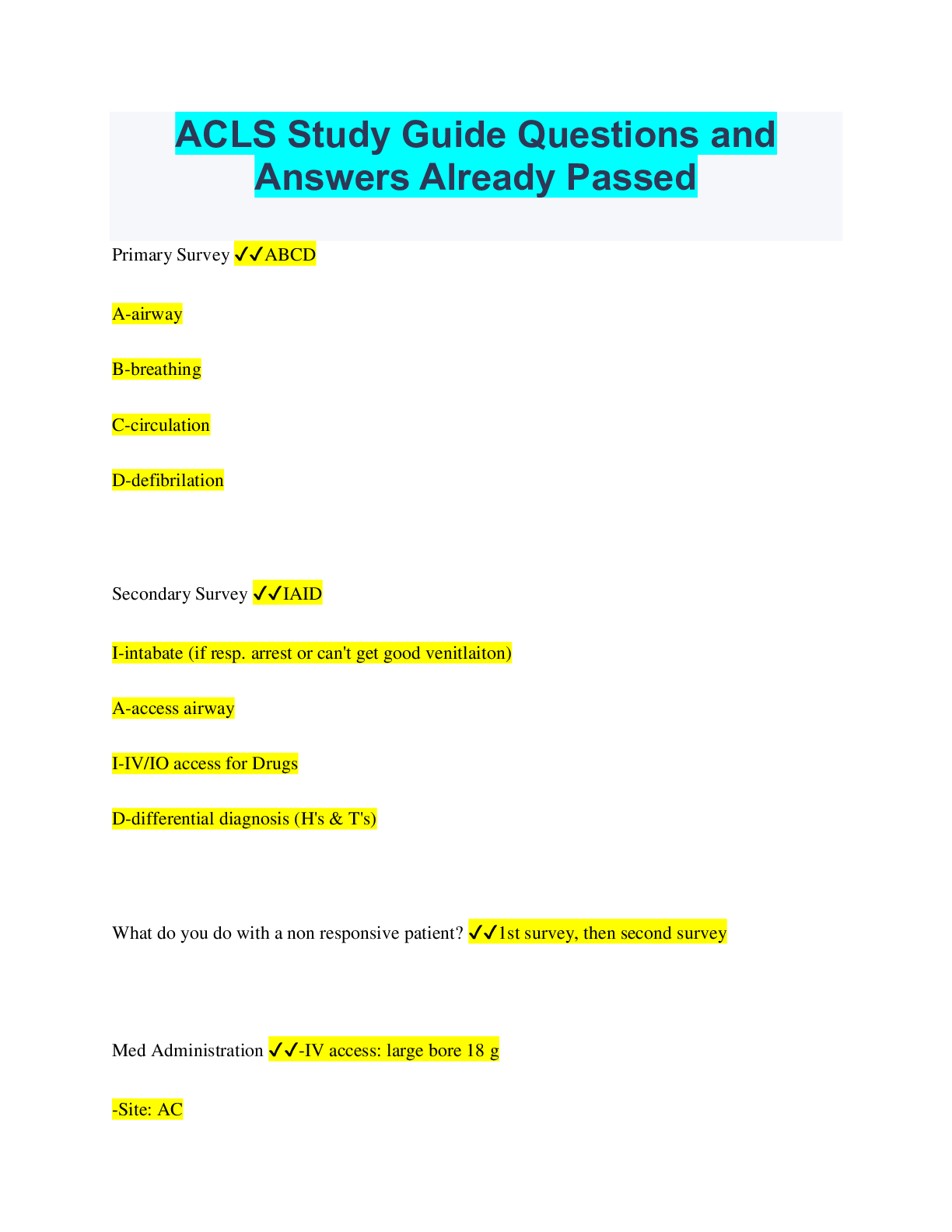
ACLS Study Guide Questions and
Answers Already Passed
Primary Survey ✔✔ABCD
A-airway
B-breathing
C-circulation
D-defibrilation
Secondary Survey ✔✔IAID
I-intabate (if resp. arrest or can't get good venitlaiton)
A
...
ACLS Study Guide Questions and
Answers Already Passed
Primary Survey ✔✔ABCD
A-airway
B-breathing
C-circulation
D-defibrilation
Secondary Survey ✔✔IAID
I-intabate (if resp. arrest or can't get good venitlaiton)
A-access airway
I-IV/IO access for Drugs
D-differential diagnosis (H's & T's)
What do you do with a non responsive patient? ✔✔1st survey, then second survey
Med Administration ✔✔-IV access: large bore 18 g
-Site: AC
-always flush after med admin
What do you do if AED determines non-shockable rhythm? ✔✔continue chest compressions
What is PEA? ✔✔Pulseless electrical activity
(ECG shows activity but there is no pulse felt in patient)
ACLS Survey ✔✔ABCD
A-airway
B-breathing
C-circulation
D-defibrilation
ACLS Airway Survey ✔✔SUPPLEMENTAL OXYGEN when indicated:
-100% for cardiac arrest
-titrate others to achieve >94% O2 sats
MONITOR VENTILATION EFFECTIVENESS by:
-chest rise/fall
-cyanosis
-O2 sats
-waveform capnography
AVOID EXCESSIVE VENTILATION
How many ventilations do you provide when patient is in cardiac arrest? With an advanced
airway? In respiratory arrest only? ✔✔2 ventilations every 30 compressions
if advanced airway: 1 every 6-8 seconds
if respiratory arrest: 1 every 5-6 seconds
What do you do with a non-responsive patient? ✔✔1. Shout for help/Activate the Emergency
Response System (get AED)
2. Check for Pulse
3. Start CPR
What do you do for a patient who is stable and has chest pain? ✔✔Monitor-support ABC
Be prepared to give CPR & Defib
Admin Aspirin (O2-sats<94%, Nitro, Morphine if needed)
Get 12 lead ECG
Cases NOT to give Nitro ✔✔hypotension (SBP < 90)
bradycardia (< 50/min)
tachycardia
Nitro Administration ✔✔1 tablet (or spray dose) every 3-5 min
up to total of 3 doses
H's ✔✔Hypovolemia
Hypoxia
Hypothermia
Hyper/Hypokalemia
Hydrogen ions (acidosis)
ECG Clues for Hypovolemia ✔✔Narrow complex
Rapid rate
Clues from History/Physical for Hypovolemia & Effective Intervention ✔✔Flat neck veins
History of condition
*internal bleeding & severe dehydration*
Intervention: volume infusion
ECG Clues for Hypoxia ✔✔slow rate
Clues from History/Physical for Hypoxia & Effective Intervention ✔✔Cyanosis
ABG
Airway Problems
Intervention: O2, ventilation, advanced airway
ECG Clues for Hydrogen Ions (acidosis) ✔✔Smaller-amplitude QRS Complexes
History/Physical Clues for Hydrogen Ions & Effective Intervention ✔✔History of diabetes
Bicarb responsive pre-existing acidosis
Renal Failure
Intervention: ventilation; sodium bicarb
ECG Clues for HyperKalemia or Hypokalemia ✔✔Hyper:
-tall, peaked T waves
-P waves get smaller
-QRS widens
-sine wave PEA
Hypo:
-flattened T waves
-prominent U waves
-QRS widens
-QT prolongs
-Wide complex tachycardia
History/Physical Clues for Hyper/HypoKalemia ✔✔HYPER:
-history of renal failure
-diabetes
-recent dialysis
-dialysis fistulas
-medications
HYPO:
-abnormal loss of potassium
-diurectic use
Effective Interventions for Hyper/HypoKalemia ✔✔HYPER:
-Calcium chloride
-Sodium Bicarb
-Glucose plus insulin
-Possibly albuterol
HYPO:
add magnesium if cardiac arrest
ECG Clues for Hypothermia ✔✔J or Osborne waves
History/Physical Clues for Hypothermia ✔✔history of cold exposure
central body temp
T's ✔✔Tension pneumothorax
Tamponade, cardiac
Toxins (drug overdoses)
Thrombosis (pulmonary)
Thrombosis (cardiac-MI)
ECG Clues for Tension pneumothorax ✔✔narrow complex
slow rate (Hypoxia)
History/Physical Clues for Tension pneumothorax & Effective Intervention ✔✔history of
condition
no pulse felt w/CPR
neck vein distention
tracheal deviation
unequal breath sounds
difficulty ventilating patient
INTERVENTION: needle decompression; tube thoracostomy
ECG Clues for Tamponade (cardiac) ✔✔narrlow complex
rapid rate
History/Physical Clues for Tamponade & Effective Intervention ✔✔history of condition
no pulse felt w/CPR
vein distention
INTERVENTION: pericardiocentesis
ECG Clues for Toxins ✔✔various but predominately prolongation of QT interval
History/Physical Clues for Toxins & Effective Intervention ✔✔bradycardia
empty bottles at scene
pupils
neurologic exam
INTERVENTION: intubation; specific antidotes
ECG Clues for Thrombosis (pulmonary) ✔✔narrow complex
rapid rate
History/Physical Clues for Thrombosis (pulmonary) & Effective Intervention ✔✔history of
condition
no pulse felt w/CPR
distended neck veins
prior positive test for DVT or PE
INTERVENTION: surgical embolectomy; fibrinolytics
ECG Clues for Thrombosis (Cardiac-MI) ✔✔abnormal 12-lead ECG with
-Q waves
-ST segment changes
-T waves, inversions
History/Physical Cues for Thrombosis (Cardiac-MI) & Effective Intervention ✔✔history of
condition
cardiac markers
good pulse with CPR
INTERVENTION: none listed
Amiodarone ✔✔VF/VT Cardiac Arrest (unresponsive to Shock, CPR & Vasopressor-epi)
-first dose 300mg
-second dose 150mg
NON Arrest
-150 mg
Atropine ✔✔Bradycardia (with or without ACS)
-0.5mg every 3-5 min not to exceed 3 mg
Adenosine ✔✔stable, narrow complex SVT
-first dose: 6 mg
-second dose: 12mg given 1-2 min after 1st dose
Vasopressin ✔✔Cardiac Arrest:
-40 mg 1 time only
-can be given instead of 1st or 2nd dose of EPI
Dopamine ✔✔Bradycardia (used after atropine)
use for hypotension <70 w/S&S of shock
-2 to 20 mcg/kg per min
Magnesium Sulfate ✔✔Cardiac Arrest (due to Hypomagnesemia OR Torsades de Pointes)
-1 to 2 g diluted in 10mL of D5W IV/IO
Torsades de Pointes w/Pulse or AMI with Hypomagnesemia
-1 to 2 g mixed in 50-100mL of D5W over 5-160 min
What is the desired PETCO2? ✔✔35-40
> or = 10 means good compressions
<10 means need to evaluate compressions
When is synchronized cardioversion indicated? ✔✔Symptomatic or Unstable SVT
VT with pulses
What joules dose do you use during cardio version? ✔✔Atrial flutter and SVT: initial 50 J - 100
J
Monomorphic VT with pulse: inital 100 J
Unstable atrial fib:
-monophasic dose 200 J
-biphasic dose 120 J - 200 J
Which drugs can be given through ET tube? ✔✔lidocaine
vasopressin
epi
atropine
[Show More]