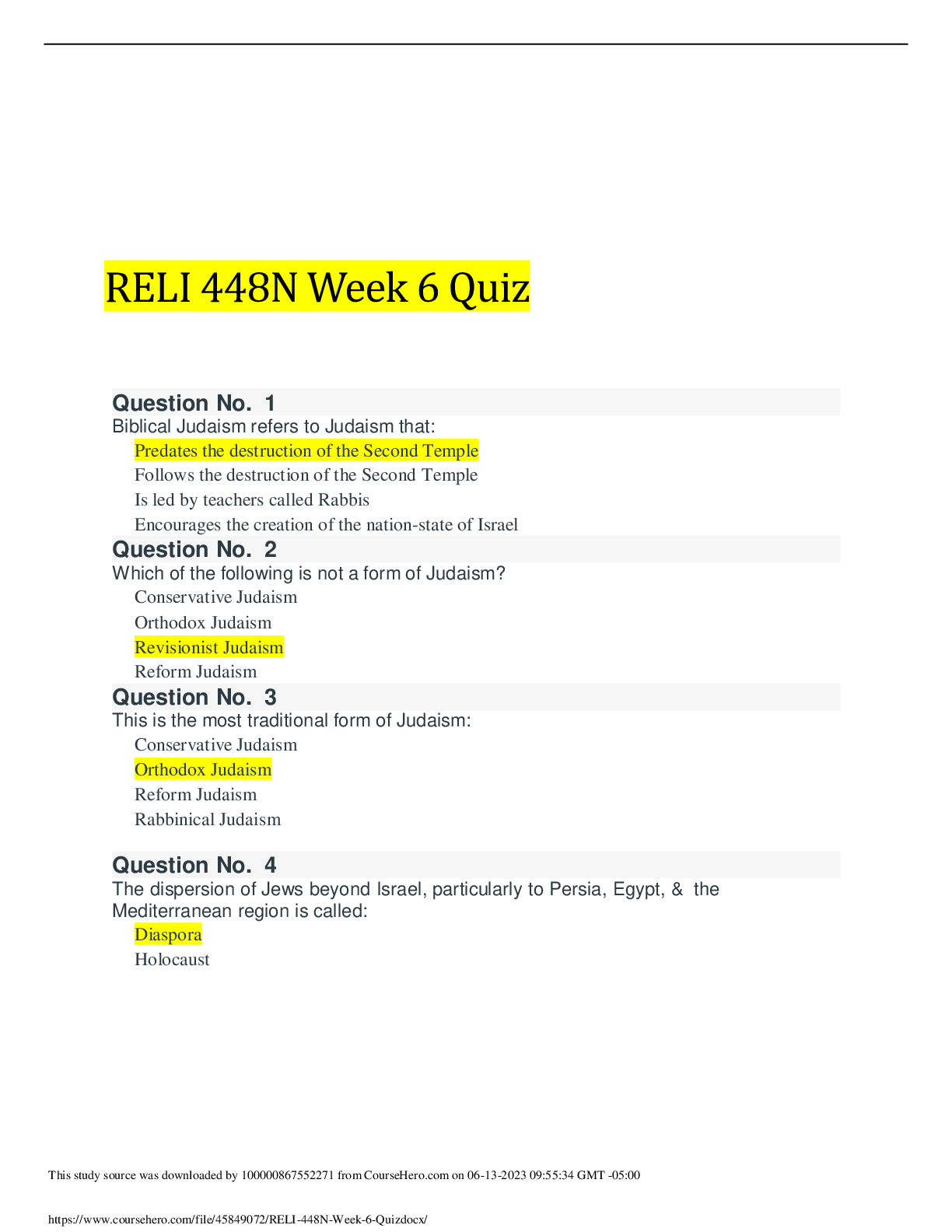
Question No. 1
Biblical Judaism refers to Judaism that: Predates the destruction of the Second Temple Follows the destruction of the Second Temple Is led by teachers called Rabbis
Encourages the creation of the nation
...
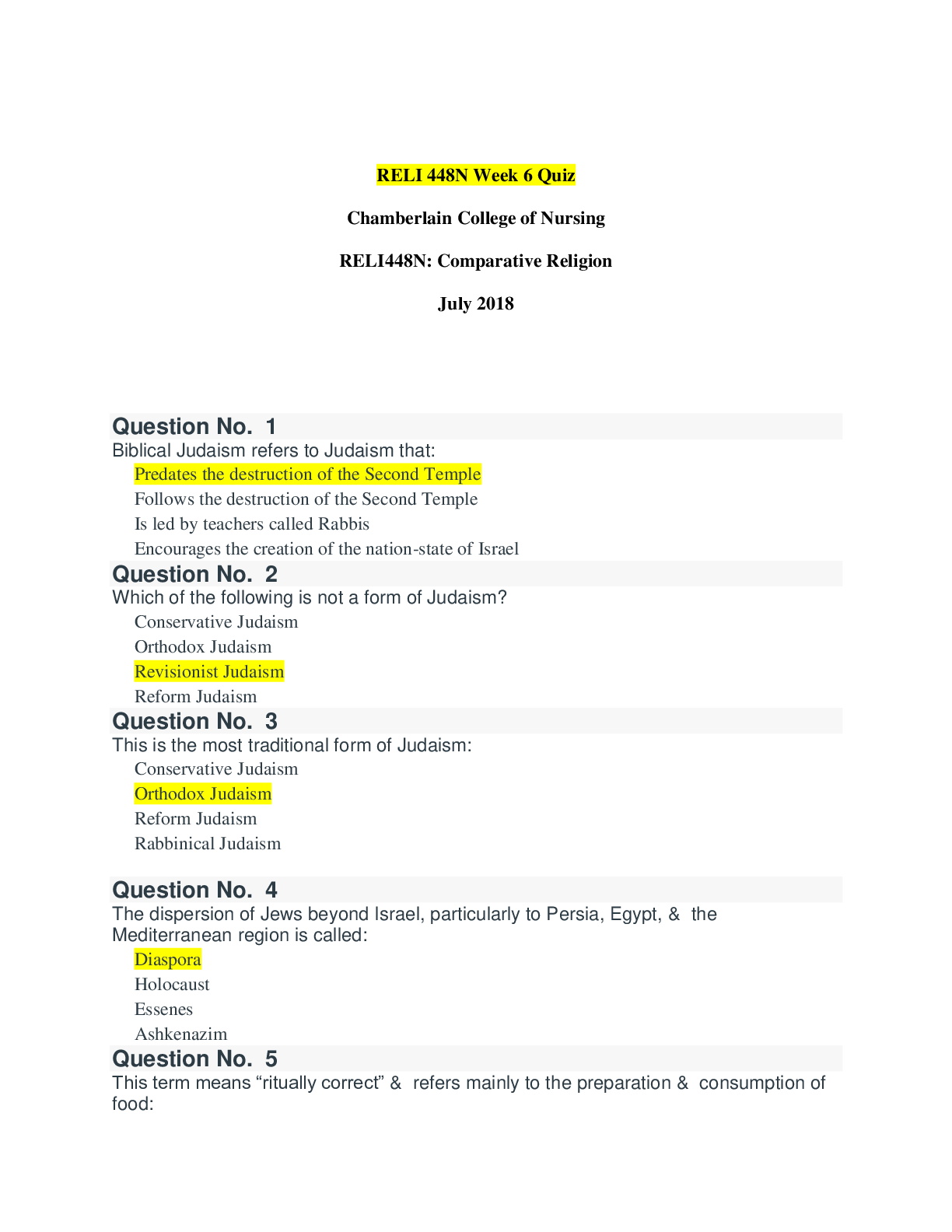
Question No. 1
Biblical Judaism refers to Judaism that: Predates the destruction of the Second Temple Follows the destruction of the Second Temple Is led by teachers called Rabbis
Encourages the creation of the nation-state of Israel
Question No. 2
Which of the following is not a form of Judaism?
Conservative Judaism Orthodox Judaism Revisionist Judaism Reform Judaism
Question No. 3
This is the most traditional form of Judaism:
Conservative Judaism Orthodox Judaism Reform Judaism Rabbinical Judaism
Question No. 4 The dispersion of Jews beyond Israel, particularly to Persia, Egypt, & the Mediterranean region is called:
Diaspora Holocaust
Essenes Ashkenazim
Question No. 5
This term means “ritually correct” & refers mainly to the preparation & consumption of food:
Kosher Midrash Tallit
Bar (Bat) Mitzvah
Question No. 6 Members of the priestly families, living primarily in Jerusalem, who were in charge of the temple & its activities were called:
Pharisees Zealots Essenes Sadducees
Question No. 7
The most recent period in Jewish history, called the reform, is characterized by all of the following except:
The innovations of the European Enlightenment The laws of Napoleon
A movement away from modern political & philosophical ideals The inspiration of the American & French Revolutions
Question No. 8
Isaiah was a: King Prophet Priest Rabbi
Question No. 9
The list of authoritative books (of the Christian Bible) is called:
The Canon The Gospels The Epistles The Torah
Question No. 10
The preparatory period of penance, preceding Easter & lasting 40 days, is called:
Passover Lent Advent Pentecost
Question No. 11
The 95 Theses were a set of demands for change & reformation that were made by:
John Calvin Martin Luther Henry VIII Huldrych Zwingli
Question No. 12
The gospel that has been referred to as the “women’s gospel” is the gospel of:
Matthew Mark Luke John
Question No. 13
Martin Luther’s reforms included:
An end to the sale of indulgences
The removal of the term filioque from the Nicene Creed The acceptance of the doctrine of predestination
The rejection of a dependence on ordained clergy
Question No. 14 The belief that because God is all-powerful & all-knowing, a human being’s ultimate reward or punishment is already decreed by God is called:
Predetermination Free Will Eternalism Predestination
Question No. 15
Our text defines all of the following forms of Christianity as “non-traditional” except:
Egyptian Coptic Christianity Mormonism
Jehovah’s Witnesses Unitarian
[Show More]