RBS Test 1 58 Questions with Verified Answers
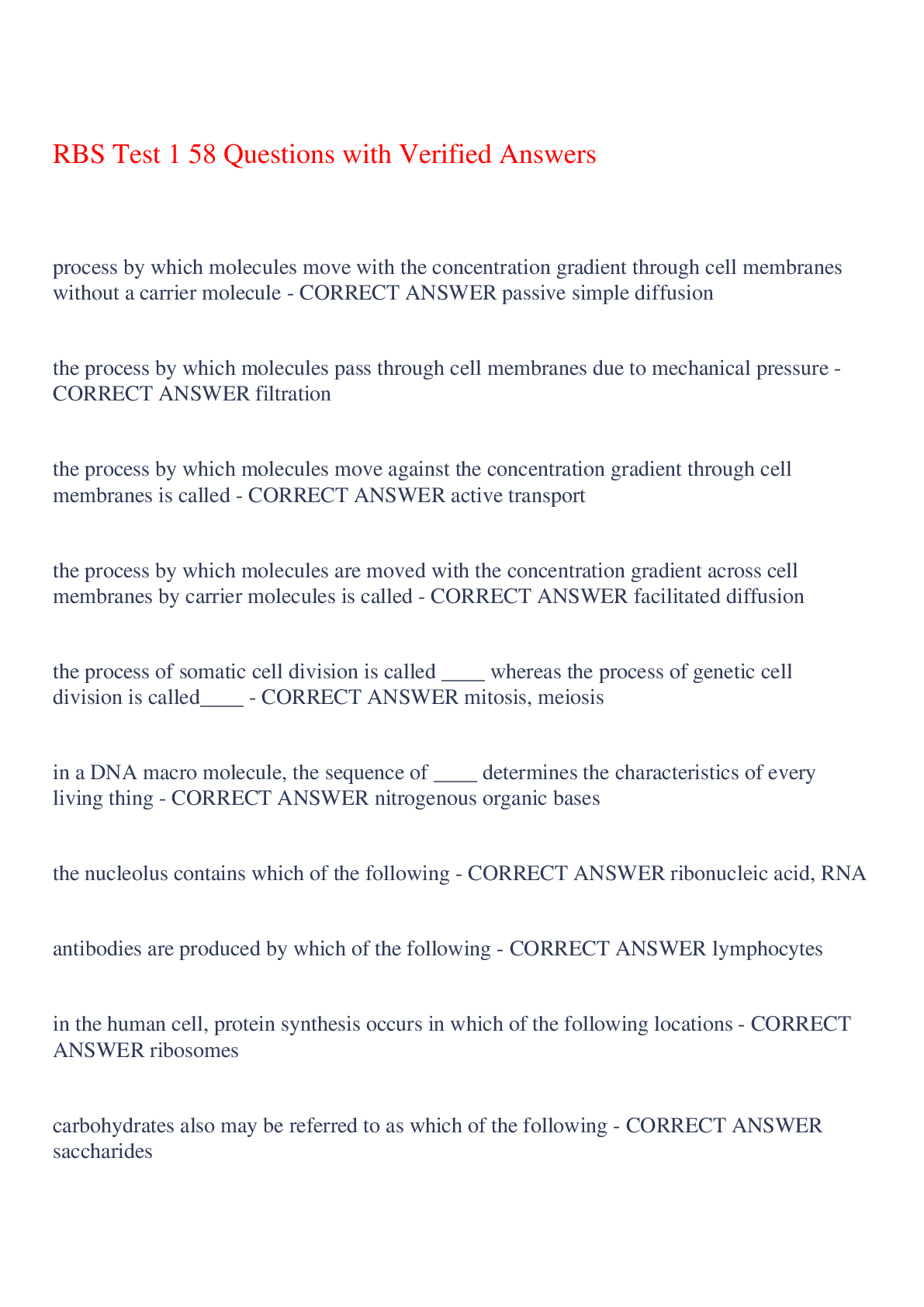
process by which molecules move with the concentration gradient through cell membranes without a carrier molecule - CORRECT ANSWER passive simple diffusion
the proces
...
RBS Test 1 58 Questions with Verified Answers
process by which molecules move with the concentration gradient through cell membranes without a carrier molecule - CORRECT ANSWER passive simple diffusion
the process by which molecules pass through cell membranes due to mechanical pressure - CORRECT ANSWER filtration
the process by which molecules move against the concentration gradient through cell membranes is called - CORRECT ANSWER active transport
the process by which molecules are moved with the concentration gradient across cell membranes by carrier molecules is called - CORRECT ANSWER facilitated diffusion
the process of somatic cell division is called ____ whereas the process of genetic cell division is called____ - CORRECT ANSWER mitosis, meiosis
in a DNA macro molecule, the sequence of ____ determines the characteristics of every living thing - CORRECT ANSWER nitrogenous organic bases
the nucleolus contains which of the following - CORRECT ANSWER ribonucleic acid, RNA
antibodies are produced by which of the following - CORRECT ANSWER lymphocytes
in the human cell, protein synthesis occurs in which of the following locations - CORRECT ANSWER ribosomes
carbohydrates also may be referred to as which of the following - CORRECT ANSWER saccharides
DNA regulates cellular activity by reproducing itself as ____ to carry genetic info from the cell to the ribosomes - CORRECT ANSWER mRNA
the human body must provide what 3 things to ensure efficient cell operation - CORRECT ANSWER food, oxygen, and water
the human cell component which controls cell division and multiplication, as well as biochemical reactions - CORRECT ANSWER nucleus
the human cell contains: - CORRECT ANSWER proteins, carbohydrates, lipids, and nucleic acids
part of the cell that functions as a garbage disposal - CORRECT ANSWER lysosomes
chemical secretions that are manufactured by various endocrine glands and carried by the bloodstream influence the activities of other parts of the body are termed - CORRECT ANSWER hormones
the primary energy source of the cell is - CORRECT ANSWER glucose
which of the following are activities of the cell membrane? - CORRECT ANSWER protection of the cellular contents from the environment, controls of the passage of water and other materials in and out of the cell
somatic cells divide through the process of - CORRECT ANSWER mitosis
lipids are also referred to as - CORRECT ANSWER fats
inorganic materials are compounds that - CORRECT ANSWER do not contain carbon
antibodies are protein molecules produced by specialized cells in the bone marrow called - CORRECT ANSWER B lymphocytes
the steps or rungs of the DNA ladder-like structure consists of complementary chemicals that are - CORRECT ANSWER pairs of nitrogenous bases
the much smaller structures that make up nucleic acids are called - CORRECT ANSWER nucleotides
which of the following serves as a prototype for messenger RNA(mRNA) - CORRECT ANSWER deoxyribonucleic acid DNA
the number of mitochondria in cells varies from a few hundred to several thousand. the greater found in cells exhibiting - CORRECT ANSWER the greatest activity
during which of the following subphases of mitosis do the centrioles migrate to opposite sides and begin to regulate the formation of the mitotic spindle - CORRECT ANSWER prophase
building blocks of carbohydrates are - CORRECT ANSWER monosaccharides
example of a simple sugar is - CORRECT ANSWER glucose
lipids will only dissolve in _____ solvents - CORRECT ANSWER non-polar
fats are composed of ____ and ___ - CORRECT ANSWER glycerol and fatty acids
building blocks of protein are - CORRECT ANSWER amino acids
proteins that regulate the rate of chemical reactions are - CORRECT ANSWER enzymes
building blocks of nucleic acids are - CORRECT ANSWER nucleotides
___ are formed from individual amino acids linked together as a chain through peptide bond formation - CORRECT ANSWER proteins are formed from individual amino acids linked together as a chain through peptide bond formation
a ____ is a specific DNA sequence that is translated into a particular protein - CORRECT ANSWER gene
ATP synthesis - CORRECT ANSWER mitochondria
RNA synthesis - CORRECT ANSWER nucleolus
protein synthesis - CORRECT ANSWER rough endoplasmic reticulum
cellular digestion - CORRECT ANSWER Lysosomes
lipid synthesis - CORRECT ANSWER smooth endoplasmic reticulum
chromosomes lined up in the center of the cell - CORRECT ANSWER metaphase
nuclear membrane disappears - CORRECT ANSWER prophase
nuclear membranes yeild 2 nuclei and cytoplasm divides - CORRECT ANSWER telophase
DNA is duplicated - CORRECT ANSWER interphase
chromatids move to opposite sides - CORRECT ANSWER anaphase
cell drinking - CORRECT ANSWER pinocytosis
frequent mitosis - CORRECT ANSWER GI lining
water moving across the cell membrane - CORRECT ANSWER osmosis
cell eating - CORRECT ANSWER phagocytosis
no mitosis - CORRECT ANSWER nervous tissue
Thallium for heart viability uses - CORRECT ANSWER active transport. Which means that this is movement against the concentration gradient and requires a carrier molecules that require energy.
Tc MDP for bones uses - CORRECT ANSWER ion exchange
Tc HMPAO for brain uses - CORRECT ANSWER simple diffusion. Which means this is a process of moving molecules from a high concentration gradient to a lower concentration gradient.
Tc DTPA for renal or aerosal for lung scans uses - CORRECT ANSWER filtration.
Tc Sulphur colloid for gastric, liver, spleen scans uses - CORRECT ANSWER phagocytosis
cells that are prolific are generally more radio-resistant than cells that are less prolific. true or false - CORRECT ANSWER false
of blood cells, liver cells, and nerve cells, the most radioresistant would be blood cells? true or false - CORRECT ANSWER False. nerve cells are the most radio resistant bc they are less prolific.
[Show More]