Social Sciences > QUESTIONS & ANSWERS > ACCS Review Practice Exam Questions and Answers Graded A+ (All)
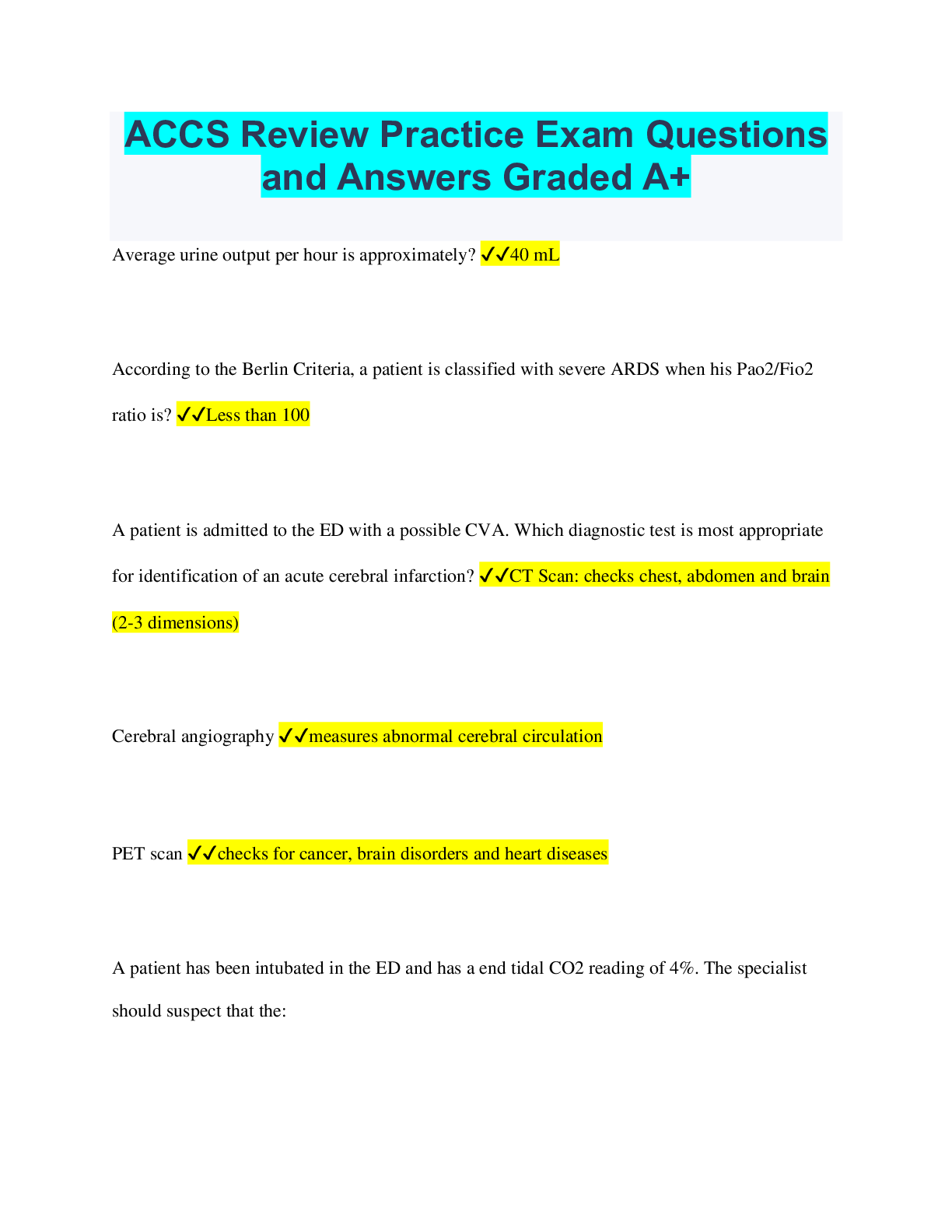
ACCS Review Practice Exam Questions and Answers Graded A+
Document Content and Description Below
ACCS Review Practice Exam Questions and Answers Graded A+ Average urine output per hour is approximately? ✔✔40 mL According to the Berlin Criteria, a patient is classified with severe ARDS when ... his Pao2/Fio2 ratio is? ✔✔Less than 100 A patient is admitted to the ED with a possible CVA. Which diagnostic test is most appropriate for identification of an acute cerebral infarction? ✔✔CT Scan: checks chest, abdomen and brain (2-3 dimensions) Cerebral angiography ✔✔measures abnormal cerebral circulation PET scan ✔✔checks for cancer, brain disorders and heart diseases A patient has been intubated in the ED and has a end tidal CO2 reading of 4%. The specialist should suspect that the: A. patient has a pulmonary embolus B. ET tube is in the correct position C. ET tube is in the esophagus D. ET tube is in the right main stem bronchus ✔✔B. ET tube is in the correct position *etco2 will be > if in the esophagus Post-operatively, Mr. Hart has a 2-3 mm ST segment elevation on his 12 lead electrocardiograph. This is indicative of ✔✔Myocardial injury Which of the following would most accurately provide necessary information regarding fluid management in the care of a critically ill patient with pulmonary edema? A. Bedside PFT B. Intake and Output measurements C. Daily weights D. Pulmonary artery catheter ✔✔D. Pulmonary artery catheter A patient who was struck in the head with a blunt object is recovering in the ICU. He is angry, combative, and irritable. He opens his eyes, grunts, and withdraws when the sole of his foot is stimulated with a sharp object. What is his score on the Glasgow Coma scale? ✔✔8 Chest radiograph changes associated with congestive heart failure include: 1. Bilateral radiolucency 2. Increased pulmonary Vasculature 3. Cardiomegaly A. 1 & 2 only B. 2&3 only C. 1& 3 only D. All of the above ✔✔B. 2 & 3 1 is normal 2 and 3 indicates CHF A 57 year old male is admitted to the ICU with chest pain radiating down his left arm. Which of the following lab tests would best confirm the diagnosis of myocardial infarction? A. PvO2 B. Phosphate C. Troponin D. Lactate ✔✔C. Troponin A 67 year old male with chest pain and shortness of breath is placed on a cardiac monitor in the intensive care unit. The following rhythm is observed on the monitor - what is the correct interpretation of a 3rd degree AV block? ✔✔No PR interval Describe a 2nd degree AV block ✔✔P wave longer and skips a beat Describe a Multifocal PVC ✔✔it's unidentifiable = treat with O2 and amiodarone Which of the following tests should the adult critical care specialist recommend in order to confirm the diagnosis of pulmonary artery hypertension? A. pulmonary functions tests B. high resolution CT scan C. Right heart catheterization D. Six minute walk test ✔✔C. Right heart catheterization A 76 y.o. male presents to the ED with shortness of breath. Upon entering the room the adult critical care specialist determines that the patient is alert and anxious on oxygen at 5L/min by nasal cannula. He is seated in the tripod position and using accessory muscles to breathe. He has audible crackles bilaterally, jugular venous distension, and +2 peripheral edema. The following patient data is obtained: HR 110/min RR 31/min BP 154/92 mmHg Spo2 90% Which of the following tests should the specialist recommend to confirm a suspicion of congestive heart failure? A. troponin B. brain natriuretic peptide C. magnesium level D. MB fraction of creatinine phosphokinase ✔✔B. Brain natriuretic peptide The adult critical care specialist assigned to the cardiovascular intensive care unit hears an alarm sound in Room 4. Upon entering the room, the specialist notes that the pulmonary artery pressure tracing is dampened. The specialist should: ✔✔flush the catheter * dampening means it's wet and not reading Mrs. Smith is in her third postoperative day following repair of fractured hip. A chest radiograph obtained tis morning reveals a left lower lobe infiltrate. Patient assessment data includes: Temp: 102*F (39*C) HR 100, RR 24, Sat 92%, BP 90/70 RBC 4, Hb 11 Hct 39, WBC 20000, Platelets 250,000 What therapy should the specialist recommend? A. anti-infective agent B. beta agonist aerosol C. sustained maximal inspiration D. oral expectorant ✔✔A. anti-infective agent A mildly obese 48 year old female presented to the ED complaining of chest discomfort. She denied any cough, fever, night seats, or weight loss. Her physical examination revealed: Temp 37.8*C, HR 100, RR 14, BP 110/70. She reported that she had a transthoracic echocardiogram two days previously that demonstrated a positive bubble study and an estimated peak pulmonary arterial systolic pressure of 59. Chest examination revealed bilateral vesicular breath sounds and resonance to percussion. Cardiac examination revealed a regular rhythm with normal heart sounds and no murmurs or pericardial friction rub. The abdomen was soft, non-tender, an without hepatosplenomegaly. There was no cyanosis, clubbing or edema. The specialist should recommend initial therapy for. A. a left to right cardiac shunt B. refractory hypoxemia C. increased system vascular resistance D. pulmonary arterial hypertension. ✔✔D. pulmonary arterial hypertension A 17 year old male is admitted to the ED after a MVA in which he sustained blunt chest trauma. While being transported to radiology, he complains of shortness of breath and severe chest pain. The adult critical care specialist is asked to assess the patient. The following CT image shows increased aeration on the left side, the specialist should recommend: ✔✔insertion of a left chest tube A 66 year old woman presents to the ED with shortness of breath. She appears alert and anxious on oxygen via nasal cannula at 5L/min. She is seated in the tripod position and using accessory muscles to breathe. Further assessment reveals bilateral audible crackles, jugular venous distension and +3 peripheral edema. The following patient data is available: HR 110, RR 31, BP 154/92, Spo2 90%, BNP 1100 (Brain Natriuretic Peptide) The specialist should recommend initiation of therapy for ✔✔Congestive heart failure Mr. Jones is admitted to the critical care unit with a 2-day history of vomiting and abdominal pain. His admission lab results include: Glucose 256 Na+ 133 K+ 5.8 Cl- 95 Hco3 15 ABG: 7.28, 35 co2, 88 Pao2, 98%, 16 The specialist should initially recommend administration of: ✔✔Insulin Norma values: Glucose <100 Na+ 135-145 K+ 35-45 Cl- 95-105 HCO3 22-26 Ms. Brown presents with acute shortness of breath and chest pain during the last trimester of her pregnancy. She complains of dizziness and anxiety with a heart rate of 125/min and blood pressure of 80/50 mmHg. Which of the following diagnostic procedures should the adult critical care specialist recommend? 1. Cerebral angiogram 2. Ventilation-perfusion scan 3. Arterial blood gas 4. PET scan ✔✔2 & 3 The adult critical care specialist is summoned to the ICU where a male patient with a past history of tobacco abuse and tuberculosis recently coughed up approximately 1 cup of bright red blood. He appears uncomfortable and in respiratory distress. Auscultation reveals rhonchi that are more pronounced on the right than the left. The chest radiograph demonstrates diffuse bilateral infiltrates. During the physical exam, the patient coughs up 450 mL of bright red blood. Vital signs: BP 110/65 HR 115 RR 33 Sat 92 O2 NRB at 12lpm Lab results are: WBC 12,00 HCT 12% Platelets 375,00 BUN 48 Creatinine 1.1 Electrolytes, serum glucose, INR, and PTT are within normal limits. What further testing should the specialist recommend? A. Transesophageal echocardiography B. Pulmonary angiography C. Carotid ultrasound D. Bronchial artery embolization ✔✔*D. Bronchial artery embolization A refers to heart B. refers to lungs C. refers to artery D. refers to bronchioles Normal: WBC 5,000-10,000 Hct 10-50% Platelets 150,000-400,000 BUN 7-20 Creatinine 0.7-1.3 A 45 y.o. female is transported to the ED following a MVA. She suffered massive abdominal injuries and a fractured femur. She is now one day postoperative repair of a lacerated liver and perforated ileum. Her urine output is 15-20mL/hr with a net fluid balance of +8L. Chest radiograph reveals bilateral, large pleural effusions. The following patient data is available: Hr 125 BP 90/45 Creatinine 4 BUN 70 Bilirubin Normal The critical care specialist should recommend initation of treatment for: A. acute renal failure B. Congestive heart failure C. Hypervolemia D. Hepatic failure ✔✔A. acute renal failure A 23y.o. man was admitted to the ED following a high - speed motor vehicle crash. He is exhibiting transient hypotension and tachycardia. The patient has multiple orthopedic injuries in addition the trauma to the right chest, pelvis and head. The radiologist noted the presence of a deep sulcus sign on the patient's AP supine chest radiograph. the nurse asks the critical care specialist the significance of this finding. The specialist should explain that the deep sulcus sign is indicative of: ✔✔pneumothorax A 74 y.o. man with a history of atrial fibrillation presents to the D with Hemoccult-positive stools. He is on multiple medications for diabetes and hypertension, as well as warfarin but he has been noncompliant. He has mild mitral valve regurgitation and an ejection fraction of 32% and has had episodes of transient cerebral ischemia in the past. The specialist should report which of the following results that indicate active bleeding? 1. INR of 3.0 2. platelet count of 300,000 3. Prothrombin time of 35 sec 4. hematocrit of 42% ✔✔B. 3 only Hint: "active bleeding" Normal: INR 0.8-1.2 or 2-3 Platelet 150,000-400,000 Prothrombin Time 12-15 secs Hematocrit 40-50% A 50 year old male present to the Ed with syncope and shock. He is admitted to the intensive care and pulmonary artery catheter is inserted. patient data is as follows: BP 70/40 MAP 50 CVP 20 RV 45/0 PAP 45/15 Mean PAP 25 PCWP 7 QT 2.5 SVR 18 (1440 dynes) PVR 8.4 (670 dynes) Arterial blood gas results on room air are as follows: 7.32, 32, 59 o2, 89%. Mixed venous blood gas results are: 7.28, 38, 28 O2, 49%. Ca-vO2 difference is 8.0 vol%. The adult critical care specialist should recommend that the patient be treated quickly for: A. acute pulmonary embolism B. left heart failure C. right heart failure D. hypervolemia ✔✔A. acute pulmonary embolism (>PAP, >CVP) Normal: BP 120/80 MAP 90 CVP 10 RV 25/0 PAP 25/8 Mean PAP 14 PCWP 8-10 Qt 4-8 SVR <20 or 1600dynes (Left heart system) PVR <2.5 or 200 dynes (Right heart - pulmonary sytem) Left heart failure (>PCWP, <MAP, <QT) Right heart failure (>CVP, <PAP) Hypervolemia (all values are increased >) An 82 year old man is admitted to the ICU with tachypnea, confusion, and hypotension. Initial assessment reveals: BP 80/50 MAP 60 RV 42/0 PAP 45/20 PCWP 8 Qt 6.5 SVR 7.4 (590 dynes) PVR 2.6 (210 dynes) ABG on RA are: 7.45, 32, 50 o2, Sat 85% VBG on RA are: 7.40, 38, 37o2, Svo2 70%. Ca-Vo2. Difference is 3.0 vol% The adult critical care specialist should recommend that the patient be treated quickly for: A. pulmonary hypertension B. mitral valve stenosis C. septic shoc D. hypervolemia ✔✔Pulmonary hypertension due to >PAP and >CVP Indications for: Mitral Valve stenosis= Lt heart, >PCWP, <MAP, <Qt Septic shock = Hypervolemia = all values are elevated (fluid overloaded) Normal: BP 120/80 MAP 90 CVP 10 RV 25/0 PAP 25/8 Mean PAP 14 PCWP 8-10 Qt 4-8 SVR <20 or 1600dynes (Left heart system) PVR <2.5 or 200 dynes (Right heart - pulmonary sytem) The adult critical care specialist is assigned to care for a 55 year old patient with a history of alcoholism who is complaining of abdominal pain. The chest radiograph reveals cardiomegaly and a left pleural effusion. The CBC is normal. Patient data is as follows: BP 80/50 MAP 60 CVP 1 RV 20/0 PAP 20/10 Mean PAP 13 PCWP 4 Qt 3.0 SVR 19.7 (1570 dynes) PVR 3.0 (240 dynes) ABG on RA are: 7.34, 30, 80 o2, Sat 90% VBG on RA are: 7.31, 38, 29 o2, 49%. Ca-Vo2 difference is 8.2% The ACCS should recommended that the pt be treated quickly for: A. hypovolemic shock B. Tricuspid valve stenosis C. Right heart failure D. Congestive heart failure ✔✔A. hypovolemic shock Indications for: tricuspid valve stenosis = Rt side (>CVP, <PAP) Right heart failure = (>CVP, <PAP) Congestive heart failure = Lt side, >PCWP, <MAP, <Qt Normal: BP 120/80 MAP 90 CVP 10 RV 25/0 PAP 25/8 Mean PAP 14 PCWP 8-10 Qt 4-8 SVR <20 or 1600dynes (Left heart system) PVR <2.5 or 200 dynes (Right heart - pulmonary sytem) Twenty four hours later the Pt in the previous question is anxious and complaining of respiratory distress. RR 32 BP 80/50 MAP 60 CVP 4 RV 45/0 PAP 45/25 Mean PAP 13 PCWP 4 Qt 3.0 SVR 19.7 (1570dynes) PVR 3.0 (240 dynes) ABG on RA are: 7.46, 32, 55 o2, Sat 89% VBG on RA are: 7.40, 31, 35o2, Sat 65% Ca-Vo2 Difference is 4.8 vol%. The ACCS should contact the attending physician and report that the patient has developed: A. hypervolemia B. Congestive heart failure C. Cor Pulmonale D. Pulmonary hypertension ✔✔D. Pulmonary hypertension Indications for: Hypervolemia = all values are elevated Congestive heart failure = Lt side of heart, >PCWP, <MAP, <Qt Cor Pulmonale = Rt heart failure, >CVP, <PAP Pulmonary hypertension = >PAP, >PCWP, >PVR = lungs Normal: BP 120/80 MAP 90 CVP 10 RV 25/0 PAP 25/8 Mean PAP 14 PCWP 8-10 Qt 4-8 SVR <20 or 1600dynes (Left heart system) PVR <2.5 or 200 dynes (Right heart - pulmonary sytem) An 88 y.o. woman arrives at the hospital confused and hypotensive. Available patient assessment data: BP 80/50 MAP 60 CVP 12 RV 40/12 PAP 40/30 Mean PAP 33 PCWP 29 Qt 2.5 SVR 19.2 (1530 dynes) PVR 1.6 (130 dynes) ABG RA: 7.30, 45, o2 60, Sat 90 VBG RA: 7.26, 50, O2 28, Svo2 49 Ca-Vo2 Difference is 8.2 vol% The ACCS should report that the pt has developed: A. Congestive heart failure B. Hypovolemia C. Cor Pulmonale D. Pulmonary hypertension ✔✔A. Congestive heart failure (lt heart, >PCWP, <MAP, <Qt) Indications for: Hypovolemia = decreased values Cor pulmonale = Rt side, >CVP, <PAP Pulmonary hypertension = PVR is >2 or 200 dynes Normal: BP 120/80 MAP 90 CVP 10 RV 25/0 PAP 25/8 Mean PAP 14 PCWP 8-10 Qt 4-8 SVR <20 or 1600dynes (Left heart system) PVR <2.5 or 200 dynes (Right heart - pulmonary sytem) A 55 y.o. male is admitted with a two week history of shortness of breath and dyspnea. The chest radiograph reveals a large left pleural effusion and atelectasis of the left lower lobe. Which of the following diagnostic findings should the ACCS recommend to determine whether the pleural fluid is an exudate or transudate? A. Lateral decubitus radiograph B. Amylase C. Protein D. pH ✔✔C. Protein The most serious complication associated with airway suctioning is ✔✔hypoxemia What size endotracheal tube would be appropriate for the average size adult male? ✔✔7.5 - 8.5 For patients on mechanical ventilation, the best body position to minimize the risk of aspiration is: ✔✔semi - fowlers When managing the patient's airway, sedation should be given in order to: A. decrease the patient's heart rate B. induce amnesia C. paralyze the patient D. relieve pain during laryngoscopy ✔✔B. induce amnesia The ACCS is managing a patient's airway and believes the patient would benefit from a sedativehypnotic. The most appropriate agent would be A. propofol B. succinylcholine B. vecuronium bromide D. rocuronium ✔✔A. propofol (diprivan) Succinylcholine (Anectine) = paralytic Vecuronium bromide (Norcuron) = paralytic Rocuronium = paralytic The ACCS is preparing to intubate a patient and wishes to administer a muscle relaxant that has a fast onset and short duration. The most appropriate agent would be. A. rocuronium B. etomidate C. ketamine D. succinylcholine ✔✔D. Succinylcholine Rocuronium (rapid onset, intermediate duration) Etomidate (fast onset, rapid recovery) Ketamine (affects CNS, not respiratory drive Succinylcholine (fast onset, short duration) Neuromuscular blocking agents affect all of the following muscles EXCEPT: A. intercostal muscles B. Cardiac muscle C. Diaphragm D. Skeletal Muscle ✔✔B. Cardiac Muscle Rapid sequence induction is being performed utilizing Succinylcholine (Anectine). An important side effect unique to this medication is ✔✔hypokalemia An important advantage of the use of succinylcholine as a paralytic is its ✔✔Fast onset and loss of effect in a short amount of time. (Fast onset, short duration) The adult critical care specialist is transporting a patient to radiology. The physician has requested that the patient remain paralyzed during several lengthy procedures. Which of the following paralytics would be LEAST appropriate? A. Rocuronium B. Atracurium C. Succinylcholine D. Vecuronium ✔✔C. Succinylcholine While preparing to the intubate a patient who has a closed head injury, what sequence should the specialist employ during the procedure? ✔✔1) preoxygenate 2) lidocaine 3) sedation 4) paralytic 5) cricoid pressure While monitoring a patient who is using a tracheal speaking device, the adult critical care specialist should: A. suction the patient through the center of the device as needed. B. Initiate use of the device as soon as possible after tracheostomy C. monitor the patient for adequacy of exhalation D. ensure that the tracheostomy tube cuff is inflated ✔✔C. monitor the patient for adequacy of exhalation. While preparing to intubate a 56 y.o. male patient, the adult critical care specialist notices that the patient has a bull neck, a receding mandible, and thyromental distance of 3 cm. The specialist should A. use a straight laryngoscope blade B. request the difficult airway cart C. perform a Sellick maneuver D. intubate using a nasal approach. ✔✔B. request the difficult airway cart The ACCS respond to a Code Blue alert. upon entering the room, the specialist finds the patient unresponsive to pain and exhibiting sonorous upper airway sounds. Equal, bilateral chest movement is observed. The patient's heart rate is 110 and his respiratory rate is 6. The nurse reports to the specialist that she suspects the patient has had a CVA. prior to intubating the patient, the specialist should administer ✔✔Cricoid Pressure A 60 year old patient with COPD is scheduled to undergo and exploratory laparotomy. Which of the following airway adjuncts should the adult critical care specialist recommend for post operative management of this patient? A. tracheostomy B. Hi-Lo Evac tube C. Antibacterial coated endotracheal tube D. Endobronchial tube ✔✔B. Hi-Lo Evac Tube Which of the following strategies should the adult critical care specialist employ in preparing for the pre-op employ in preparing for the pre-op intubation of a 72 y.o. female patient with rheumatoid arthritis and a Mallampati score of 3? ✔✔Fiberoptic bronchoscopy See Mallampati score The medical emergency team responds to a call in the ICU. The patient has decreased level of consciousness and impending erespiratory failure. The adult critical care specialist notes that the patient has a short neck with a thyromental distance of 4cm. Which of the following devices should the ACCS utilize to intubate this patient quickly and safely? A. esophageal tracheal combitube B. needle cricothyrotomy C. gum elastic bougie D. retrograde wire kit ✔✔C. gum elastic bougie A 60 year old male patient is very anxious and complaining of chest pain and dyspnea with a heart rate of 100/min, respiratory rate of 28/min, blood pressure of 150/98, and sats of 92% on room air. His 12 lead ECG shows significant Q waves. He has been orally intubated for impending respiratory failure and IV propofol (Diprivan) is started. Five mins later, the pt is in no apparent distress with a heart rate of 95/min, respiratory rate of 10/min, blood pressure of 70/40, and sats of 95% on oxygen at 4l/min by nasal cannula. The ACCS should recommend: 1) reducing the oxygen flow to 2lpm 2) initiating IV dopamine 3) discontinuing propofol 4) initiating IV midazolam (Versed) ✔✔3 only The ACCS is called to ICU to investigate a persistent low tidal volume alarm on the ventilator in Room 1. As she enters the room, the specialist hears a gurgling sound from the patient's mouth each time the ventilator cycles into inspiration. The measured cuff pressure is 5mmHg. After adding air to the cuff, the specialist notes that the gurgling returns within 60 seconds. The specialist should FIRST: A. use an airway exchange catheter to replace the ET tube B. attach a three-way stopcock to the pilot balloon valve C. use hemostats to clamp the pilot balloon line D. introduce a blunt 22 gauge needle into the pilot line. ✔✔B. attach a three-way stopcock to the pilot balloon valve The ACCS is unable to intubate a 40 y.o. female patient who is 5'2" (157 cm) tall and weighs 325lbs(148 kg) on a his first attempt. The patient is then manually ventilated with oxygen. After two additional unsuccessful intubation attempts, the specialist is unable to manually ventilate the patient with the bag valve mask device despite repositioning the patient's head. The specialist should now: ✔✔apply cricoid pressure A patient in the ICU develops acute respiratory failure and the ACCS is asked to evaluate the patient for endotracheal intubation. The specialist notes that the patient has a small mouth opening (3.5 cm). On inspection of the patient's mouth, the specialist can visualize the base of the vallecula, soft palate and hard palate. The specialist should assign a Mallampati class of: ✔✔3 The ACCS is called to the ED to assist in the treatment of a patient who suffered multiple gunshot wounds to the face and abdomen. The specialist is asked to secure an airway for the patient prior to transporting the patient to the OR. After an unsuccessful attempt at oral endotracheal intubation, the specialist should recommend. A. an oropharyngeal airway B. a blind nasal intubation C. an esophageal obturator airway D. a percutaneous tracheostomy ✔✔D. a percutaneous tracheostomy Following oral endotracheal intubation, the ACCS should confirm ETT placement by evaluating: A. chest movement B. Breath sounds C. PetCo2 D. condensation in the tube ✔✔C. PetCo2 The ACCS is called o the ICU to evaluate a mechanically ventilated patient with sepsis. The low pressure alarm on the veilator is sounding. There is an audible air leak from the patient's mouth and the patient has very diminished breath sounds. The specialist is unable to maintain air in the endotracheal tube cuff. The most appropriate action is to ✔✔use a tube exchanger to replace the ET tube. The ACCS is preparing to assist the intensivist with a difficult intubation using a video assist device. The specialist should also obtain a: A. preformed rigid stylet B. fiberoptic bronchoscope C. retrograde wire kit D. gum elastic bougie ✔✔A. preformed rigid stylet Normal cerebral perfusion pressure is ✔✔60 - 100 mmHg Which of the following is considered a deliberate limitation of ventilator support to avoid overdistensions of the lung and barotrauma/ volutrauma in the patient with ARDS? A. tracheal gas insufflation B. high frequency ventilation C. permissive hypercapnia D. airway pressure release ventilation ✔✔D. airway pressure release ventilation A 34 year old male has been admitted with bilateraly lung contusions after a 20 ft. fall from a deer stand. ABG on 35% are: 7.51, 28, 42 o2, 23. What is the patient's P/F ratio? ✔✔120 Formula: Pao2/ O2 = 42/ 0.35 *Don't forget the decimal! In order to prevent barotrauma/ volutrauma in a patient with ARDS, it is most important for the ACCS to monitor the patient's A. maximal inspiratory pressure B. plateau pressure C. intracranial pressure D. mean airway pressure ✔✔B. plateau pressure A patient develops hypoxemia, tachypnea, and progressive dyspnea approximately 18 hours after lengthy abdominal surgery. Chest radiographic findings are consistent with a diagnosis of ARDS. What phase of ARDS is this patient currently in? ✔✔Exudative 3 stages: 1) Exudative 2) Proliferative 3) Fibrotic Define Exudative phase of ARDS ✔✔1st stage Early stage 4-7 days neutrophils are responding to injury increased capillary permeability and elastin and collagen destruction occur tiny microclots occur vasoconstriction occurs surfactant decreases and alveoli are unable to open atelectasis occurs pressure in the lungs increases accumulation of excess fluid in alveoli Define Proliferative phase of ARDS ✔✔2nd stage sub-acute stage occurs 7-10 days later pt finds it harder to breathe pulmonary hypertension begins cap permeability and movement of fluid out of vascular space and into tissue occurs stretch of lungs stops hypoxemia occurs with no response to oxygen therapy lungs fill with puss and fluid rather than O2 Define Fibrotic phase of ARDS ✔✔3rd stage recovery stage last 6-10 months pt will have pulmonary fibrosis scar tissue in lungs and decreased lung capacity The initial management of the patient with a spinal cord injury is to ✔✔immobilize using a cervical collar. A patient is brought into the ED following an automobile accident. The patient is unconscious and has abrasions about his head and face. Which of the following diagnostic studies would provide beneficial information about this patient's condition? 1. Lung Scan 2. CT scan 3. Serum electrolytes 4. ABG ✔✔2, 3, and 4 The most rapid method of temporarily lowering a patient's ICP is A. administration of corticosteroids B. insertion of an intracranial catheter C. intentional hyperventilation D. administration of loop diuretic ✔✔D. administration of loop diuretic All types of acute respiratory failure (Hypoxemic, hypercapnic, and mixed) will demonstrate: 1. rapid development 2. P/F ratio <300 3. Pao2 >80 torr 4. PaCo2 >50 torr ✔✔1 & 2 only A 40 year old female is admitted to the ICU following mitral valve replacement surgery. Her INR is 1.5 and her platelet count is 150, 000/mm3. Prior to insertion of an arterial line, the ACCS should recommend: A. transfusing packed red blood cells. B. administering Activated Factor 7. C. infusing fresh frozen plasma. D. maintaining current therapy of aspirin and Plavix. ✔✔D. maintaining current therapy of aspirin and Plavix. An 18 y.o. male is admitted with a fractured femur suffered in a fall from a roof. The admitting chest radiograph and ABG are essentially normal. Approximately 36 hours later, he becomes confused and dyspneic. Physical examination reveals tachycardia, tachypnea, and widespread petechiae on the chest. ABG on room air are: 7.47, 33, 51 o2, 26 A more recent chest radiograph suggests the appearance of ARDS and he is subsequently intubated. Which of the following interventions should the adult critical care specialist recommend at this time? A. Fluid restriction B. Inhaled flolan C. Heparin therapy D. Low tidal volume ventilation ✔✔B. Inhaled flolan Hint: Petechiae Mr. Jackson has a right chest tube inserted for a large pneumothorax. Following insertion, the ACCS notes that there is no fluctuation or bubbling in the underwater seal. The specialist should first: A. milk the chest tube B. increase the level of suction C. request a chest radiograph D. increase the volume in the water seal ✔✔C. request a chest radiograph A 19 year old man was struck in the head with a blunt object and sustained a depressed skull fracture. He is started on dopamine infusion to support his blood pressure. Which of the following therapies should the adult critical care specialist recommend to maintain a low ICP? 1. Position the head of bed 30* or greater 2. Administer mannitol 3. Maintain paCo2 at 25-30 torr 4. Control fever and agitation ✔✔1, 2, & 4 Mr. White was admitted to the coronary care unit in the last 3 hours post aortic valve replacement. Despite analgesia, his blood pressure has increased from 115/65 mmHg at admission to 150/95mmHg. Urine output is 150 mL/hr. Physical exam findings reveal: HR 72 RR 12 Temp 37* BS clear bilaterally Which of the following should the ACCS recommend? A. antihypertensive B. Fluid bolus C. Anticoagulation D. Intubation and mechanical ventilation ✔✔A. antihypertensive Mr. Jackson develops cardiogenic shock, respiratory failure and acute renal failure following a large anterolateral wall myocardial infarction. He is receiving epinephrine at 3ug/min and is on mechanical ventilation with an Fio2 of 60, PEEP 12. Patient data reveals: HR 93 RR 16 BP 110/72 HGB 8.2 MAP 66 CVP 14 SVo2 42 The ACCS should recommend what? ✔✔packed red blood cells An unrestrained 26 y.o. female involved in a motor vehicle crash is admitted to the ED. She has a left parietal scalp laceration with controlled bleeding. The patient is awake and complaining of neck pain. She is immobilized on a backboard with a rigid cervical collar in place. Vital signs are as follows: HR 64 RR 24 with shallow breathing BP 94/55 Oral temp 102.2*F She appears dusky and her skin is warm and dry to the touch. Oxygen is being administered via a non-rebreather. She has a loss of noxious stimuli sensation, loss of temperature control, and loss of crude sensation to the right side. Based on this assessment, what problem should the ACCS suggest to the attending physician? A. closed head injury with cerebral edema B. stroke C. spinal cord injury D. subluxation of C-5 with phrenic nerve damage ✔✔C. spinal cord injury Candy, an 18 y.o. female, in previously good health, has noticed that in the past month, she is increasingly thirsty. She gets up several times each night to urinate, and finds herself gulping down glasses of water. She has lost 5 pounds in the past month without trying. In the past three days, she has become nauseated and vomited on three occasions. Her urine tested positive for glucose and for ketone bodies. Blood glucose level is 534 mg/dL and blood pH is 7.23. ABG results are pending. What acid/base balance should the ACCS expect to find? ✔✔Metabolic acidosis A 32 y.o. male went to cardiac arrest following a seizure. Despite appropriate resuscitation efforts, he was asystolic for approximately 5 mins. Results of urine toxicology and alcohol screens were negative. His CSF analysis was inconclusive. He never awakened and he progressively lost neurologic function. Which of the following criteria should the ACCS use to establish the diagnosis of clinical brain death? 1. Pupils nonreactive at 4-mm diameter 2. Paco2 of 70 torr during apnea test 3. Lack of ocular reflexes to ice water 4. Cerebral angiogram with prominent hemispheric perfusion. ✔✔1, 2, & 3 only A 25 y.o. old man with a history of Croh's disease and pulmonary coccidioidomycosis is admitted because of abdominal pain, vomiting, diarrhea, fatigue, and decreased oral intake. On physical examination, the patient is in mild to moderate distress with a heart rate of 140/min, blood pressure of 80/40 mmHg, RR of 18, and temp of 99.8*F. His mucous membranes are dry, BUN is normal but creatinine is elevated. His abdominal exam reveals diffuse tenderness to palpation with hyperactive bowel sounds. Which of the following is he MOST appropriate intervention? A. administer dobutamine HCl (Dobutrex) B. Administer norepinephrine C. Initiate rapid infusion of normal saline D. Initiate renal dialysis ✔✔C. Initiate rapid infusion of normal saline A 58 y.o. male is admitted to the ICU following an ATV collision in which he hit a tree and flipped over. On admission, he is alert and oriented by anxious. He states that he feels weak and cannot feel his legs Chest radiographs is within normal limits. His temperature is 98*F; heart rate is 56, RR is 26/min, blood pressure is 102/76 and his SPO2 Is 88% on a NRB at 10lpm. The ACCS should inform the ED attending that the patient is suffering from which type of shock? ✔✔Distributive A 50 y.o. female was admitted to the ED with a chief complaint of a cough and fever for past 5 days. She has a history of hypertension, Type II diabetes, renal insufficiency and dementia. Home medications include aspirin, furosemide, tolterodine tartrate, memantine, Valsartan, metformin, Lovastatin and niacin. She presented w/ a temp of 37.9*, BP of 70/30, and HR of 130. Lab results are: WBC 16.7 RBC 3.3. Hgb 9.2 BUN 40 Creatinine 1.6 Albumin 2.7 Sodium 135 Potassium 3.8 Glucose 310 Albumin 2.2 Heart sounds: Clear S1 & S2 BS dim rt with dull percussion over RLB Abdomen is soft with no tenderness or distension. Which of the following interventions should the ACCS first recommend for administration? A. Vasopressor B. Fluids C. Insulin D. Antibiotics ✔✔Insulin A CT scan of a 32 y.o. female who is on continuous mechanical ventilation reveals large bilateral pleural effusions. Physical exam findings are as follows: HR 120 RR 14 BP 90/50 Creatine 7.2 BUN 135 The pt has +8 L net fluid balance with oliguria. The ACCS should inform the attending physician that the patient is most likely suffering from A. cardiac failure B. renal failure C. diabetes mellitus D. dehydration ✔✔B. renal failure A 32 year old female who is on continuous mechanical ventilation has a +8 L net fluid ✔✔ [Show More]
Last updated: 2 years ago
Preview 1 out of 51 pages
Buy this document to get the full access instantly
Instant Download Access after purchase
Buy NowInstant download
We Accept:

Reviews( 0 )
$11.00
Can't find what you want? Try our AI powered Search
Document information
Connected school, study & course
About the document
Uploaded On
Jun 17, 2023
Number of pages
51
Written in
All

Additional information
This document has been written for:
Uploaded
Jun 17, 2023
Downloads
0
Views
167





.png)