Business > EXAM > CFA- Level 1 Ethical & Professional Standards Exams 72 Questions with Answers,100% CORRECT (All)
CFA- Level 1 Ethical & Professional Standards Exams 72 Questions with Answers,100% CORRECT
Document Content and Description Below
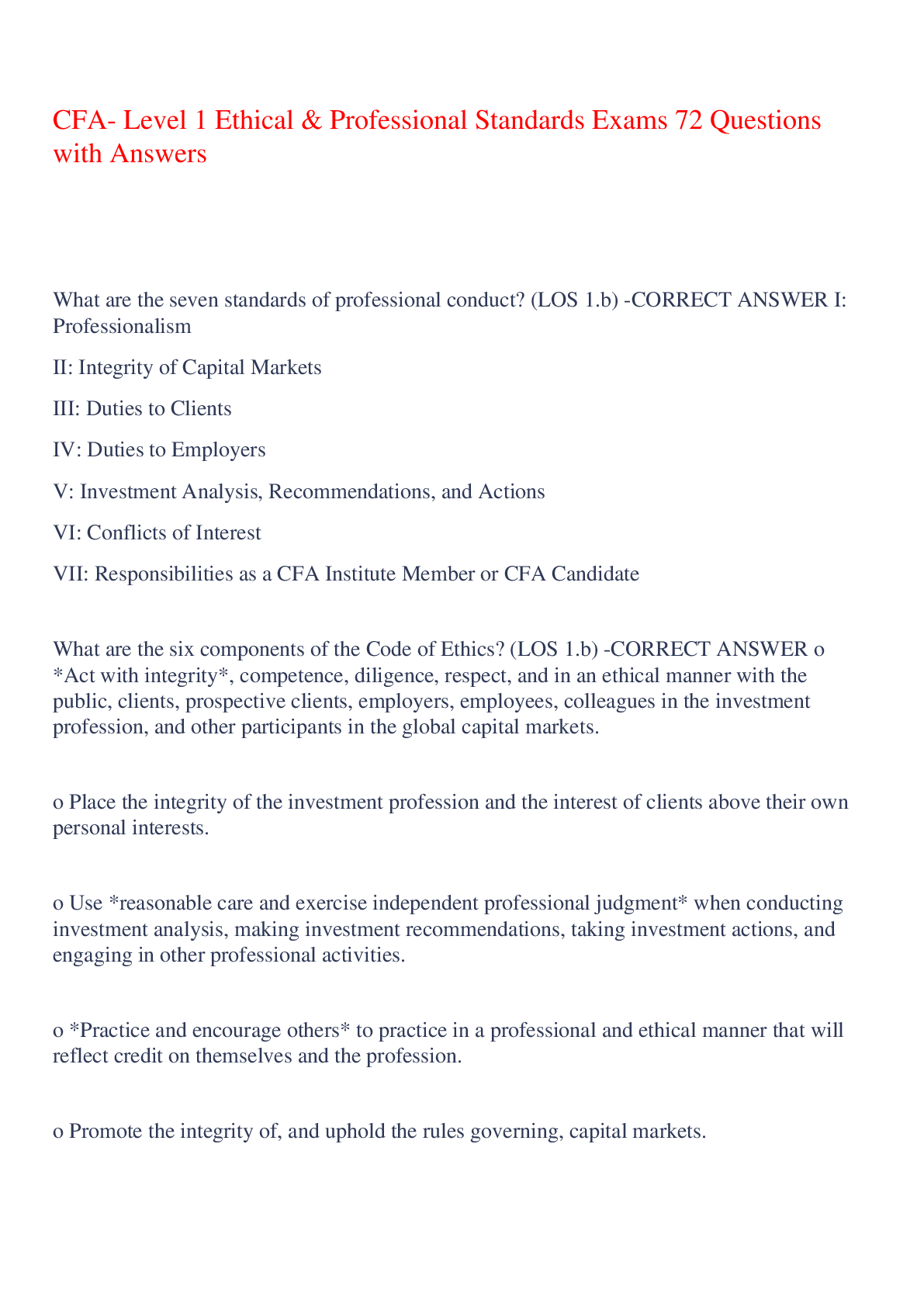
CFA- Level 1 Ethical & Professional Standards Exams 72 Questions with Answers What are the seven standards of professional conduct? (LOS 1.b) -CORRECT ANSWER I: Professionalism II: Integrity o ... f Capital Markets III: Duties to Clients IV: Duties to Employers V: Investment Analysis, Recommendations, and Actions VI: Conflicts of Interest VII: Responsibilities as a CFA Institute Member or CFA Candidate What are the six components of the Code of Ethics? (LOS 1.b) -CORRECT ANSWER o *Act with integrity*, competence, diligence, respect, and in an ethical manner with the public, clients, prospective clients, employers, employees, colleagues in the investment profession, and other participants in the global capital markets. o Place the integrity of the investment profession and the interest of clients above their own personal interests. o Use *reasonable care and exercise independent professional judgment* when conducting investment analysis, making investment recommendations, taking investment actions, and engaging in other professional activities. o *Practice and encourage others* to practice in a professional and ethical manner that will reflect credit on themselves and the profession. o Promote the integrity of, and uphold the rules governing, capital markets. o *Maintain and improve professional competence* and strive to maintain and improve the competence of other investment professionals. Standards of Professional Conduct (7) -CORRECT ANSWER 1) Professionalism 2) Integrity of Capital Markets 3) Duties to Clients 4) Duties to Employers 5) Investment Analysis, Recommendations and Actions 6) Conflicts of Interest 7) Responsibilities as a Member of the CFA Institute or CFA Candidate I. Professionalism -CORRECT ANSWER I. Professionalism a. Knowledge of the Law b. Independence and Objectivity c. Misrepresentation d. Misconduct Standard 1: Professionalism (A) -CORRECT ANSWER 1) Knowledge of the Law: Members and candidates must understand and comply with all applicable laws, rules and regulations (including the COE and SPC) of any body governing their professional activities. In the event of conflict, members must comply with the more strict rule. Members may not knowingly participate in and must dissociate from any violation of such laws, rules or regulations. Standard 1: Professionalism (B) -CORRECT ANSWER 2) Independence and Objectivity: Members must use reasonable care and judgment to achieve and maintain independence and objectivity. Members and candidates must not offer, solicit, or accept any gift, benefit, compensation or consideration that reasonably could be expected to compromise their own or another's independence. Standard 1: Professionalism (C) -CORRECT ANSWER 3) Misrepresentation: Members and candidates must not knowingly make any misrepresentation relating to investment analysis, recommendations, actions or other professional activities. Prohibits assurances or guarantees on risky investments. Standard 1: Professionalism (D) -CORRECT ANSWER 4) Misconduct: Members and Candidates must not engage in any professional conduct involving dishonesty, fraud, or deceit or commit any act that reflects adversely on their professional reputation, integrity or competence. II. Integrity of Capital Markets -CORRECT ANSWER II. Integrity of Capital Markets a. Material Nonpublic Information b. Market Manipulation Standard 2: Integrity of Capital Markets (A) Material nonpublic information -CORRECT ANSWER Material nonpublic information. Members and candidates who possess material nonpublic information that could affect the value of an investment must not act or cause others to act on the information. Standard 2: Integrity of Capital Markets (B) Market Manipulation -CORRECT ANSWER Market Manipulation. Members and candidates must not engage in practices that distort prices or artificially inflate trading volume with the intent to mislead market participants. III. Duties to Clients -CORRECT ANSWER III. Duties to Clients a. Loyalty, Prudence, and Care b. Fair Dealing c. Suitability d. Performance Presentation Standard 3: Duties to Clients (A) Loyalty, Prudence and Care. -CORRECT ANSWER Loyalty, Prudence and Care. Members have a duty of loyalty to their clients and must act with reasonable care and exercise prudent judgment. Members must act for the benefit of their clients and place their clients' interests before their employer's or their own interests. Soft Dollars -CORRECT ANSWER Practice of paying higher brokerage fees for the purpose of securing goods/services (research reports) from the brokerage firm, without an corresponding benefit to the client Best Execution -CORRECT ANSWER Trading process maximized client value Standard 3: Duties to Clients (B) Fair Dealing -CORRECT ANSWER Fair Dealing. Members and candidates must deal fairly and objectively with all clients when providing investment analysis, making investment recommendations, taking investment action or engaging in other professional activities. Standard 3: Duties to Clients (C) Suitability -CORRECT ANSWER Suitability. 1) Members and Candidates must make a reasonable inquiry into a client's investment experience, objectives and financial constraints prior to making any investment recommendation or taking investment action and must reassess regularly. Further, they must determine than an investment is suitable to the client's situation, written objectives, mandates and constraints before making an investment recommendation or taking investment action. 2) When managing a portfolio to a specific strategy, mandate or style, members must make only investment recommendations or take investment actions that are consistent with the stated objectives and constraints of the portfolio. Suitability - Unsolicited Trade Requests from Clients -CORRECT ANSWER Explain the impact on the total portfolio and why the investment may deviate from the IPS. In cases where the request deviates, the IPS should be updated. If client declined to modify IPS, candidate needs to consider the overall relationship. Standard 3: Duties to Clients (D) Performance Presentation -CORRECT ANSWER Performance Presentation. Members and candidates must make reasonable efforts to ensure that performance information is fair, accurate and complete. Standard 3: Duties to Clients (E) Preservation of Confidentiality -CORRECT ANSWER Preservation of Confidentiality. Members and candidates must keep information about clients confidential unless: 1) It concerns illegal activities 2) Disclosure is legally required 3) The client allows disclosure IV. Duties to Employers -CORRECT ANSWER IV. Duties to Employers a. Loyalty b. Additional Compensation Arrangements c. Responsibility of Supervisors Standard 4: Duties to Employers (A) Loyalty -CORRECT ANSWER Loyalty: In matters related to their employment, Members and Candidates must act for the benefit of their employer and not deprive their employer of the advantage of their skills and abilities, divulge confidential information or otherwise cause harm to their employer. Competing with Current Employer -CORRECT ANSWER No competing with current employer unless allowed in writing. Standard 4: Duties to Employers (B) Additional compensation arrangements -CORRECT ANSWER Additional compensation arrangements: Members and candidates must not accept gifts, benefits, compensation or consideration that competes with or might reasonably be expected to create a conflict of interest with their employers interest unless they obtain written consent from all parties involved. Standard 4: Duties to Employers (C) Responsibilities of Supervisors -CORRECT ANSWER Responsibilities of Supervisors: Members and candidates must make reasonable efforts to detect and prevent violations of applicable laws, rules, regulations and the Code and Standards by anyone subject to their supervision or authority. Delegate Responsibilities -CORRECT ANSWER Supervisors may delegate duties to subordinates, but must provide guidance on achieveing compliance with code Inability to Discharge supervisory responsibilitied due to inadequate compliance system -CORRECT ANSWER Decline in writing to accept supervisory responsibilities until the firm adopts appropriate procedures. V: Investment Analysis, Recommendations, and Actions -CORRECT ANSWER V: Investment Analysis, Recommendations, and Actions a. Diligence & Reasonable Basis b. Communication with clients and prospective clients c. Record Retention Standard 5: Investment Analysis (A) Diligence and Reasonable Basis -CORRECT ANSWER Diligence and Reasonable Basis. Members and candidates must: 1) Exercise diligence, independence and thoroughness in analyzing investments. 2) Have a reasonable and adequate basis for any investment analysis. Standard 5: Investment Analysis (B) Communication with Clients and Prospective Clients -CORRECT ANSWER Communication with Clients and Prospective Clients. Members and candidates must: 1) Disclose to clients the basic format and general principles of the investment process and disclose promptly any changes. 2) Use reasonable judgment to identify which factors are important to investment analyses and include those factors in communications with clients. 3) Distinguish between fact and opinion in the presentation of investment analysis and recommendations Standard 5: Investment Analysis (C) Record Retention -CORRECT ANSWER Record Retention: Members and candidates must develop and maintain appropriate records or analyses and communication with clients. Standard 6: Conflicts of Interest (A) Disclosure of Conflicts -CORRECT ANSWER Disclosure of Conflicts: Members must make full and fair disclosure of all matters that could reasonably be expected to impair their objectivity. Members and Candidates must ensure that such disclosures are prominent and delivered in plain language. VI: Conflicts of Interest -CORRECT ANSWER VI: Conflicts of Interest a. Disclosure of Conflicts b. Priority of Transactions c. Referral Fees Standard 6: Conflicts of Interest (B) Priority of Transactions. -CORRECT ANSWER Priority of Transactions. Investment transactions for clients and employers must have priority over investment transactions in which a member or candidate is the beneficial owner. Standard 6: Conflicts of Interest (C) Referral Fees. -CORRECT ANSWER Referral Fees. Members must disclose to their employer, clients and prospective clients any compensation, consideration or benefit received from or paid to others for the recommendation of products or services. VII: Responsibilities as a CFA Institute Member or CFA Candidate -CORRECT ANSWER VII: Responsibilities as a CFA Institute Member or CFA Candidate a. Conduct as Members and Candidates in the CFA Program b. Reference to CFA Institute, the CFA Designation, and the CFA Program Standard 7: Responsibilities as a CFA Institute Member or Candidate (A) Conduct. -CORRECT ANSWER Conduct. Members must not engage in any conduct that compromises the reputation or integrity of the CFA institute or the CFA designation or the CFA Exams. Standard 7: Responsibilities as a CFA Institute Member or Candidate (B) Reference to CFA. -CORRECT ANSWER Reference. Members must not misrepresent or exaggerate the meaning or implications of membership in the CFA institute, holding the CFA designation or candidacy in the CFA program. Ethical Dissociation -CORRECT ANSWER 1) Attempt to stop behavior by bringing it to the employer's attention 2) Dissociate from activity Disclosure of Third Party Violations -CORRECT ANSWER The Code and Standards do not compel members to report violations to their governmental or regulatory organizations unless mandatory under law. Figuring out which law applies -CORRECT ANSWER In general, either the Code and Standards or a more strict law must apply. If the more strict law's country states that the client's home country governs, the code and standards supersede if the home country is less strict. IPO and Private Placement Compliance -CORRECT ANSWER Firms should require prior approval for employee participation in IPOs, with prompt disclosure of investment actions taken following. Strict limits should be imposed on investment personnel acquiring securities in private placements. Gift Regulations -CORRECT ANSWER Gifts are allowed, but the purpose cannot be to influence or reward members or candidates. Citing intermediary sources -CORRECT ANSWER There is no need to cite a source if it is only an intermediary to another source. For example, a newspaper article leading to a study need not be cited if the writer cites the study. Material information -CORRECT ANSWER Information is "material" if its disclosure would probably have an impact on the price of a security or if reasonable investors would want to know the information before making an investment decision. Nonpublic information -CORRECT ANSWER Information is "nonpublic" until it has been disseminated or is available to the marketplace in general (as opposed to a select group of investors). Do not need to wait for slowest form of delivery. Biggest concern is selective disclosure on the part of businesses. Mosaic Theory -CORRECT ANSWER Violations of Standard II(A) will not result when a perceptive analyst reaches a conclusion about a corporate action or event through an analysis of public information and items of nonmaterial nonpublic information Insider trading and sell side ratings -CORRECT ANSWER Though sell-side ratings can be material (aka move the share price), there is no "insider information" (assuming compliance on the part of the sell-side firm). Proprietary trading and insider info -CORRECT ANSWER Market-making is still okay even with insider info, but it must be market neutral. Arbitrage trading is much more difficult to prove, and while technically possible requires rigorous internal procedures. Two types of market manipulation -CORRECT ANSWER 1) False or misleading information 2) Transactions that deceive by distorting the price-setting mechanism "Pump-priming" and Manipulation -CORRECT ANSWER A company may use an agreement to increase liquidity on a new instrument or exchange, so long as it is disclosed. Otherwise it violates IIB as an attempt to mislead investors. Who is the client of a mutual fund? -CORRECT ANSWER Weirdly, the client of a mutual fund does not exist. Managers owe the duty of loyalty, prudence and care to a mandate, not investors, so they are not responsible for tailoring to their investors' risk profiles, that is for investment advisers. Proxy Voting -CORRECT ANSWER Voting of proxies is an integral part of the management of investments. Directed Trading and IIIA -CORRECT ANSWER Trades may be directed for any reason so long as the best possible price and execution is achieved (rare and difficult), BUT it must be disclosed to investors regardless. Proration of IPOs and Secondaries -CORRECT ANSWER Should be done on a round-lot basis to avoid odd-lot distributions Families and IPOs/Secondaries -CORRECT ANSWER Members should forgo sales to their families or to themselves in the case of an oversubscribed offering, UNLESS a family member is a normal client Client consent and allocation procedures -CORRECT ANSWER A member's or candidate's duty of fairness and loyalty to clients can NEVER be overridden by client consent to patently unfair allocation procedures. IPS -CORRECT ANSWER Investment Policy Statement Investment Policy Statement -CORRECT ANSWER A statement that addresses a client's risk tolerance, return equivalents, and all investment constraints (liquidity, tax concerns, legal restraints, time horizon, etc.). Should be updated at least annually. GIPS Standards and Compliance -CORRECT ANSWER Beware companies treating data correctly but falsely claiming conformance with GIPS standards CFA Investigations and Confidentiality -CORRECT ANSWER When permissible under law, members shall consider the PCP an extension of themselves. Clients, Leaving and Confidentiality -CORRECT ANSWER The names and existence of former clients is generally not confidential information unless deemed such by an agreement or by law. Dissociating from Group Research -CORRECT ANSWER If confident in the process, no need to disassociate from group research you disagree with per 5A How long to maintain records? -CORRECT ANSWER In the absence of local guidelines or other regulations, at least seven years. Records and Job Transitions -CORRECT ANSWER The member or candidate cannot use historical recommendations or research reports created at the previous firm because the supporting documentation is unavailable. For future use, the member or candidate must re-create the supporting records at the new firm with information gathered through public sources or directly from the covered company and not from memory or sources obtained at the previous employer. Partiality when recommending and employer's products (6C) -CORRECT ANSWER Standard VI(C) is meant to address instances where the invest- ment advice provided by a member or candidate appears to be objective and independent but in fact is influenced by an unseen referral arrange- ment. It is not meant to cover compensation by employers to employees for generating new business when it would be obvious to potential clients that the employees are "referring" potential clients to the services of their employers. Information that cannot be disclosed by a candidate after an exam: (2) -CORRECT ANSWER 1) Specific details of questions on the exam 2) Broad topical areas and formulas tested or not tested on the exam CFA Institute Membership -CORRECT ANSWER The term "CFA Institute Member" refers to regular or affiliate members of CFA institute who have met the membership requirements. Once accepted, members must satisfy the following requirements to maintain status: 1) Remit annually a completed Professional Conduct Statement renewing the COE commitment 2) Pay dues "CFA Charterholder" Title -CORRECT ANSWER To use the designation, must have the work experience, exam scores AND be a current CFA Institute Member. Being a Candidate (2) -CORRECT ANSWER One can identify as a candidate if: 1) The person's application for registration has been accepted and the person is enrolled to sit for a specific exam 2) An exam has been take but results aren't back. Using CFA or "Chartered Financial Analyst" -CORRECT ANSWER Adjectives, never as nouns. CFA Usage Principles (8) -CORRECT ANSWER 1) Adjectives, not nouns 2) Always capitalized 3) No alteration for new words and phrases 4) Never as part of a firm name 5) Never given more prominence than the charterholder's name 6) No citing expected date 7) No designation for passing exams. 8) No periods. 9) Cite in resume using "CFA Institute as conferring body and the date the designation was received." [Show More]
Last updated: 2 years ago
Preview 1 out of 12 pages
Buy this document to get the full access instantly
Instant Download Access after purchase
Buy NowInstant download
We Accept:

Also available in bundle (1)
Click Below to Access Bundle(s)

CFA LEVEL 1 Exam (18 SETS) Questions with Verified Answer 2023,100% CORRECT
CFA LEVEL 1 Exam 275 Questions with Verified Answer 2023, CFA Level 1 - 101 Must Knows 368 Questions with Verified Answers,CFA level 1 Exam 48 Questions with Verified Answers,CFA Level 1 FRA Exam 96...
By Nolan19 2 years ago
$35.5
18
Reviews( 0 )
$8.50
Can't find what you want? Try our AI powered Search
Document information
Connected school, study & course
About the document
Uploaded On
Jun 18, 2023
Number of pages
12
Written in
All

Additional information
This document has been written for:
Uploaded
Jun 18, 2023
Downloads
0
Views
129