NR 200 Peripheral Vascular Exam 30 Questions with Answers
Neck Vessel IPPA - CORRECT ANSWER Inspection
- General for pulsation, location
- Jugular Venous Pressure/Jugular Venous Distention (JVD)
Palpation
- C
...
NR 200 Peripheral Vascular Exam 30 Questions with Answers
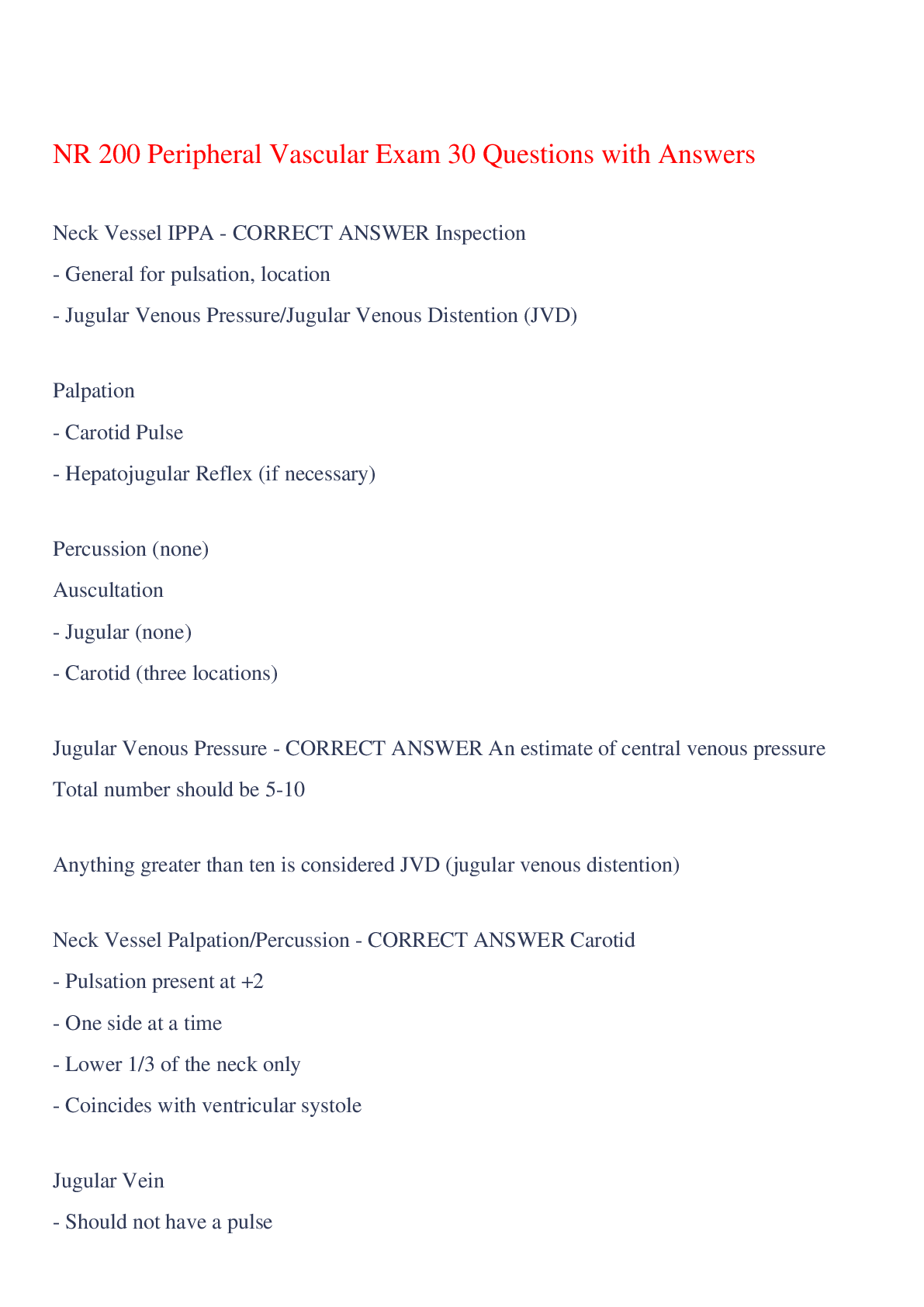
Neck Vessel IPPA - CORRECT ANSWER Inspection
- General for pulsation, location
- Jugular Venous Pressure/Jugular Venous Distention (JVD)
Palpation
- Carotid Pulse
- Hepatojugular Reflex (if necessary)
Percussion (none)
Auscultation
- Jugular (none)
- Carotid (three locations)
Jugular Venous Pressure - CORRECT ANSWER An estimate of central venous pressure
Total number should be 5-10
Anything greater than ten is considered JVD (jugular venous distention)
Neck Vessel Palpation/Percussion - CORRECT ANSWER Carotid
- Pulsation present at +2
- One side at a time
- Lower 1/3 of the neck only
- Coincides with ventricular systole
Jugular Vein
- Should not have a pulse
- Hepatojugular Reflex can be utilized to locate the jugular vein for the measurement of Jugular venous pressure
No percussion of either vessel
Carotid Palpation - CORRECT ANSWER
Hepatojugular Reflex - CORRECT ANSWER A test in which the examiner presses gently on the liver to increase venous return.
Pulsation increases for a few beats and then returns to normal less than 3 cm above the sternal angle
Peripheral Vascular Palpation - CORRECT ANSWER Pulse location/grading
Edema
Turgor
Temperature
*Homan's sign* (controversial, not advised in most areas anymore, but may still see in some centers and in some textbooks)
Allen test
Manual Compression Test
Capillary Refill
Palpable Peripheral Pulses - CORRECT ANSWER
Brachial Pulse - CORRECT ANSWER beating or throbbing felt over the brachial artery, usually palpated in the antecubital space
Radial Pulse - CORRECT ANSWER beating or throbbing felt over the radial artery, usually palpated over the groove along the thumb side of the inner wrist
Femoral Pulse - CORRECT ANSWER pulse of the femoral artery felt in the groin
Popliteal Pulse - CORRECT ANSWER Pulse felt at the back of either knee; lower part of femoral artery
Posterior Tibial pulse - CORRECT ANSWER The pulse just behind the medial malleolus of the ankle
Dorsalis Pedis Pulse - CORRECT ANSWER pulse located on top of the foot
Arterial Pulse Evaluation - CORRECT ANSWER Pulse deficit: difference between the apical rate and the peripheral
Weak, thready pulse=low cardiac output
Bounding pulse=hyperkinetic states
Pulsus alternans
Pulsus paradoxus
Edema - CORRECT ANSWER Usually not detectable until interstitial fluid (fluid between the cells) is 30% above normal
- Bilateral
-Unilateral
- Anasarca
Nonpitting or graded 0 (absent) to +4 (deep, visible, mark remains)
Bilateral Edema - CORRECT ANSWER Heart failure
Chronic venous insufficiency
Unilateral Edema - CORRECT ANSWER Venous blockage
Lymph blockage
Infectious process
Anasarca Edema - CORRECT ANSWER Generalized edema
Seen in: severe heart failure, cirrhosis/liver failure, nephrotic syndrome
Skin Turgor - CORRECT ANSWER Lift fold of skin between thumb, finger
Best location is over sternum or clavicle
Expected response is "brisk recoil"
Decreased (tenting)=dehydration
- The skin fold slowly returns to original position
Allen test - CORRECT ANSWER will turn white, when released will turn back pink
- fails if not pinked up
Cannulation of the Radial Artery - CORRECT ANSWER
Manual Compression Test - CORRECT ANSWER Test for varicose Vein
No varicose vein: no wave felt
Varicose Vein: wave felt
Venous Problem vs. Arterial Problem - CORRECT ANSWER Diagnostic Testing is often needed, which is ordered by a practitioner, however, there are definitely telltale signs of both
Never "intervene" until an actual diagnosis is confirmed and there are physician orders
The wrong intervention can make things much worse
Thrombophlebitis - CORRECT ANSWER Superficial venous clot
Rubor
Heat
Calf enlargement
May have pain to the calf area
close to surface
Deep Vein Thrombosis (DVT) - CORRECT ANSWER Deep clot
Often asymptomatic
Check calf sizes daily, may be only sign and very subtle
Patient will have risk factors
-subtle kill
Venous Insufficiency - CORRECT ANSWER Normal pulses
Normal color in other areas
Edema
Brown pigment around the ankles
Ulcers medial malleolus
changes skin color
-creates ulcers
The Four "P" Continuum of Acute Arterial Disease = arterial clot - CORRECT ANSWER Pain
Pallor
Poikilothermia
Pulselessness
(4 Ps)
Arterial Insufficiency - CORRECT ANSWER Color: dusky dependent, pale elevated
Temperature: cool
Skin: shiny, taut, hairless
Capillary refill: greater than 2 seconds
Nails: thick, positive profile sign
Decreased sensation
Potentially decreased motor ability
Chronic Arterial Occlusive Disease=Raynaud's Disease - CORRECT ANSWER Intermittent arteriolar vasoconstriction that causes coolness, pallor, and pain of the fingers and/or toes
Can result in ulcerations and gangrene (rare)
Avoid extremes in temperature and stress
NO SMOKING
Documentation example (healthy) - CORRECT ANSWER Skin warm, dry, intact.
Turgor with brisk recoil.
All peripheral pulses palpable and equal bilaterally at +2.
No edema noted.
Carotid +2, no bruits auscultated.
JVP estimated to be +3.
[Show More]