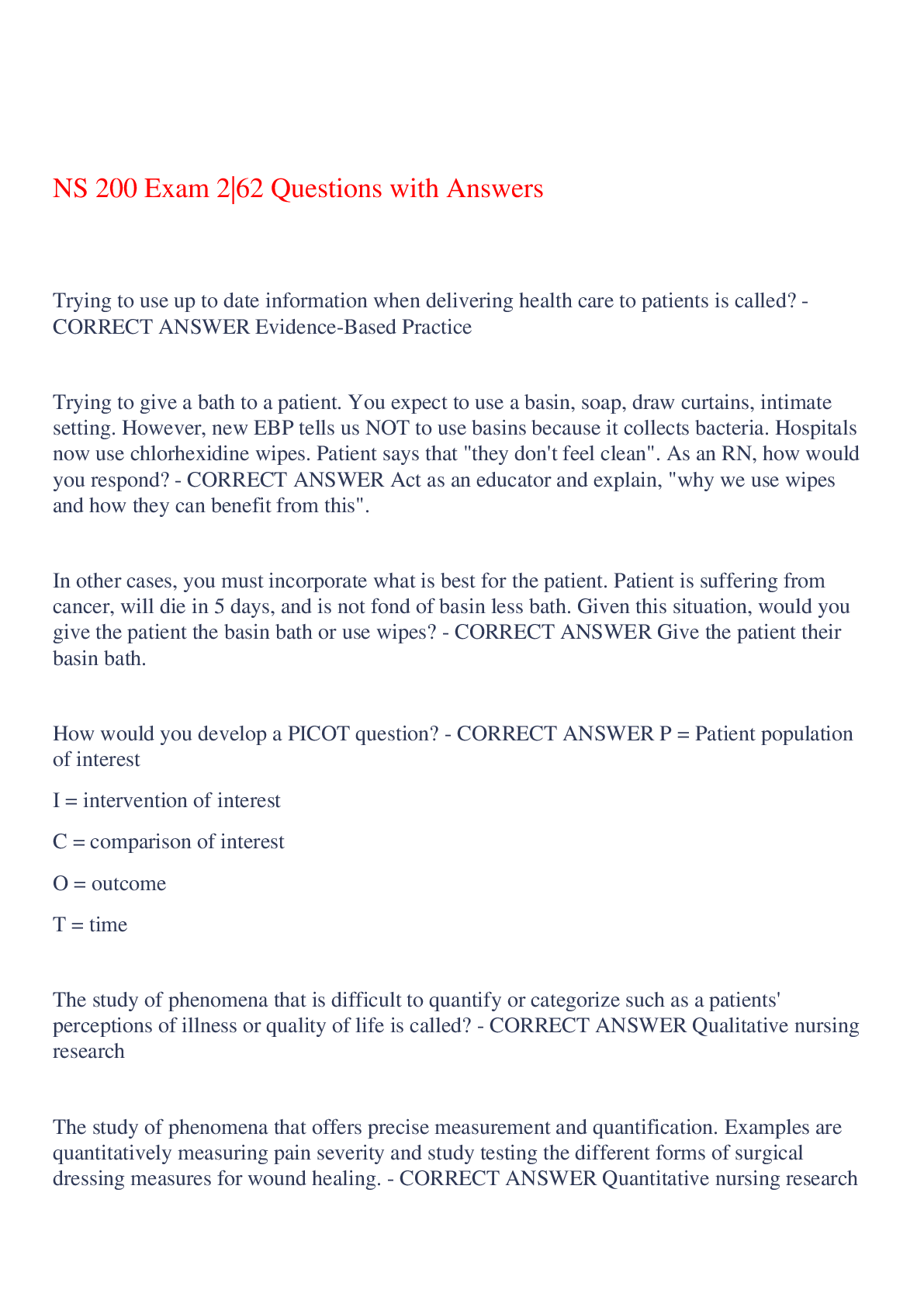
NS 200 Exam 2|62 Questions with Answers
Trying to use up to date information when delivering health care to patients is called? - CORRECT ANSWER Evidence-Based Practice
Trying to give a bath to a patient. You exp
...
NS 200 Exam 2|62 Questions with Answers
Trying to use up to date information when delivering health care to patients is called? - CORRECT ANSWER Evidence-Based Practice
Trying to give a bath to a patient. You expect to use a basin, soap, draw curtains, intimate setting. However, new EBP tells us NOT to use basins because it collects bacteria. Hospitals now use chlorhexidine wipes. Patient says that "they don't feel clean". As an RN, how would you respond? - CORRECT ANSWER Act as an educator and explain, "why we use wipes and how they can benefit from this".
In other cases, you must incorporate what is best for the patient. Patient is suffering from cancer, will die in 5 days, and is not fond of basin less bath. Given this situation, would you give the patient the basin bath or use wipes? - CORRECT ANSWER Give the patient their basin bath.
How would you develop a PICOT question? - CORRECT ANSWER P = Patient population of interest
I = intervention of interest
C = comparison of interest
O = outcome
T = time
The study of phenomena that is difficult to quantify or categorize such as a patients' perceptions of illness or quality of life is called? - CORRECT ANSWER Qualitative nursing research
The study of phenomena that offers precise measurement and quantification. Examples are quantitatively measuring pain severity and study testing the different forms of surgical dressing measures for wound healing. - CORRECT ANSWER Quantitative nursing research
After implementing a EBP change, it is important to _____________ the results. - CORRECT ANSWER communicate
A step-by-step process to ensure that findings from a study are valid, reliable, and generalizable to a similar group of subjects is called? - CORRECT ANSWER The Scientific Approach
What does it mean to have informed consent? (PTTT) - CORRECT ANSWER 1. Participants receive full and complete information
2. They can understand the information
3. They have free choice to participate
4. They understand how their confidentiality will be kept
What are the benefits of EBP? (IRH) - CORRECT ANSWER 1. Improves quality, safety, patient outcomes, and nursing satisfaction.
2. Reduce costs.
3. Helps you make effective, timely, and appropriate clinical decisions.
What are the 7 steps of EBP? (Cascies) - CORRECT ANSWER 1. Cultivate a spirit of inquiry.
2. Ask a clinical question in PICOT format.
3. Search for the most relevant and best evidence.
4. Critically appraise the evidence you gather.
5. Integrate all evidence with your clinical expertise and patient preferences and values.
6. Evaluate the outcomes of practice decisions or changes using evidence.
7. Share the outcomes of EBP changes with others.
Explain how nursing research improves nursing practice. (IIU) - CORRECT ANSWER 1. Identify new knowledge.
2. Improve professional education and practice.
3. Use resources effectively.
The ability to think in a systematic and logical manner with openness to question and reflect on the reasoning process is called? - CORRECT ANSWER Critical Thinking
A patient is suffering with necrotic tissue. The wounds are becoming yellow and non-viable. The nurse uses honey to treat the wounds because it eats some of the bad tissue. This thinking is an example of what? - CORRECT ANSWER General critical thinking, because the nurse was able to think "outside the box".
You instructor is making a pouting face with arms crossed after an exam. You are able to make an inference that she is upset. Most likely because of the bad scores. This thinking is an example of what? - CORRECT ANSWER Specific critical thinking, because you are able to attach behaviors from the instructor to make an educated guess.
What is the relationship between clinical experience and critical thinking? - CORRECT ANSWER Patient experiences become stepping-stones for building new knowledge and inspiring innovative thinking.
Why is one type of surgical dressing ordered over another, why do patients on your nursing unit fall, and what can you do to help patients with literacy problems? When a nurse asks questions like these, what attitude is the nurse displaying? - CORRECT ANSWER Thinking independently
A RN that is honest and willing to admit their mistakes or inconsistencies in their own behavior, ideas, and beliefs is showing what attitude? - CORRECT ANSWER Integrity
You have a patient who is in pain. Instead of only asking the patient "How severe is your pain from 0-10?" , you also ask more specific questions such as "What makes it worse?", "How long have you experienced this pain?" or "Where does it hurt?". You are showing what attitude? - CORRECT ANSWER Discipline
__________ involves collecting information from the patient and from secondary sources (e.g., family members), along with interpreting and validating the information to form a complete database. - CORRECT ANSWER Assessment
What are the 2 stages of assessment? - CORRECT ANSWER 1. Collection and verification of data
2. Analysis of data
1. Patient's verbal descriptions of their health problems
2. Observations or measurements of a patient's health status - CORRECT ANSWER 1. Subjective data
2. Objective data
What are the phases of an interview? - CORRECT ANSWER 1. Orientation and setting an agenda - introduce yourself and explain purpose of interview. Your aim is make an agenda for how you will gather information about a patient's chief problems.
2. Working phase - start an assessment with open-ended questions that allow the patients to describe more clearly their concerns.
3. Termination - summarize your discussion with your patient and check for accuracy the info given.
Explain the relationship between data interpretation and validation. - CORRECT ANSWER 1. When critically interpreting assessment data, you determine the presence of abnormal findings, recognize that further observations are needed to clarify information, and begin to identify patient problems.
2. Before you complete data interpretation, validate the information you have collected to avoid inaccuracies.
"I notice that you have been crying." What would be the next response to validate the real reason why the patient is crying? - CORRECT ANSWER "Can you tell me about it?"
Commitment to include patients in decisions. - CORRECT ANSWER Autonomy
Taking positive actions to help others. - CORRECT ANSWER Beneficence
Avoidance of harm or hurt. - CORRECT ANSWER Nonmalificence
Being fair. Has to do with the distribution of resources. - CORRECT ANSWER Justice
Agreement to keep promises. - CORRECT ANSWER Fidelity
actions deemed right or wrong based on PRINCIPLE; must comprehend autonomy, justice and overall "goodness".
Ex: Pediatricians recommend vaccinations against measles but the parent does not accept it. Whose autonomy should we respect? - CORRECT ANSWER Deontology
Value of something determined by usefulness (aka consequentialism); related to "teleology" (study of ends). Provides guidance but does not guarantee agreement (differs from deontology). Measure of good and greatest. Ex. Education about safe sex practices will reduce the spread of HIV. Reducing HIV is good for a great amount of people. - CORRECT ANSWER Utilitarianism
What are the results of moral distress (anguish)? - CORRECT ANSWER 1. Difficult to process ethical dilemmas when multiple conflicting views are present
2. Lack of knowledge of entire situation
3. Lack of staff resources or mechanisms of coping
What are issues in health care ethics? (QDEL) - CORRECT ANSWER 1. Quality of Life
2. Disabilities
3. End-of-Life Care
4. Legislation
What are the 7 steps of processing an ethical dilemma? - CORRECT ANSWER Step 1: Ask if this is an ethical dilemma.
Step 2: Gather all relevant information.
Step 3: Clarify values.
Step 4: Verbalize the problem.
Step 5: Identify possible courses of action.
Step 6: Negotiate the outcome.
Step 7: Evaluate the action.
What do ethical committees do to help nurses in ethical dilemmas? (EPC) - CORRECT ANSWER Education (your resource)
Policy recommendation (dictate how you do something)
Case consultation (don't have to make decisions by yourself)
____________ are the legal requirements for nursing practice that describe minimum acceptable nursing care. - CORRECT ANSWER Standards of care
1. Protects rights of people with physical or mental disabilities
2. When a patient presents to an emergency department, they must be treated
3. Protects employees from losing health coverage when changing jobs. Patient's have the right to consent use of Protected Health Information (PHI).
4. healthcare institution provide info to patient about right and decisions - CORRECT ANSWER 1. Americans with Disabilities Act (ADA)
2. Emergency Medical Treatment and Active Labor Act (EMTALA)
3. Health Insurance Portability and Accountability Act (HIPAA) 1996
4. Patient Self-Determination Act (PSDA)
List sources for standards of care for nurses:
1. Standards outline scope, function and role of the nurse
2. requires accredited hospital have policies and procedures (P&Ps). - CORRECT ANSWER 1. American Nurses Association
2. The Joint Commission (TJC)
Describe the nurse's role regarding a "do not resuscitate" (DNR) order. - CORRECT ANSWER Use the steps in the resolution of an ethical dilemma.
_____________ is conduct that falls below the generally accepted standard of care of a reasonably prudent person. - CORRECT ANSWER Negligence
List elements needed to prove negligence. - CORRECT ANSWER 1. the nurse (defendant) owed a date of care to the patient (plaintiff)
2. the nurse did not cary out that breached duty
3. the patient was injured
4. the nurse's failure to carry out the duty caused the injury
1. from state legislature (ex. Nurse Practice Acts)
2. protect individual's rights
3. protect society as a whole - CORRECT ANSWER 1. Statutory law
2. Civil law
3. Criminal law
1. crimes that cause injury with no serious harm
2. serious crime with serious harm - CORRECT ANSWER 1. Misdemeanors
2. Felonies
judicial decisions from individual legal cases
i.e. informed consent, negligence, malpractice - CORRECT ANSWER Common law
_________ restraint is physically padding down the patient and tying them to the bed frame to prevent injury. While __________ restraint is in the form of sedation. - CORRECT ANSWER Mechanical and Chemical
1. Strengthens mental health services
2. Protects the donor's estate from damage from the organ "gift"
3. Response to new technology (particularly, social media); expands HIPAA principles - CORRECT ANSWER 1. Mental Health Parity Act as Enacted Under PPACA
2. Uniform Anatomical Gift Act
3. Health Information Technology Act for Economic and Clinical Health Act (HITECH)
Limit liability, offer legal immunity of nurse helps at scene WITHOUT gross negligence. - CORRECT ANSWER Good Samaritan Laws
Public Health Laws:
1. Reporting communicable diseases
2. Enforce nation workplace safety regulations - CORRECT ANSWER 1. Center for Disease Control and Prevention (CDC)
2. Occupational Health and Safety Act (OSHA)
states that healthcare providers can use either the cardiopulmonary or the whole-brain definition to determine death. (UDDA) - CORRECT ANSWER The Uniform Determination of Death Act
Crimes, homicide, acts of violence, un-witnessed actions is when a _____________ can be used. Investigation. - CORRECT ANSWER Autopsy
stated that a competent individual with a terminal disease could make an oral or written request for medication to end his or her life in a humane and dignified manner. - CORRECT ANSWER Death with Dignity or Physician-Assisted Suicide
_________ are civil wrongful acts or omissions made against a person or property. - CORRECT ANSWER Torts
Types of Intentional torts:
1. intentional threat. Ex: A nurse threatening to give a patient an injection or to threaten to restrain a patient for an x-ray procedure when the patient has refused consent.
2. intentional threat with no consent. Ex: If the nurse actually gives the injection without consent.
3. unjustified restraint. Ex. Nurse restrains a patient in a confined area to keep the person from freedom. - CORRECT ANSWER 1. Assault
2. Battery
3. False imprisonment
Types of Quasi-intentional torts:
1. protects the patient's right to be free from unwanted intrusion into his or her private affairs.
2. to speak falsely
3. written defamation of character (charting false entries in a medical record) - CORRECT ANSWER 1. Invasion of privacy
2. Slander
3. Libel
Types of Un-intentional torts:
1. below standard of care that a reasonably prudent (imaginary person used as a standard)
2. a type of negligence or professional negligence - CORRECT ANSWER 1. Negligence
2. Malpractice
Agreement to allow care based on full disclosure of risks, benefits, alternatives, and consequences of refusal. - CORRECT ANSWER Informed consent
What makes a patient's signature AUTHENTIC? - CORRECT ANSWER the nurse's signature as a WITNESS
What are the procedures for Termination of Pregnancy? - CORRECT ANSWER 1st trimester - can abort without state regulation
2nd trimester - focus on maternal health
3rd trimester - focus on protecting fetus (prohibited unless needed to save mother)
What are Abandoment/Assignment issues?
1. not enough resources
2. out of your scope of practice, unless you advocate for yourself ahead of time. Must inform the supervisor of any lack of experience in caring for types of patients in the unit. Request and receive an orientation.
3. if you ever question an order, tell the doctor that you do not feel comfortable carrying out an order. - CORRECT ANSWER 1. Short Staffing
2. Floating
3. Health Care Provider's Orders
A system of ensuring appropriate nursing care that attempts to identify potential hazards and eliminate them before harm occurs.
Steps involve:
Identify possible risks
Analyze risks
Act to reduce risks
Evaluate steps taken - CORRECT ANSWER Risk Management and
Quality Assurance
Serves as a database for further investigation. Alerts risk management to a potential claim situation. NOT part of the medical record. We use this to minimize risk.
Example: Patient or visitor falls or injury; failure to follow healthcare provider orders. - CORRECT ANSWER Occurence/Incident Reporting
[Show More]