ACLS EXAM COMPLETE WITH ANSWERS. LATEST 2023.BEST PLAYLIST I'VE FOUND FOR ALL HEART.ORG ACLS CODES! correct
answerhttps://www.youtube.com/watch?v=qQTpqjvvduI&list=PLy60DSDPg9urf_l5ss1FLakrRQDKOkTZj
This is a good start
...
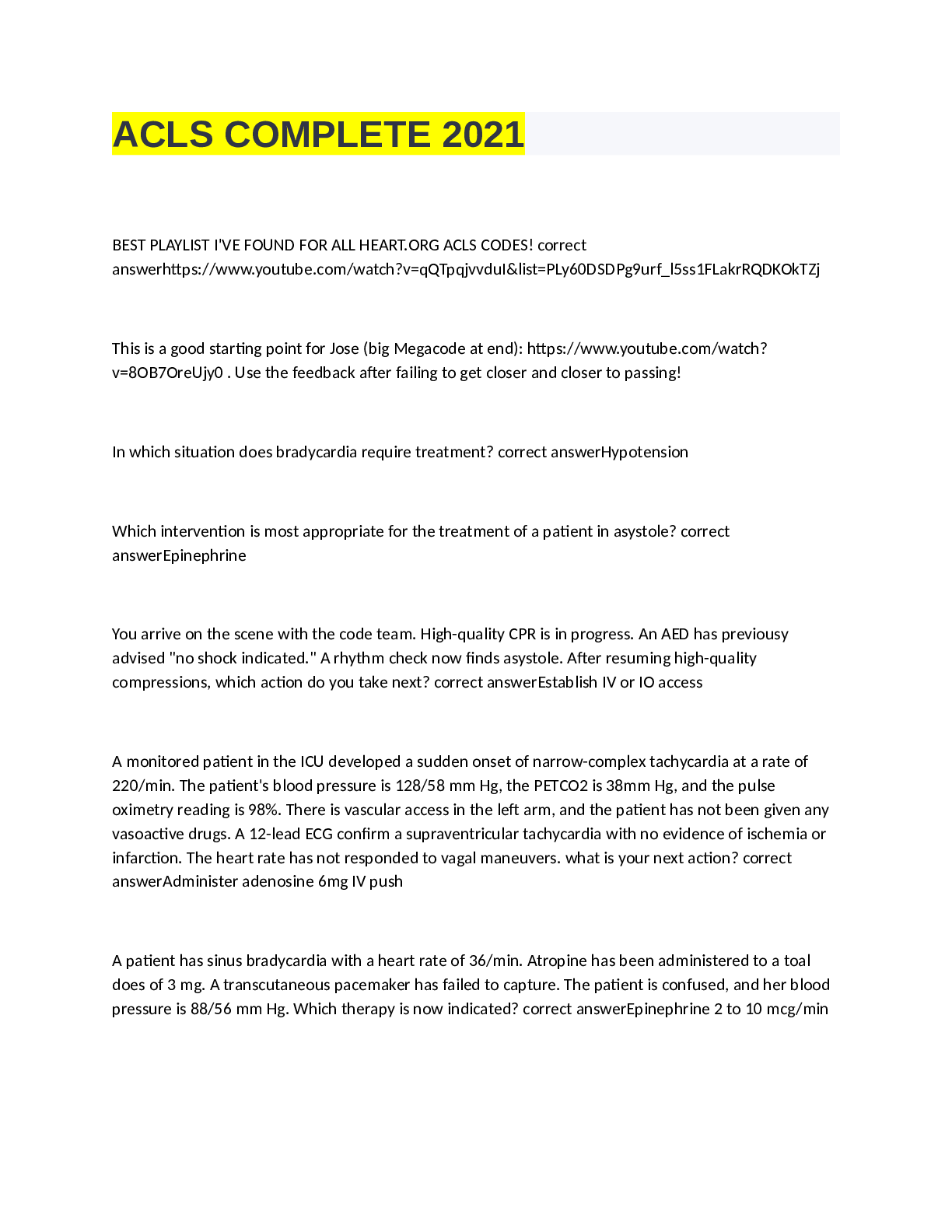
ACLS EXAM COMPLETE WITH ANSWERS. LATEST 2023.BEST PLAYLIST I'VE FOUND FOR ALL HEART.ORG ACLS CODES! correct
answerhttps://www.youtube.com/watch?v=qQTpqjvvduI&list=PLy60DSDPg9urf_l5ss1FLakrRQDKOkTZj
This is a good starting point for Jose (big Megacode at end): https://www.youtube.com/watch?
v=8OB7OreUjy0 . Use the feedback after failing to get closer and closer to passing!
In which situation does bradycardia require treatment? correct answerHypotension
Which intervention is most appropriate for the treatment of a patient in asystole? correct
answerEpinephrine
You arrive on the scene with the code team. High-quality CPR is in progress. An AED has previousy
advised "no shock indicated." A rhythm check now finds asystole. After resuming high-quality
compressions, which action do you take next? correct answerEstablish IV or IO access
A monitored patient in the ICU developed a sudden onset of narrow-complex tachycardia at a rate of
220/min. The patient's blood pressure is 128/58 mm Hg, the PETCO2 is 38mm Hg, and the pulse
oximetry reading is 98%. There is vascular access in the left arm, and the patient has not been given any
vasoactive drugs. A 12-lead ECG confirm a supraventricular tachycardia with no evidence of ischemia or
infarction. The heart rate has not responded to vagal maneuvers. what is your next action? correct
answerAdminister adenosine 6mg IV push
A patient has sinus bradycardia with a heart rate of 36/min. Atropine has been administered to a toal
does of 3 mg. A transcutaneous pacemaker has failed to capture. The patient is confused, and her blood
pressure is 88/56 mm Hg. Which therapy is now indicated? correct answerEpinephrine 2 to 10 mcg/min
A patient is in cardiac arrest. Ventricular fibrillation has been refractory to a second shock. Which drug
should be administered first? correct answerEpinephrine 1 mg IV/IO
A 62-year-old man suddenly experienced difficulty speaking and left-sided weakness. He meets initial
criteria for fibrinolytic therapy, and a CT scan of the brain si ordered. Which best describes the guidelines
for antiplatelet and fibrinolytic therapy? correct answerHold aspirin for at least 24 hours if rtPA is
administered
A patient is in refractory ventricular fibrillation and has received multiple appropriate defribillation
shocks, epinephrine 1 mg IV twice, and an initial dose of amiodarone 300mg IV. The patient is intubated.
Which best describe the recommended second does of amiodarone for this patient? correct answer150
mg IV push
A patient with sinus bradycardia and a heart rate of 42/min has diaphoresis and a blood pressure of
80/60mm Hg. What is the initial does of atropine? correct answer0.5mg
A 35-year-old woman has palpitations, light-headedness, and a stable tachycardia. The monitor shows a
regular narrow-complex QRS at a rate of 180/min. Vagal maneuvers have not been effective in
terminating the rhythm. An IV has been established. Which drug should be administered? correct
answerAdenosine 6mg
A patient is in cardiac arrest. Ventricular fibrillation has been refractory to an initial shock. If no pathway
for medication administration is in place, which method is preferred? correct answerIV or IO
What is the indication for the use of magnesium in cardiac arrest? correct answerPulseless ventricular
tachycardia-associated torsades de pointes
A patient has a rapid irregular wide-complex tachycardia. The ventricular rate is 138/min. He is
asymptomatic, with a blood pressure of 110/70 mm Hg. He has a history of angina. What action is
recommended next? correct answerSeeking expert consultation
[Show More]









.png)

.png)