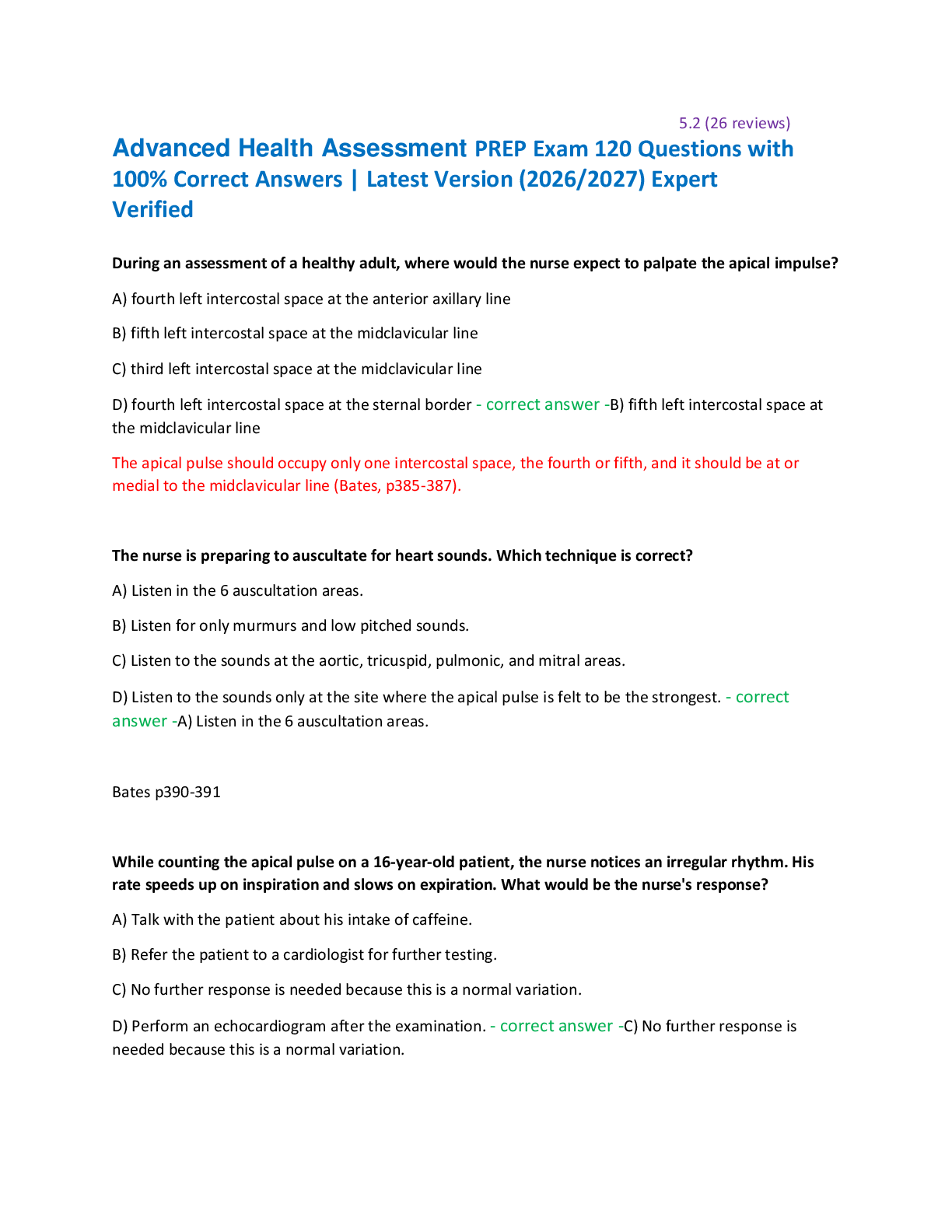
Advanced Health Assessment Exam
Questions And Answers All correct
A 59 year old patients tells the nurse practitioner that he thinks he must have
ulcerative colitis. He has been having "black stools" for the last 24 h
...
Advanced Health Assessment Exam
Questions And Answers All correct
A 59 year old patients tells the nurse practitioner that he thinks he must have
ulcerative colitis. He has been having "black stools" for the last 24 hours. How
would the nurse practitioner best document THE FACTS for his reason for seeking
care?
A) JM is a 59 year old male here for having "black stools" for the past 24 hours.
B) JM came into the clinic complaining of black stools for the past 24 hours.
C) JM is a 59 year old male here for "ulcerative colitis."
D) JM, a 59 year old male, states he has ulcerative colitis and wants it checked.
Correct Answer: A) JM is a 59 year old male here for having "black stools" for the
past 24 hours.
Chief Complaint(s) The one or more symptoms or concerns causing the patient to
seek care. Make every effort to quote the patient's own words.
A patient tells the nurse practitioner that she has had abdominal pain for the past
week. What would be the best response by the nurse practitioner?
A) We'll talk more about that later in the interview."
B) "Have you ever had any children?"
C) "What have you had to eat in the last 4 hours?"
D) "Can you point to where it hurts?" Correct Answer: D) "Can you point to
where it hurts?"
Each principle symptom should be well-characterized, with descriptions of
location; along with the other seven attributes. Location: Ask the patient to point to
the pain because lay terms may not be specific enough to localize the site of origin.
A 29-year-old woman tells the nurse that she has "excruciating pain" in her back.
Which of the following would be an appropriate response by the nurse to her
statement?
A) "How does your family react to your pain?"
B) "That must be terrible. You probably pinched a nerve."
C) "I've had back pain myself and it can be excruciating."
D) "How would you say the pain affects your ability to do your daily activities?"
Correct Answer: D) "How would you say the pain affects your ability to do your
daily activities?"
Inquire about the effects of pain on the patient's daily activities, mood, sleep, work,
and sexual activity.
In recording the childhood illnesses of a patient who denies having had any, which
of the following notes by the nurse would be most accurate?
A) Patient denies usual childhood illnesses.
B) Patient states he was a "very healthy" child.
C) Patient states sister had measles, but he didn't.
D) Patient denies measles, mumps, rubella, chickenpox, pertussis, rheumatic fever,
and polio. Correct Answer: D) Patient denies measles, mumps, rubella,
chickenpox, pertussis, rheumatic fever, and polio.
Childhood illnesses include measles, rubella, mumps, whooping cough, rheumatic
fever, scarlet fever, and polio. They are included in the past history
[Show More]












.png)

.png)