Law > QUESTIONS & ANSWERS > CNO Jurisprudence exam (class 2) questions and answers 100% pass (All)
CNO Jurisprudence exam (class 2) questions and answers 100% pass
Document Content and Description Below
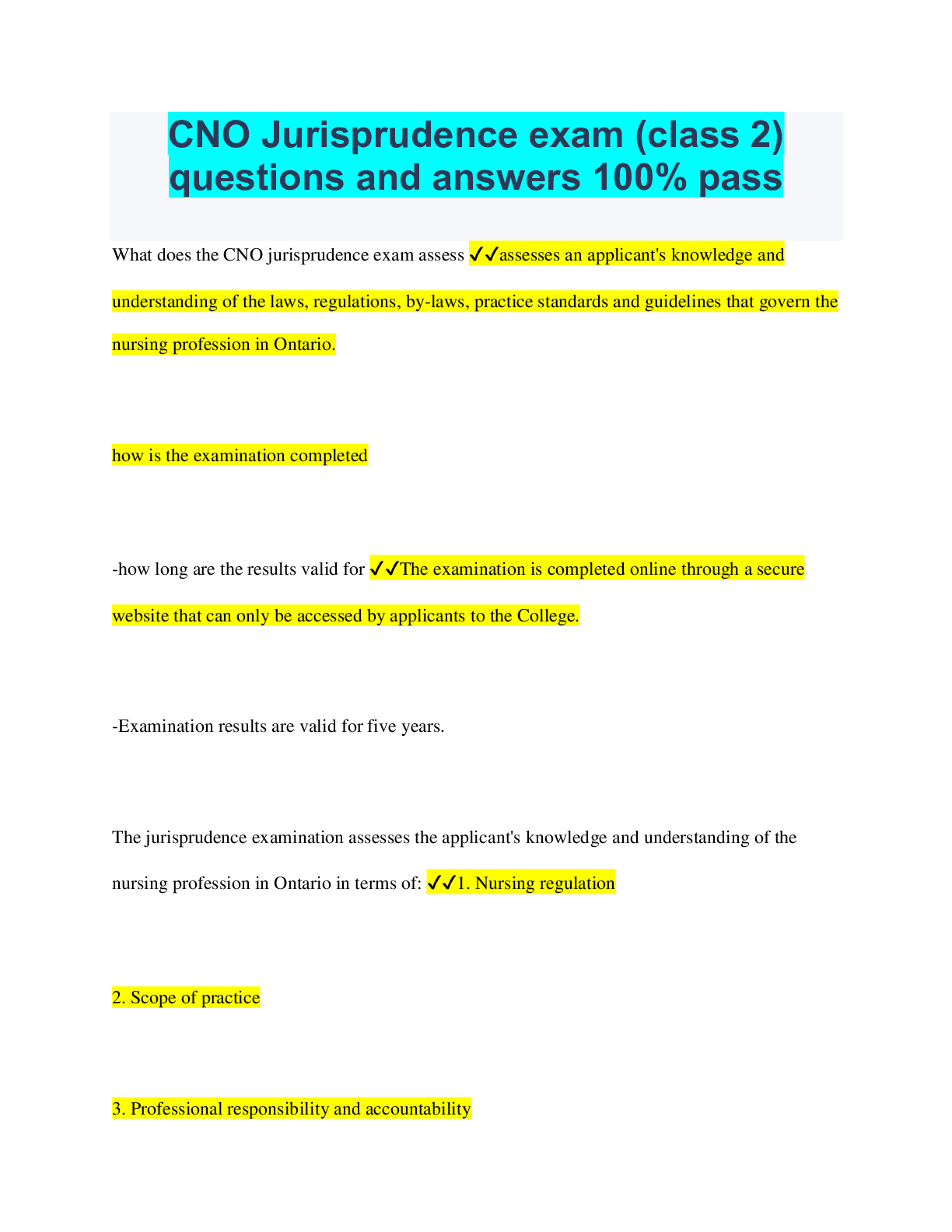
CNO Jurisprudence exam (class 2) questions and answers 100% pass What does the CNO jurisprudence exam assess ✔✔assesses an applicant's knowledge and understanding of the laws, regulations, by-l ... aws, practice standards and guidelines that govern the nursing profession in Ontario. how is the examination completed -how long are the results valid for ✔✔The examination is completed online through a secure website that can only be accessed by applicants to the College. -Examination results are valid for five years. The jurisprudence examination assesses the applicant's knowledge and understanding of the nursing profession in Ontario in terms of: ✔✔1. Nursing regulation 2. Scope of practice 3. Professional responsibility and accountability 4. Ethical practice 5. The nurse-client relationship how long do you have to write it -how long is it to write ✔✔-The RN/RPN Jurisprudence Examination consists of 150 multiplechoice questions. -Applicants have 3 hours and 15 minutes to write the examination. what can applicants use during the exam ✔✔-The jurisprudence examinations are "open-book" exams, which means that applicants can access and use paper, electronic, or online resources (e.g., laws, regulations, the College's practice standards) while writing the examination. -However, since there is a time limit and a wide range of material covered, it is strongly recommended that applicants do a thorough review of the recommended study material before taking the examination. -The examination is intended to be written by individuals working on their own. -It cannot be written together with other applicants. Examination Fee ✔✔-There is a fee of $40 (CDN), plus applicable taxes, to write the jurisprudence examination. -Applicants can pay the fee through the examination website. -Applicants can write the examination as many times as they need to in order to pass; however, a $40 fee applies to each attempt to take the exam. -As soon as the applicant pays the fee, the jurisprudence examination will begin. -Applicants do not have the option of paying the fee and then writing the examination at a later time. Jurisprudence Examination consists of multiple-choice questions designed to assess an applicant's competencies at three different levels of cognitive ability: ✔✔1. knowledge and comprehension 2. Application 3. Critical Thinking 1. knowledge and comprehension ✔✔-ability to recall and understand relevant content 2. Application ✔✔-ability to apply knowledge and comprehension in a straightforward situation/ scenario 3. Critical thinking ✔✔-ability to apply knowledge and comprehension in complex situations through analytical problem solving Ethical practice -how does the nurse demonstrate an understanding of ethical practice ✔✔The nurse demonstrates an understanding of ethical practice by: -applying ethical principles and values, and -incorporating knowledge from College practice standards and relevant legislation. The nurse: ✔✔4.01 Lists the College's ethical values as outlined in the Ethics practice standard. 4.02 Describes the ethical value related to Client Well-Being as outlined in the Ethics practice standard. 4.03 Identifies the legislation related to the use of restraints. 4.04 Outlines the nursing responsibilities related to the use of restraints (e.g., the principle of least/minimal restraints, the use of different types of restraints, etc.). 4.05 Applies the College's decision-making process when determining whether to discontinue nursing services. 4.06 Identifies the three conditions under which discontinuing nursing services may not constitute professional misconduct. 4.07 Identifies that there is employment-related legislation relevant to refusing assignments and discontinuing nursing services. 4.08 Describes the ethical value related to Client Choice as outlined in the Ethics practice standard. 4.09 Defines key terms related to consent as per the Consent practice guideline (e.g., continuing power of attorney for property, power of attorney for personal care, spouse, substitute decisionmaker, plan of treatment, treatment). 4.10 Identifies the major features of the Health Care Consent Act, 1996 as it relates to consent. 4.11 Identifies when consent to treatment is required under the Health Care Consent Act, 1996. 4.12 Identifies the key elements of informed consent according to the Consent practice guideline. the nurse cont'd ✔✔4.13 Identifies the major features of the Substitute Decisions Act, 1992 as it relates to consent. 4.14 Identifies the hierarchy of substitute decision-makers. 4.15 Describes the ethical value related to Privacy and Confidentiality as outlined in the Ethics practice standard. 4.16 Describes the nurse's responsibilities in relation to client confidentiality and privacy. 4.17 Identifies the Personal Health Information Protection Act, 2004 is the key piece of legislation governing health care information privacy in Ontario. 4.18 Identifies information that may be considered to be personal health information. 4.19 Articulates the conditions under which personal health information can be collected, used and disclosed (may include reference to the related Standard Statements). 4.20 Describes the ethical value related to Respect for Life as outlined in the Ethics practice standard. 4.21 Describes the ethical value related to Maintaining Commitments as outlined in the Ethics practice standard (to clients, oneself, nursing colleagues, the nursing profession, team members/colleagues, quality practice settings). 4.22 Describes the ethical value related to Truthfulness as outlined in the Ethics practice standard. 4.23 Describes the ethical value related to Fairness as outlined in the Ethics practice standard. A father expresses concerns about his son's upcoming surgery. The nurse listens to the father's concerns and validates his feelings. What component of the nurse-client relationship is the nurse demonstrating? a) Trust b) Respect c) Empathy d) Professional intimacy ✔✔Answer: C. Rationales: A) Not the correct component. B) Not the correct component. C) The nurse is empathizing with the father. D) Not the correct component. Reference: Therapeutic Nurse-Client Relationship Jurisprudence Competency: 5.01 A nurse gives a double dose of acetaminophen (Tylenol) to a client who only requires a single dose. What, if anything, must the nurse do? a) Ask a colleague to help assess the client b) Withhold the client's next dose of Tylenol c) Report the error as soon as possible d) Nothing, because this is an over-the-counter medication ✔✔Answer: C. Rationales: A) Nurses should be accountable for all errors made. B) All errors should be reported so that appropriate action can be taken. C) This is according to the standard. D) Nurses should be accountable for all errors made. Reference: Professional Standards, Revised 2002 Jurisprudence Competency: 3.05 An RN orders a PSW colleague to insert a urethral catheter into a newly admitted client. What should the PSW colleague do? a) Confirm the order with a physician before proceeding with the intervention b) Accept the order and proceed with the intervention c) Consult with an RN before proceeding with the intervention d) Decline to accept the order ✔✔Answer: D. Rationales: A) The original order was made by an RN and a controlled act cannot be ordered by an RN. B) A controlled act cannot be ordered by an RN. C) A controlled act cannot be ordered by an RN D) An RN cannot order another nurse to perform a controlled act. Reference: Decisions about Procedures and Authority, Revised 2006 Jurisprudence Competency: 2.16 A client writes to the College of Nurses stating that a nurse assaulted him during care. What action may the College take in this situation? a) Report the nurse to the employer b) Investigate the allegation c) Request that the nurse's employment be terminated d) Refer the complaint to local law enforcement ✔✔Answer: B Rationales: A) The employer may investigate but the legislation requires the allegation be investigated by the College. B) The College is required under the RHPA to investigate all complaints. C) This might be an outcome of the complaint but not at this point. D) Not the obligation of the College. Reference: Addressing Complaints at the College of Nurses of Ontario: Process Guide Jurisprudence Competency: 1.14 [Show More]
Last updated: 2 years ago
Preview 1 out of 15 pages
Buy this document to get the full access instantly
Instant Download Access after purchase
Buy NowInstant download
We Accept:

Reviews( 0 )
$10.00
Can't find what you want? Try our AI powered Search
Document information
Connected school, study & course
About the document
Uploaded On
Jun 26, 2023
Number of pages
15
Written in
All

Additional information
This document has been written for:
Uploaded
Jun 26, 2023
Downloads
0
Views
162




.png)