EMT EXAM: Neurologic Emergencies - Questions & Answers (MFD)-What Glasgow Coma Scale (GCS) score would you assign to a patient who responds to painful stimuli, uses inappropriate words, and maintains his or her arms in a
...
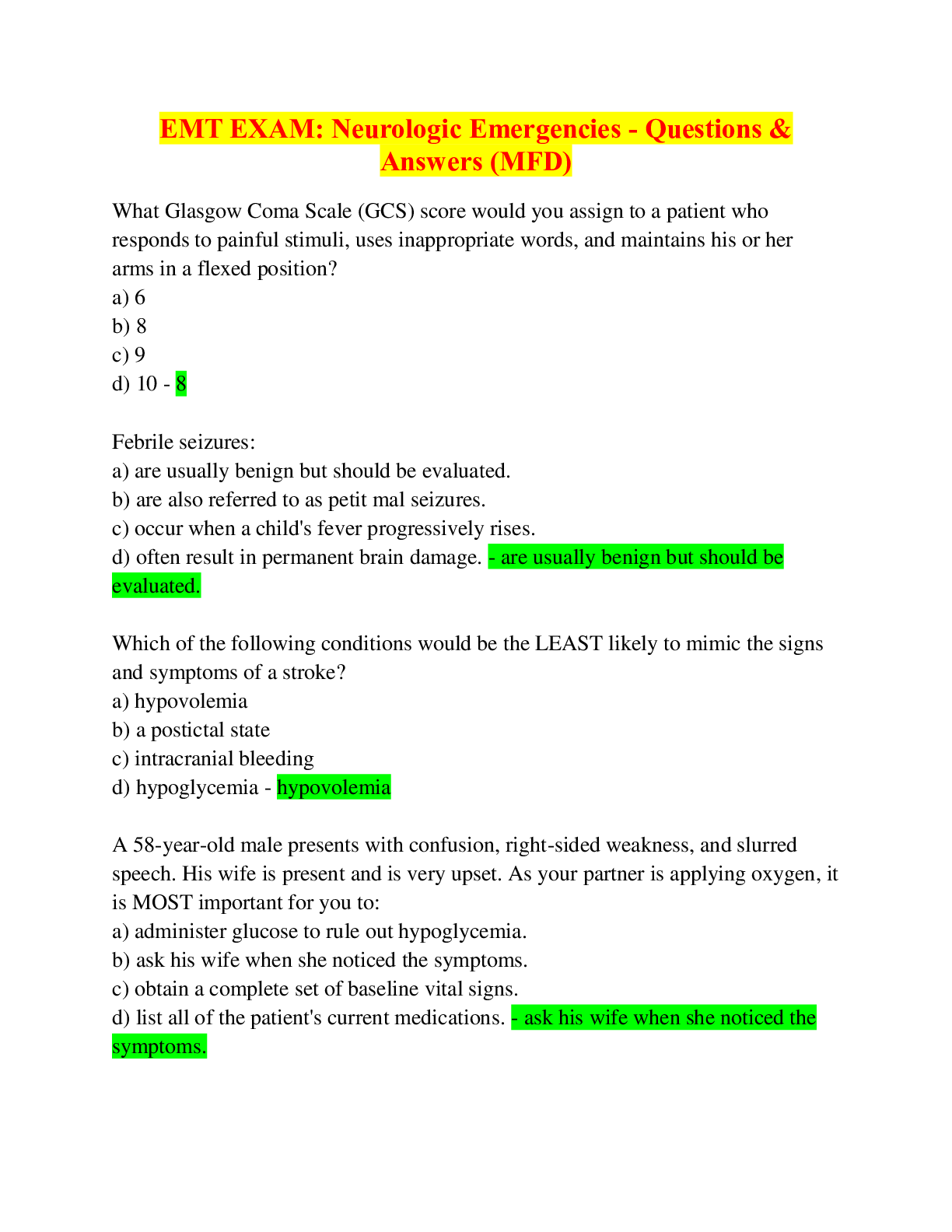
EMT EXAM: Neurologic Emergencies - Questions & Answers (MFD)-What Glasgow Coma Scale (GCS) score would you assign to a patient who responds to painful stimuli, uses inappropriate words, and maintains his or her arms in a flexed position?
a) 6
b) 8
c) 9
d) 10 - 8
Febrile seizures:
a) are usually benign but should be evaluated.
b) are also referred to as petit mal seizures.
c) occur when a child's fever progressively rises.
d) often result in permanent brain damage. - are usually benign but should be evaluated.
Which of the following conditions would be the LEAST likely to mimic the signs and symptoms of a stroke?
a) hypovolemia
b) a postictal state
c) intracranial bleeding
d) hypoglycemia - hypovolemia
A 58-year-old male presents with confusion, right-sided weakness, and slurred speech. His wife is present and is very upset. As your partner is applying oxygen, it is MOST important for you to:
a) administer glucose to rule out hypoglycemia.
b) ask his wife when she noticed the symptoms.
c) obtain a complete set of baseline vital signs.
d) list all of the patient's current medications. - ask his wife when she noticed the symptoms.
You arrive at a grocery store shortly after a 35-year-old male stopped seizing. Your assessment reveals that he is confused and incontinent of urine. The patient's girlfriend tells you that he has a history of seizures and takes carbamazepine (Tegretol). When obtaining further medical history from the girlfriend, it is MOST important to:
a) determine when he was last seen by his physician.
b) ask her how long the patient has been taking his medication.
c) determine if the patient is a known alcohol abuser.
d) obtain a description of how the seizure developed. - obtain a description of how the seizure developed.
You are caring for a 70-year-old female with signs and symptoms of an acute stroke. She is conscious, has secretions in her mouth, and is breathing at a normal rate with adequate depth. You should:
a) use a bag-mask device to assist her ventilations.
b) insert an oral airway, apply oxygen, and transport.
c) place her on her side and prepare for rapid transport.
d) suction her oropharynx and apply 100% oxygen. - suction her oropharynx and apply 100% oxygen.
The most basic functions of the body, such as breathing, blood pressure, and swallowing, are controlled by the:
a) brain stem.
b) cerebrum.
[Show More]