NR 507 MIDTERM EXAM ALL EXAMS COMBINED plus Study Guide LATEST 5 NEW VERSIONS VERIFIED QUESTIONS AND ANSWERS (2022-2023)
The lung is innervated by the parasympathetic nervous system via which nerve?
Vagus
...
NR 507 MIDTERM EXAM ALL EXAMS COMBINED plus Study Guide LATEST 5 NEW VERSIONS VERIFIED QUESTIONS AND ANSWERS (2022-2023)
The lung is innervated by the parasympathetic nervous system via which nerve?
Vagus
Phrenic
Brachial
Pectoral
Fibers of the parasympathetic division of the autonomic nervous system (ANS) travel only in the vagus nerve to the lung.
What is the action of urodilatin?
Urodilatin causes vasoconstriction of afferent arterioles.
It causes vasodilation of the efferent arterioles.
Urodilatin inhibits antidiuretic hormone secretion.
It inhibits salt and water reabsorption.
Urodilatin (a natriuretic peptide) inhibits sodium and water reabsorption from the medullary part of collecting duct, thereby producing diuresis. It is not involved in the actions described by the other options.
What is the direct action of atrial natriuretic hormone?
Sodium retention
Sodium excretion
Water retention
Water excretion
Atrial natriuretic peptide (ANP) and brain natriuretic peptide (BNP) inhibit the secretion of renin, inhibit angiotensin-induced secretion of aldosterone, vasodilate the afferent and constrict the efferent glomerular arterioles, and inhibit sodium and water absorption by kidney tubules. The other actions are not a result of the atrial natriuretic hormone.
Which statement best describes a Schilling test?
Administration of radioactive cobalamin and the measurement of its excretion in the urine to test for vitamin B12 deficiency
Measurement of antigen-antibody immune complexes in the blood to test for hemolytic anemia
Measurement of serum ferritin and total iron-binding capacity in the blood to test for iron deficiency anemia
Administration of folate and measurement in 2 hours of its level in a blood sample to test for folic acid deficiency anemia.
The Schilling test indirectly evaluates vitamin B12 absorption by administering radioactive B12 and measuring excretion in the urine. This selection is the only option that accurately describes a Schilling test.
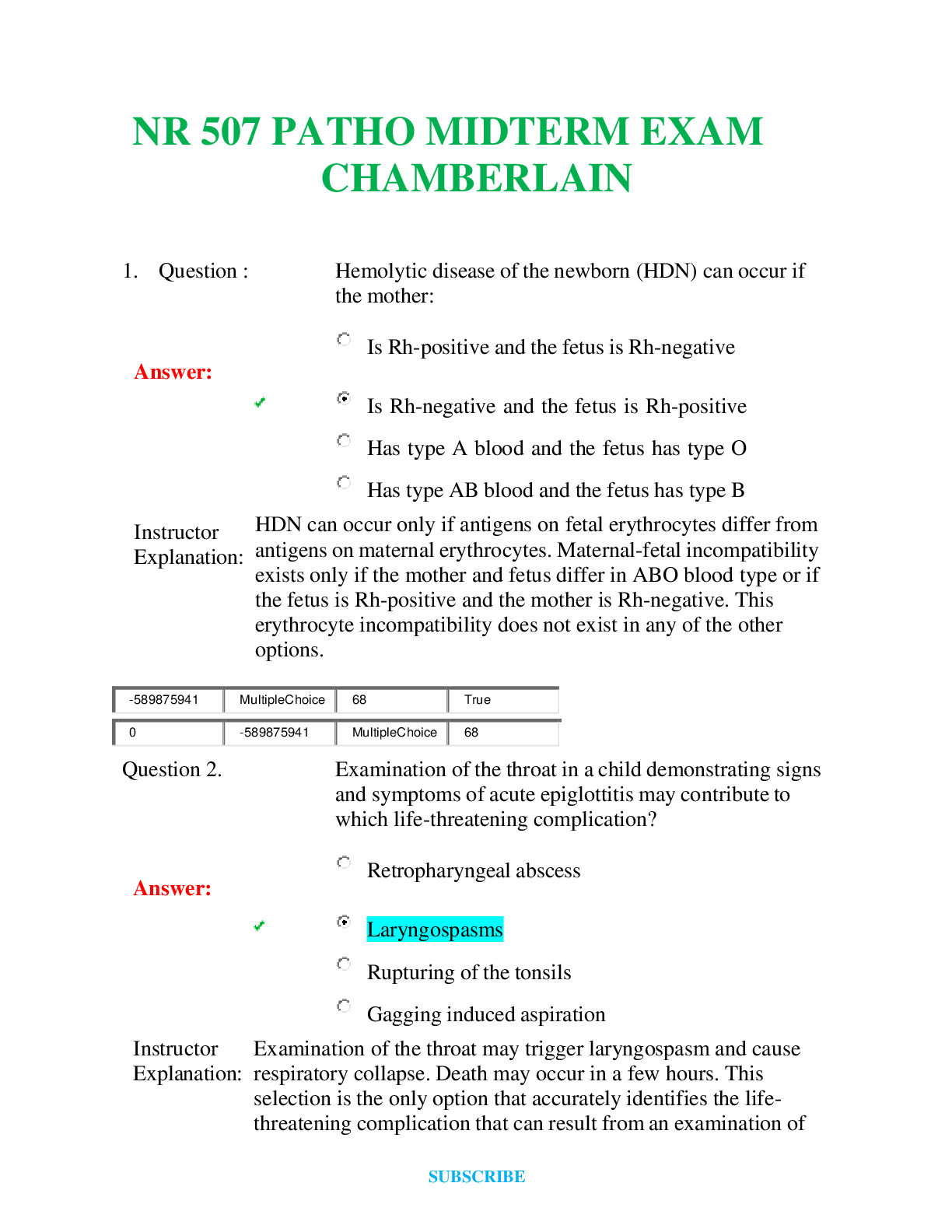
Hemolytic disease of the newborn (HDN) can occur if the mother:
Is Rh-positive and the fetus is Rh-negative
Is Rh-negative and the fetus is Rh-positive
Has type A blood and the fetus has type O
Has type AB blood and the fetus has type B
HDN can occur only if antigens on fetal erythrocytes differ from antigens on maternal erythrocytes. Maternal-fetal incompatibility exists only if the mother and fetus differ in ABO blood type or if the fetus is Rh-positive and the mother is Rh-negative. This erythrocyte incompatibility does not exist in any of the other options.
Which T-lymphocyte phenotype is the key determinant of childhood asthma?
Cluster of differentiation (CD) 4 T-helper Th1 lymphocytes
CD4 T-helper Th2 lymphocytes
CD8 cytotoxic T lymphocytes
Memory T lymphocytes
Asthma develops because the Th2 response (in which CD4 T-helper cells produce specific cytokines, such as interleukin [IL]–4, IL-5, and IL-13) promotes an atopic and allergic response in the airways. This selection is the only option that accurately identifies the appropriate T-lymphocyte phenotype.
Perceived stress elicits an emotional, anticipatory response that begins where?
Prefrontal cortex
Anterior pituitary
Limbic system
Hypothalamus
Perceived stressors elicit an anticipatory response that begins in the limbic system of the brain, the only option responsible for emotions and cognition.
Hypersensitivity is best defined as a(an):
Disturbance in the immunologic tolerance of self-antigens
Immunologic reaction of one person to the tissue of another person
Altered immunologic response to an antigen that results in disease
Undetectable immune response in the presence of antigens
Hypersensitivity is an altered immunologic response to an antigen that results in disease or damage to the host. The other options are not accurate definitions of hypersensitivity.
It has been determined that a tumor is in stage 2. What is the meaning of this finding?
Cancer is confined to the organ of origin.
Cancer has spread to regional structures.
Cancer is locally invasive.
Cancer has spread to distant sites
Cancer confined to the organ of origin is stage 1; cancer that is locally invasive is stage 2; cancer that has spread to regional structures, such as the lymph nodes, is stage 3; and cancer that has spread to distant sites, such as a liver cancer spreading to the lung or a prostate cancer spreading to bone, is stage 4.
An infant has a loud, harsh, holosystolic murmur and systolic thrill that can be detected at the left lower sternal border that radiates to the neck. These clinical findings are consistent with which congenital heart defect?
Atrial septal defect (ASD)
Ventricular septal defect (VSD)
Patent ductus arteriosus (PDA)
Atrioventricular canal (AVC) defect
On physical examination, a loud, harsh, holosystolic murmur and systolic thrill can be detected at the left lower sternal border. The intensity of the murmur reflects the pressure gradient across the VSD. An apical diastolic rumble may be present with a moderate-to-large defect, reflecting increased flow across the mitral valve. The
presentations of the other congenital heart defects are not consistent with the described symptoms.
[Show More]