Amelia Sung Post Sim. Complete Solution.Ms. Sung's sister asks why there is a step stool in the room. What
would be the best response by the nurse?
Question CorrectTime Spent - 00:01:23
Your Response: Given the patien
...
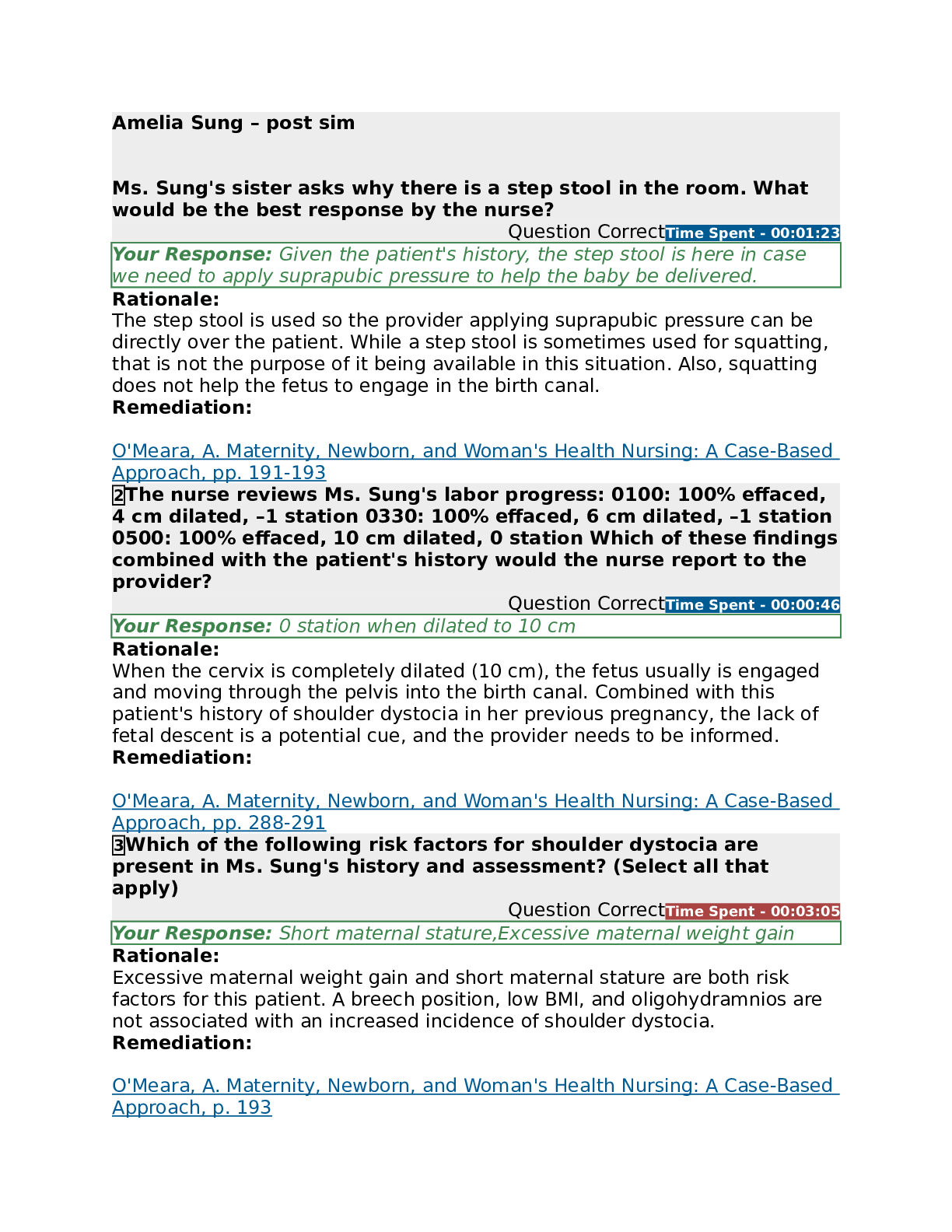
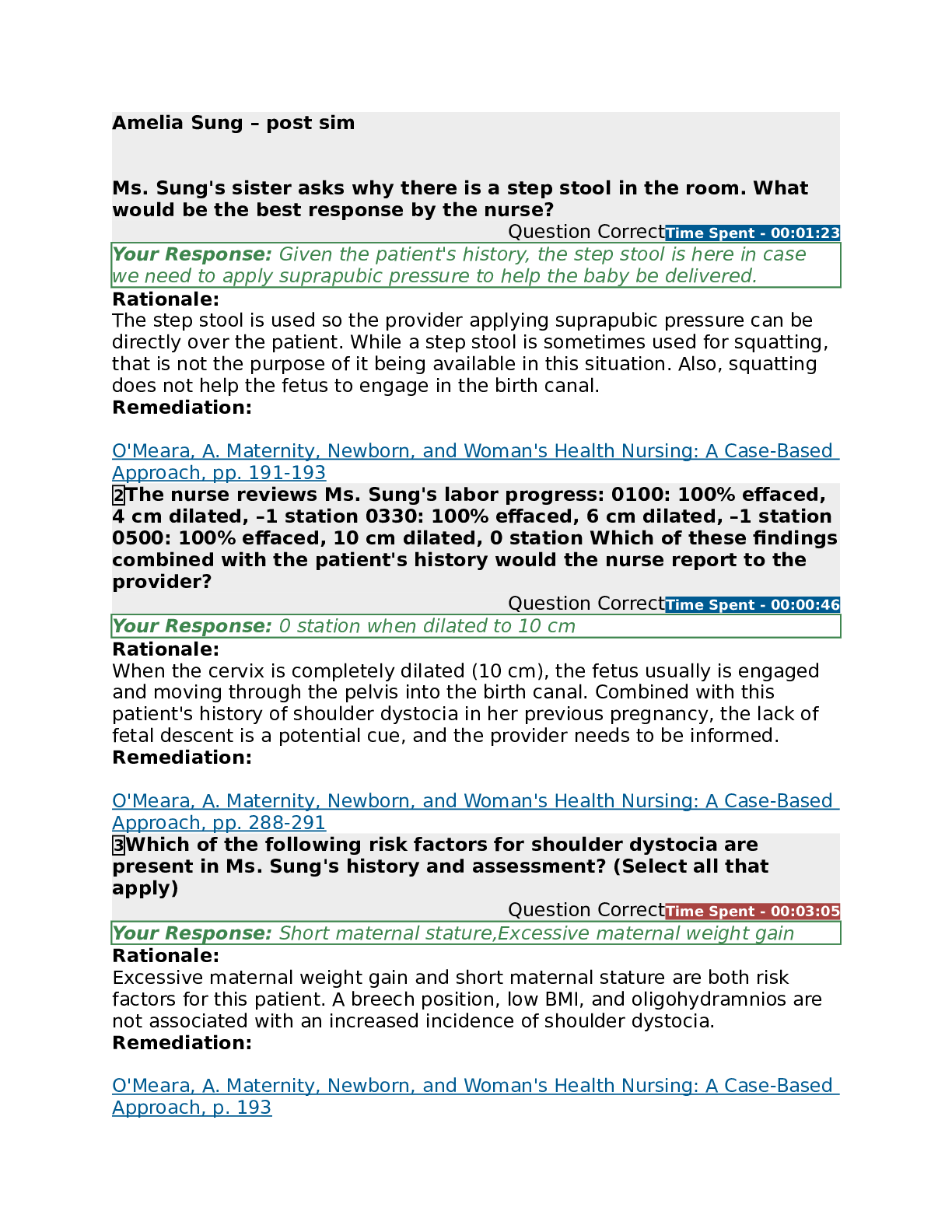
Amelia Sung Post Sim. Complete Solution.Ms. Sung's sister asks why there is a step stool in the room. What
would be the best response by the nurse?
Question CorrectTime Spent - 00:01:23
Your Response: Given the patient's history, the step stool is here in case
we need to apply suprapubic pressure to help the baby be delivered.
Rationale:
The step stool is used so the provider applying suprapubic pressure can be
directly over the patient. While a step stool is sometimes used for squatting,
that is not the purpose of it being available in this situation. Also, squatting
does not help the fetus to engage in the birth canal.
Remediation:
O'Meara, A. Maternity, Newborn, and Woman's Health Nursing: A Case-Based
Approach, pp. 191-193
2The nurse reviews Ms. Sung's labor progress: 0100: 100% effaced,
4 cm dilated, –1 station 0330: 100% effaced, 6 cm dilated, –1 station
0500: 100% effaced, 10 cm dilated, 0 station Which of these findings
combined with the patient's history would the nurse report to the
provider?
Question CorrectTime Spent - 00:00:46
Your Response: 0 station when dilated to 10 cm
Rationale:
When the cervix is completely dilated (10 cm), the fetus usually is engaged
and moving through the pelvis into the birth canal. Combined with this
patient's history of shoulder dystocia in her previous pregnancy, the lack of
fetal descent is a potential cue, and the provider needs to be informed.
Remediation:
O'Meara, A. Maternity, Newborn, and Woman's Health Nursing: A Case-Based
Approach, pp. 288-291
3Which of the following risk factors for shoulder dystocia are
present in Ms. Sung's history and assessment? (Select all that
apply)
Question CorrectTime Spent - 00:03:05
Your Response: Short maternal stature,Excessive maternal weight gain
Rationale:
Excessive maternal weight gain and short maternal stature are both risk
factors for this patient. A breech position, low BMI, and oligohydramnios are
not associated with an increased incidence of shoulder dystocia.
Remediation:
O'Meara, A. Maternity, Newborn, and Woman's Health Nursing: A Case-Based
Approach, p. 193
4Ms. Sung's family asks what can be done to prevent the baby from
getting "stuck" like the last baby. Which of the follow is the best
response from the nurse?
Question CorrectTime Spent - 00:00:51
Your Response: While we cannot prevent shoulder dystocia, we will monitor
both mother and fetus and have everything ready if we need to intervene.
Rationale:
The nurse should be reassuring yet honest. Shoulder dystocia is not
preventable, but being prepared for the potential emergency can decrease
morbidity and mortality. The other responses are neither therapeutic nor
accurate.
Remediation:
[Show More]

.png)










.png)

.png)