Bakeshop Production: Basic Principles and Ingredients Exam You overheard the following four students discussing the section of this chapter on the advantages and disadvantages of using butter in baking. Which of them do
...
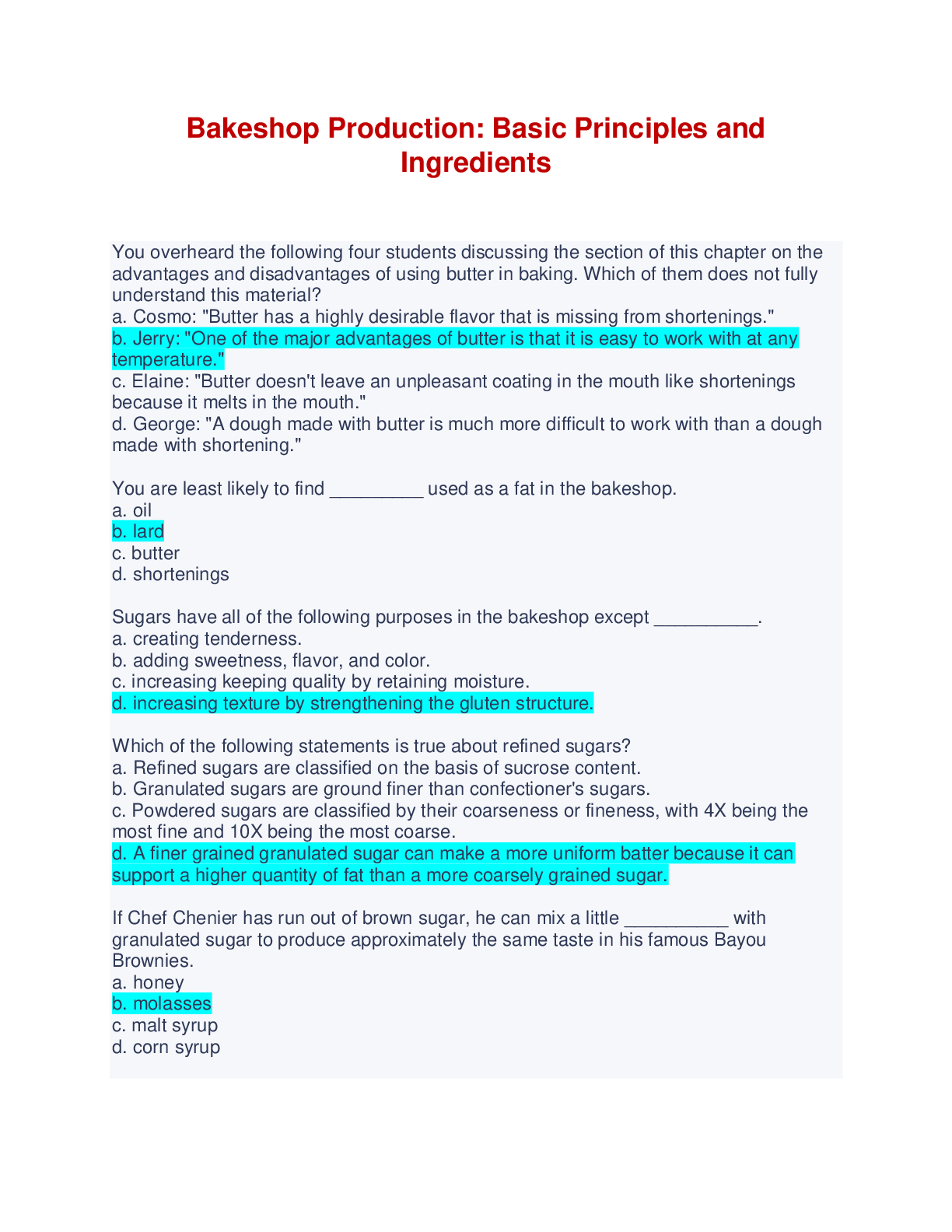
Bakeshop Production: Basic Principles and Ingredients Exam You overheard the following four students discussing the section of this chapter on the advantages and disadvantages of using butter in baking. Which of them does not fully understand this material? a. Cosmo: "Butter has a highly desirable flavor that is missing from shortenings." b. Jerry: "One of the major advantages of butter is that it is easy to work with at any temperature." c. Elaine: "Butter doesn't leave an unpleasant coating in the mouth like shortenings because it melts in the mouth." d. George: "A dough made with butter is much more difficult to work with than a dough made with shortening." You are least likely to find _________ used as a fat in the bakeshop. a. oil b. lard c. butter d. shortenings Sugars have all of the following purposes in the bakeshop except __________. a. creating tenderness. b. adding sweetness, flavor, and color. c. increasing keeping quality by retaining moisture. d. increasing texture by strengthening the gluten structure. Which of the following statements is true about refined sugars? a. Refined sugars are classified on the basis of sucrose content. b. Granulated sugars are ground finer than confectioner's sugars. c. Powdered sugars are classified by their coarseness or fineness, with 4X being the most fine and 10X being the most coarse. d. A finer grained granulated sugar can make a more uniform batter because it can support a higher quantity of fat than a more coarsely grained sugar. If Chef Chenier has run out of brown sugar, he can mix a little __________ with granulated sugar to produce approximately the same taste in his famous Bayou Brownies. a. honey b. molasses c. malt syrup d. corn syrup ___________ is the major reason for using honey in a baking formula. a. Flavor b. Cost reduction c. Leavening power d. Moisture retention Malt syrup is used primarily in yeast breads to __________. a. add flavor. b. add crust color. c. provide food for the yeast. d. all of the above As Chef Laitiere lectures about the use of milk and cream in baking, you will not hear her say __________. a. Cream is often used as a liquid in doughs and batters. b. Buttermilk is an effective leavening agent when combined with baking soda. c. Dry milk is convenient, inexpensive, and can often be simply mixed with the dry ingredients. d. If you use whole milk in a formula, you must calculate its fat content as part of the shortening. The main purpose of a leavening agent is to produce __________. a. gas. b. flavor. c. moisture. d. structure. Yeast, baking soda, baking powder, baking ammonia, air, and steam are all ___________. a. emulsifiers. b. leavening agents. c. anti-staling agents. d. both a and b Leavening __________ a baked product. a. increases the volume of b. produces shape and texture of c. refers to the production of gases in d. all of the above Fermentation is the process by which yeast acts on __________ and changes them into carbon dioxide gas and alcohol. a. fats b. leavening agents c. proteins d. carbohydrates Which set of words completes the following sentence correctly? If the temperature of yeast is __________, then __________. a. 45°F (7°C) or less, it is dead. b. 140°F (60°C) or more, it is inactive. c. 100°F (38°C) to 140°F (60°C), its action speeds up. d. 70°F to 90°F (20°C to 32°C), it is growing most rapidly. The bread formula Chef Levure is using calls for 1.5 lb of compressed yeast, but he has only active dry yeast. How much dry yeast should he use? a. 3.75 oz b. 6 oz c. 9.6 oz d. 6 lb If Chef Poudre wants to mix her cake batter in the morning and bake her cakes in the afternoon, then she should definitely not use __________ in her formula. a. baking soda b. single-acting baking powder
[Show More]

![Preview of FDSC 1133 Exam 1 [Food Science Fundamentals] 140 Questions & 100% Verified Answers Grade A](https://browseimages.nyc3.digitaloceanspaces.com/paper-images/2026/04/01/znnLS2iB2026-04-01-01-4869cc4f56594bb.png)