MSK Practice Questions - Full Questions, Answers with Complete Solutions
Document Content and Description Below
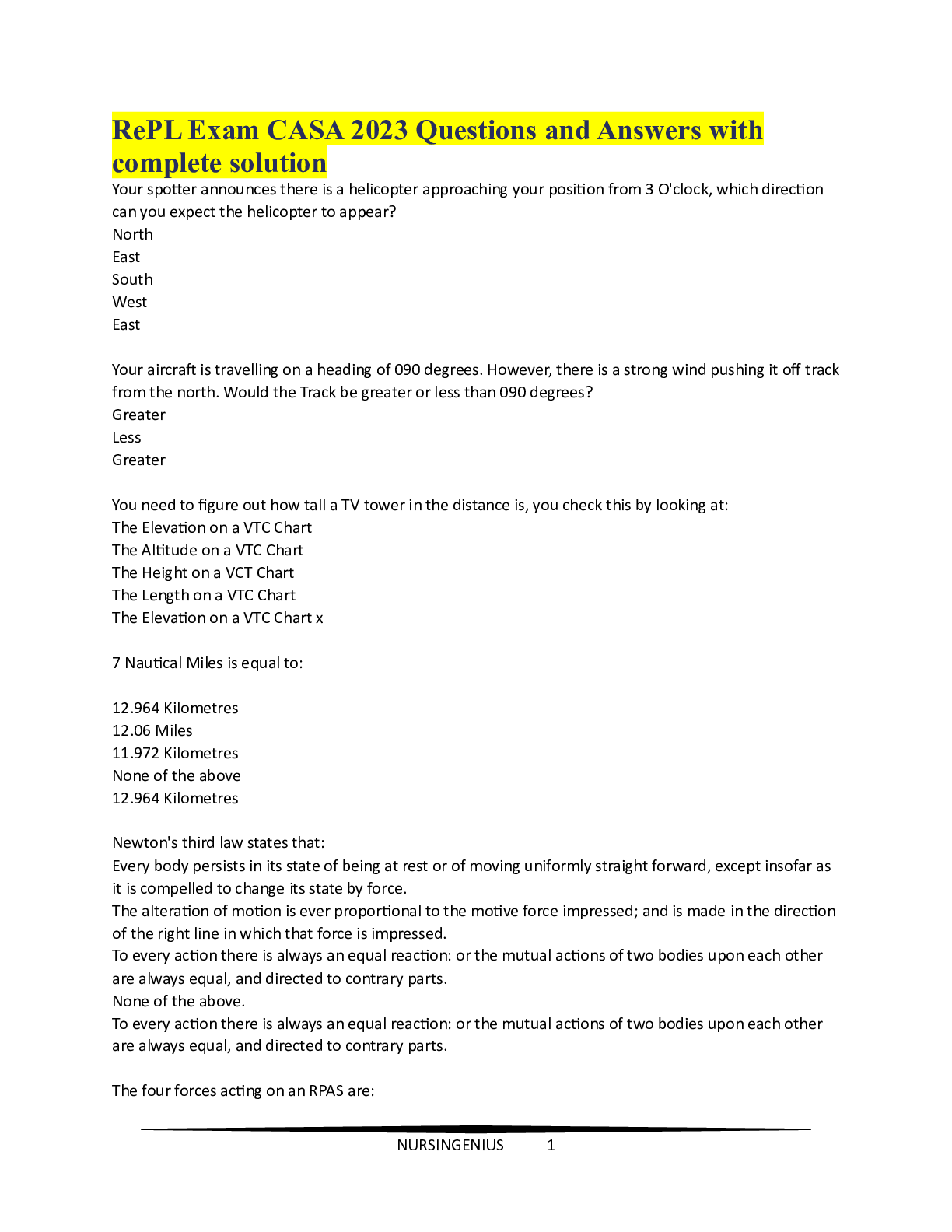
1. A 20 year old college basketball player reports of pain, stiffness and feeling of weakness in his left knee which aggravates after playing. On examination, there is no crepitus, no popping or locking of the joint move
...
[Show More]
Last updated: 3 years ago
Preview 1 out of 23 pages
Instant download
Buy this Document to get the Full Access Instantly
Provided by Students Who Aced it
We Verify Document Content to Gurantee Accuracy
Reviews( 0 )
Document information
Connected school, study & course
About the document
Uploaded On
Jul 01, 2023
Number of pages
23
Written in
All

Additional information
This document has been written for:
Uploaded
Jul 01, 2023
Downloads
0
Views
125
Topic Tags
Related Subjects & Courses
Explore similar study resources and related concepts.
Recommended For You
Get more on EXAM »
$12.5
47 Pages
NRNP 6635 FINAL EXAM QUESTIONS AND ANSWERS 2023! Rated A + Ans...
$12
6 Pages
FEMA FINAL EXAM ICS 100: IS-100.C: INTRODUCTION TO THE INCIDEN...

![Preview of [eBook] [PDF] Clinical Nursing Calculations 3rd Edition By Susan Sienkiewicz, Sandra Meg](https://browseimages.nyc3.digitaloceanspaces.com/paper-images/2025/Jul/04/4jF14r9I2025-07-04-05-586867ec3011731.png)
$25
1116 Pages
[eBook] [PDF] Clinical Nursing Calculations 3rd Edition By S...






$10.5
3 Pages
Blue Cloud NIHSS Certificate A (v5) Stroke Scale Certificatio...
More related documents below