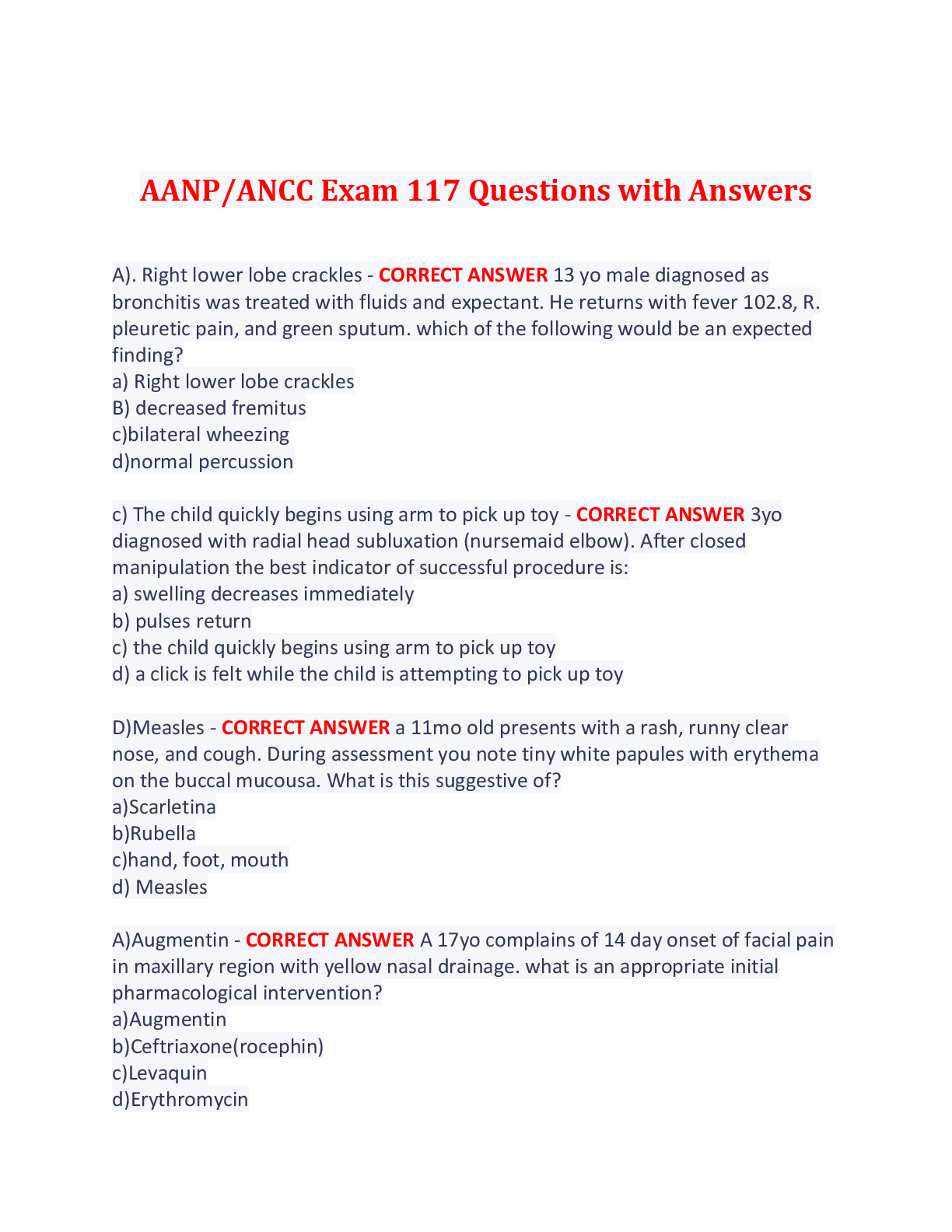
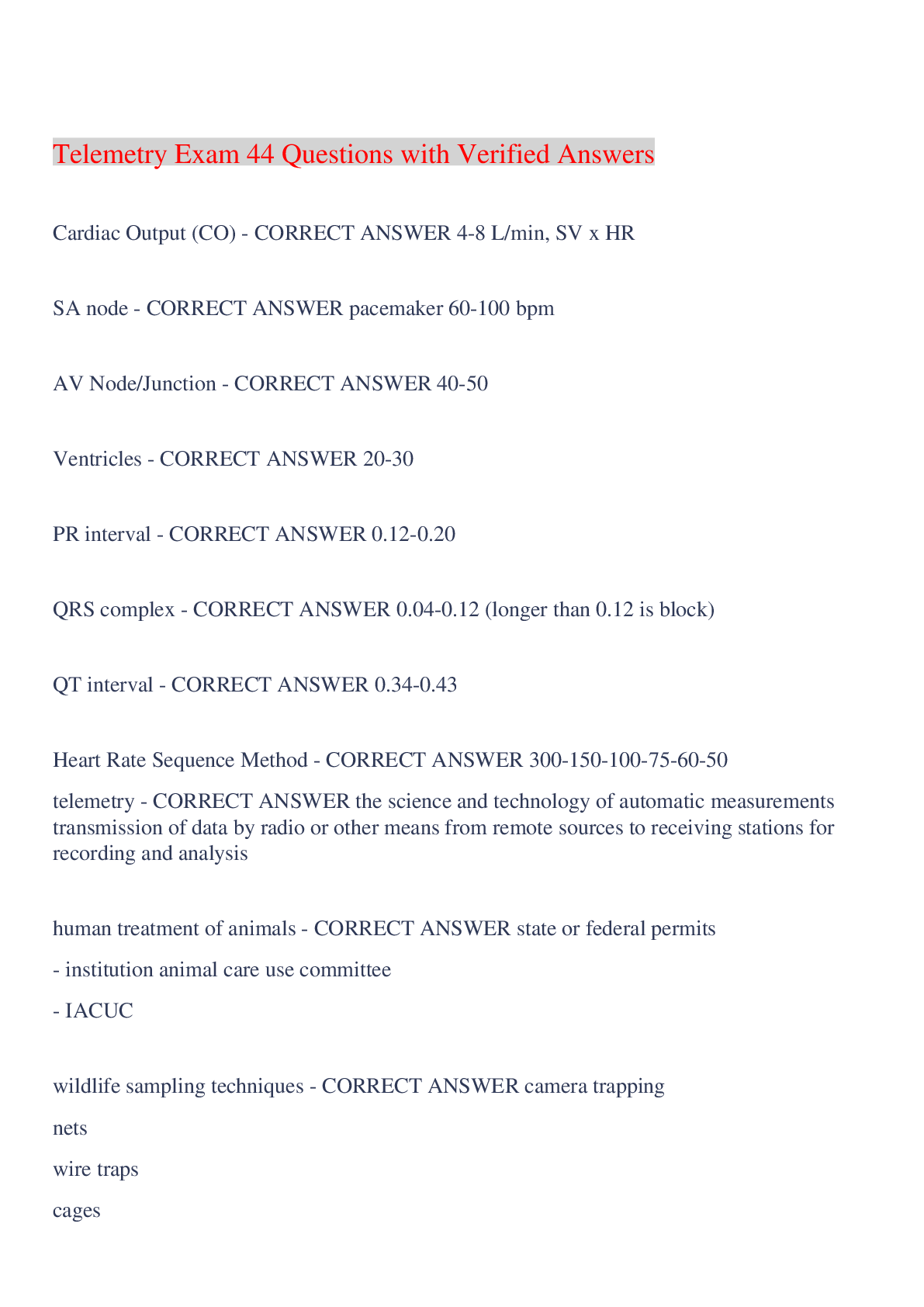
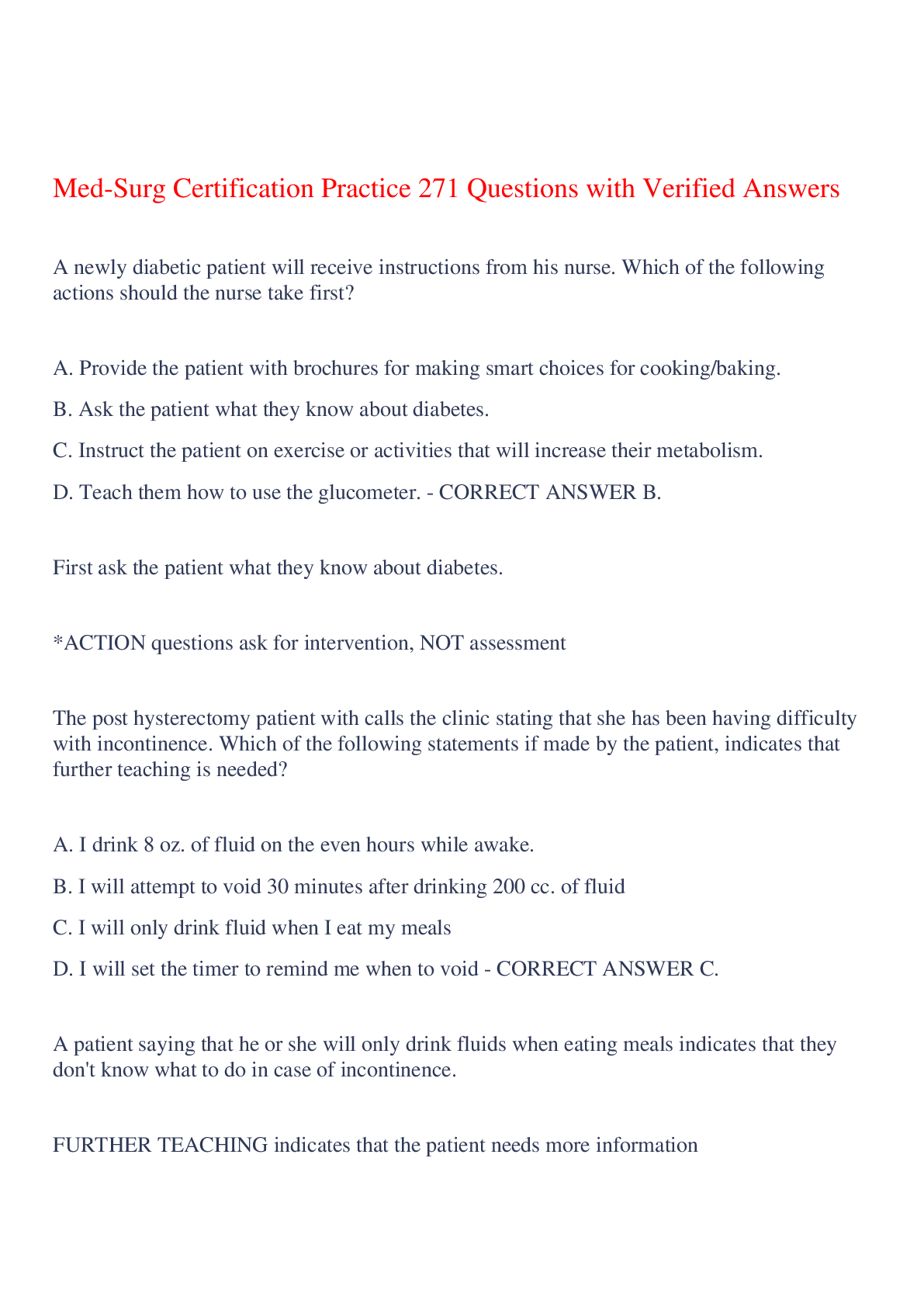
AANP exam 77 Questions with Answers
Tanner Stage I: Girls - CORRECT ANSWER prepubertal
Tanner Stage II: Girls - CORRECT ANSWER Breast bud
Tanner Stage III: Girls - CORRECT ANSWER Breast and nipple growth, one
...
AANP exam 77 Questions with Answers
Tanner Stage I: Girls - CORRECT ANSWER prepubertal
Tanner Stage II: Girls - CORRECT ANSWER Breast bud
Tanner Stage III: Girls - CORRECT ANSWER Breast and nipple growth, one mound, no separation
Tanner Stage IV: Girls - CORRECT ANSWER Nipple/areola elevated from breast, secondary mound
Tanner Stage V: Girls - CORRECT ANSWER Adult
Tanner Stage I: Boys - CORRECT ANSWER prepubertal
Tanner Stage II: Boys - CORRECT ANSWER testes/scrotum enlarges, scrotum darkens, more ruggae
Tanner Stage III: Boys - CORRECT ANSWER penis grows longer, scrotum continues to grow
Tanner Stage IV: Boys - CORRECT ANSWER penis becomes wider, continues getting longer, scrotum larger, darker, more ruggae
Tanner Stage V: Boys - CORRECT ANSWER adult
kiesselbach's plexus - CORRECT ANSWER blood vessels on anterior septum where 90% of nosebleeds originate
Finkelstein's test - CORRECT ANSWER used to dx DeQuervain's tenosynovitis, thumb in fist, bend wrist towards little finger. positive c pain in wrist on thumb side
anterior drawer test - CORRECT ANSWER used to check for ACL injury, pull tibia forward from femur c both hands on tibia c pt laying and knee flexed at 90 deg, positive c >5mm translation or increase laxity compared to unaffected side
lachman maneuver - CORRECT ANSWER tests ACL integrity, pt on back knee flexed 20-30 deg, one hand stabilize femur, other applies pressure to back of knee, positive c mushy end point
pivot test - CORRECT ANSWER tests ACL integrity, pt on back, knee fully extended, rotate foot internally. Apply valgus stress while flexing knee. Positive= translation of tibia on femur
McMurray test - CORRECT ANSWER checks for meniscus injury, pt supine, knee flexed. medial: apply valgus force, externally rotate the foot and passively extend knee. lateral: apply varus force, internally rotate foot and passively extend knee. Positive= audible or palpable snap in knee during extension
diabetic retinopathy - CORRECT ANSWER cotton wool spots, hard exudates, neovascularization, microaneurysms
hypertensive retinopathy - CORRECT ANSWER AV nicking, silver and/or copper wire arterioles
Tinel's sign - CORRECT ANSWER Detects irritated nerves, most often c carpal tunnel. Tap on median nerve. Positive= tingling down thumb, index, and middle finger
Phalen's maneuver - CORRECT ANSWER Detects carpal tunnel syndrome. allow wrists to fall into maximum flexion, hold for 60 seconds. Positive= tingling down thumb, index, and middle finger
Kernig's sign - CORRECT ANSWER sign of meningitis. Pt supine, hip flexed at 90, attempt to straighten leg. Positive= inability to straighten leg
Maculopapular rash in lace like pattern - CORRECT ANSWER Fifth's disease
Maculopapular rash with papules, vesicles, and crusts - CORRECT ANSWER Varicella
Maculopapular rashes that are oval shaped with herald patch or Christmas tree - CORRECT ANSWER pityriasis rosea
vesicular rashes on an erythematous base - CORRECT ANSWER herpes simplex
scarlet fever (scarletina) - CORRECT ANSWER caused by group A strep, rash is fine, red, and rough textured. non-puritic. accompanied by sore throat, stawberry tongue, and peeling of hands and feet. tx c abx for strep (Penicillin)
S3 - CORRECT ANSWER Heard best over pulmonic area (2nd L intercostal space), indicates heart failure, ventricular overload
psoas sign (ilipsoas muscle sign) - CORRECT ANSWER used c acute abdomen, appendicitis. Pt lays on left side, hyperextends right thigh. Positive= abd pain
obturator sign - CORRECT ANSWER used c acute abdomen, appendicitis. Pt supine, flex knee and hip to 90 deg, internally rotate hip. Positive= abd pain (c R leg for appendix)
Rovsing's sign - CORRECT ANSWER used c acute abdomen, appendicitis. Palpate LLQ, Positive= pain in RLQ
McBurney's point - CORRECT ANSWER 2/3rds of distance from umbilicus to the R anterior superior iliac spine. Deep tenderness at this point may be indicative of appendicitis
Hirschsprung (Hirschberg) test - CORRECT ANSWER aka corneal light reflex. Checks for strabismus.
Rocky Mountain spotted fever - CORRECT ANSWER S central US. Red rash on wrists and ankles that spreads centrally that appears 3rd day after fever (103-105). Can cause death if not tx in 1st 8 days of symptoms
Cholesteatoma - CORRECT ANSWER Cauliflower like growth in ear c foul smelling discharge. Can eat through tm, bone, & nerves. Refer to EENT
Koplik's spots - CORRECT ANSWER Small red papules with white center inside cheeks by lower molars. Indicates measles, before rash.
hordeolum - CORRECT ANSWER stye. infection on hair follicle of eye lash. tx c abx eye drops and warm packs.
Pinguecula - CORRECT ANSWER yellow triangular thickening of the bulbar conjunctiva. on inner and outer margins of cornea. Caused by UV light damage.
Pterygium - CORRECT ANSWER yellow triangular thickening of the bulbar conjunctiva, extends to the cornea. Caused by UV light damage.
Chalazion - CORRECT ANSWER chronic inflammation of meibomian (sweat) gland of eyelid. small painless movable bead-like nodule. Should resolve within weeks.
Rinne test - CORRECT ANSWER tests for conductive hearing loss. normal= AC>BC
Webber test - CORRECT ANSWER tuning fork on middle of head. Abnormal= lateralization to affected ear
meningococcemia prophylaxis - CORRECT ANSWER Rifampin for close contacts
basal cell carcinoma - CORRECT ANSWER pearly or waxy lesion with atrophic or ucerated center that does not heal.
acral lentiginous melanoma - CORRECT ANSWER dark brown to black lesions on nail bed, palmar, and plantar surfaces. subungal (nail bed) are longitudinal brown/black bands. Most common melanoma in African Americans and Asians.
actinic keratosis - CORRECT ANSWER numerous dry, round, red colored lesions with rough texture that do not heal in older adults. on sun exposed areas. May lead to squamous cell carcinoma.
seborrheic keratosis - CORRECT ANSWER soft, round wart-like growths on trunk, tan to black. benign.
Koebner phenomenon - CORRECT ANSWER seen c psoriasis. New plaques over areas of skin trauma.
Auspitz sign - CORRECT ANSWER seen c psoriasis. pin point bleeding under where plaque was removed.
Amsler grid - CORRECT ANSWER Used to assess for macular degeneration
presbycusis - CORRECT ANSWER age related hearing loss. bilateral, symmetrical, high frequencies.
Hemic murmur - CORRECT ANSWER murmur heard in persons with no valvular lesions, heard with anemia
erysipelas - CORRECT ANSWER st. anthony's fire. tender, erythemous plaques with sharply demarcated boarder. Type of skin infection, usually caused by group B strep.
Vibrio vulnificus - CORRECT ANSWER micro organism that can cause rapidly expanding cellulitis or sepsis, found in brackish or salt water.
Somogyi effect - CORRECT ANSWER increased morning fasting blood sugar d/t too much insulin or hypoglycemia at night
keratoacanthoma - CORRECT ANSWER rapid growing, domed shaped with surrounding erythema. Maybe self limiting or lead to squamous cell carcinoma.
Top CAP micro organisms - CORRECT ANSWER 1) Strep. pneumoniae
2) Haemophilus pneumonia
PPD + c >5mm - CORRECT ANSWER HIV+, exposure to infective TB, immunocompromised, children <5 c close contact or symptoms, +CXR changes
PPD + c >10mm - CORRECT ANSWER homeless, IV drug user, healthcare worker, employee/resident of high incidence area, recent immigrant from high incidence country, children < 4 yrs, any child exposed to high risk adults
Physiologic split S2 - CORRECT ANSWER <30 yrs. Best heard over pulmonic area on inspiration
Split S2 - CORRECT ANSWER atrial septal defect
S4 - CORRECT ANSWER uncontrolled HTN, recurrent MI
blue dot sign - CORRECT ANSWER torsion of the appendix testis, most common in school aged boys, blue colored round mass on testes surface
Prehn's sign - CORRECT ANSWER Positive= relief of pain c scrotal elevation. indicative of epididymitis
heberden's nodes - CORRECT ANSWER bony nodules on DIP, seen c OA
Bouchard's nodes - CORRECT ANSWER bony nodules on PIP, seen c OA
swan neck deformity - CORRECT ANSWER flexion of DIP joint with hyperextension of the PIP joint, seen c RA
Boutonniere deformity - CORRECT ANSWER Hyperextension of the DIP with flexion of PIP, seen c RA
Cullen's sign - CORRECT ANSWER blue discoloration around umbilicus, seen c acute pancreatitis, ruptured ectopic pregnancy
Grey-Turner's sign - CORRECT ANSWER blue discoloration on the flanks, seen c acute pancreatitis
spurling maneuver - CORRECT ANSWER tilt head towards radicular pain, press down. positive=pain radiating down that side. indicates cervical rediculopathy
straight leg raise test - CORRECT ANSWER tests for lumbar root compression
drop arm test - CORRECT ANSWER tests for rotator cuff
markel sign - CORRECT ANSWER aka heel jar test. up on heels, drop suddenly. sign of paritoneal irritation
blumberg sign - CORRECT ANSWER aka rebound tenderness
Murphy's maneuver - CORRECT ANSWER press deeply on RUQ under costal margin during inspiration. mid-inspiratory arrest = positive. Indicative of cholecystitis.
Osler nodes - CORRECT ANSWER painful violet nodes on fingers and feet, sign of infective endocarditis
Janeway lesions - CORRECT ANSWER tender red spots on the palms/soles
[Show More]