MV22 Memory Items (IC 85/60) 30 Questions with Answers
FIRE Engine, On Ground - CORRECT ANSWER Note: Bleed air or other hot gas leakage maytrigger an engine fire warning without associated secondary indications.
...
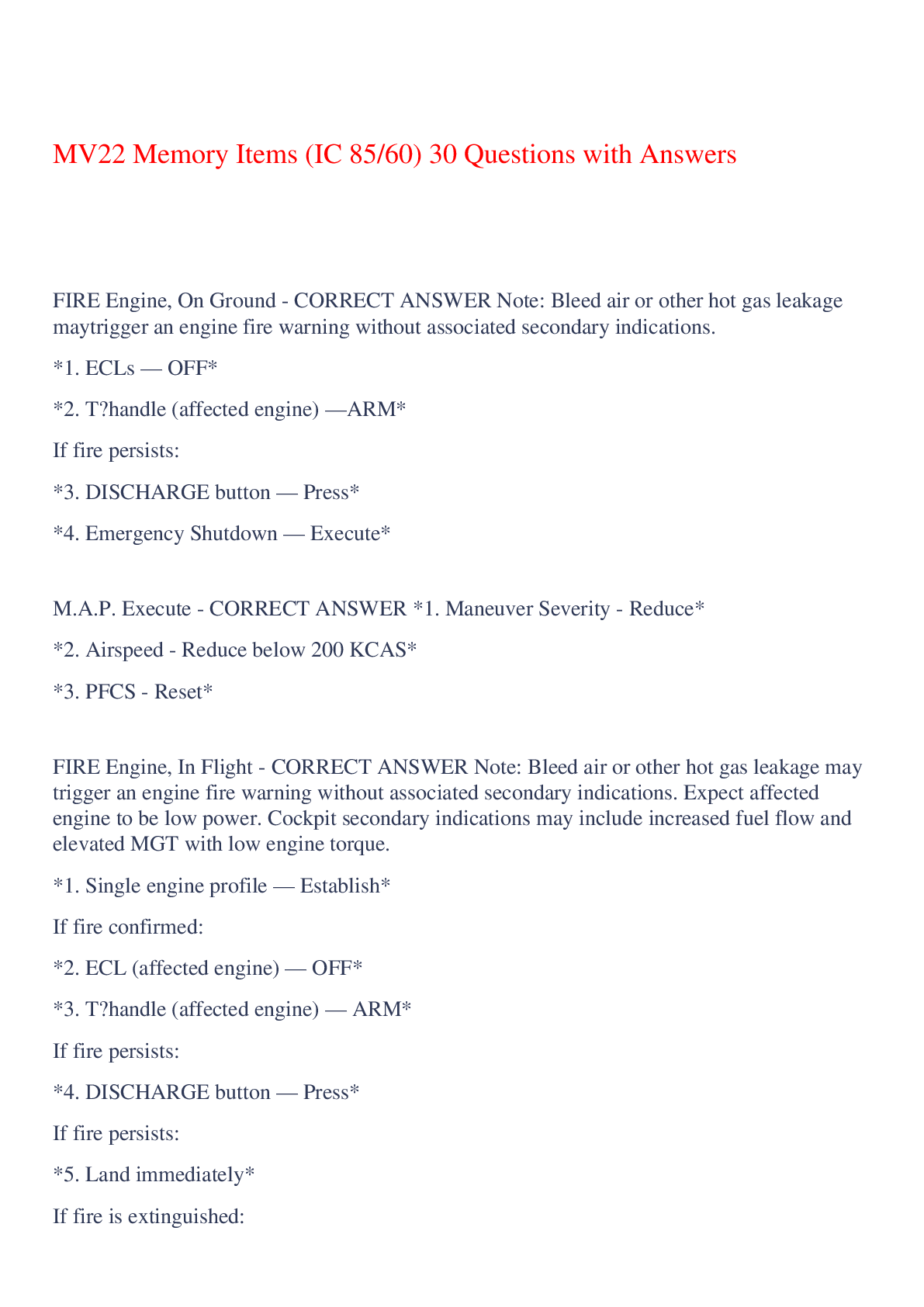
MV22 Memory Items (IC 85/60) 30 Questions with Answers
FIRE Engine, On Ground - CORRECT ANSWER Note: Bleed air or other hot gas leakage maytrigger an engine fire warning without associated secondary indications.
*1. ECLs — OFF*
*2. T‐handle (affected engine) —ARM*
If fire persists:
*3. DISCHARGE button — Press*
*4. Emergency Shutdown — Execute*
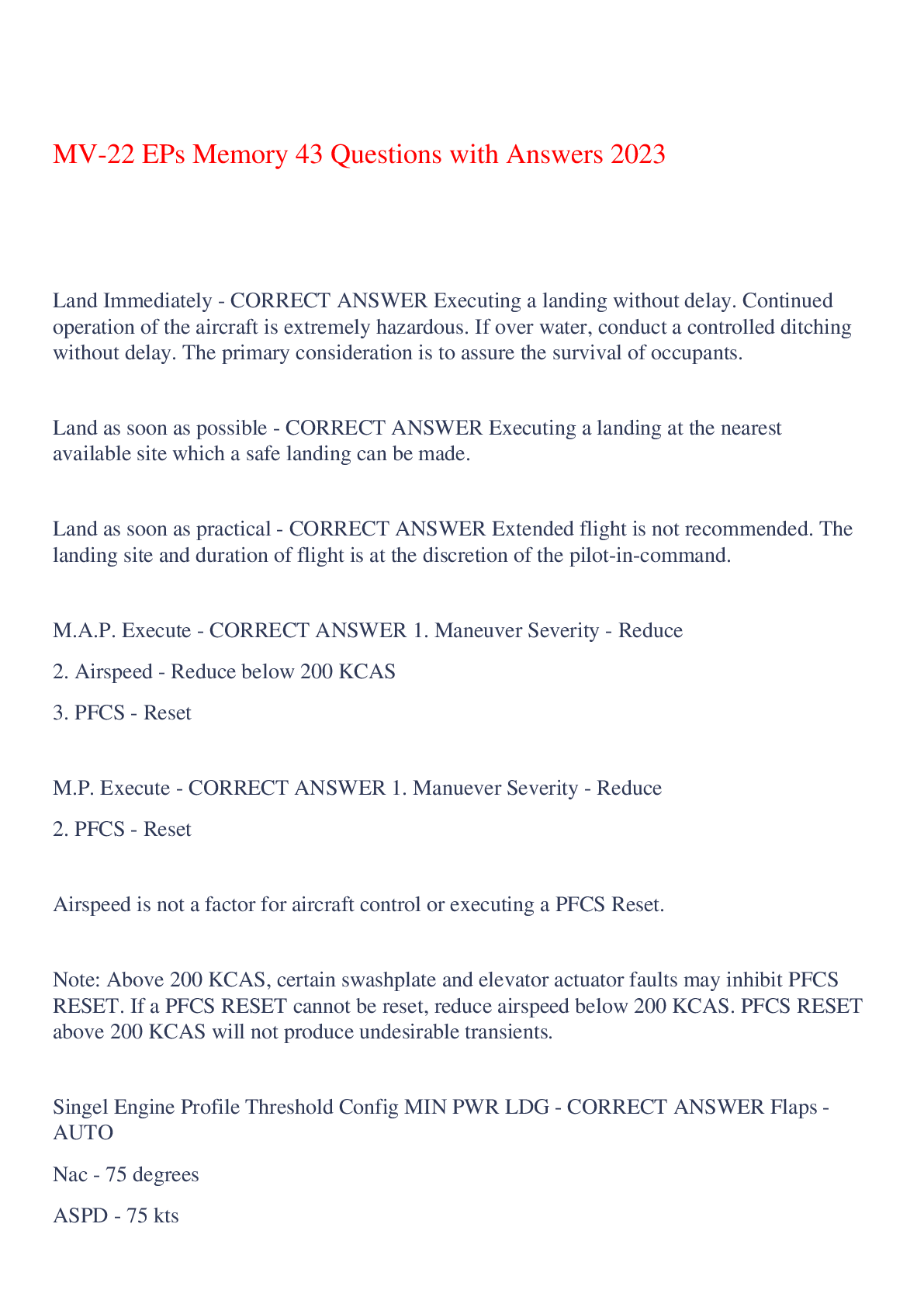
M.A.P. Execute - CORRECT ANSWER *1. Maneuver Severity - Reduce*
*2. Airspeed - Reduce below 200 KCAS*
*3. PFCS - Reset*
FIRE Engine, In Flight - CORRECT ANSWER Note: Bleed air or other hot gas leakage may trigger an engine fire warning without associated secondary indications. Expect affected engine to be low power. Cockpit secondary indications may include increased fuel flow and elevated MGT with low engine torque.
*1. Single engine profile — Establish*
If fire confirmed:
*2. ECL (affected engine) — OFF*
*3. T‐handle (affected engine) — ARM*
If fire persists:
*4. DISCHARGE button — Press*
If fire persists:
*5. Land immediately*
If fire is extinguished:
6. ENG, Single, In Flight — Execute
FIRE, Wing, In Flight - CORRECT ANSWER Note: A sustained MFD FIRE annunciation is an indication of a persistent fire. The FIRE SUPPRESSION panel indicator light(s) may or may not provide positive indication of a sustained fire.
*1. TPUMP BOOST — VERIFIED OFF*
If fire persists:
*2. Land immediately.*
If fire is extinguished:
3. Land as soon as possible.
FIRE, Wing, On Ground - CORRECT ANSWER *1. Emergency Shutdown — Execute*
ENG Dual, NAC >=60° - CORRECT ANSWER WARNING: Dual engine loss in CONV will result in a rapid Nr decay. If Nr decay is not arrested rapidly, autorotation is not recoverable.
Simultaneously (first 4):
*1. TCL — Full aft*
*2. Nacelles — Max rate to aft stop*
*3. Airspeed — 120 KCAS*
*4. FLAPS — 0°*
*5. APU — EMERG RUN/ENGAGE*
*6. Landing gear — Down*
At 150 ft AGL:
*7. Cyclic — Flare, level prior to impact*
*8. TCL — Full forward*
ENG Dual, NAC <60° - CORRECT ANSWER *1. TCL — Full aft*
*2. Nacelles — Max rate to downstop, then 84% Nr*
*3. Airspeed — 170 KCAS*
*4. FLAPS — AUTO*
*5. APU — EMERG RUN/ENGAGE*
*6. ELP — Intercept*
Note: After configuring for glide, attempt engine restart if conditions permit.
*7. Landing gear — EMERG DOWN (As required) (allow 20 seconds for extension)*
WARNING: Extension of landing gear is recommended only if assured of landing on a prepared surface. Landing with gear extended on an unprepared surface may result in loss ofaircraft control.
Note: Expect 200 to 600 fpm increase in rate of descent with landing gear extended.
At approximately 400 — 200 ft AGL:
*8. Mild Flare — EXECUTE, holding 8°-10° nose up. Expect airspeed to decay to 120-115 KCAS on touchdown.*
Note: Flaps FULL can be used on short final to slightly extend the flare.
ENG Single, Hover - CORRECT ANSWER *1. TCL — FULL FORWARD*
*2. Cyclic — Level attitude prior to touchdown*
CAUTION: Aft stick control margin significantly decreases as nacelles are rotated towards 70 degrees. Consideration should be given to adjusting the nacelles aft prior to touch down in order to achieve normal landing attitude.
If a flyaway is to be attempted:
*3. ENG, Single, In Flight — Execute*
Note: Aircraft vertical velocity is sensitive to nacelle beep rate. During climb out, ensure beep rate is slow enough to not induce an uncommanded sink rate.
ENG Single, In Flight - CORRECT ANSWER *1. TCL — Full forward*
*2. Single engine profile — Establish*
If level flight cannot be established:
3. Land as soon as possible (ROL recommended)
Note: Time permitting, dumping fuel (800 lbs/minute) or getting rid of cargo should be considered to reduce weight. Fuel dump will cause a large amount of fuel to be spread over the empennage and aft cabin. If climbing flight can be established:
4. APLN — Transition
5. ECL (affected engine) — OFF
If engine restart is to be attempted:
6. Engine Restart In Flight — Execute
Note: Within one minute of the engine shutting off, the appropriate ECL should be placed in CRANK to prevent thermal lock‐up and then to OFF to reset the start logic.
7. TPUMP BOOST — ON
8. XFER VALVE — OPEN
9. Land as soon as possible (ROL recommended)
If there is a risk of losing the remaining engine, intercept and fly the Emergency Landing Profile. Consideration should be given to starting the APU.
ELEV - CORRECT ANSWER WARNING: If the elevator fails trailing edge down,unrecoverable loss of longitudinal control may occur above 40 KCAS with nacelles less than 85°.
*1. Cyclic — Roll toward 60° AOB*
*2. VTOL — Convert*
3. PFCS — RESET
4. Land as soon as practical
ICDS - CORRECT ANSWER WARNING: Single engine with an ICDS failure is unrecoverable below 170 to 175 KCAS.
CAUTION: Flapping controller is lost. Extended operations between 10° and 75° nacelle should be avoided due to heat buildup and possible elastomeric bearing failure. Transition/convert according to the following to minimize potential for damage.
NAC KCAS
0° 180
30° 150
60° 100
Note:
The ICDS Failure warning will post in the event of a triple Nr sensor failure on one side. Average rotor speed will increase to 104% >=60° nacelle to preserve lateral control authority. Interim Power must still be selected to access higher mast torque levels within the normal Interim Power envelope.
Consideration should be given to reducing gross weight and DA.
*1. M.A. — Execute*
2. Interim Power — As required
3. Land as soon as possible (ROL recommended)
If continued flight is required:
4. APLN — Transition (100% Nr)
If high vibration levels are present:
5. Nacelles — 10°
Once on the ground:
6. Emergency Shutdown — Execute (simultaneous — no rotor brake)
PRGB/TAGB - CORRECT ANSWER If secondary indications confirm impending gearbox failure:
*1. Land immediately*
If no secondary indications exist:
2. Land as soon as possible.
SINK - CORRECT ANSWER If VRS is suspected:
*1. Nacelles — Beep forward (max rate for 2 sec/<15°)*
*2. Cyclic — Forward to accelerate*
*3. TCL — Fixed (alt permitting)*
NOTE: TCL power application within VRS may cause uncontrollable roll.
STALL - CORRECT ANSWER *1. Maneuver Severity — Reduce to decrease angle of attack and load factor*
*2. TCL — Forward*
If unable to complete steps 1 and 2:
*3. CONV — Convert, max rate*
*4. TCL — As required*
ECL NOT IN FLY - CORRECT ANSWER If committed to flight:
*1. ECLs — FLY (immediately)*
If still on deck:
*2. TCL — Full aft*
*3. Hover Nacelle - Set*
4. ECLs — FLY
FCC X/Y FAIL
(1/2. 1/3. 2/3) - CORRECT ANSWER WARNING:
EXPECT:
— Severe difficulty controlling the aircraft in all axes.
—Loss of TCRS, ECL functionality, conversion protection, SLL, primary flapping protection,
and reliable stall warning.
CAUTION:
Overtorques are possible due to the loss of TCRS. Pilot will need to manually manage Qm. Lateral maneuvering above 109%mast
torque may result in PRTR OVERTORQUE.
- Backup flapping controller provides trimmed‐flight flapping protection; however, in maneuvering flight the aircraft is still vulnerable to critical flapping condition.
- Operations between 10 and 75 nacelle may result in destructive heat buildup in the elastomeric bearing.
NOTE:
-Keeping the TCL softstop active may aid in reducing overtorques. Pushing through the softstop may be necessary to achieve 100%
Qm.
- With a FCC X/3 failure, setting flaps to 0 in APLN may improve roll control. Reset flaps to AUTO before landing.
- With a FCC X/3 failure, establishing a steady‐heading sideslip and keeping airspeed above 170 KCAS will help preserve some lateral authority in APLN.
- The trim system will be degraded and AFCS
trim backdrives are disabled.
*1. M.P. — Execute*
If CCDL failure exists:
2. NACELLE B/U ENABLE — ON
If caution fails to clear:
3. Land as soon as possible (ROL recommended)
If extended flight is required:
4. APLN — Transition (100% Nr)
Transition/Convert accordingly:
NAC KCAS
0° 180
30° 150
60° 100
5. Altitude — < 5,000 ft
6. Gross weight — Reduce, as practical
If caution clears:
7. Land as soon as practical
FEATHERING HIGH HOT - CORRECT ANSWER CAUTION: CONV operations may not clear the caution.
APLN at low angle of attack or VTOL at low
airspeed (<40 KCAS) is recommended. Destructive
heat buildup may occur in as little as
5 minutes after caution posts if heat buildup
is allowed to continue.
Note: Once the condition has been alleviated, the
FEATHERING HIGH HOT condition may
take several minutes to clear.
*1. Maneuver Severity — Reduce*
2. APLN — Transition
If unable to transition to APLN:
3. Rotor condition/airspeed — Reduce (FFR in green or yellow)
If caution fails to clear:
4. Land as soon as possible (ROL recommended)
FLAPPING HIGH HOT - CORRECT ANSWER CAUTION: Operations between 35° and 75° nacelle may not clear the caution. Flapping is most critical near 60° nacelle, high GW, forward CG, and high DA. Destructive heat buildup may occur in as little as 1 minute after caution posts if heat buildup is allowed to continue.
Note: Once the condition has been alleviated, the
FLAPPING HIGH HOT condition may take
several minutes to clear.
*1. Maneuver Severity — Reduce*
2. APLN — Transition
If unable to transition to APLN:
3. Rotor condition/airspeed — Reduce (FFR in green or yellow)
If caution fails to clear:
4. Land as soon as possible (ROL recommended)
PLT NAC CONTR FAIL - CORRECT ANSWER *1. NAC CONTR switches (both sides) — Attempt to override nacelle motion*
*2. NAC CONTR DSBL switches — DSBL*
3. PFCS — RESET
4. NAC CONTR DSBL switches — Individually
select NAC CONTR one at a time to isolate
PRGB CHIPS - CORRECT ANSWER If abnormal secondary indications exists (oil pressure/ temperature, noises, vibrations):
*1. Land immediately*
Otherwise:
2. Land as soon as possible
PRTR VIBRATION HIGH - CORRECT ANSWER WARNING: Excessive pitch link wear can lead to catastrophic failure without initially feeling severe
vibration levels. Nacelle pitching motion may
provide the best indication of increasing
vibration levels.
- With high vibration levels, 0° nacelle may
cause catastrophic failure of the nacelle
downstop.
*1. Maneuver Severity — Reduce*
If severe vibration levels are present and rotor system failure seems imminent:
*2. Land immediately (ROL recommended)*
If vibration levels do not appear to be severe:
3. Nacelles — 10°
4. Land as soon as possible (ROL recommended)
WARNING: Delay conversion until immediately prior to
landing due to possible damaged elastomeric
bearings or pitch links.
ROTOR LOAD HIGH - CORRECT ANSWER Indicates excessive oscillatory loads in critical
rotor components. The intent of the emergency
procedure is to minimize angle‐of‐attack and to
utilize the FFR to reduce critical rotor loading
conditions.
Note: Once the condition has been alleviated, the
caution should clear within seconds.
*1. Maneuver Severity — Reduce*
2. APLN — Transition
If unable to transition to APLN:
3. Rotor condition/airspeed — Reduce (FFR in green or yellow)
If caution fails to clear:
4. Land as soon as possible (ROL recommended)
EMERGENCY SHUTDOWN
ON THE GROUND - CORRECT ANSWER *1. ECLs — OFF (Simultaneously)*
*2. T‐handles — ARM*
*3. ROTOR BRAKE — ON*
CAUTION: If the reason for the emergency
shutdown is due to a ICDS Fail or
midwing fire or midwing accessories,
do not use the ROTOR BRAKE for
shutdown.
*4. APU — STOP (As required)*
*5. BATTERY — OFF*
*6. Egress — As required*
COCKPIT OR CABIN FIRE IN FLIGHT - CORRECT ANSWER *1. EMERGENCY OXYGEN/Masks — ON*
Note: The emergency oxygen system is designed to provide approximately 3 minutes of 100% oxygen for a crew of 4.
*2. TPUMP BOOST — OFF*
*3. Portable fire extinguishers — Employ*
If fire persists:
*4. Land immediately.*
If fire is extinguished:
5. Smoke and Fume Elimination — Execute
LOW SPEED UNCOMMANDED NOSE DOWN - CORRECT ANSWER *1. Nacelles — Max rate aft, as required*
*2. Pedals and lateral stick — Neutral*
MLG BAY FIRE - CORRECT ANSWER Note: There are no cockpit indications associated with a MLG bay fire and activation of the MLG bay FSS. Potential indications or effects may be noticed in-flight or during landing, which may or may not include: LANDGEAR ABORT and/or LAND GEAR FAULT, inability to extend landing gear, failed tires or tire failure upon touchdown, loss of wheel brake function on affected side, UTIL SYSTEMS INOP, LDG GEAR/UTIL INOP and/or HYD 3 FAIL. One or more fuel system operations may be negatively impacted including fuel transfer, all refuel operations, refuel manifold purge, once per flight check (OPFC), and fuel jettison.
If Fire Persists:
*1. Land Immediately*
If Fire is Extinguished:
*2. Land as soon as possible.*
OUT OF CONTROL RECOVERY - CORRECT ANSWER The departure from controlled flight paragraph in A1-V22AB-NFM-000, NATOPS Flight Manual Navy Model MV-22B Tiltrotor, Chapter 11, addresses some of the possible characteristics of a V-22 departure from controlled flight. This procedure addresses those departures and provides a means of recovery from other out of control situations.
*1. Controls — Neutral*
*2. Pedals — Cancel yaw*
*3. AOA — Assess*
4. Execute unusual attitude recovery.
FORMATION FLIGHT ROLL-OFF - CORRECT ANSWER *1. Lateral Cyclic — Opposite Roll, As Required*
*2. TCL — Increase, As Required*
*3. Pedals — Relax*
*4. Nacelles — Fixed*
CAUTION
- Opposing the directional backdrive
via large or rapid pedal inputs may
cause FLAPPING CRITICAL with no
measurable improvement in roll-off
recovery.
- Executing this recovery procedure
may result in proprotor gearbox overtorques.
SMOKE AND FUME ELIMINATION - CORRECT ANSWER Smoke and fumes in the aircraft can quickly
incapacitate the crew and should be eliminated as
quickly as possible. Smoke can potentially obscure
visibility creating a greater flying hazard than the fire
itself. Consideration should be given that opening the
ramp or cargo door may cause the smoke and fumes
to move forward into the cockpit obscuring the pilots'
vision. The cockpit side window vents may assist in
clearing smoke and fumes, but low pressure makes
the vents difficult to open in APLN above 170 KCAS. A
sideslip in CONV may assist in opening the cockpit
side window vents and clearing the smoke and fumes.
Note: The emergency oxygen system is
designed to provide approximately
3 minutes of 100% oxygen for a crew
of 4.
*1. EMERGENCY OXYGEN/Masks — ON*
2. Cockpit door — As required
3. Cockpit side window vents — Open
4. Utility Isolation valve — OPEN
5. RAMP/DOOR — As required
If ECS is suspected source:
6. ECS — OFF
If battery venting is suspected (putrid sulfur (rotten
egg) smell):
7. BATTERY switch — OFF
8. Land as soon as practical.
EMERGENCY LUBE FAIL - CORRECT ANSWER *1. If PRGB PRESS LOST posts — Land immediately.*
If the caution does not clear:
2. Land as soon as practical.
[Show More]

.png)