BUS 475
>
EXAM
>
Splunk Core Certified User & Splunk Fundamentals 1|237 Questions with Answers,100% CORRECT (All)
Splunk Core Certified User & Splunk Fundamentals 1|237 Questions with Answers,100% CORRECT
Document Content and Description Below
Splunk Core Certified User & Splunk Fundamentals 1|237 Questions with Answers
T/F:
Machine data is always structured. - CORRECT ANSWER False.
Machine data can be structured or unstructured.
Machine data makes
...
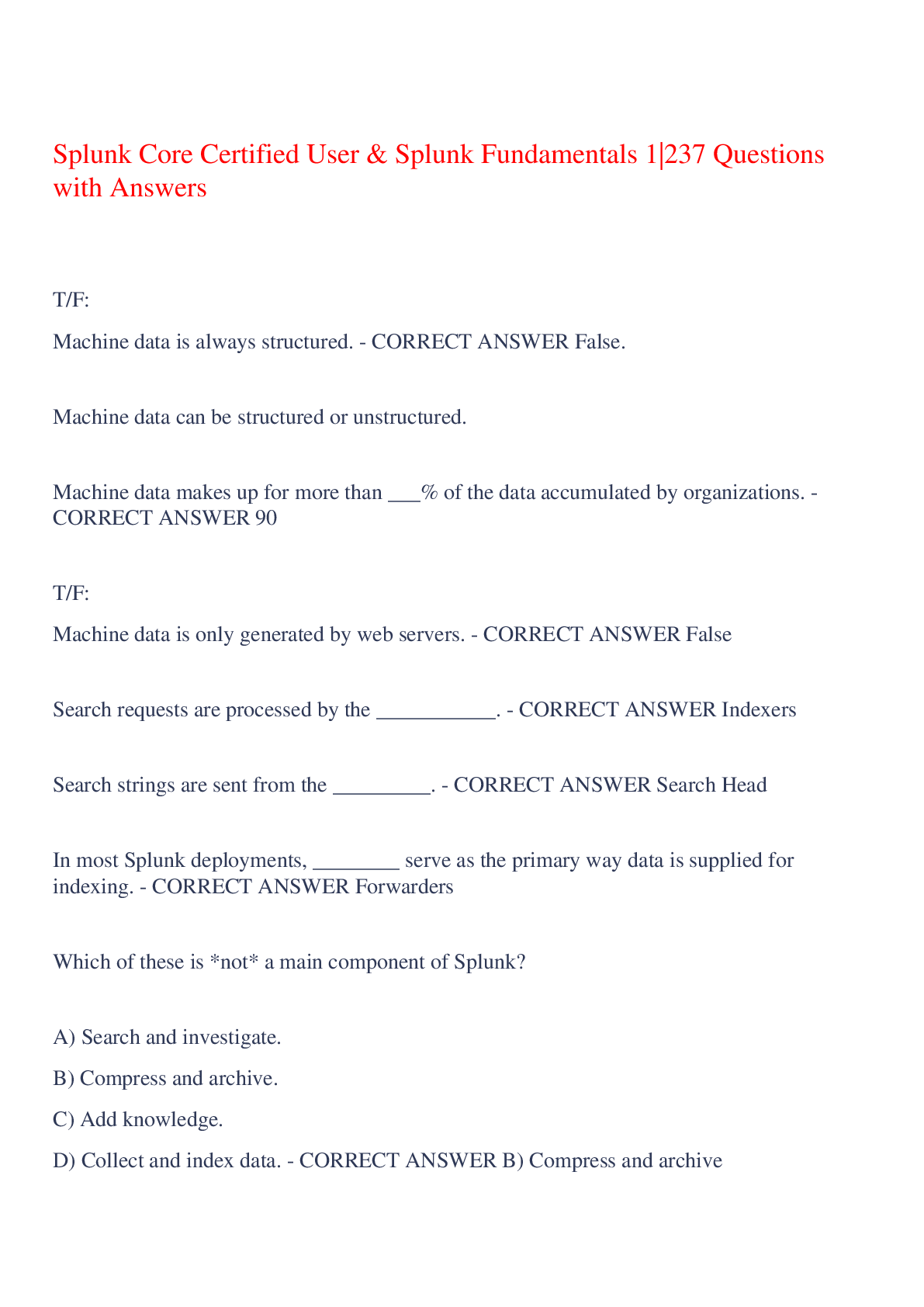
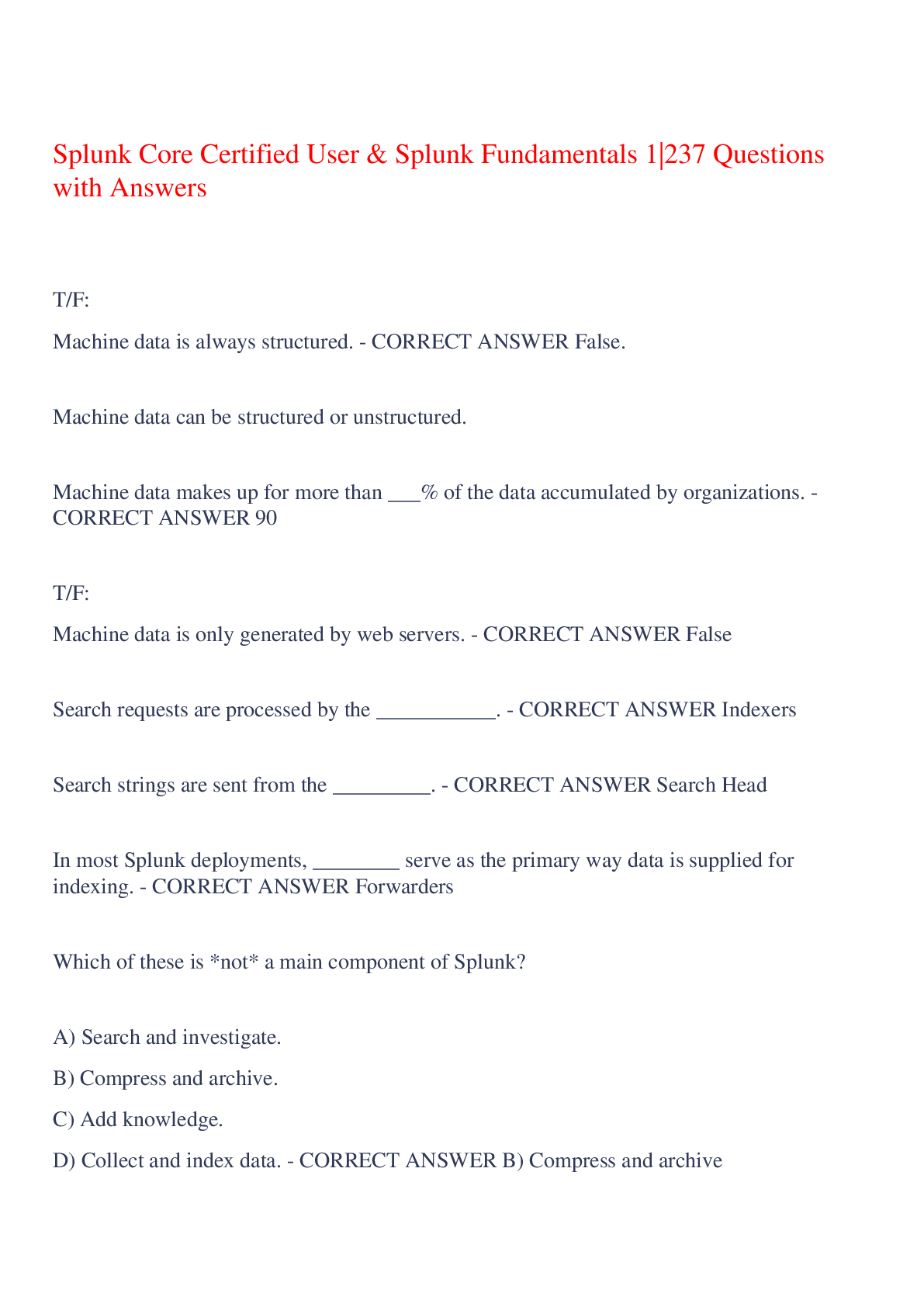
Splunk Core Certified User & Splunk Fundamentals 1|237 Questions with Answers
T/F:
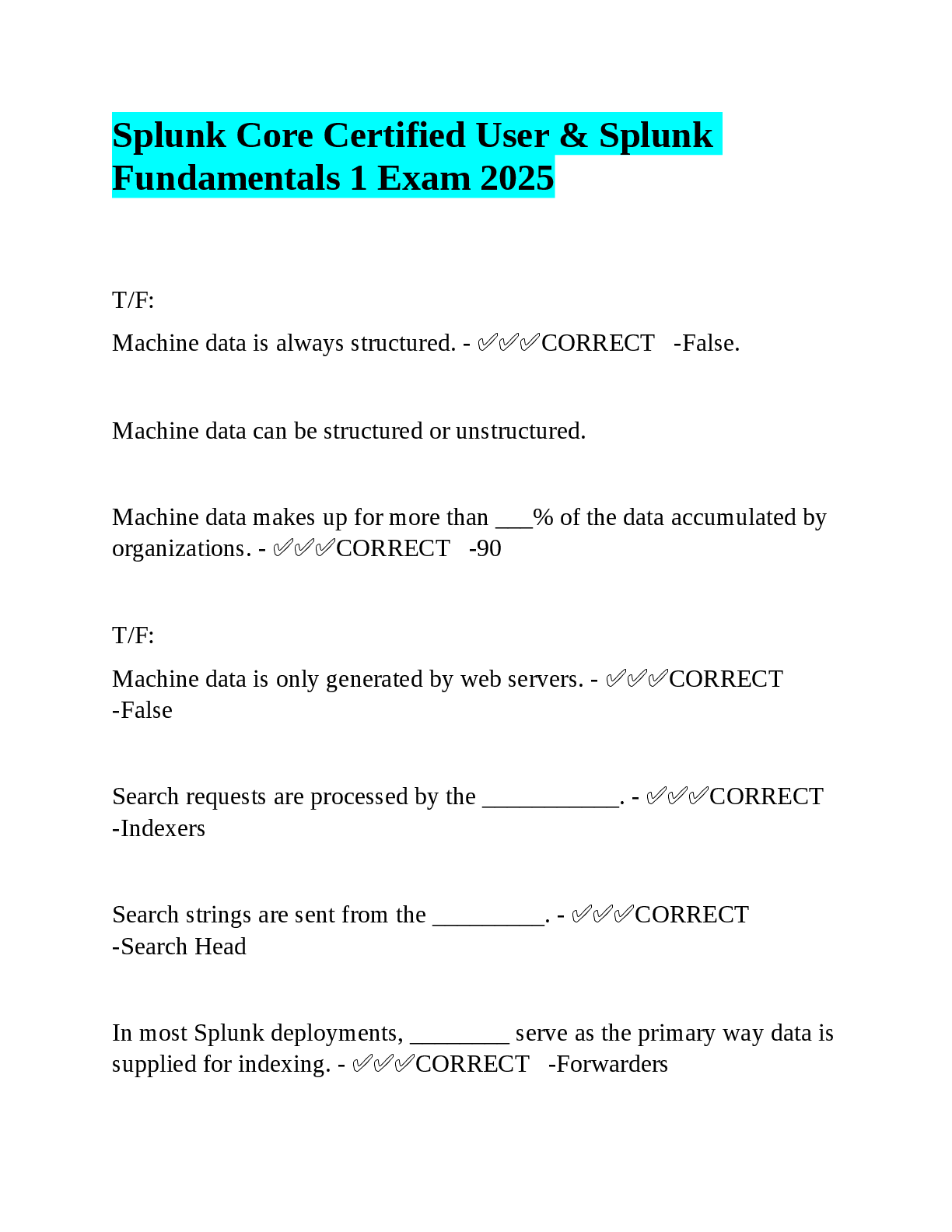
Machine data is always structured. - CORRECT ANSWER False.
Machine data can be structured or unstructured.
Machine data makes up for more than ___% of the data accumulated by organizations. - CORRECT ANSWER 90
T/F:
Machine data is only generated by web servers. - CORRECT ANSWER False
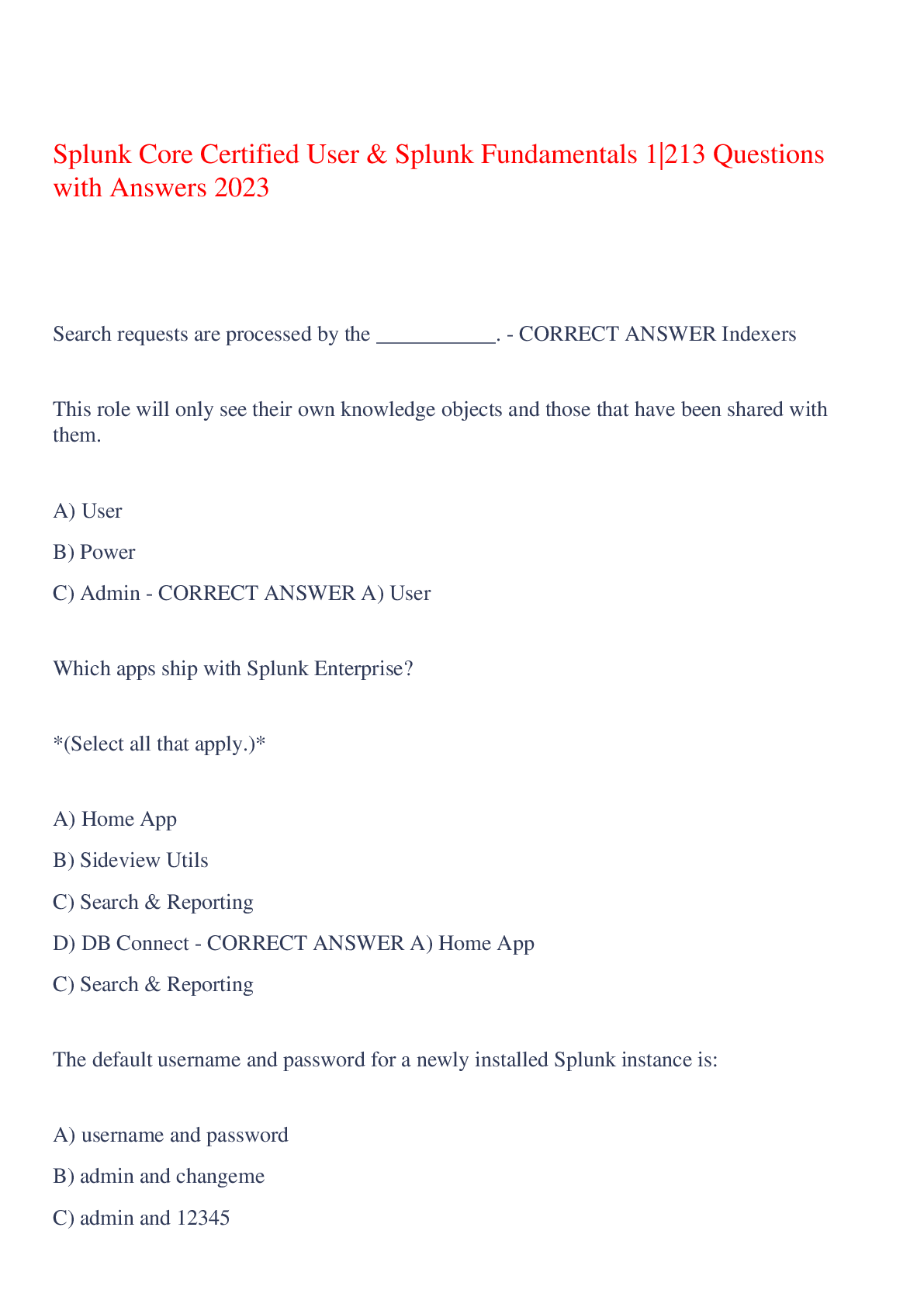
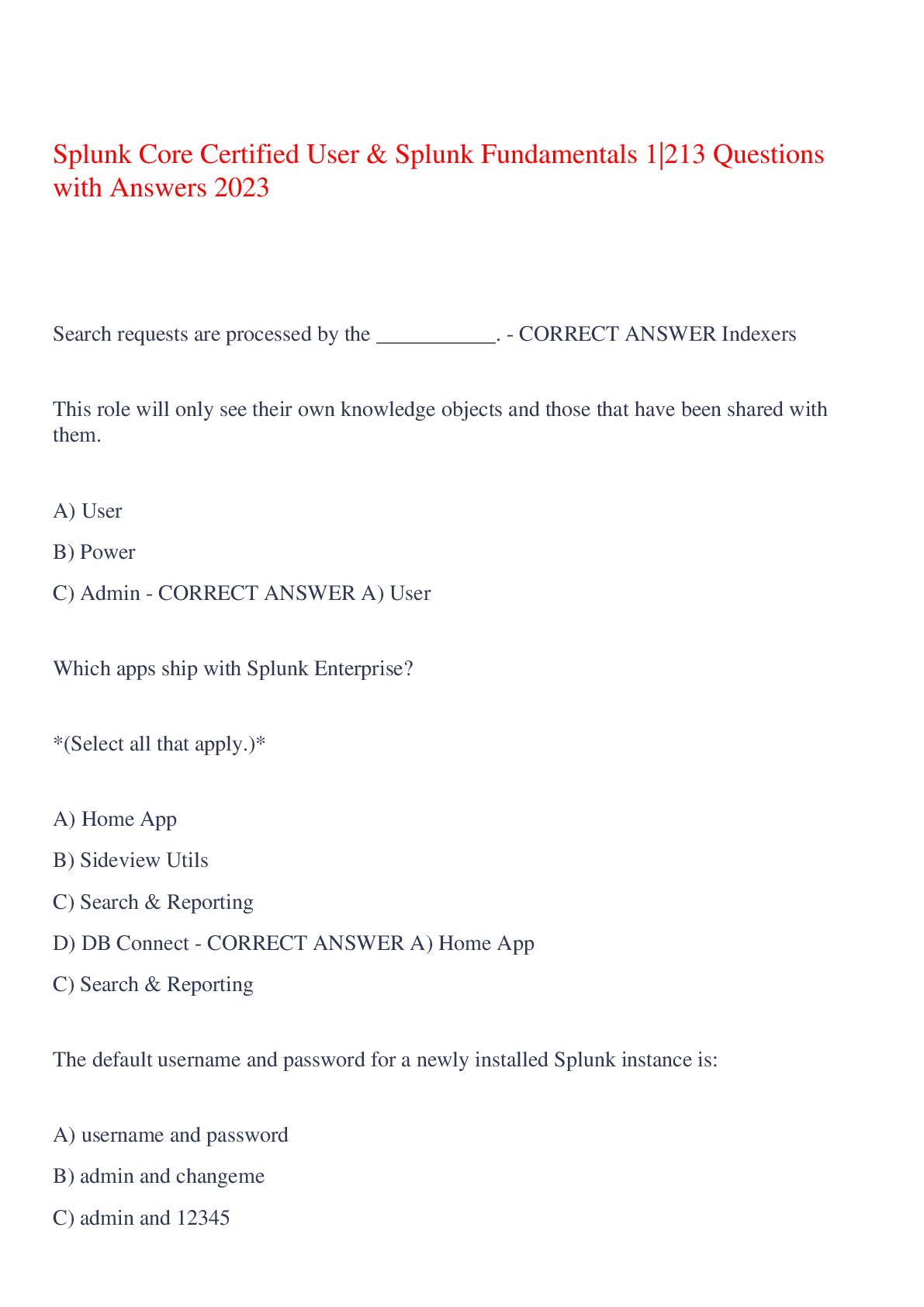
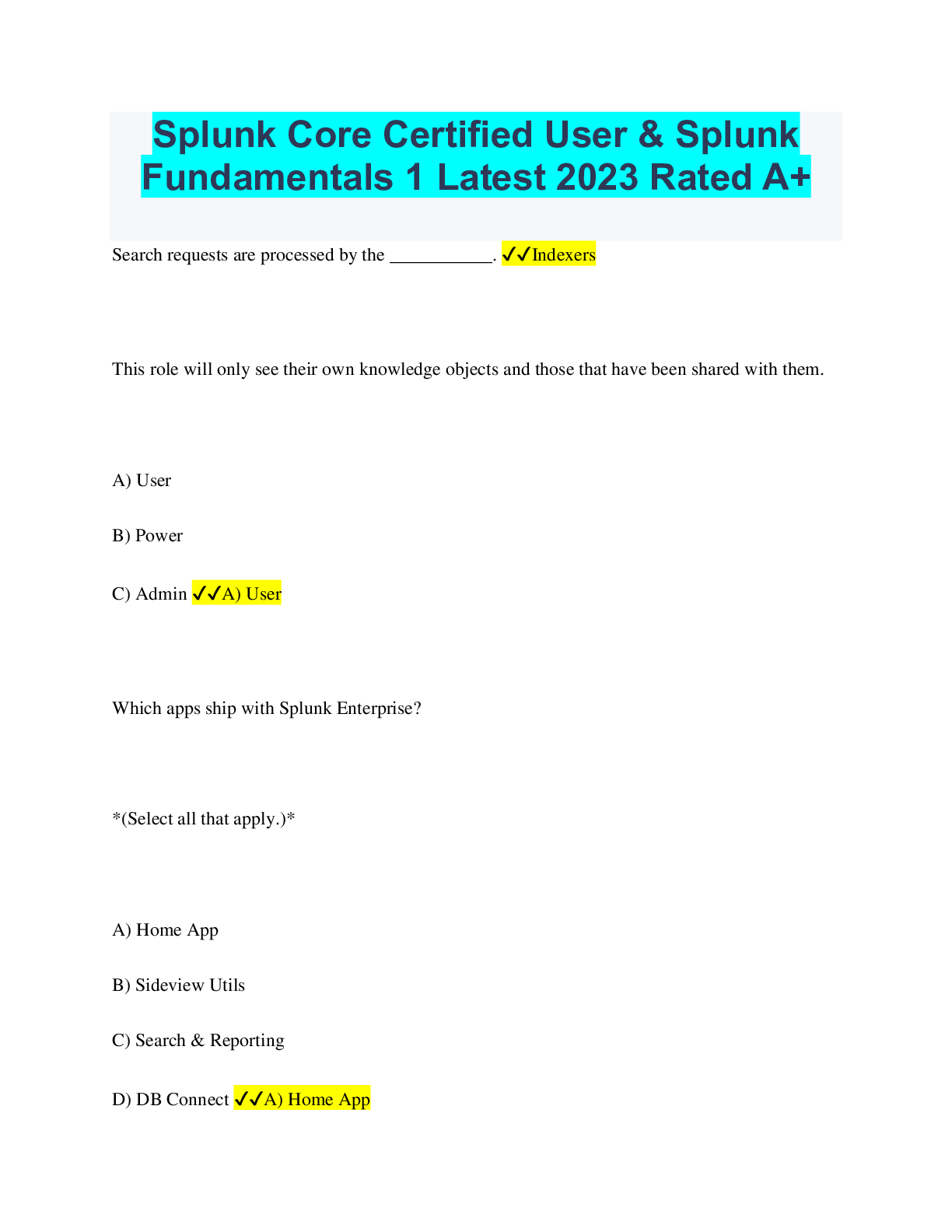
Search requests are processed by the ___________. - CORRECT ANSWER Indexers
Search strings are sent from the _________. - CORRECT ANSWER Search Head
In most Splunk deployments, ________ serve as the primary way data is supplied for indexing. - CORRECT ANSWER Forwarders
Which of these is *not* a main component of Splunk?
A) Search and investigate.
B) Compress and archive.
C) Add knowledge.
D) Collect and index data. - CORRECT ANSWER B) Compress and archive
What are the three main processing components of Splunk?
*(Select all that apply.)*
A) Indexers
B) Deployment Maker
C) Search Heads
D) Forwarders
E) Distributors - CORRECT ANSWER A) Indexers
C) Search Heads
D) Forwarders
_________ define what users can do in Splunk.
A) Tokens
B) Disk permissions
C) Roles - CORRECT ANSWER C) Roles
This role will only see their own knowledge objects and those that have been shared with them.
A) User
B) Power
C) Admin - CORRECT ANSWER A) User
T/F:
You can launch and manage apps from the home app. - CORRECT ANSWER True
What are the three main default roles in Splunk Enterprise?
*(Select all that apply.)*
A) King
B) User
C) Manager
D) Admin
E) Power - CORRECT ANSWER B) User
D) Admin
E) Power
Which apps ship with Splunk Enterprise?
*(Select all that apply.)*
A) Home App
B) Sideview Utils
C) Search & Reporting
D) DB Connect - CORRECT ANSWER A) Home App
C) Search & Reporting
The default username and password for a newly installed Splunk instance is:
A) username and password
B) admin and changeme
C) admin and 12345
D) buttercup and rawks - CORRECT ANSWER B) admin and changeme
Files indexed using the *upload* input option get indexed _____.
A) Each time Splunk restarts.
B) Every hour.
C) On every search.
D) Once. - CORRECT ANSWER D) Once.
T/F:
The monitor input option will allow you to continuously monitor files. - CORRECT ANSWER True
Splunk knows where to break the event, where the time stamp is located and how to automatically create field value pairs using these.
A) Line breaks
B) Source types
C) File names - CORRECT ANSWER B) Source types
Splunk uses ______________ to categorize the type of data being indexed. - CORRECT ANSWER sourcetype
In most production environments, _____________ will be used as your the source of data input. - CORRECT ANSWER Forwarders
How is the *asterisk* used in Splunk search?
A) As a wildcard.
B) To make a nose for your clown emoticon.
C) As a place holder.
D) To add up numbers. - CORRECT ANSWER A) As a wildcard.
Which following search mode toggles behavior based on the type of search being run?
A) Smart
B) Fast
C) Verbose - CORRECT ANSWER A) Smart
T/F:
When zooming in on the event time line, a new search is run. - CORRECT ANSWER False
T/F:
These searches will return the same results...
failed password
failed AND password - CORRECT ANSWER True
A search job will remain active for _____ minutes after it is run.
A) 5
B) 10
C) 30
D) 60
E) 90 - CORRECT ANSWER B) 10
What attributes describe the field below?
a dest 4
(Select all that apply.)
A) It contains 4 values.
B) It contains numerical values.
C) It cannot be used in a search.
D) It contains string values. - CORRECT ANSWER A) It contains 4 values.
D) It contains string values.
T/F:
Wildcards cannot be used with field searches. - CORRECT ANSWER False
T/F:
Field values are case sensitive. - CORRECT ANSWER False
Which is not a comparison operator in Splunk?
(Select your answer.)
A) >
B) ?=
C) <=
D) !=
E) = - CORRECT ANSWER ?=
Field names are ________.
*(Select all that apply.)*
A) Always capitalized.
B) Not important in Splunk.
C) Case sensitive.
D) Case insensitive. - CORRECT ANSWER C) Case sensitive
This symbol is used in the "Advanced" section of the time range picker to round down to nearest unit of specified time.
(Select your answer.)
A) %
B) ^
C) @
D) &
E) * - CORRECT ANSWER C) @
T/F:
Time to search can only be set by the time range picker. - CORRECT ANSWER False
What is the most efficient way to filter events in Splunk?
A) By time.
B) Using booleans.
C) With an asterisk. - CORRECT ANSWER A) By time.
T/F:
As a general practice, exclusion is better than inclusion in a Splunk search. - CORRECT ANSWER False
Having separate indexes allows:
*(Select all that apply.)*
A) Faster Searches.
B) Ability to limit access.
C) Multiple retention policies. - CORRECT ANSWER A) Faster Searches.
B) Ability to limit access.
C) Multiple retention policies.
Would the ip column be removed in the results of this search? Why or why not?
sourcetype=a* | rename ip as "User" | fields - ip
A) Yes, because a pipe was used between search commands.
B) No, because the name was changed.
C) No, because table columns can not be removed.
D) Yes, because the negative sign was used. - CORRECT ANSWER B) No, because the name was changed.
T/F:
Excluding fields using the Fields Command will benefit performance. - CORRECT ANSWER False
Which command removes results with duplicate field values?
A) Dedup
B) Limit
C) Join
D) Distinct - CORRECT ANSWER A) Dedup
What is missing from this search?...
sourcetype=a* | rename ip as "User IP" | table User IP
A) A pipe.
B) Search terms
C) Quotation marks around User IP.
D) A table command. - CORRECT ANSWER C) Quotation marks around User IP.
What command would you use to *remove the status field* from the returned events?
sourcetype=a* status=404 | ___________ status
A) table
B) fields -
C) not
D) fields - CORRECT ANSWER B) fields -
Which one of these is not a stats function?
A) Count
B) Avg
C) Addtotals
D) List
E) Sum - CORRECT ANSWER C) Addtotals
To display the most common values in a specific field, what command would you use?
A) top
B) all
C) table
D) rare - CORRECT ANSWER A) top
Which clause would you use to rename the count field?
sourcetype=vendor* | stats count __________ "Units Sold"
A) rename
B) to
C) as
D) show - CORRECT ANSWER C) as
How many results are shown by default when using a Top or Rare Command? - CORRECT ANSWER 10
Which stats function would you use to find the average value of a field? - CORRECT ANSWER average (or avg)
If a search returns this, you can view the results as a *chart*.
A) A list.
B) Statistical values
C) Time limits.
D) Numbers - CORRECT ANSWER B) Statistical values
T/F:
A time range picker can be included in a report. - CORRECT ANSWER True
These roles can create reports:
*(Select all that apply.)*
A) Admin
B) User
C) Power - CORRECT ANSWER A) Admin
B) User
C) Power
In a dashboard, a time range picker will only work on panels that include a(n) __________ search.
A) transforming
B) inline
C) visualization
D) accelerated - CORRECT ANSWER B) inline
T/F:
The User role can not create reports. - CORRECT ANSWER False
Adding child data model objects is like the ______ operator in the Splunk search language.
A) NOT
B) AND
C) OR - CORRECT ANSWER B) AND
T/F:
Pivots cannot be saved as reports panels. - CORRECT ANSWER False
The instant pivot button is displayed in the statistics and visualization tabs when a _______ search is run.
A) transforming
B) non-transforming - CORRECT ANSWER B) non-transforming
These are knowledge objects that provide the data structure for pivot.
A) Alerts
B) Indexes
C) Reports
D) Data models - CORRECT ANSWER D) Data models
T/F:
Pivots can be saved as dashboards panels. - CORRECT ANSWER True
T/F:
A lookup is categorized as a dataset. - CORRECT ANSWER True
External data used by a Lookup can come from sources like:
*(Select all that apply.)*
A) Scripts.
B) CSV files.
C) None. Only internal data can be used.
D) Geospatial data. - CORRECT ANSWER A) Scripts
B) CSV files
D) Geospatial data
When using a .csv file for Lookups, the first row in the file represents this.
A) Field names.
B) Output fields.
C) Nothing, it is ignored.
D) Input fields. - CORRECT ANSWER A) Field names.
Finish this search command so that it displays data from the http_status.csv Lookup file.
| _________________ http_status.csv
A) inputlookup
B) lookup=*
C) datalookup
D) lookup - CORRECT ANSWER A) inputlookup
To keep from *overwriting* existing fields with your Lookup you can use the _________ clause. - CORRECT ANSWER OUTPUTNEW
T/F:
Alerts can be shared to all apps. - CORRECT ANSWER True
T/F:
Real-time alerts will run the search continuously in the background. - CORRECT ANSWER True
T/F:
Alerts can run uploaded scripts. - CORRECT ANSWER True
T/F:
Once an alert is created, you can no longer edit its defining search. - CORRECT ANSWER False
T/F:
Alerts can send an email. - CORRECT ANSWER True
Which function is not a part of a single instance deployment?
A) Searching
B) Parsing
C) Clustering
D) Indexing - CORRECT ANSWER C) Clustering
T/F:
Events are always returned in chronological order. - CORRECT ANSWER False
Finish the rename command to change the name of the status field to HTTP Status.
sourcetype=a* status=404 | rename ______________
A) as "HTTP Status"
B) status as "HTTP Status"
C) status to "HTTP Status"
D) status as HTTP Status - CORRECT ANSWER B) status as "HTTP Status"
_____________ are reports gathered together into a single pane of glass.
A) Dashboards
B) Panels
C) Alerts
D) Scheduled Reports - CORRECT ANSWER A) Dashboards
An alert is an action triggered by a _____________.
A) Selected field
B) Tag
C) Report
D) Saved search - CORRECT ANSWER D) Saved Search
What is a transforming command? - CORRECT ANSWER A type of search command that *orders the results into a data table*. Transforming commands "transform" the specified cell values for each event into numerical values that Splunk Enterprise can use for statistical purposes.
What are *seven* common transforming commands? - CORRECT ANSWER Transforming commands include:
1) chart
2) timechart
3) stats
4) top
5) rare
6) contingency
7) highlight.
What does CIM stand for and what is it? - CORRECT ANSWER Common Information Model (CIM).
A shared semantic model focused on extracting value from data. The CIM is implemented as an add-on that contains a collection of data models, documentation, and tools that support the consistent, normalized treatment of data for maximum efficiency at search time.
What is a lookup? - CORRECT ANSWER Lookup is a command to *invoke field value lookups*. The lookup command can merge unstructured and structured data
For example:
...| lookup AS
What is a scheduled report? - CORRECT ANSWER A report that is scheduled to run on a regular interval, making it a type of *scheduled search*. Scheduled reports typically initialize one or more alert actions each time they run, such as sending the results of the report run to a set of recipients, logging and indexing custom log events, or adding the results to a CSV lookup.
What is pivot? - CORRECT ANSWER Pivot is a command that applies a pivot operation to data.
For example: This command counts the number of events in the "HTTP Requests" object in the "Tutorial" data model.
...| pivot Tutorial HTTP_requests count(HTTP_requests) AS "Count of HTTP requests"
What are the *three* required parts of a pivot? - CORRECT ANSWER The pivot command is a generating command and must be first in a search pipeline. It requires a large number of inputs: *the data model*, *the data model object*, and *pivot elements*.
...| pivot
What does SPL stand for and what are some of it's features? - CORRECT ANSWER Search Processing Language (SPL)
It is Splunk's *proprietary* language. SPL encompasses all the search commands and their functions, arguments, and clauses. Its syntax was originally *based on the Unix pipeline and SQL*. The scope of SPL includes *data searching, filtering, modification, manipulation, insertion, and deletion*.
What is the most recent version of Splunk that is stable? - CORRECT ANSWER Spunk Version 7.2.1
(As of 12/06/2018)
What are the *three* Splunk search modes? - CORRECT ANSWER 1) *Verbose* (returns most amount of data)
2) *Fast* (limits types of data returned and emphasizes speed)
3) *Smart* (switches to verbose or fast based on search)
How would you use a wildcard to create a search that looks for all of the *product IDs* that begin with the letter *S* and end in *G01*. - CORRECT ANSWER productID=S*G01
Indexes consist of what *two* types of files? - CORRECT ANSWER 1) Raw data files
2) Index files
What is an index? - CORRECT ANSWER A collection of databases.
What is time-series data? - CORRECT ANSWER Any data with time stamps.
How does Splunk indexing work? - CORRECT ANSWER Time-series data is broken into events, based on the timestamps.
When should you avoid using wildcards? - CORRECT ANSWER When the items searched against have *punctuation*, such as SF-RT_5G01
A typical search would be: productID=S*G01
But due to the way Splunk indexes punctuation (such as underscore or dash), this search would likely fail.
What is the difference between *stats*, *chart*, and *time chart*? - CORRECT ANSWER Stats: Tabular format that allows *unlimited fields*.
Chart: Graphical format that allows *two fields* (x and y axis) and can be pie chart, bar chart, line chart etc.
Time Chart: Allows display in bar or line graph format, and only takes in *one field* because it uses time for the X axis.
What are the *five* default fields for every event in Splunk? - CORRECT ANSWER 1) host
2) source
3) source type
4) index
5) timestamp
All of Splunk's configurations are written within what file type? - CORRECT ANSWER Plain text *.conf* files.
What are the *five* Splunk data bucket ages, from most current to oldest? - CORRECT ANSWER 1) Hot
2) Warm
3) Cold
4) Frozen
5) Thawed
What happens to data once it reaches the frozen bucket? - CORRECT ANSWER Depending on the aging policy, the data in the frozen bucket is either *archived or deleted*.
What does a Splunk license specify? - CORRECT ANSWER How much *data* you can index per calendar day.
What does a generating command do? - CORRECT ANSWER A generating command *fetches information* from the indexes, *without any transformations*.
Generating commands are either event-generating (distributable or centralized) or report-generating. Most report-generating commands are also centralized. Depending on which type the command is, the results are returned in a list or a table.
What does the metadata command do? - CORRECT ANSWER The metadata command returns a list of sources, sourcetypes, or hosts from a specified index or distributed search peer.
For Example: ...| metadata type=hosts
What is the Splunk data inspector process? - CORRECT ANSWER 1) Look at data and decide how to process it.
2) Label data by source type.
3) Break data into events.
4) Normalize timestamps.
5) Added to Splunk index to be searched
Where would you go to determine whether the built-in search optimizations are helping your search to complete faster? - CORRECT ANSWER Job Inspector
What is the job of the Search Head? - CORRECT ANSWER *Handle search requests* using Splunk search language. Enriches data with reports, dashboards, visualizations.
Search heads send searches to... - CORRECT ANSWER Indexers
What processes machine data, storing the results in indexes as events, and enables fast search and analysis? - CORRECT ANSWER The Splunk *Indexer*.
As the Indexer indexes data, it creates a number of files organized by __________ - CORRECT ANSWER age
(using the imestamps)
What do Indexes point to? - CORRECT ANSWER Indexes point to raw compressed data.
Which Splunk component allows a user to extract fields and transform data without changing the underlying index data? - CORRECT ANSWER Search Heads
Where do forwarders usually reside? - CORRECT ANSWER Forwarders reside on the machines where the data originates.
Which Splunk component supplies data to be indexed? - CORRECT ANSWER Forwarders
What are the three less common Splunk components? - CORRECT ANSWER 1) Deployment Server
2) Cluster Master
3) License Master
What are the Splunk *Basic* Deployment limitations? - CORRECT ANSWER 1) Indexing less than 20GB per day.
2) Under 20 users.
3) Limited number of forwarders.
What is the minimum number of search heads required for a search head cluster? - CORRECT ANSWER Three
What is used to *manage and distribute apps* to the members of the search head cluster? - CORRECT ANSWER A deployer.
What are the benefits of a Search Head Cluster? - CORRECT ANSWER 1) Services more users.
2) Allows users and searches to share resources.
3) Distribute requests across the set of indexers.
What are the benefits of a traditional Index Cluster? - CORRECT ANSWER 1) Replicate data.
2) Prevent data loss.
3) Promote availability.
4) Manage multiple indexers.
Which ports are required for Splunk? - CORRECT ANSWER 1) splunkweb, port 8000
2) splunkd, port 8089
3) forwarder, port 9997
What does the *NIX command do for a Splunk installation? - CORRECT ANSWER *NIX decompresses the .tar.gz file in the path you want Splunk to run from.
What file extension is the Windows installer? - CORRECT ANSWER .msi
While Splunk starts automatically on Windows after installation, to automatically start Splunk on a Linux a user is required to enable... - CORRECT ANSWER boot-start
The difference between a single deployment and an Splunk enterprise deployment is in... - CORRECT ANSWER The post-deployment configuration.
Which CLI command is used to...
*Display a command usage summary* - CORRECT ANSWER splunk help
Which CLI commands are used to...
*Manage the Splunk processes* - CORRECT ANSWER splunk [start | stop | restart]
Which CLI command is used to...
*Automatically accept the license without prompt* - CORRECT ANSWER splunk start --accept-license
Which CLI command is used to...
*Display the Splunk process status* - CORRECT ANSWER splunk status
Which CLI command is used to...
Show the port that the *splunkd* listens on - CORRECT ANSWER splunk show splunkd-port
Which CLI command is used to...
Show the port that *Splunk Web* listens on - CORRECT ANSWER splunk show web-port
Which CLI command is used to...
*Show the servername of this instance* - CORRECT ANSWER splunk show servername
Which CLI command is used to...
*Show the default host name used for all data inputs* - CORRECT ANSWER splunk show default-hostname
Which CLI command is used to...
*Initialize script to run Splunk Enterprise at system startup* - CORRECT ANSWER splunk enable boot-start -user
Users with the account type __________ can create additional roles and create apps. - CORRECT ANSWER administrator
What is the *URL* used by administrators for creating and installing additional Splunk apps? - CORRECT ANSWER splunkbase.splunk.com
What are the *three* options for adding app data? - CORRECT ANSWER 1) Upload
2) Monitor
3) Forward
In what circumstance might you use the *upload* option for app data? - CORRECT ANSWER When *testing* OR when searching small data sets that are *not updated*.
In the following sample device log entries, which parts are the field names, field values, and delimiters?...
icmp_seq=0
ttl=64 - CORRECT ANSWER Field names: icmp_seq and ttl
Field values: 0 and 64
Delimiters: equal signs "="
When Splunk does not have a predefined way to *break events*, how does is it accomplish the task? - CORRECT ANSWER Either through *time stamps* or *regular expressions*.
What happens if the forwarder to indexer connection is lost? - CORRECT ANSWER Splunk will queue the input data and once the connection is reestablished, Splunk will begin sending data from where it left off.
In regards to the Data Summary window, what is the difference between: Host, Source, and Sourcetype? - CORRECT ANSWER *Host*: A semi-unique identifier, such as host name, IP address, etc.
*Source*: Name of the file, stream, path, etc.
*Sourcetype*: The product or software type, such as cisco_asa, ps, win_audit, etc.
Every report and visualization is built based on _______. - CORRECT ANSWER an underlying search.
What is the benefit of using a monitor over a forwarder? - CORRECT ANSWER A monitor sends event data as it happens, rather than on a schedule, allowing near real time information.
For production environments what are the main source of data input? - CORRECT ANSWER Forwarders
Which boolean operator is implied between search terms? - CORRECT ANSWER AND
Are search terms case sensitive? - CORRECT ANSWER No.
While field names are case sensitive, search terms are case *insensitive*.
Searching *exact phrases*, such as *best effort* or *unit 0837* require the use of what? - CORRECT ANSWER Quotation marks, i.e. ...
"best effort" or "unit 0837"
Which default automated tool provides selections for how to complete the search string? - CORRECT ANSWER Search Assistant
What are the two Search Assistant modes? - CORRECT ANSWER 1) Compact
2) Full
In what order are search results returned? - CORRECT ANSWER Reverse chronological order, i.e. newest first.
T/F:
Matching search terms are highlighted. - CORRECT ANSWER True
When Splunk parses data into individual events, each event typically includes which *four* fields? - CORRECT ANSWER 1) timestamp
2) host
3) source
4) sourcetype
What is the name of the tab that displays possible field choices on the left of the search results screen? - CORRECT ANSWER The Fields Sidebar
If you click a highlighted keyword from search results, what are the three options you are given? - CORRECT ANSWER 1) Add to search
2) Exclude from search
3) New Search
What are the *three* search result view options? - CORRECT ANSWER 1) List (default)
2) Table
3) Raw
What are the *six* time range tabs in the time picker drop down menu? - CORRECT ANSWER 1) Presets (default)
2) Relative
3) Real-time
4) Date Range
5) Date & Time Range
6) Advanced
What is the search results timeline used for? - CORRECT ANSWER The search results timeline *displays the distribution of the event results* and can be used to *drill into specific time ranges* of interest.
What are Splunk jobs typically tied to? - CORRECT ANSWER Searches
What is the default time search jobs are available for? - CORRECT ANSWER 10 minutes
What are the *three* ways can you share a particular search you've created? - CORRECT ANSWER In the bottom right of the search bar there are *job options*, which allow you to do the following:
1) Obtain a sharable *link* for the search/results.
2) *Print* the Search results.
3) Save the search results as a *PDF*.
What are the *four* search result export formats? - CORRECT ANSWER 1) Raw events
2) CSV
3) XML
4) JSON
How would you access recent or saved search jobs? - CORRECT ANSWER Click the *Activity* drop down menu in the top right of the search app and then select the *Jobs* option.
How does Splunk discover fields for a search? - CORRECT ANSWER The fields are populated based on *sourcetype* and any *key/value pairs* found in the data.
Which *meta fields* are stored with events in the index prior to search time? - CORRECT ANSWER 1) host
2) source
3) sourcetype
4) _time
5) _raw
What are the *three* sections of the Fields Sidebar on the left of the search results? - CORRECT ANSWER 1) Selected Fields (the configured default events)
2) Interesting Fields (frequently observed events)
3) All Fields (link to every field)
How do you make an *Interesting Field* become a *Selected Field*? - CORRECT ANSWER Click on the Interesting Field and then click the *Yes* button for "Selected"
Which of the following are case sensitive:
A) Field Names
B) Field Values
C) Both A & B
D) None of the above - CORRECT ANSWER A) Field Names
Which of the following is a valid CIDR aware Splunk search:
A) clientip="141.146.8.0/24"
B) clientip="141.146.8.*"
C) Both A & B
D) None of the above - CORRECT ANSWER C) Both A & B
Which of the following is using *incorrect syntax*:
A) src_port>1000 src_port<4000
B) referer_domain=*.cn
C) host!=www3
D) None of the above - CORRECT ANSWER D) None of the above
What is the difference between *!=* and *NOT* in the Splunk search language? - CORRECT ANSWER A search with *NOT* will *include NULL* (i.e. blank) entries in addition to all other events that match the search. Therefore, NOT usually returns more events.
A search with *!=* will *not include NULL* entries in addition to all other events that match the search.
*Tip:
"LARGE letters return a LARGE number of events."
In other words, NOT returns NULL entries.*
What is the default Splunk search mode? - CORRECT ANSWER Smart
Where in a search should a user specify the index value? - CORRECT ANSWER The index value should be specified at the *beginning* of a Splunk search.
What is a common way to improve Splunk search efficiency, other than specifying time frame and index? - CORRECT ANSWER Adding as many search terms as possible.
Which is a more optimal search term?
*"access denied"*
OR
*NOT "access granted"* - CORRECT ANSWER *"access denied"*
Inclusion is generally better than exclusion. Searching for "access denied" is faster than NOT "access granted"
Which command allows you to remove duplicate entries from search results? - CORRECT ANSWER *dedup*
i.e. ...
...| dedup name_of_your_field
Is it more efficient to use wildcards at the beginning or end or strings? - CORRECT ANSWER Wildcards are more efficient when used at the *end of strings*.
i.e. sourcetype=cisco*
What are the Splunk time unit abbreviations? - CORRECT ANSWER s = seconds
m = minutes
h = hours
d = days
w = week
mon = months
y = year
What does the *@* aka snap symbol do? - CORRECT ANSWER The snap symbol rounds a search down to the nearest specified unit, i.e. ...
Current time when the search starts is 09:37:12 *-30m@h* looks back to 09:00:00
What does the following search command translate to?...
earliest=-2d@d latest=@d - CORRECT ANSWER Look back from two days ago, up to the beginning of today.
What is a common way for Splunk admins to separate data based on user role? - CORRECT ANSWER An admin typically creates indexes for specific data and then places role based access control on the indexes.
How would you add the *web* index to the current search parameter?...
index=security "failed password" - CORRECT ANSWER (index=security OR index=web) "failed password"
Is it possible to use wildcards for index values? - CORRECT ANSWER Yes.
One example: index=*
What does the following search do?
index=web sourcetype=access_* status=503 | stats sum(price) as lost_revenue | eval lost_revenue = "$" + tostring(lost_revenue, "commas") - CORRECT ANSWER 1) Return all web index entries for status of 503.
2) Calculate the sum of the price field and name it lost_revenue.
3) Format the lost_revenue field so that it is a string that starts with $ and has commas.
What are the *five* basic components that can be used in making Splunk searches? - CORRECT ANSWER 1) Search terms
2) Commands
3) Functions
4) Arguments
5) Clauses
How many results are returned by default when using the *top* command? - CORRECT ANSWER 10
What would the following command do to your results?...
... | field - percent - CORRECT ANSWER Removes the column showing percentages.
What keyboard shortcut allows you to place each pipe on a new line? - CORRECT ANSWER *Ctrl + \*
or
*⌘ + \*
What is returned by a *table*? - CORRECT ANSWER All fields specified in the search argument list.
What search command *changes the name of a field* to a different specified name? - CORRECT ANSWER rename
Which of the following are valid search entries using the *rename* command?...
A) rename productId as ProductID
B) rename action as "Customer Action"
C) rename status as "HTTP Status"
D) All of the above. - CORRECT ANSWER D) All of the above.
What are the *two* commands used to add or remove fields from search results? - CORRECT ANSWER 1) *fields +*
2) *fields -*
How would you finish the following search, in order to successfully display network failures during the previous week, and *retrieve only user, app, and src_ip*?...
index=security sourcetype=linux_secure (fail* OR invalid) ... - CORRECT ANSWER index=security sourcetype=linux_secure (fail* OR invalid) | fields user, app, src_ip
How would you change the following search, in order to *remove duplicate* entries for *Vendors* and *VendorCity* from the results?
index=sales sourcetype=vendor_sales
| table VendorCountry, VendorStateProvince, VendorCity, Vendor - CORRECT ANSWER index=sales sourcetype=vendor_sales
*| dedup VendorCity, Vendor *
| table VendorCountry, VendorStateProvince, VendorCity, Vendor
How do you specify whether to sort search results as either *ascending* or *descending*? - CORRECT ANSWER sort *-*FieldName
OR
sort *+*FieldName
i.e. ...
| sort -VendorCountry, +VendorStateProvince
When the *top* command is used, what *two* additional *columns* populate for the returned data? - CORRECT ANSWER Count and percent.
How would you change this search to show the top 25 results?...
sourcetype=linux_secure index=security (fail* OR invalid)
| top src_ip - CORRECT ANSWER sourcetype=linux_secure index=security (fail* OR invalid)
| top *limit=25* src_ip
What does *limit=0* equate to? - CORRECT ANSWER Return unlimited results.
What does *showperc=t* equate to? - CORRECT ANSWER Show percentage is set to true.
i.e. the percentage column would be included in a search of something like top values.
How could this search be modified to return the top 3 common web categories browsed by each user?...
index=network sourcetype=cisco_wsa_squid | top x_webcat_code_full limit=3 - CORRECT ANSWER index=network sourcetype=cisco_wsa_squid | top x_webcat_code_full *by user* limit=3
What are the *three* ways to set a boolean value? - CORRECT ANSWER 1) t or f
2) true or false)
3) 1 or 0
How would you modify this search to change the name of the count column to "Total Viewed" ?...
index=network sourcetype=cisco_wsa_squid
| top user x_webcat_code_full limit=3 showperc=f - CORRECT ANSWER index=network sourcetype=cisco_wsa_squid
| top user x_webcat_code_full limit=3 *countfield="Total Viewed"* showperc=f
What does the *rare* command return? - CORRECT ANSWER The *least common* field values of a given field.
What are some of the common *stats* functions? - CORRECT ANSWER 1) *count*
2) *distinct_count* or *dc* (unique value count)
3) *sum*
4) *avg*
5) *list*
6) *values* (unique value list)
What does this piped stats command do?...
index=security sourcetype=linux_secure
*| stats count(vendor_action) as ActionEvents, count as TotalEvents* - CORRECT ANSWER Counts the number of events that contain a vendor action field (as "ActionEvents"), and counts the total events (as "TotalEvents").
What does this piped stats command do?...
index=security sourcetype=linux_secure
*| stats count by user, app, vendor_action* - CORRECT ANSWER Counts the number of events by user, app, and vendor action.
i.e. the pipe returns the total number of entries that meet all the field requirements... such as...
USER...APP...VENDOR_ACTION...COUNT
John sshd Failed 8
Sam sshd Failed 2
What should be added to this search in order to get the total count of all unique domains visited during the search time frame?...
index=network sourcetype=cisco_wsa_squid - CORRECT ANSWER index=network sourcetype=cisco_wsa_squid
*| stats dc(domain)*
What does this command do?
index=network sourcetype=cisco_wsa_squid
| stats sum(sc_bytes) as Bandwidth by s_hostname
| sort -Bandwidth - CORRECT ANSWER 1) Pull values from the network index for cisco wsa squid.
2) Get the stats for source bytes, renamed to Bandwidth, and by source host.
3) Sort the results in descending order by Bandwidth.
T/F:
Reports *can't* be shared and added to dashboards. - CORRECT ANSWER False
What are the *two* ways to create a report? - CORRECT ANSWER 1) Pivot
2) Search
T/F:
Running a report returns fresh results each time you run it. - CORRECT ANSWER True
What *naming convention* does Splunk recommend for reports? - CORRECT ANSWER _
A clear description of the copyrighted work infringed;
A statement that you have a good faith belief that the use of the content identified in your DMCA notice is not authorized by the copyright owner, its agent or the law;
Your contact information (such as your name, email address and telephone number);
A certification, under penalty of perjury, that the DMCA notice is accurate, signed (either electronically or physically) by the copyright owner or the copyright owners legal representative.
What is Scholarfriends
Scholarfriends.com Online Platform by Browsegrades Inc. 651N South Broad St, Middletown DE. United States.