NR 507 Week 7 Quiz – Advanced Pathophysiology
Question 1
2 / 2 pts
Most dysphasias are associated with cerebrovascular accidents involving which artery?
Correct!
Middle cerebral artery
Posterior communica
...
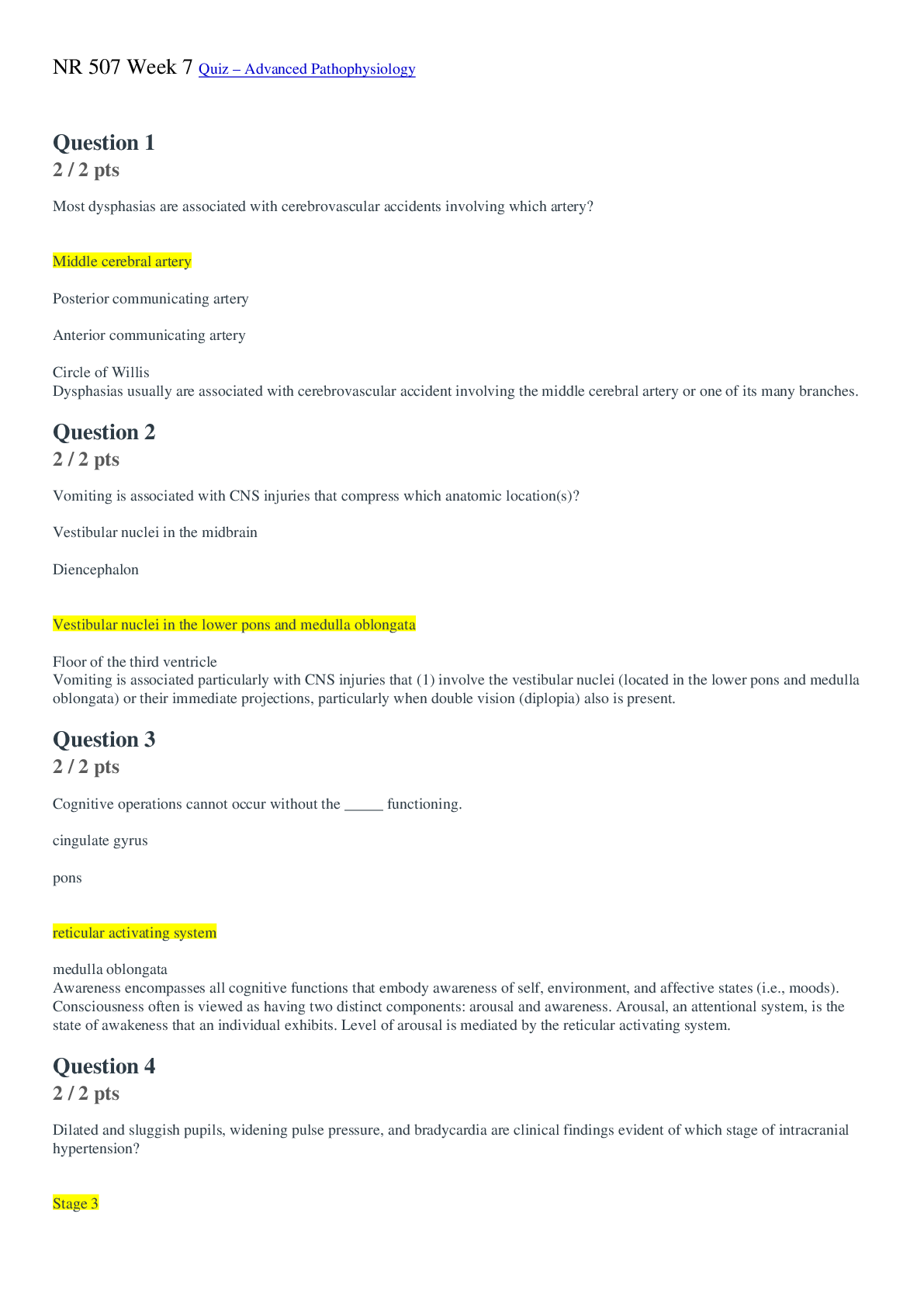
NR 507 Week 7 Quiz – Advanced Pathophysiology
Question 1
2 / 2 pts
Most dysphasias are associated with cerebrovascular accidents involving which artery?
Correct!
Middle cerebral artery
Posterior communicating artery
Anterior communicating artery
Circle of Willis
Dysphasias usually are associated with cerebrovascular accident involving the middle cerebral artery or one of its many branches.
Question 2
2 / 2 pts
Vomiting is associated with CNS injuries that compress which anatomic location(s)?
Vestibular nuclei in the midbrain
Diencephalon
Correct!
Vestibular nuclei in the lower pons and medulla oblongata
Floor of the third ventricle
Vomiting is associated particularly with CNS injuries that (1) involve the vestibular nuclei (located in the lower pons and medulla oblongata) or their immediate projections, particularly when double vision (diplopia) also is present.
Question 3
2 / 2 pts
Cognitive operations cannot occur without the _____ functioning.
cingulate gyrus
pons
Correct!
reticular activating system
medulla oblongata
Awareness encompasses all cognitive functions that embody awareness of self, environment, and affective states (i.e., moods). Consciousness often is viewed as having two distinct components: arousal and awareness. Arousal, an attentional system, is the state of awakeness that an individual exhibits. Level of arousal is mediated by the reticular activating system.
Question 4
2 / 2 pts
Dilated and sluggish pupils, widening pulse pressure, and bradycardia are clinical findings evident of which stage of intracranial hypertension?
Correct!
Stage 3
Stage 1
Stage 2
Stage 4
Stage 3 of intracranial hypertension presents clinical manifestations that include decreasing levels of arousal, Cheyne-Stokes respiration or central neurogenic hyperventilation, pupils that become sluggish and dilated, widened pulse pressure, and bradycardia.
Question 5
2 / 2 pts
Which description is consistent with a complex partial seizure?
Alternative tonic and clonic movements
Correct!
Consciousness is impaired as well as the ability to respond to exogenous stimuli
One seizure followed by another in less than 1 minute
Focal motor movement without loss of consciousness
A complex partial seizure results in impaired consciousness as well as the inability to respond to exogenous stimuli.
Question 6
2 / 2 pts
Cerebral edema is an increase in the fluid content of the
Correct!
brain tissue.
meninges.
neurons.
ventricles.
Cerebral edema is an increase in the fluid content of brain tissue: a net accumulation of water within the brain.
Question 7
2 / 2 pts
Since his cerebrovascular accident, a man has been denying his left hemiplegia. What term is used to describe this finding?
Agraphia agnosia
Visual agnosia
Amusia agnosia
Correct!
Anosognosia
Anosognosia is ignorance or denial of existence of the disease.
Question 8
2 / 2 pts
The existence of regular, deep, and rapid respirations after a severe closed head injury is indicative of neurologic injury to the
cerebral area.
pontine area.
Correct!
lower midbrain.
supratentorial.
Central reflex hyperpnea, a sustained deep rapid but regular pattern (hyperpnea), may result from central nervous system damage or disease that involves the lower midbrain and upper pons. It is seen after increased intracranial pressure and blunt head trauma.
........continued....
[Show More]