NR 507 Week 7 Quiz Advanced Pathophysiology – Version 3
Question 1
2 / 2 pts
Uncal herniation occurs when
a cerebellar tonsil shifts through the foramen magnum.
the cingulate gyrus shifts under the falx cereb
...
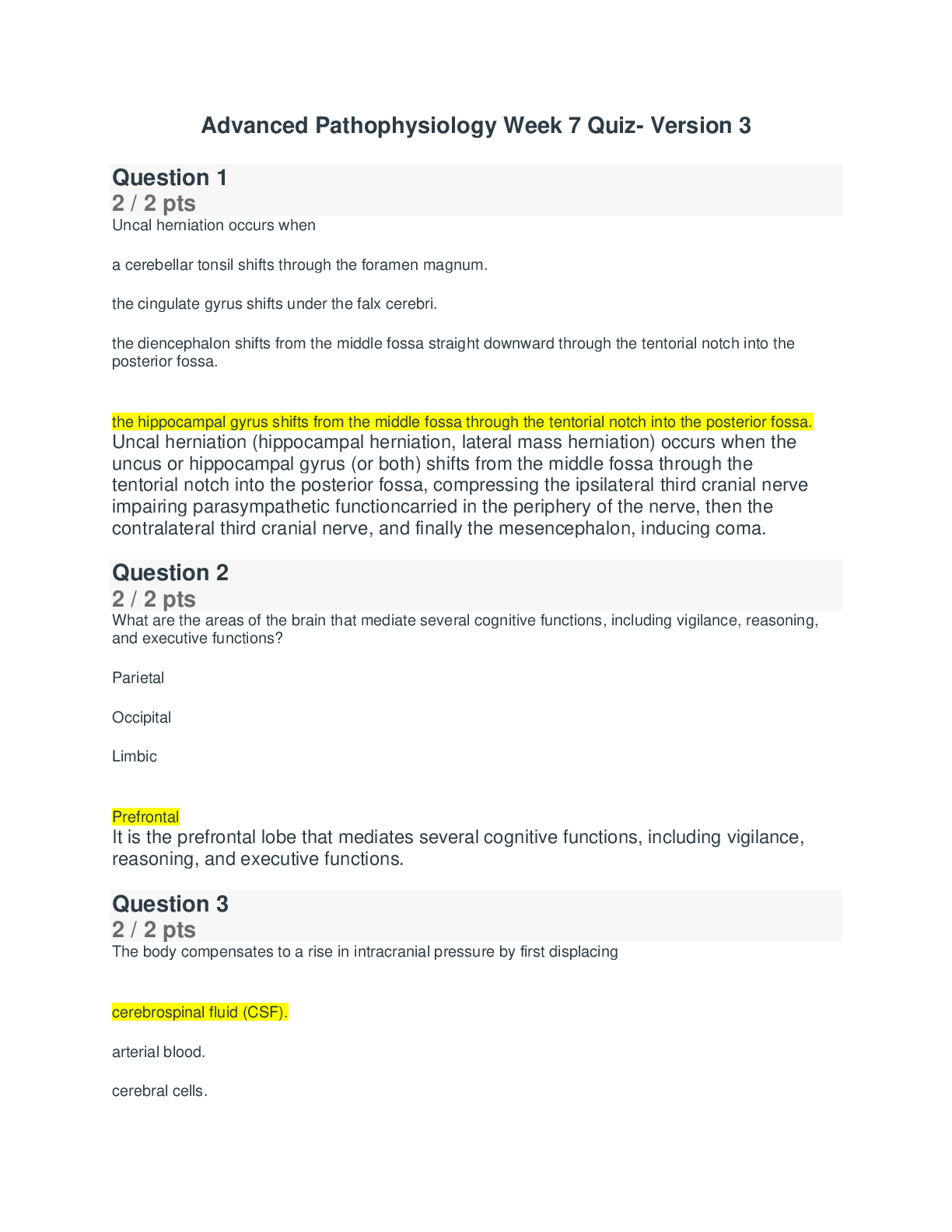
NR 507 Week 7 Quiz Advanced Pathophysiology – Version 3
Question 1
2 / 2 pts
Uncal herniation occurs when
a cerebellar tonsil shifts through the foramen magnum.
the cingulate gyrus shifts under the falx cerebri.
the diencephalon shifts from the middle fossa straight downward through the tentorial notch into the posterior fossa.
Correct!
the hippocampal gyrus shifts from the middle fossa through the tentorial notch into the posterior fossa.
Uncal herniation (hippocampal herniation, lateral mass herniation) occurs when the uncus or hippocampal gyrus (or both) shifts from the middle fossa through the tentorial notch into the posterior fossa, compressing the ipsilateral third cranial nerve impairing parasympathetic functioncarried in the periphery of the nerve, then the contralateral third cranial nerve, and finally the mesencephalon, inducing coma.
Question 2
2 / 2 pts
What are the areas of the brain that mediate several cognitive functions, including vigilance, reasoning, and executive functions?
Parietal
Occipital
Limbic
Correct!
Prefrontal
It is the prefrontal lobe that mediates several cognitive functions, including vigilance, reasoning, and executive functions.
Question 3
2 / 2 pts
The body compensates to a rise in intracranial pressure by first displacing
Correct!
cerebrospinal fluid (CSF).
arterial blood.
cerebral cells.
venous blood.
A rise in intracranial pressure necessitates an equal reduction in volume of the other contents. The most readily displaced content of the cranial vault is CSF.
Question 4
2 / 2 pts
Subarachnoid hemorrhage causes communicating hydrocephalus by obstructing
the cerebrospinal fluid flow into the subarachnoid space.
Correct!
the absorption of cerebrospinal fluid by the arachnoid villi.
the cerebrospinal fluid flow between the ventricles.
blood flow to the arachnoid villi.
Hydrocephalus from impaired absorption outside the ventricles is called communicating (extraventricular) hydrocephalus.
Question 5
0 / 2 pts
With receptive dysphasia (fluent), the individual is able to
respond in writing, but not in speech.
You Answered
respond verbally, but not comprehend speech.
Correct Answer
comprehend speech, but not respond verbally.
speak back, but not comprehend speech.
Receptive dysphasia may result in expressive deficits.
Question 6
2 / 2 pts
Dementia is characterized by
easy distractibility and poor concentration.
irritability, agitation, and restlessness.
Correct!
loss of recent and remote memory.
deficits in attention and coherence of thought.
Memory is the most common cognitive ability lost but the dementias are all characterized by reduction in cognitive functions (intellectual function). Mental abilities are impaired, with a decrease in orienting, recent memory, remote memory, language, executive attentional functions, and alterations in behavior.
Question 7
0 / 2 pts
In Parkinson disease (PD), the basal ganglia influences the hypothalamic function to produce which grouping of clinical manifestations?
You Answered
Bradykinesia of chewing, swallowing, and articulation
Involuntary contractions of skeletal muscles that impair active and passive movement
Asymmetric, regular, rhythmic tremors with slow alternating flexion and extension contractions
Correct Answer
Inappropriate diaphoresis, orthostatic hypotension, constipation, and urinary retention
The basal ganglia influence hypothalamic function (autonomic and neuroendocrine) through pathways connecting the hypothalamus with the basal ganglia and cerebral cortex. Common autonomic symptoms in PD include inappropriate diaphoresis, gastric retention, constipation, and urinary retention.
Question 8
0 / 2 pts
The existence of regular, deep, and rapid respirations after a severe closed head injury is indicative of neurologic injury to the
Correct Answer
lower midbrain.
supratentorial.
pontine area.
You Answered
cerebral area.
Central reflex hyperpnea, a sustained deep rapid but regular pattern (hyperpnea), may result from central nervous system damage or disease that involves the lower midbrain and upper pons. It is seen after increased intracranial pressure and blunt head trauma.
..........continued.......
[Show More]