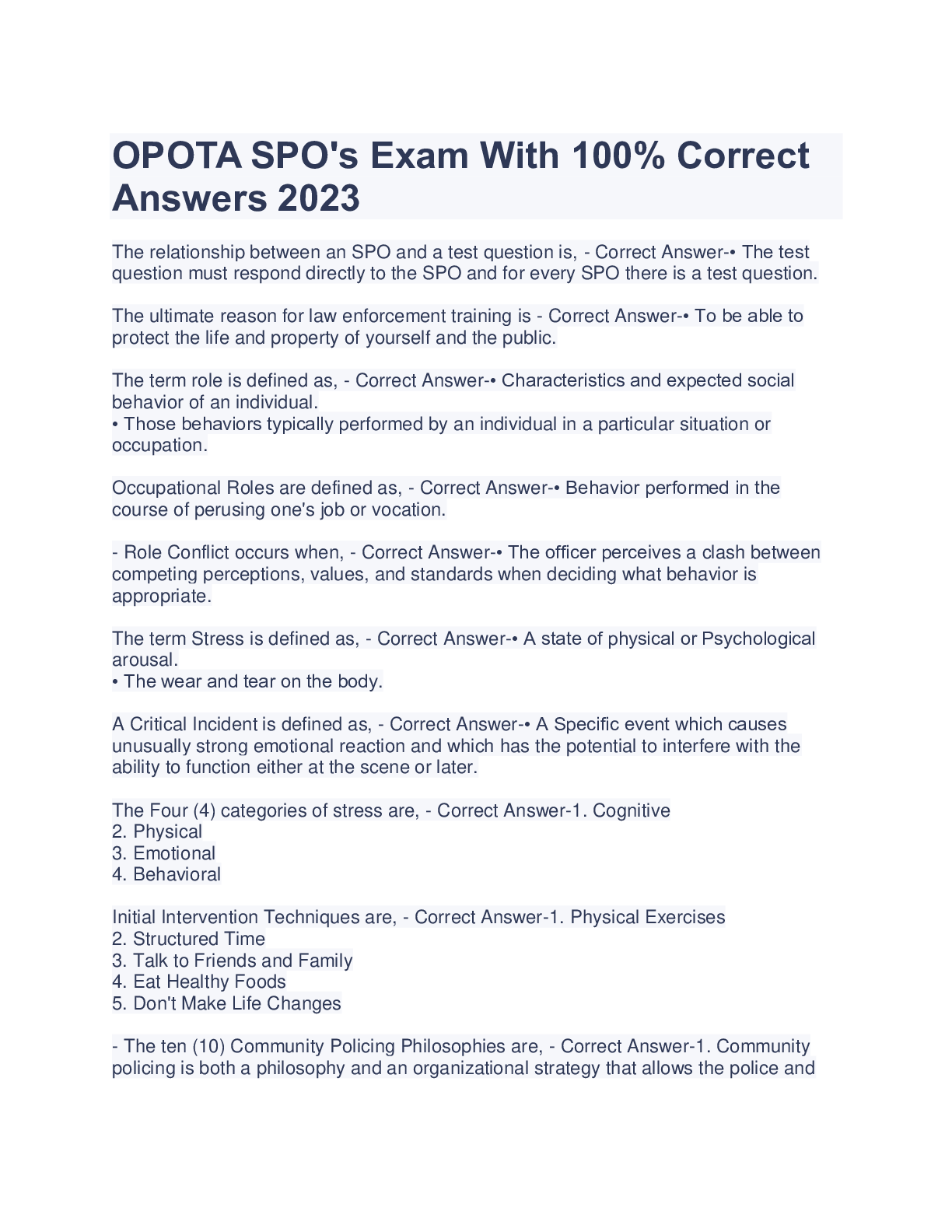
The relationship between an SPO and a test question is, - Correct Answer-• The test
question must respond directly to the SPO and for every SPO there is a test question.
The ultimate reason for law enforcement training
...
The relationship between an SPO and a test question is, - Correct Answer-• The test
question must respond directly to the SPO and for every SPO there is a test question.
The ultimate reason for law enforcement training is - Correct Answer-• To be able to
protect the life and property of yourself and the public.
The term role is defined as, - Correct Answer-• Characteristics and expected social
behavior of an individual.
• Those behaviors typically performed by an individual in a particular situation or
occupation.
Occupational Roles are defined as, - Correct Answer-• Behavior performed in the
course of perusing one's job or vocation.
- Role Conflict occurs when, - Correct Answer-• The officer perceives a clash between
competing perceptions, values, and standards when deciding what behavior is
appropriate.
The term Stress is defined as, - Correct Answer-• A state of physical or Psychological
arousal.
• The wear and tear on the body.
A Critical Incident is defined as, - Correct Answer-• A Specific event which causes
unusually strong emotional reaction and which has the potential to interfere with the
ability to function either at the scene or later.
The Four (4) categories of stress are, - Correct Answer-1. Cognitive
2. Physical
3. Emotional
4. Behavioral
Initial Intervention Techniques are, - Correct Answer-1. Physical Exercises
2. Structured Time
3. Talk to Friends and Family
4. Eat Healthy Foods
5. Don't Make Life Changes
- The ten (10) Community Policing Philosophies are, - Correct Answer-1. Community
policing is both a philosophy and an organizational strategy that allows the police andcommunity residents to work closely together in a new way to solve the problems of
crime, fear of crime, physical and social disorder, and neighborhood decay.
2. Community policing organizational strategy first demands that everyone in the
department, including both civilian and sworn personal, must investigate ways to
translate the philosophy into practice.
3. To implement true community policing, Police departments must also create and
develop a new breed of line officer, the Community Policing Officer (CPO), who acts as
the direct link between the police and the community.
4. The CPO's broad role demands continuous, sustained contact with the law-abiding
people in the community, so that together they can explore creative new solutions to
local concerns involving crime, fear of crime; disorder and decay, with private citizens
serving as unpaid volunteers.
5. Community policing implies a new contract between the police and the citizens it
serves, one that offers the hope of overcoming widespread apathy, at the same time it
restrains any impulse to vigilantism.
6. Community policing adds a vital pro-active element to the reactive role of police,
resulting in full-spectrum police services.
7. Community policing stresses exploring new ways to enhance and protect the lives of
those who are most vulnerable- juveniles, elderly, minorities, the poor, the disabled, the
homeless.
8. Community policing promotes the judicious use of technology, but also rests on the
belief that nothing surpasses what dedicated human beings, talking and working
together, can achieve.
9. Community policing must be a fully integrated approach that involves everyone in the
department, with the CPO's as specialists in bridging the gaps between the police and
the people.
10. Community policing provides decentralized personalized police service to the
community. It recognizes that police cannot impose order on the community from the
outside, but that people must be encouraged to think of the police as a resource they
can use in helping solve contemporary community concerns
Seven (7) Traditional criteria of a profession are, - Correct Answer-1. A specific body of
knowledge.
2. Extensive preparation through professional education, training.
3. A code of ethics.
4. Licensing, regulations by boards and councils.
5. Commitment and obligation to clientele.
[Show More]