TEFL Questions and Answers Already
Passed
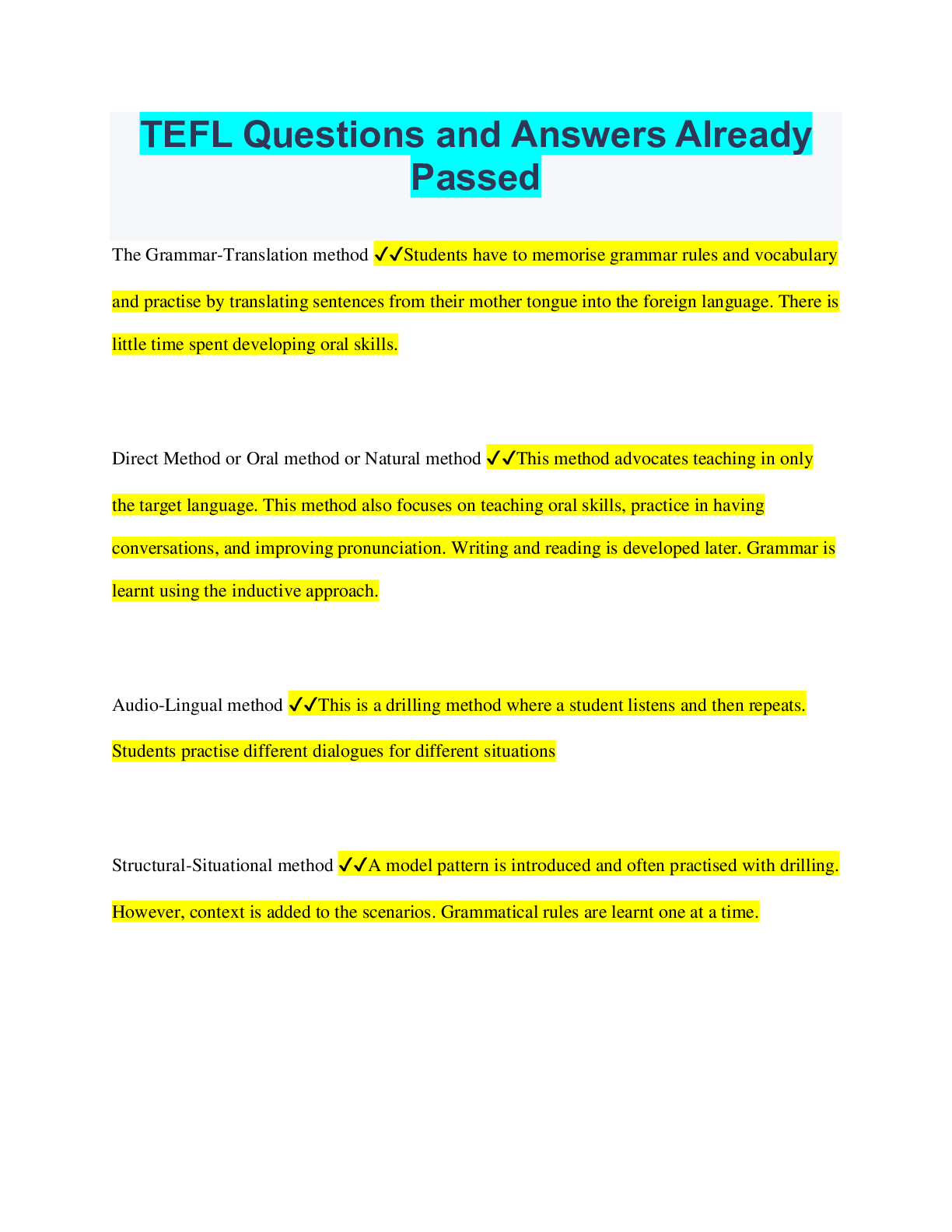
The Grammar-Translation method ✔✔Students have to memorise grammar rules and vocabulary
and practise by translating sentences from their mother tongue into the foreign languag
...
TEFL Questions and Answers Already
Passed
The Grammar-Translation method ✔✔Students have to memorise grammar rules and vocabulary
and practise by translating sentences from their mother tongue into the foreign language. There is
little time spent developing oral skills.
Direct Method or Oral method or Natural method ✔✔This method advocates teaching in only
the target language. This method also focuses on teaching oral skills, practice in having
conversations, and improving pronunciation. Writing and reading is developed later. Grammar is
learnt using the inductive approach.
Audio-Lingual method ✔✔This is a drilling method where a student listens and then repeats.
Students practise different dialogues for different situations
Structural-Situational method ✔✔A model pattern is introduced and often practised with drilling.
However, context is added to the scenarios. Grammatical rules are learnt one at a time.
Task Based Learning ✔✔With this form of learning, the students are given a task and try to work
out the structure themselves. Often there is no formal instruction and students must find the
solution themselves.
Silent Way ✔✔he teacher will say as little as possible and encourages students to create their
own language, prompted by physical objects.
Immersion: ✔✔students are immersed in English throughout the day in school. They are taught
all subjects in English. This method is often used in Asian schools.
Lexical Approach ✔✔In this approach, the students are taught the most commonly used lexical
chunks of words and structures. The idea is that common phrases are taught
Eclectic Approach ✔✔all of the above teaching methods and bits from the Communicative
Approach below and uses styles which suit learners at different levels.
Communicative Approach ✔✔Drilling is a form of repetition, getting students to repeat after
you. Drilling comes from the behaviourist theorists of the 1950's who concluded that habit
forming was a good way to learn a new language
Drilling: ✔✔Drilling is a form of repetition, getting students to repeat after you. Drilling comes
from the behaviourist theorists of the 1950's who concluded that habit forming was a good way
to learn a new language
Intrinsic ✔✔This student tells us that she does everything she can to get better at English. Her
problem is that her family does not have enough money to help her
Extrinsic ✔✔My parents are making me come to the Extra English lessons
Intrinsic ✔✔This student spends her spare time organising an English Speaking club at her
school
Extrinsic, ✔✔The school forces me to learn English
Instrumental ✔✔Learning English will improve your chances of finding a better job
Integrative ✔✔n individual has to take an English Language Test to gain citizenship in the UK
true ✔✔An item of language can be divided into Structural, Lexical and Phonological items to
help students understand better.
true ✔✔One of the most straight forward ways to introduce a new item of Grammar, Lexis or
Phonology is to use the Presentation-Practice-Production Technique?
Adding context to structure is an essential part of adding meaning to a new item. ✔✔true
A Teacher must try to explain the following during a lesson: ✔✔meaning
The correct answer is: This method is used in a traditional setting where rules are introduced first
then practised. - Deductive, In this method students practise specific dialogues for specific
scenarios and drill. - Audio-Linguistic, Students spend the day learning different subjects in
English. - Immersive, It's an inductive method, using target language only, focusing on oral skills
and conversations. - Direct Method, Students have to memorise Grammar rules. - GrammarTranslation, Rules are worked out by students before formal instruction. - Inductive, 3 stages are
used in the lesson, new rules are introduced, then an activity to practise followed by a more
creative practice activity. - Present-Practice-Production ✔✔
The correct answer is: Create a Mind Map - Eliciting new vocabulary, Create a Timeline. -
Showing Verb Tenses, Create a table with rules of structure. - Grammar Table, Draw a picture of
different jobs. - Introducing new vocabulary, Write a word on the board showing where the
emphasis should be. - Intonation ✔✔
The correct answer is: Getting students to look up words in groups using a bi-lingual dictionary.
- Good, Writing instructions on the board and giving students 5 worksheets each. - Not so good,
Using realia. - Good, Using mime to try to elicit a new word. - Good, Using Flashcards with
images that are unclear and too small. - Not so good ✔✔
The correct answer is: What do you think about the present perfect? - Incorrect, Does my shirt
have long or short sleeves? - Correct, Is this concept difficult? - Incorrect, Do you understand? -
Incorrect, How many times a week do I wash my hair? - Correct ✔✔
The correct answer is: Drilling should be supported by modelling a new item., Get your students
to practise Drilling using different moods like happy or sad. , It's a good idea to support Drilling
by showing intonation and stress on the board. ✔✔
The correct answer is: If you find yourself really out of your depth then ask your partner.
- Incorrect, Work with the person to your right.
- Correct, If you need any help don't be afraid to give me a shout.
- Incorrect, Would you mind if you work with a partner?
- Incorrect, Ask me if you don't understand.
- Correct ✔✔
All of the following are ways to elicit - except one. Please select the odd one out. ✔✔Explaining
the meaning
What does CCQ stand for? ✔✔Concept Checking Question
Competitions - Teams, Project work - Groups, Debates and Presentations - Horseshoe,
Examinations and Tests - Rows, Sometimes a good idea for free writing. - Individual, Everyone
can see the board and the teacher can make eye contact. This style reduces distractions. - Rows
✔✔
Offering feedback to your learners on a regular basis offers many benefits except one. Please
select the odd one out ✔✔Helps tackle all behaviour problems
"The Teacher has all the knowledge and should do most of the talking." ✔✔false
The correct answer is: Being serious and never smiling will mean your students respect you. -
False, Using worksheets every lesson with drilling will improve learners' desire to learn more. -
False, Using a textbook every lesson will give learners a chance to be creative. - False, Using
words like "well done, outstanding, excellent" increases motivation. - True, Promising a school
trip and never going is bad for motivation. - True ✔✔
The correct answer is: To create an informal piece of writing updating your status. - Facebook,
To give learners a chance to publish written material so that parents can see their children's work.
- Blog, To connect to another school in another country using face to face communication. -
Skype, To enable learners to look up examples at home using your website. - Wikispaces, To
write an email requisition for more information about a summer internship. - Formal email ✔✔
bus ✔✔Common , Concrete , Countable
doctor ✔✔Common , Concrete , Countable
courage ✔✔Common, Abstract , Uncountable
James ✔✔Proper , Concrete , Countable
love ✔✔Common , Abstract , Uncountable
The correct answer is: A word that is used to express emotion or surprise. - Interjection, A word
that refers to people, places, things and ideas. - Noun, A word that is used in the place of a noun.
- Pronoun, A word that is used to describe and modify a verb, adjective or other adverb. -
Adverb, A word that is used to join sentences or words together. - Conjunction, A word that is
used to describe or specify a noun or pronoun. - Adjective, A word that is used to show where
and when something is. - Preposition, A word that is used to show an action or state of being. -
Verb, A word that comes before a noun, the most common are "the" or "a". - Determiner ✔✔
The correct answer is: He spent all night driving and he felt tired. - Conjunction, We all had
dinner in the restaurant in the square. - Noun, We left the Airport at about 10pm but got caught
in the storm. - Verb, If you want to win the marathon you have to believe in yourself. - Pronoun,
My daughter said, " Wow that tastes good!" - Interjection, The stairs were too steep for her to
walk up, she caught the lift instead. - Determiner, He ran as fast as his legs would carry him. -
Verb, The woman was not strong enough to lift her heavy suitcase up the stairs. - Adjective, We
went to the supermarket to get some baby food and some milk. - Preposition, We spent nearly 10
hours walking but we all still enjoyed it. - Conjunction, She felt completely exhausted after a
long week at work. - Adverb, He didn't have anything to cover it with. - Pronoun ✔✔
Quickly is an Adjective ✔✔false
Sometimes is a Noun. ✔✔false
Where are Emily's toys? "toys" is a Pronoun. ✔✔false
If you walk through the jungle, you will need some mosquito spray. - First, If I had won the race
that day, I would have been the oldest winner. - Third, If the baby cries, she needs attention. -
Zero, If I won the race, I would move to the USA to train. - Second, If you go to a Thai Temple,
you take your shoes off and cover your arms and legs.
- Zero, If I spoke English, I would go and work in England. - Second, If I found gold on my land
, I would look for more.
- Second, If you train hard for the run, you will win.
- First, If I had cooked the beef instead of the chicken, I would have finished at the top of the
class. - Third, If I had departed a little earlier that day, I would have avoided seeing the accident.
- Third, If you leave the gas on, you will blow up the house. - First, When Jack sees his wife, he
smiles. - Zero ✔✔
Making a guess about the future: I bet she will be having a baby very soon. - Future Continuous,
Actions that started in the past and continue to the present: He has been writing a book for two
years.
- Present Perfect Continuous, Actions in progress at the same time in the past: I was cleaning the
kitchen while my wife was washing the car.
- Past Continuous, Actions in the past which have an effect on the present: He has finished his
shift. - Present Perfect, Events in the past which are now finished.
- Past Simple, Temporary actions: Jack is working as a waiter in the summer holidays. - Present
Continuous, Arrangements we can't change like a train timetable: The train leaves at 3pm. -
Present Simple, Predictions: It will rain later if it stays this hot. - Future Simple, Completion of
an action before a specified point in time in the future
- Future Perfect, Present actions: Jack is talking with friends.
- Present Continuous, Actions which began in the past and continue in the present: He has
worked as a policeman for 20 years. - Present Perfect, Unhappy about the past: I wished I had
eaten more before the Test. - Past Perfect, Cause of a future situation: In ten minutes you will
have been driving for 12 hours, your eyes are looking tired.
- Future Perfect Continuous, Looking at the cause of an action. - Past Perfect Continuous, Habits
and routines: I get up at 8am. - Present Simple, Completed action before another action in the
past: I had finished my work before I went running.
- Past Perfect ✔✔
Subject + will have + Past Participle - Future Perfect, Subject + will + be + Present Participle or
"ing"
- Future Continuous, Subject + Present of "to have" + Past Participle of Verb
- Present Perfect, Subject + will have been + Present Participle of verb or "ing"
- Future Perfect Continuous, Subject + Present form "to have" + been + Present Participle of
Verb or "ing"
- Present Perfect Continuous, Subject + Present Form of the Verb
- Present Simple, Subject + Present of "to be" + Present Participle of Verb or "ing"
- Present Continuous, Subject + Past form of "to have"+ been + Present Participle or "ing"
- Past Perfect Continuous, Subject + will + Present form of the Verb
- Future Simple, Subject + Past form of "to be" + Present Participle of Verb or "ing"
- Past Continuous, Subject + Past form of "to have" + Past Participle of Verb
- Past Perfect, Subject + Past form of the Verb
- Past Simple ✔✔
Jack is critically ill. - Adverb, Here is a crocodile.
- Countable Noun, Jack is a terrible singer. - Adjective, Where is the book? It's on the table. -
Definite Article, The House has a big garden. - Indefinite Article, I listened in the lesson but I
didn't remember it very well. - Adverb, All that is said during this meeting stays between you
and me. - Pronoun, It took a great deal of courage to dive into the swimming pool and save the
boy.
- Abstract Noun, I called you on Monday. - Preposition, He was a great tennis player but he
lacked commitment. - Conjunction ✔✔
Using a real life object (Realia) to show the meaning of a new word. - Concrete, Acting to try to
convey a feeling of happiness. - Abstract, Using a flashcard to show the new word. - Concrete
✔✔
These words are vital for creating a sentence in English. They can describe a physical movement
like walking or running or how a person thinks or feels. - Verbs, These words refer to the names
of specific people or places. - Proper Nouns, These words are descriptive words used to describe
nouns. - Adjective, These words add detail to a sentence and describe a verb. - Adverb, These
words can be identified through one of the five senses (taste, touch, sight, hearing, smell).
- Concrete Noun, These words come before nouns. - Articles, These words are used to connect
two sentences together to help the flow of writing. - Conjunction, These words can be used to
replace nouns. - Pronouns ✔✔
Least - Superlative, Worse - Comparative, Best - Superlative, Better - Comparative, Farther -
Comparative, Most - Superlative ✔✔
Have you eaten dinner yet?
- Present Perfect, He said that he had been waiting for ages before she arrived for the date.
- Past Perfect Continuous, Jack will not have learnt anything if he doesn't go to class.
- Future Perfect, Will you be coming to Chiang Mai next week? - Future Continuous, I hadn't
read anything before the test. - Past Perfect, Will you jog today? - Future Simple, He has been
waiting for over 12 hours at the Airport. His plane is delayed badly because of the weather. -
Present Perfect Continuous, Thailand isn't getting wealthier each year.
- Present Continuous, He boarded the plane and sat in business class. - Past Simple, Will he have
been writing for that many years?
- Future Perfect Continuous, The teacher asked when he wasn't working on his project.
- Past Continuous, I live in Chiang Mai. - Present Simple ✔✔
He has worked as a teacher for 10 years. ✔✔Present Perfect
We have been living in Mumbai for one month. ✔✔Present Perfect Continuous
I wished I had not taken that wrong turn. ✔✔Past Perfect
By next year Bob and Kathy will have been living together for 50 years. ✔✔Future Perfect
Continuous
Victoria will have lived in New York for 3 years in 2015. ✔✔Future Perfect
It's vital that you know every single Grammar Rule and Verb Tense when you start teaching.
✔✔false
[Show More]