Liberty University PSYC 210 Quiz 3
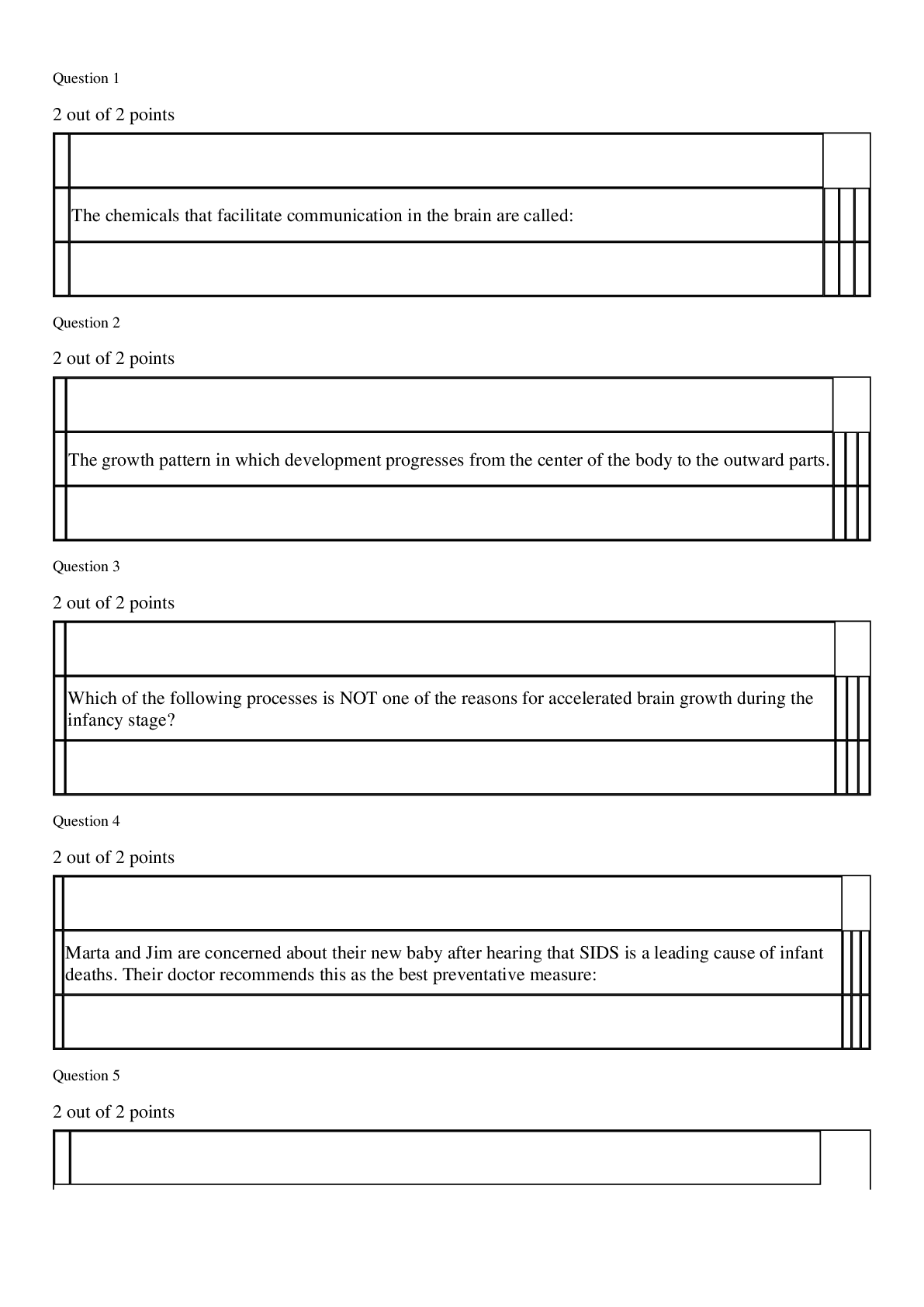
Question 1
2 out of 2 points
The chemicals that facilitate communication in the brain are called:
Selected Answer:
Question 2
2 out of 2 points
The growth pattern in wh
...
Liberty University PSYC 210 Quiz 3
Question 1
2 out of 2 points
The chemicals that facilitate communication in the brain are called:
Selected Answer:
Question 2
2 out of 2 points
The growth pattern in which development progresses from the center of the body to the outward parts.
Selected Answer:
Question 3
2 out of 2 points
Which of the following processes is NOT one of the reasons for accelerated brain growth during the infancy stage?
Selected Answer:
Question 4
2 out of 2 points
Marta and Jim are concerned about their new baby after hearing that SIDS is a leading cause of infant deaths. Their doctor recommends this as the best preventative measure:
Selected Answer:
Question 5
2 out of 2 points
These parts of the brain are responsible for hearing and memory.
Selected Answer:
Question 6
2 out of 2 points
Breastfeeding appears to help mothers avoid certain types of cancer.
Selected Answer:
Question 7
2 out of 2 points
The highest number of infant deaths in the United States is attributed to:
Selected Answer:
Question 8
2 out of 2 points
An interactionist would say that language development is influenced by:
Selected Answer:
Question 9
2 out of 2 points
Memory with unconscious recollection:
Selected Answer:
Question 10
2 out of 2 points
Children communicate before they learn language.
Selected Answer:
Question 11
2 out of 2 points
Sammie lives in the city with her parents and one pet (a cat). When she visited her cousins in the country she soon learned that each type of animal has its own name -- they were not all called "kitty." This is an example of:
Selected Answer:
Question 12
2 out of 2 points
Piaget's first stage of development is called:
Selected Answer:
Question 13
0 out of 2 points
Children understand almost all spoken language at this age:
Selected Answer:
Question 14
0 out of 2 points
The tendency to stop responding when something becomes commonplace.
Selected Answer:
Question 15
2 out of 2 points
An emotional reaction marked by caution and wariness when an infant encounters an unfamiliar person.
Selected Answer:
Question 16
2 out of 2 points
The emotional reaction expressed by children around 7-14 months of age when their primary caregiver leaves.
Selected Answer:
Question 17
2 out of 2 points
To facilitate positive infant attachment, parents should provide care that is:
Selected Answer:
Question 18
2 out of 2 points
The “Rouge Test” is used to determine whether an infant has the ability to:
Selected Answer:
Question 19
2 out of 2 points
Which of the following emotions are only expressed after a child has developed a sense of self-awareness?
Selected Answer:
Question 20
2 out of 2 points
Mary Ainsworth developed a model for studying attachment in very young children. Her experiment is called:
Selected Answer:
Question 21
2 out of 2 points
A fear and distress reaction displayed by infants when their primary caregiver leaves their side.
Selected Answer:
Question 22
2 out of 2 points
Scripture does not address the spiritual development of infants.
Selected Answer:
Question 23
2 out of 2 points
Morgenthaler, Keiser & Larsen emphasize _____ memories in talking about spiritual formation in infancy.
Selected Answer:
Question 24
2 out of 2 points
A secure attachment bond between an infant and his or her parents may facilitate a later relationship with God.
Selected Answer:
Question 25
2 out of 2 points
One’s future relationship with God depends solely on whether he or she formed a secure attachment bond to his or her parents.
Selected Answer:
Question 26
5 out of 5 points
Describe three reasons why it is difficult to tell whether spiritual development is taking place in the life of an infant.
Selected Answer:
Question 27
0 out of 5 points
Identify the “father of modern linguistics” and briefly describe what he said about the way we learn to use language.
Selected Answer:
[Show More]

.png)













.png)