[Solved] SEJPME 1 Module 6
1) Which of the following statements best describes the renewed focus on the term design? [objective244]
The value of design as a complementary concept to planning has grow
...
[Solved] SEJPME 1 Module 6
1) Which of the following statements best describes the renewed focus on the term design? [objective244]
The value of design as a complementary concept to planning has grown significantly in recent years. It includes more commander-led direction concluding with some form of operational approach.
Design focuses on a narrow view of view of mission analysis, often creating a checklist mentality and a more structured approach to framing the problem.
In certain crises situations, planning replaces design due to the amount of critical resources required to conduct design activities. This results in a more efficient process.
________________________________________
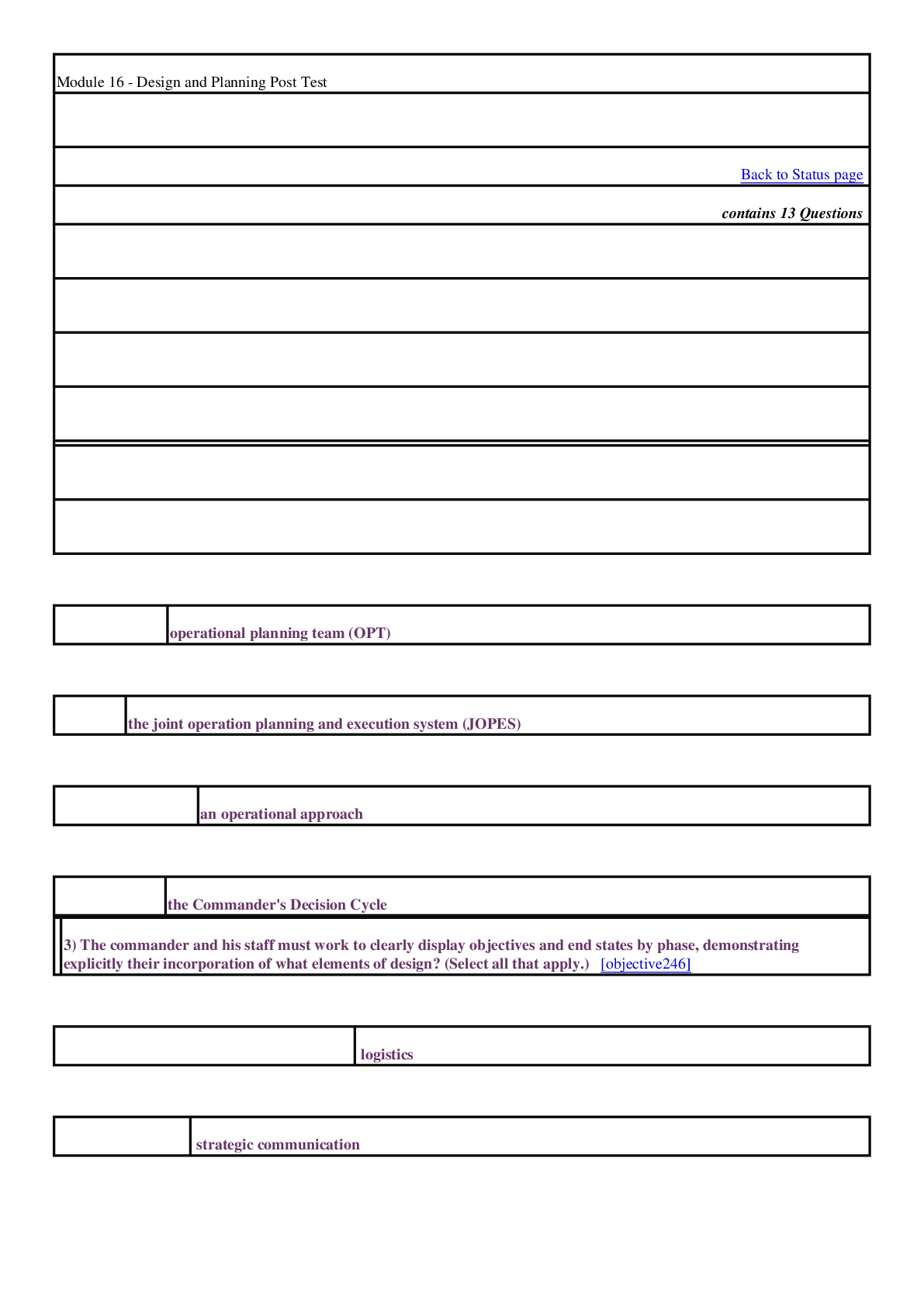
2) Which of the following links design activities to more detailed planning commonly associated with the joint operation planning process (JOPP)? [objective245]
operational planning team (OPT)
the joint operation planning and execution system (JOPES)
an operational approach
the Commander's Decision Cycle
________________________________________
3) The commander and his staff must work to clearly display objectives and end states by phase, demonstrating explicitly their incorporation of what elements of design? (Select all that apply.) [objective246]
logistics
strategic communication
end state
arranging operations (through phasing)
lines of effort
________________________________________
4) What has given commanders the ability to leverage many joint capabilities at the lowest levels? [objective247]
The "co-creation of context" principle has given commanders unique viewpoints to leverage joint capabilities.
Recent changes in joint command hierarchical structures have enabled commanders to delegate authority more efficiently across all echelons.
Advances in information technology have enabled collaborative and decentralized approaches to better understand the operational environment.
________________________________________
5) What pitfall can occur when a problem statement proposes a solution (even implicitly)? [objective248]
none, problem statement should propose a solution
can lead the commander and planners to spend more time on design, rather than detailed planning and execution
invariably, problem statement becomes the mission statement
can lead the commander and planners to narrow the focus too soon
________________________________________
6) Combatant command operations influence planning focus by prioritizing and resourcing planning efforts across which level(s) of planning? (Select all that apply.) [objective249] [Remediation Accessed :N]
operational
mission
strategy
policy
tactical
________________________________________
7) The first step in achieving efficiency and effectiveness in planning at all headquarters is _____. [objective256]
establishing "touch points"
the Commander's Decision Cycle
establishing a viable battle rhythm
limiting the number of planning problems
________________________________________
8) Which of the following choices accurately describes how commands follow the standard joint operation planning process (JOPP) steps to achieve success in the development of commander's critical information requirements (CCIRs)? [objective251]
Core planners interact with the commander to create the initial estimates during initiation of the JOPP; the staff develops CCIRs during course of action development in consultation with the commander.
Core planners collaborate with working groups during initial JOPP steps; the staff creates initial estimates during mission analysis and the commander interacts with the staff to develop CCIRs.
Commands have not actually achieved success by following the JOPP steps; success in the development of CCIRs has been achieved through creative, unstructured collaboration between the commander and his staff.
The commander interacts with the staff during course of action development; planners collaborate with working groups during course of action analysis to develop CCIRs.
________________________________________
9) The coherent integration of lethal and nonlethal actions at the operational level is provided by _____. [objective252]
crisis situations
tactical units
operational framework
commander's intent
planning guidance
________________________________________
10) Which of the following statement(s) describes the benefit of the adaptive planning process? (Select all that apply.) [objective253]
allows for continual update and shared awareness of the plans
centers on a strategic-level "Capstone" plan that provides the framework for other plans that address contingencies that could happen in the geographic combatant command's areas of responsibility
ensures each of the contingency plans take into account national interests so that actions addressing one contingency do not inadvertently impact U.S. national interests in another area
________________________________________
11) Training exercises are conducted by joint force commanders and their headquarters and based on their operation plans, concept plans, and scenarios related to "most likely" and "most dangerous" crises/contingencies in their areas of responsibility. What is a secondary role of these complex training events? [objective254]
provide an intensive venue for the focused, structured dialogue that drives design and subsequent planning
understand how the planning process affects the readiness of the joint headquarters to control operations
test the readiness of the staff in understanding their commander's battle rhythm
________________________________________
12) Which of the following describes a role of the Chief of Staff in design and planning? [objective255]
helps prioritize the planning efforts with a disciplined approach
provides personnel to the planning teams
serves to inform the planning staff on constraints or restraints concerning caveats or dialogue with outside agencies
translates higher echelon dialogue into clear and concise guidance and intent
________________________________________
13) How can joint task force (JTF) headquarters promote the sharing of design products to the greatest extent possible? [objective250]
ensuring design products are at a classification level that promotes sharing
by not promote the sharing of design products due to the risks associated with divulging classified information
carefully choosing stakeholders to ensure they are cleared to access the available design products
________________________________________
[Show More]



![Preview of THE TEFL ACADEMY LEVEL 5 - ASSIGNMENT C - AUTHENTIC MATERIAL [2026]](https://browseimages.nyc3.digitaloceanspaces.com/paper-images/2026/04/10/HpVkRcWV2026-04-10-11-5769d96426bd64f.png)
.png)