CPCE Counseling and Helping Relationships Exam 138 Question with Answers
Alfred Adler - CORRECT ANSWER Theorist that created individual psychology; emphasized the drive for superiority; one of the first therapists t
...
CPCE Counseling and Helping Relationships Exam 138 Question with Answers
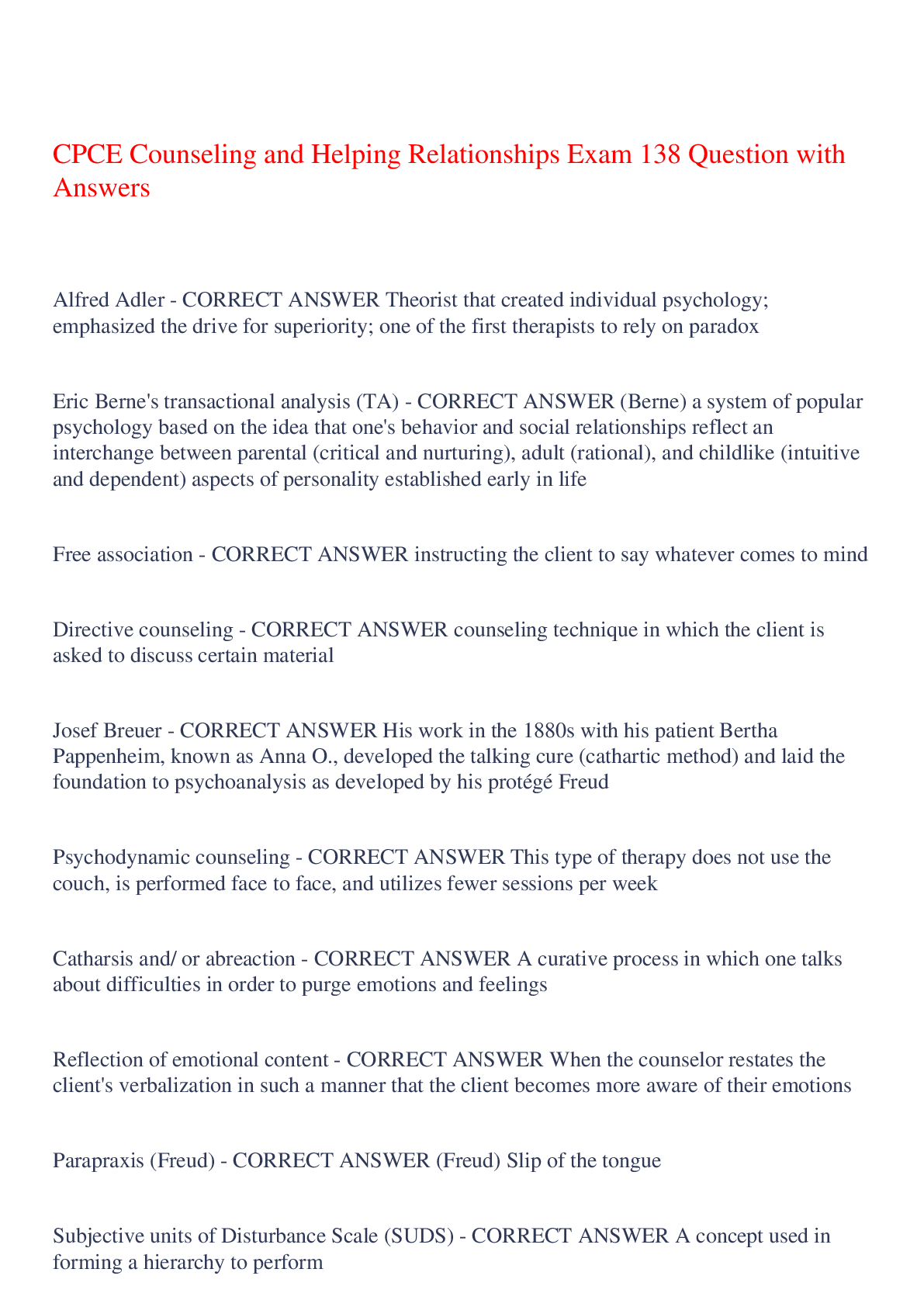
Alfred Adler - CORRECT ANSWER Theorist that created individual psychology; emphasized the drive for superiority; one of the first therapists to rely on paradox
Eric Berne's transactional analysis (TA) - CORRECT ANSWER (Berne) a system of popular psychology based on the idea that one's behavior and social relationships reflect an interchange between parental (critical and nurturing), adult (rational), and childlike (intuitive and dependent) aspects of personality established early in life
Free association - CORRECT ANSWER instructing the client to say whatever comes to mind
Directive counseling - CORRECT ANSWER counseling technique in which the client is asked to discuss certain material
Josef Breuer - CORRECT ANSWER His work in the 1880s with his patient Bertha Pappenheim, known as Anna O., developed the talking cure (cathartic method) and laid the foundation to psychoanalysis as developed by his protégé Freud
Psychodynamic counseling - CORRECT ANSWER This type of therapy does not use the couch, is performed face to face, and utilizes fewer sessions per week
Catharsis and/ or abreaction - CORRECT ANSWER A curative process in which one talks about difficulties in order to purge emotions and feelings
Reflection of emotional content - CORRECT ANSWER When the counselor restates the client's verbalization in such a manner that the client becomes more aware of their emotions
Parapraxis (Freud) - CORRECT ANSWER (Freud) Slip of the tongue
Subjective units of Disturbance Scale (SUDS) - CORRECT ANSWER A concept used in forming a hierarchy to perform Wolpe's systematic desensitization
Preconscious mind - CORRECT ANSWER Capable of bringing ideas, images, and thoughts into awareness with minimal difficulty (ex. taking just a few minutes)
Unconscious mind - CORRECT ANSWER Composed of material which is normally unknown or hidden from the client
Reaction formation - CORRECT ANSWER a behavior in which a person behaves in a manner opposite to the way they truly feel
defense mechanism in which unacceptable impulses are transformed into their opposite
Repression - CORRECT ANSWER unconsciously keeping distressing thoughts and feelings buried in the unconscious; most important defense mechanism
Sublimation - CORRECT ANSWER the transformation of unacceptable impulses into socially valued motivations (ex. aggressive person becomes a boxer)
Suppression - CORRECT ANSWER A conscious effort to put something out of mind or to keep it from awareness
Displacement - CORRECT ANSWER defense mechanism in which feelings about one person are transferred to someone else
Introjection - CORRECT ANSWER Unconsciously incorporating values and attitudes of others as if they were your own
Sour grapes rationalization - CORRECT ANSWER belittling what you fail to achieve
Sweet lemon rationalization - CORRECT ANSWER convincing yourself that you are just as well off without whatever you failed to achieve
Identification - CORRECT ANSWER results when a person identifies with a cause or a successful person with the unconscious hope that he/she will be perceived as successful or worthwhile
Resistance - CORRECT ANSWER Client's tendency to inhibit or fight against the therapeutic process
Totem (Freud) - CORRECT ANSWER (Freud) An object that represents a family or group
Taboo (Freud) - CORRECT ANSWER (Freud) the dread of incest
Interpretation - CORRECT ANSWER making the clients aware of their unconscious processes
Organ inferiority - CORRECT ANSWER the insight of being deficient or somehow lesser than other people as a outcome of aversive emotions about a physical attribute.
Logos - CORRECT ANSWER Implies logic
Eros - CORRECT ANSWER Implies intuition
Mandala - CORRECT ANSWER A sacred geometric circular figure that represents the universe; used by Jung
Constructivist theorist - CORRECT ANSWER These theorists stress that is it imperative that we as helpers understand the client's view (also known as constructs) to explain their problems
Neo-Freudians - CORRECT ANSWER These type of theorists emphasized social factors (Adler, Erikson, Sullivan, Horney)
Rudolf Dreikurs - CORRECT ANSWER The first to discuss the use of group therapy in practice
Social Connectedness (Adler) - CORRECT ANSWER (Adler) people's wish to belong
The collective unconscious (Jung) - CORRECT ANSWER (Jung) Implies that all humans have "collected" universal inherited, unconscious neural patterns
Paradoxical interventions (Frankl) - CORRECT ANSWER (Frankl) often the direct antithesis of common sense directives; client is instructed to intensify or purposely engage in the maladaptive behavior
Archetype (jung) - CORRECT ANSWER (Jung) a primal universal symbol, which means the same thing to all men and women (i.e. the cross)
Symtom substitution - CORRECT ANSWER A psychoanalytic concept that states if you deal with the symptom, another symptom will manifest itself since the real problem is in the unconscious mind
Eclectic counselor - CORRECT ANSWER a counselor that attempts to choose the best theoretical approach based on the client's attributes, resources, and situation; also associated with Frederick Thorne
Associationism - CORRECT ANSWER Asserts that ideas are held together by associations
Law of effect (Thorndike) - CORRECT ANSWER (Thorndike) asserts that responses accompanied by satisfaction will be repeated, while those which produce unpleasantness or discomfort will be stamped out
Delayed conditioning - CORRECT ANSWER When the CS is delayed until the US occurs
Trace conditioning - CORRECT ANSWER When the CS terminates before the occurrence of the US
Stimulus generalization (aka second-order conditioning) - CORRECT ANSWER Occurs when a stimulus similar to the CS produces the same reaction
Experimental neurosis - CORRECT ANSWER When the differentiation process becomes too tough because stimuli are almost identical
extinction - CORRECT ANSWER the gradual weakening and disappearance of a conditioned response tendency
Spontaneous recovery - CORRECT ANSWER the return of a learned response at some time after extinction has occurred
Chaining - CORRECT ANSWER A behavioristic term; a sequence of behaviors in which one response renders a cue that the next response is to occur
Baseline - CORRECT ANSWER Indicates the frequency of the behavior untreated
Neil Miller - CORRECT ANSWER showed that by utilizing rewards, rats could be trained to alter their autonomic responses (i.e. heart rate, intestinal contractions, blood pressure)
Edward Thorndike - CORRECT ANSWER Postulated the "law of effect"
Law of effect - CORRECT ANSWER Thorndike's rule that behaviors which have positive outcomes tend to be repeated
Paradigm - CORRECT ANSWER another term for counseling "model"
Nondirective approach - CORRECT ANSWER an approach where the counselor allows the client to explore thoughts and feelings with a minimum of direction; initially popularized by Rogers
Directive approach - CORRECT ANSWER An approach where the therapist leads the client to discuss vertain topics and provides "direct suggestions" about how the client should think, act, or behave
Concreteness - CORRECT ANSWER An approach in which the counselor attempts to eliminate vague language
Biofeedback - CORRECT ANSWER provides the client and helper with biological information such that the client can master self-regulation
Operant - CORRECT ANSWER And behavior which is not elicited by an obvious stimulus
Respondent - CORRECT ANSWER the consequence of a known stimulus
Higher-order conditioning - CORRECT ANSWER When a new stimulus is associated or "paired" with the CS and the new stimulus takes on the power of the CS
Token - CORRECT ANSWER something which represents a reinforcer; can be exchanged for the primary (i.e. actual) reinforcer
Temperature training - CORRECT ANSWER raising the temperature of a hand to ward off migraines
EMG Feedback - CORRECT ANSWER measuring muscle tension
Premack Principle - CORRECT ANSWER commonly occurring behavior can reinforce a less frequent behavior
EEG Feedback - CORRECT ANSWER Used to secure feedback related to brain wave rhythms
continuous reinforcement - CORRECT ANSWER when a reinforcer is given every time a desired response occurs
thinning - CORRECT ANSWER The process of gradually decreasing reinforcement given for a particular behavior.
VR (variable ratio), VI (variable interval), FR (fixed ratio, FI (fixed interval) - CORRECT ANSWER Schedules of reinforcement, from most to least effective
Yerkes-Dodson Law - CORRECT ANSWER Stipulates that a moderate amount of arousal actually improves performance
secondary reinforcement - CORRECT ANSWER a stimulus which accompanies a primary reinforcer takes on reinforcement properties of its own
Covert - CORRECT ANSWER behavior that is not observable (ex. thought or visualization)
back-up reinforcer - CORRECT ANSWER an item or activity which can be purchased using tokens
in vivo aversive conditioning - CORRECT ANSWER techniques that are not performed in the imagination
behavioral rehearsal - CORRECT ANSWER the act of practicing a behavior in a counseling session that can be beneficial in the client's life
fixed role therapy - CORRECT ANSWER An approach where the client is given a sketch of a person or a fixed role. The client is instructed to read the script several times and to act, think, and verbalize like the person in the script
sensate focus - CORRECT ANSWER (Masters & Johnson) form of behavioral sex therapy, relies on counterconditioning and graduated touch exercises
Flooding - CORRECT ANSWER prolonged exposure to the most feared stimuli; no relaxation or escape
implosive therapy - CORRECT ANSWER A method for decreasing anxiety by exposing the client to an imaginary anxiety stimulus; always conducted in the imagination
Accurate empathy - CORRECT ANSWER The ability to experience another person's subjective experience
sympathy - CORRECT ANSWER an expression of *pity* for another; compassion
Logotherapy (Frankly) - CORRECT ANSWER (Frankl) based on existentialism; healing through meaning
Existentialism - CORRECT ANSWER a humanistic form of helping in which the counselor helps the client discover meaning in their life by doing a deed (eg. accomplishment), experiencing a value (eg. love), or suffering; criticized for being too vague regarding techniques and procedures
Horizontal relationship (I-Thou) - CORRECT ANSWER This type of relationship assumes equality between persons (i.e. counselor and client)
Cognitive triad of depression (Beck) - CORRECT ANSWER (Beck) the assertion that the depressed individual (1) feels worthless and has a negative view of himself; (2) has a negative view of the world as unfair; (3) feels the future as hopeless
Umwelt, Mitwelt, and Eigenwelt (Existentialism) - CORRECT ANSWER (Existentialism) physical, relationship, and identity
Phenomenology (Existentialism) - CORRECT ANSWER the client's internal personal experience
Ontology - CORRECT ANSWER the philosophy of being and existing
Rational imagery - CORRECT ANSWER a technique used by rational-emotive behavior therapists in which the client is to imagine that he or she is in a situation which has traditionally caused emotional disturbance. The client then imagines changing the feelings via rational, logical, scientific thought.
Choice theory - CORRECT ANSWER This theory asserts that the only person whose behavior we can control is our own
Summarizing - CORRECT ANSWER when a counselor reviews what has transpired in past counseling sessions or in a single session; condensing the material to capture the essence of the therapeutic change
REBT (Ellis) - CORRECT ANSWER (Ellis) This therapy assumes that the client's emotional disturbance is the result of irrational thoughts and ideas
REBT ABC theory of personality - CORRECT ANSWER Activating agent; Belief system; Emotional consequence
Bibliotherapy - CORRECT ANSWER The use of books or writings pertaining to self-improvement; a form of homework
musterbations (Ellis) - CORRECT ANSWER (Ellis) Absolutist thinking by the client; the use of "musts, shoulds, and oughts."
catastrophizing (awfulizing and terribilizing) - CORRECT ANSWER Dramatically exaggerating the negative consequences of any minor event
Therapeutic cognitive restructuring - CORRECT ANSWER refuting irrational ideas and replacing them with rational ones
cognitive disputation - CORRECT ANSWER the act of changing the client's mode of thinking
imaginal disputation - CORRECT ANSWER imagery to help with the process of changing the client's mode of thinking
Maxie Maultsby Jr. - CORRECT ANSWER Father of RBT (similar to REBT but emphasizes a written self-analysis)
Aaron Beck - CORRECT ANSWER Created cognitive therapy; believed that dysfunctional ideas are too absolute and broad though not necessarily irrational
Donald Meichenbaum - CORRECT ANSWER Cognitive therapist most closely associated with the concept of stress inoculation treatment; his approach is called "self-instructional training"
Eric Berne - CORRECT ANSWER Creator of transactional analysis (TA)
transactional analysis (TA) therapists - CORRECT ANSWER these types of therapists are most likely to incorporate gestalt therapy
Parent ego state or exteropsyche (Berne) - CORRECT ANSWER (Berne) The ego state similar to Freud's superego; contains the "shoulds" and "oughts"
Adult ego state or neopsyche (Berne) - CORRECT ANSWER (Berne) this TA state corresponds to Freud's ego; it is rational, logical, and does not focus on feelings
Child ego state or archaeopsyche (Berne) - CORRECT ANSWER (Berne) TA state that may manifest itself as the natural child, the adapted child, and the little professor
Tom Harris - CORRECT ANSWER Researcher that suggested four basic life positions of which the "Im OK- You're OK" orientation is chosen by successful winners
Drama triangle (Karpman) - CORRECT ANSWER (Karpman) Suggests that there are three roles for manipulative drama: persecutor, rescuer, and victim ; the person can switch roles during the course of the interaction
Rackets - CORRECT ANSWER unpleasant feelings after a person creates a game; created after a client manipulates others to experience a childhood feeling
script analysis - CORRECT ANSWER The process of ferreting out a client's script
life script - CORRECT ANSWER a person's ongoing drama which dictates how a person will live their life
Fritz Perls - CORRECT ANSWER Father of Gestalt Therapy
Core dimensions - CORRECT ANSWER The 5 distinct qualities that counselors must possess: genuine and authentic, not phony; gives positive regard through acceptance; and has accurate empathic understanding
Carkhuff scale - CORRECT ANSWER A 5 point empathy scale ranging from 1 to 5. created by Robert Carkhuff
Global Scales for Rating Helper Responses (Gazda) - CORRECT ANSWER A Level One Response giving no help to the client at all
A Level Two Response being strictly superficial
A Level Three Response facilitating growth but only minimally since the counselor's responses are at least not distorted though only surface
A Level Four (Gazda's highest level) Response which entails the counselor's going beyond reflection to underlying feelings and meanings
Transtheoretical model of change (TTM) (Prochaska) - CORRECT ANSWER Steps needed for change: precontemplation, contemplation, preparation, action, and maintenance
Neurolinguistic programming (NLP) - CORRECT ANSWER is an approach to communication, personal development, and psychotherapy created by Richard Bandler and John Grinder; creators claim there is a connection between neurological processes (neuro-), language (linguistic) and behavioral patterns learned through experience (programming), and that these can be changed to achieve specific goals in life
refraiming (NLP) - CORRECT ANSWER NLP technique in which counselor helps the client to perceive a given situation in a new light so as to produce a new emotional reaction
anchoring (NLP) - CORRECT ANSWER NLP technique in which a desirable emotional state is evoked via an outside stimulus such as a touch or a sound or specific body motion; similar to classical conditioning
Playing the projection - CORRECT ANSWER a Gestalt technique in which the client acts like the person they dislike
Here and now - CORRECT ANSWER Primary concern for Gestalt therapy
dream work - CORRECT ANSWER an integral part of Gestalt approach in which the client it told to recount the dream as if its happening in the present
Retroflection - CORRECT ANSWER the act of doing to yourself what you really wish to do to someone else
Gestalt - CORRECT ANSWER a form, figure, or configuration unified as a whole; implies that the integrated whole is greater than the sum of its parts
Perls' five levels of neurosis - CORRECT ANSWER phony layer; phobic layer (fear that others will reject his/her uniqueness); impasse layer (the person feels stuck); implosive layer (willingness to expose the true self); explosive layer (person has relief due to authenticity)
unfinished business (Gestalt therapy) - CORRECT ANSWER (gestalt therapy) unexpressed emotions
1950's - CORRECT ANSWER golden age for developmental psychology
1960's - CORRECT ANSWER peak period of competition between the various schools of counseling and therapy
1970's - CORRECT ANSWER period when biofeedback, behavior modification, and crisis hotlines flourished
1980's - CORRECT ANSWER time when professionalism (i.e. licensing and improvement in professional organizations)
Person centered approach - CORRECT ANSWER This approach uses reflection a lot, yet the counselor rarely gives advice
Qualities that an effective counselor must possess (person-centered approach) - CORRECT ANSWER empathy, congruence, genuineness, and demonstration of unconditional positive regard to crate a desirable "I-Thou relationship"
Congruence (Rogers) - CORRECT ANSWER external behavior matches an internal response or state
attending behavior (also called verbal tracking) - CORRECT ANSWER eye contact, warmth, vocal style, empathy, body posture
abstractive behavior - CORRECT ANSWER When the counselor is thinking about their own concerns
Counselor's social power is related to - CORRECT ANSWER Expertise, Attractiveness, Trustworthiness
Factors what impact the counselor's "social influence" - CORRECT ANSWER competence, power, and intimacy
Traux and Carkhauff - CORRECT ANSWER Created a program to help counselors learn accurate empathy
Three types of empathy (Ivey) - CORRECT ANSWER In basic empathy the counselor's response is on the same level as the client's. In the case of subtractive empathy, the counselor's behavior does not completely convey an understanding of what has been communicated. Additive empathy is most desirable since it adds to the client's understanding and awareness.
[Show More]