CARES Certification Test
Abiding by the CARES Code of Ethics does not allow you to: - ✔✔Safely avoid all ethical
dilemmas
The first ethical priority of a CARES is: - ✔✔Your recovery
The purpose of maintaining healthy
...
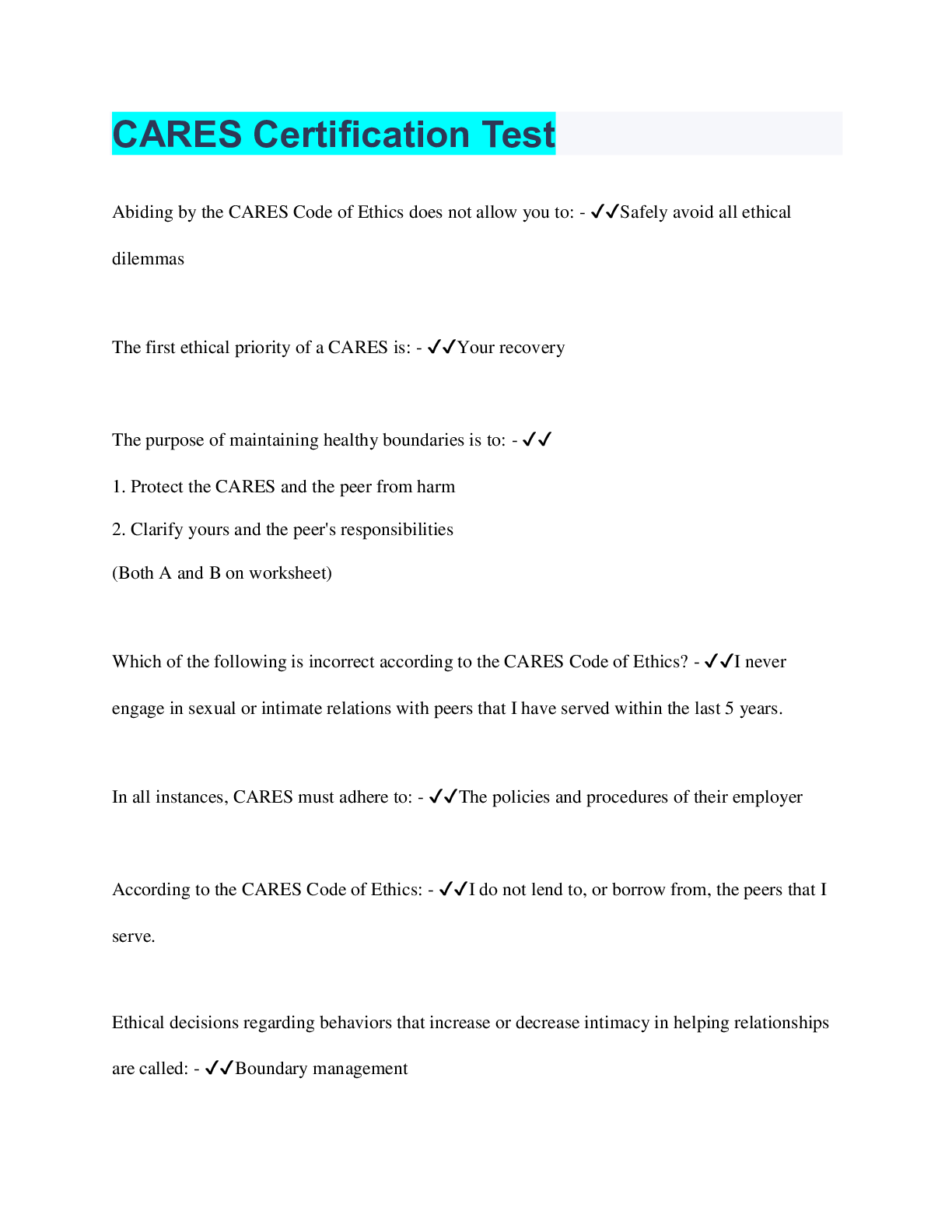
CARES Certification Test
Abiding by the CARES Code of Ethics does not allow you to: - ✔✔Safely avoid all ethical
dilemmas
The first ethical priority of a CARES is: - ✔✔Your recovery
The purpose of maintaining healthy boundaries is to: - ✔✔
1. Protect the CARES and the peer from harm
2. Clarify yours and the peer's responsibilities
(Both A and B on worksheet)
Which of the following is incorrect according to the CARES Code of Ethics? - ✔✔I never
engage in sexual or intimate relations with peers that I have served within the last 5 years.
In all instances, CARES must adhere to: - ✔✔The policies and procedures of their employer
According to the CARES Code of Ethics: - ✔✔I do not lend to, or borrow from, the peers that I
serve.
Ethical decisions regarding behaviors that increase or decrease intimacy in helping relationships
are called: - ✔✔Boundary management
The most helpful self-care strategies involve: - ✔✔1. Build on your strengths
2. Involve activities that you enjoy and are energized by
3. Reduce rather than add stress to your life
(All of the above on worksheet)
As CARES consider the ethics of situations at work, which of the following may guide her/his
decisions and behaviors? - ✔✔1. Federal and state laws
2. Workplace standards/policies/procedures
3. Historical practices of my agency
(All of the above on worksheet)
What are the possible outcomes of not intentionally engaging in self-care: - ✔✔Burnout and
compassion fatigue
Engaging in self-care activities helps: - ✔✔1. Maximize productivity through heightened energy
2. Be a positive role model for our peers
3. Maintain appropriate boundaries with our work environment
4. Deal with stress in our daily lives
(All of the above on worksheet)
Even if a CARES has the appropriate skills, experience and training, he or she: - ✔✔May NOT
step out of the CARES role to perform sponsorship, counseling or pastoral tasks with a peer
There are many definitions of: - ✔✔Recovery
Becoming culturally competent is: - ✔✔A process without an endpoint
To better serve peers of a different race, nationality, sexual orientation or gender, you should: -
✔✔Recognize, honor and respect the cultural differences
Ideas for creating change include all of the following except: - ✔✔Communicate only with
people that are close to you
Which of the following terms or phrases contribute to stigma and discrimination? - ✔✔1.
Dirty/clean
2. Substance abuse
3. Denial
4. She/he has to want sobriety
(All of the above on the worksheet)
Prejudice is an emotional commitment to a particular point of view that is: - ✔✔Not swayed by
contradictory evidence
(True on worksheet)
Culture includes but is not limited to: - ✔✔The shared values, norms, traditions, customs, art,
history, folklore, religious and healing practices and institutions of a racial, ethnic, religious or
social group that are generally transmitted to succeeding generations.
(True on worksheet)
Spirituality does not: - ✔✔Refer to the externals of our belief system: church, prayer, traditions,
rites, rituals, etc.
(False on worksheet)
Hidden rules are the "unspoken cues and habits of a group." - ✔✔1. These rules become part of
the group members' belief system and guide how each member behaves.
2. Relationships can be broken when you do not know the hidden rules.
3. Hidden rules limit your interaction with people who are different than you.
(All of the above on worksheet)
Culturally competent organizations value all of the following except: - ✔✔Resistance to
diversity
Stereotyping is: - ✔✔A natural part of what we as "people" do
Working with peers: - ✔✔Is NOT always a cross-cultural experience
The cycle of conditioning involves: - ✔✔1. Using a trusted person to share inaccurate
information
2. Separating or identifying the members of a group
3. Pointing out one individual's behavior as a stereotype of the larger group
4. Justifying the marginalized group's "acting out" behavior
(All of the above on worksheet)
What is used by allies who are effective? - ✔✔1. Listening
2. Asking questions
3. Learning about others
4. Stretching
(All of the above on worksheet)
What do people with physical or mental challenges identify as the biggest barrier to their
continued wellness? - ✔✔Stigma
Cultural competence begins with: - ✔✔Awareness of one's own beliefs, biases, feelings,
perceptions and reactions
"Recovery Capital" refers to: - ✔✔Internal and external resources that can be used to initiate and
maintain long-term recovery
Charting Outcome Rating Scale scores on the Self-Completed Overview of Recovery Experience
(SCORE) Board helps to: - ✔✔1. See the progress being made
2. Identify whether a change effort is working
3. Decide to abandon a task that is yielding undesired results and try something else
(All of the above on worksheet)
Which of the following best illustrates how to interpret scores on the Outcome Rating Scale? -
✔✔Your score is a _________________ and that is above (below) the clinical cutoff
Who's rating of the quality of the alliance or helping relationship is related to outcomes? -
✔✔Peer
The Relationship Rating Scale and the Group Session Rating Scale measures the: - ✔✔Peer's
view of the quality of the helping relationship
Mandated peers who score above the clinical cutoff should: - ✔✔Be asked to repeat the ORS and
score it as if s/he was the referral person (i.e., probation/parole office, spouse, boss, etc.).
(True on worksheet)
The Outcome Rating Scale score becomes meaningful only when: - ✔✔The peer connects the
marks on the lines with the last week's experiences and her/his reasons for seeking services
When an interaction seems to fizzle out, the conversation goes astray, or you are uncertain of the
peer's priorities, you should: - ✔✔Pick up the completed Outcome Rating Scale and redirect to
the reason for service and what can be done to increase the score on the lowest subscale.
The quality of the working alliance is based on: - ✔✔Validating/affirming the peer and agreeing
with her/his goals and the activities s/he wants to pursue for achieving those goals.
(True on the worksheet)
The CARES' main job in a Recovery Group is: - ✔✔Modeling the relationship enhancement
skills (OARSI).
Identifying yourself as a recovering alcoholic or addict is: - ✔✔Generally NOT well-received or
the preferred way to introduce yourself to peers.
(False on the worksheet)
Which of the following activities can a CARES do? - ✔✔1. Promote attendance at a particular
church or following specific religious practices
2. Suggest or express disagreement with diagnoses
3. Guide someone through the 12 Steps or the principles of a particular recovery program
4. Take a peer to a meeting
(E on worksheet: Each of the above activities raises boundary issues for a CARES.)
As an advocate, a CARES: - ✔✔1. Advocates for the recovery community
2. Advocates for the peer
3. Assists the peer to protect his/her rights
(All of the above on worksheet)
In which areas of life do people seeking or in recovery face discrimination? - ✔✔1. Housing
2. Employment
3. Healthcare
4. Relationships
(All of the above on worksheet)
Empathy is: - ✔✔1. The ability to accurately understand the peer's meaning
2. The ability to reflect that accurate understanding back to the peer
(A and B but not C on workheet)
Motivational Interviewing is NOT: - ✔✔A way to confront people
Four skills (OARS) used throughout motivational interviewing are: - ✔✔Open-ended questions,
affirmations, reflections and summaries
With permission from the peer, you can: - ✔✔Recommend participation in particular mutual
support organizations by saying something like, "Others have told me they liked attending
XYZ."
(True on worksheet)
The higher one's recovery capital is, the better are: - ✔✔Her/his chances of sustaining recovery.
Reflections are NOT: - ✔✔Questions rather than statements
(False on the worksheet)
A goal of Motivational Interviewing is: - ✔✔To create and amplify discrepancies or differences
between a person's behavior and her/his stated goals.
(True on worksheet)
A guiding principle of Motivational Interviewing is: - ✔✔To have the peer, rather than the
CARES, voice the arguments for change.
(True on worksheet)
Which of the following recognizes strengths or positive actions, builds feelings of empowerment
and promotes hope and the belief that the person can or already has changed? - ✔✔Affirmation /
Validation
A mastery level of MI skill is demonstrated by asking no more than how many questions in a
row? - ✔✔Two
What can be used to identify a situation's pros and cons and is potentially useful when the peer is
in early readiness for change, or offers very little change talk? - ✔✔Decisional Balance
The experience of conflicting positive and negative thoughts or feelings about a particular
behavior or change is called: - ✔✔Ambivalence
Change talk is any speech that favors movement toward change and may include statement's
regarding one's: - ✔✔Desires, abilities, reasons or needs (DARN)
Dr. Barry Duncan's Partners for Change Outcome Management System (PCOMS) approaches
change by: - ✔✔1. Building on each individual's strengths
2. Seeking what and how each individual has successfully changed before
(Answer is F on worksheet - both A and B)
How many people in the United States are in recovery? - ✔✔23 million
What is the CARES mission statement? - ✔✔CARES promote long-term recovery from
substance use by providing experienced peer support and advocating for self-directed care.
Peer recovery coaching is based on: - ✔✔1. Recovery-oriented systems of care principles
2. Person-directed and outcome-informed evidence-based practices (PCOMS)
3. Relationship enhancement EBP skills (Motivational Interviewing & Appreciative Inquiry)
(D - All of the above on worksheet)
Which of the following is not a core CARES competency? - ✔✔Transporting or escorting peers
to recovery support or 12-Step meetings
Recovery-Oriented Systems of Cares (ROSC) principles include: - ✔✔1. There are many
pathways to recovery
2. Recovery has cultural dimensions
3. Recovery emerges from hope and gratitude
4. Recovery involves addressing discrimination and transcending shame and stigma
(E - All of the above on worksheet)
Relapse is NOT an indicator that: - ✔✔The person is not ready to change and CARES will reengage when s/he sees some sign of finally being ready.
(False on worksheet - we work with people who may still be actively using/drinking.)
Most people: - ✔✔Do NOT achieve long-term recovery through 12-Step meetings after going
through treatment.
(False on worksheet)
Relapse is: - ✔✔NOT a natural part of recovery
(False on worksheet)
Which of the following contributes to the development of addiction: - ✔✔1. Genetic, stress, drug
used, frequency
2. Quantity of drug used, quality of drug used, educational level
3. Socioeconomic status, race, gender
(D - All of the above on worksheet)
The brain: - ✔✔Has a remarkable ability to adapt, heal and change.
(True on worksheet)
Research shows that relapse rates following addiction treatment: - ✔✔Are similar to relapse
rates after treatment for other chronic disorders like Type 1 diabetes, hypertension and asthma.
(True on worksheet)
Repeating or recalling emotionally intense experiences, like takin alcohol or other drugs, causes
the brain/mind to: - ✔✔1. Override the storage of past memories
2. Dampen the recall of negative experiences / emotions while heightening the recall of even
temporary, positive experiences
3. Re-set what is used in logical reasoning, decision and priorities
(D - All of the above on worksheet)
Research shows that during recovery, healing and rewiring of the brain occurs by: - ✔✔1. Active
and sustained engagement with one or more recovery communities
2. Mindful focus on progressive wellness and gratitude
3. Keeping a positive attitude
(D - All of the above on worksheet)
[Show More]