CBT Exam 1
The most important aspect of therapy with client? - ✔✔The most important aspect of therapy
with client is the client-therapist relationship
why is homework important in CBT? - ✔✔- helps clients build confid
...
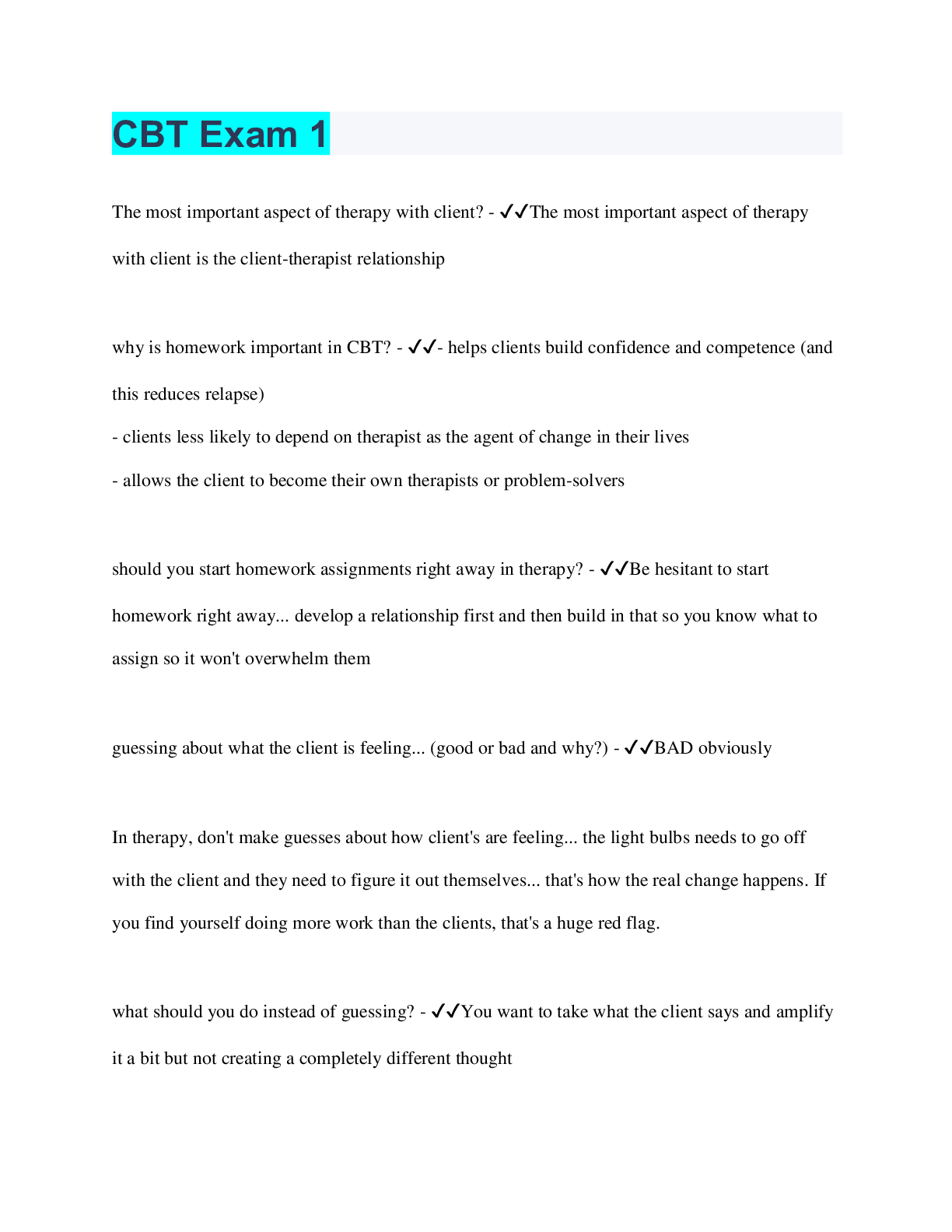
CBT Exam 1
The most important aspect of therapy with client? - ✔✔The most important aspect of therapy
with client is the client-therapist relationship
why is homework important in CBT? - ✔✔- helps clients build confidence and competence (and
this reduces relapse)
- clients less likely to depend on therapist as the agent of change in their lives
- allows the client to become their own therapists or problem-solvers
should you start homework assignments right away in therapy? - ✔✔Be hesitant to start
homework right away... develop a relationship first and then build in that so you know what to
assign so it won't overwhelm them
guessing about what the client is feeling... (good or bad and why?) - ✔✔BAD obviously
In therapy, don't make guesses about how client's are feeling... the light bulbs needs to go off
with the client and they need to figure it out themselves... that's how the real change happens. If
you find yourself doing more work than the clients, that's a huge red flag.
what should you do instead of guessing? - ✔✔You want to take what the client says and amplify
it a bit but not creating a completely different thought
clients who are blunt and use profanity... (good or bad?) - ✔✔GOOD!
You want to verbally praise clients for being blunt and using profanity.. You want to know the
harsh truth
what does it mean if the client is using resistance? - ✔✔If the client doesn't want to work with
you and is using resistance, they're not ready for therapy
how do clients learn about ethical boundaries in therapy? - ✔✔It is your responsibility to teach
ethical boundaries to your clients
as a therapist, how can you sell treatment better to the client? - ✔✔Try techniques on yourself
and see if it works so that way you're better able to sell it to the client; if you don't believe in
something your client definitely won't
- you'll come up with ways to describe the process and obstacles that you never would've figured
out if you didn't practice on yourself
where does the majority of change take place in CBT? - ✔✔the majority of the change that's
going to take place is IN BETWEEN SESSIONS
* this is why homework is so important!!
what is the most effective CBT strategy for depression and what does it involve? -
✔✔BEHAVIORAL ACTIVATION
you would have clients come up with small activities even if it's just showering to experience the
reward of feeling better and more positive
- note: flexibility is important so you're able to individualize these approaches to clients bc
everyone's different and moves at different paces
what is behavioral activation? what is the premise? - ✔✔- aims to alleviate depressive symptoms
and prevent relapse by focusing specifically on BEHAVIOR CHANGE
- premise of BA is that problems in vulnerable individuals' lives and their behavioral responses
to these problems reduce their ability to experience positive reward from their environment
- the goal of this treatment is to help clients experience more contact with sources of reward in
their lives and to solve life problems
what do BA treatment procedures focus on? - ✔✔focuses on activation and processes that inhibit
activation (i.e. escape and avoidance behaviors, rumination)
~this helps to increase experiences that are pleasurable or productive and improve quality of life
in BA, what is guided activation? - ✔✔- this is the use of a series of behavior change strategies
developed by the therapist and client together to carefully examine what activities will be
reinforcing for the client and help disrupt the relationships that are maintaining the depression
should you be enthusiastic if the client is doing better? why or why not? - ✔✔Even if client is
doing better, you need to be really neutral in your enthusiasm because they won't want to let you
down so they won't tell you the truth when you're not doing well
when first interviewing client, what are the 3 things you want to know about symptoms? -
✔✔INTENSITY, FREQUENCY, AND DURATION
- you want exact times, exact numbers, exact definitions
- be careful about filling in the blanks!
~ for example, use the SUDS scale (subjective units of distress scale) so lay out a scale like 1-10
and have them rate it so this way you have a baseline to compare future weeks with (i.e. where
are you on your suds scale)
what is GAD? why do these people usually have depressive symptoms? - ✔✔difficulty
controlling excessive worry which is why you see people with anxiety have depression or
depressive symptoms bc THEY FEEL LIKE THE CANNOT CONTROL IT
what does acceptance mean in mindfulness? - ✔✔acceptance doesn't mean youre getting over it
but you're acknowledging that it truly happened and youre ready to deal with it
what should you be looking for if a client has anxiety? - ✔✔COMORBIDITY WITH OTHER
DISORDERS!
- you're likely going to be looking for another disorder in terms of anxiety... there's a lot of
comorbidity with anxiety
what does CBT protocol usually look like (i.e. duration, etc) - ✔✔CBT is designed to be brief
and solution oriented - when you're done and reach the goal, you're done!
- But in terms of number of sessions, be optimistic but be FLEXIBLE even if it's not in
protocol...
how does mindfulness work in treating anxiety? - ✔✔We want to promote ACCEPTANCE into
our internal experienceS
- so much that happens with anxiety is physiological so this acceptance really combats
catastrophizing which increases all of your physiological anxiety responses and makes
everything worse which is how we get into panic attacks
- so instead of suppressing thoughts and fears, accepting it will help change those interpretations
and not catastrophizing that you're heart is racing instead of saying youre having a heart attack...
I have a stomach ache and accept it
- it doesn't mean it doesn't suck or that it has to go away but that you're ACCEPTING it
as a therapist, what should you focus on when treating a client with anxiety issues? - ✔✔the
FUNCTION of their worry
- there is a FUNCTION for this worry and you have to figure out what it is
- basically, we're reinforced for learning bc with worrying, it's like mental rehearsal (which helps
us remember stuff) so worrying helps us remember stuff
- having a mental checklist can cause anxiety bc if you don't practice this mental checklist and
you forget something it triggers worry
- SO we need to figure out what the FUNCTION of that worry is so we can challenge it bc that
person will never be able to get passed it unless that person can prove to themselves that, without
it, they're better off or they're going to contribute to do it
why is cultural sensitivity in therapy important? - ✔✔Barlow also talks about cultural sensitivity
which is extremely important bc something that's maladaptive to us may be perfectly normal in a
clients culture and if we don't know that, we lose them
- so figure out values of the client early on bc if you fill in the blank incorrectly you're going to
push them out
what is a component of self compassion? - ✔✔MINDFULNESS
what is mindfulness? what are the 2 components? - ✔✔- Paying attention to the present moment
on purpose
- Without judgment
~ so it doesn't mean it's right or wrong or positive or negative... you're not labeling it... it is what
it is
~ think of the example of having a stomach ache... it's not just being aware like oh I have a
stomach ache and I know it and I want it to go away... instead being mindful would be okay I
have this stomach ache maybe bc I have food poisoning and I'm just going to let it play out
NOTE: Apply these things to your life!! Anxiety symptoms, grief, end of a relationship, etc...
you should be able to feel that grief and accept it without trying to change it so you can move on
what is the opposite of mindfulness? - ✔✔MULTITASKING!
- which is why our culture has a problem with being mindful... we're very absent minded and
distracted and busy
(NOTE: The rise in ADHD might even have to do with lack of mindfulness)
How do we get people to be more mindful? - ✔✔We have to teach people ways to practice and
AS CLINICIANS WE NEED TO PRACTICE IT OURSELVES
How does CBT somewhat drift from mindfulness? - ✔✔Mindfulness says don't change it don't
judge just let it float by whereas cognitive restructuring is Changing your thoughts
what other type of therapy is mindfulness similar to? bc of this, why should you be careful using
it in therapy with certain clients? - ✔✔Mindfulness is very similar to exposure... when you're
working with trauma you want to be careful using mindfulness bc accepting about it over and
over may be bad for them and they might not be able to do mindfulness at first
what is the most effective treatment for trauma? - ✔✔EXPOSURE
- the exposure piece really has to happen to get past the trauma and manage symptoms associated
with trauma
what is exposure therapy? interoceptive vs in vivo? - ✔✔- it's designed to disconfirm
misappraisals and extinguish conditional emotional responses to external situations and contexts
IN VIVO - repeated and systematic real life expose that occurs in a graduated manner (although
ungraduated may also be effective
INTEROCEPTIVE - goal is to deliberately induce feared physical sensations a good amount of
times for a good duration each time so that misappraisals about the sensations are disconfirmed
and conditional anxiety responses are extinguished
If a patient comes in and went through a bad trauma and they say they just need to talk about it
immediately, what should you do as a therapist? - ✔✔- as a therapist you shouldn't talk about it
right then... they need the COPING SKILLS to deal with it first to avoid opening floodgates and
even suicide... if this person wants to talk about the trauma you NEED to give them coping skills
SCENARIO: If Medicaid only gives you a week to treat an inpatient for severe trauma and the
patient wants to talk about it right away, what should you do as the therapist? - ✔✔- you need to
give them COPING SKILLS... unless you have the correct amount of time (12 weeks for tfcbt)
do NOT open those doors... STABILITY is so important
- In fact, this is where medications come in... medications are useful because they help dampen
affect so their reactions aren't as extreme during exposure... so they can actually USE the coping
skills
~it's hard to expose yourself to that trauma and get worked up and then sit down and breathe...
the medications help you to tolerate this distress so you can use the coping skills; then when you
can handle it you can decrease the medication and then discontinued
Before you open the gates for the client, what should you ask yourself? - ✔✔ask yourself can
they handle it getting worse?
- If they can, you can move to the next stage of assessment of their coping skills
~ (i.e. so as the therapist, ask them when's the last time you got upset, what did you do? If they
say go shoot heroine or take a shot of alcohol, they're not ready yet. Maybe theyre ready if they
say I go for a jog, I go swimming, etc)
how does a client's perceptions contribute to social anxiety disorder? - ✔✔How you perceive
your environment can all contribute to your development of this way you see the world and when
you get reinforced by avoiding it gets even worse... it makes sense from a CBT perspective when
you look at the negative cognitive distortions
what are the disadvantages of group therapy in SAD? - ✔✔- not attending therapy bc of their
social anxiety of being around others in the group
- If others in the group do their homework and the one client doesn't, it might make them feel
bad which would further reinforce social anxiety
- Worried about what people think about you say if you don't go to therapy which may make you
stand out more, further reinforcing social anxiety
- less flexibility in making up missed sessions
what are the advantages of group therapy in SAD? - ✔✔- exposure bc they're in group therapy
- vicarious learning
- support from others w/similar problems
as a therapist, how can you put yourself in the mindset of a client with SAD? - ✔✔- When
looking at this disorder, think about your own personal experiences with social anxiety... think
about what exactly was your fear... what would it mean if everyone noticed this fear or your
nervousness (maybe it'll make you look incompetent, it would be embarrassing, etc)
~ then what would be the worst thing that could happen if they noticed?
~Maybe they'd think you're a failure... do they actually think that or is that an assumption? It's
usually just an assumption
- SO if you really track down your thoughts you can see where the fear is coming from... in this
case it's the fear of failure which could mean worthlessness, inability to succeed, etc and THIS is
what you need to do for clients with SAD... what is their actual fear?
what is the core of SAD (in terms of the fear)? - ✔✔- Social anxiety is basically fear of being
negatively evaluated by others... so it doesn't take much to get someone back into that loop.. Say
you have an interaction with someone that goes poorly, your cognitions are going to go right
back into the loop of distorted negative cognitions when you're interpreting the event
on the self-criticism scale, what are the 2 sub scales? - ✔✔- *Internalized self criticism* - you
have your own standards and you're judging yourself for not meeting the
- *Comparative self criticism* - your self evaluation based on comparing yourself to other
people
Out of these 2, studies show that COMPARATIVE SELF CRITICISM is off the charts - think
about social media
- It's easy to get sucked back into the loop of social anxiety and one reason is because of our
culture bc we tend to be so self critical
why is it so hard to change these negative cognitions in SAD and any other disorder? - ✔✔- A
lot of the time we may not even realize we're in these negative thought processes
- think about mindfulness.. My mind will go off on a whole other tangent and be halfway
through it before I realize it
- WHY? It's because this is HABITUAL THINKING.... You have to rebuild your thinking...
you're changing 23 years of habit (or however old the client is)!...
- In a lot of cases habitual thinking is worse than tangible habits i.e. smoking because we aren't
AWARE OF THEM!
- CBT says our thoughts are EVERYTHING
- Explain this to a client and make them get it by telling them how many problems it has caused
will SAD be cured? - ✔✔NO - do NOT tell your client this...
- Be honest... don't tell them their anxiety will be cured... the minute they can accept their anxiety
symptoms and fight them and not hate yourself for them is the minute they become more
manageable... tell them by the end of this they'll be able to give a class presentation rather than
by the end of this you'll have no more anxiety
how should you approach workbook homework assignments? - ✔✔go slow assigning workbook
homework since it's so formal... get them to want to do more through things like motivational
interviewing and then you'll know its times to assign more formal homework
what is a huge part in CBT protocol to help clients see that their thinking is causing problems? -
✔✔dysfunctional thought record (DTR)
- this is a HUGE part of CBT... when you get a client to realize that their thinking is causing
problems (which might not be right away), you need to have them look are these negative ways
of thinking and change them. So to do this, you have them write it out whenever they aren't
feeling good
- The DTR worksheet (received in class) will be a homework assignment and help see the
challenges and obstacles, find out what their triggers are, etc
what should you make sure you have with a client before giving them a DTR worksheet? - ✔✔-
Make sure you have a good relationship with your client before you throw this at them because
you don't want to insult them (i.e. approach it instead like "wow these thoughts are causing you
problems... it's not really functional... it's almost dysfunctional")
what is an activating event (by albert ellis)? - ✔✔anything that happens to sparks these emotions
- this is why date and time are important on the DTR... maybe it's always at night when they're
alone
basically, what is a DTR looking at? - ✔✔What happened, how did you feel, what thoughts lead
to this (show them thoughts lead to emotion), work through these thoughts, and after you've
challenged them, how do you feel now? So they can keep doing it on their own .. This is a way to
really buy in and show how this works
DTR: automatic thoughts section - ✔✔(this is the challenging part, bc they believe that the
situation causes the emotion but CBT says NO that it's the automatic thoughts that cause the
emotion)...
tell them you wanna hear their negative raw thoughts even if it's vulgar; and how much did you
believe each thought - tell them to rate on like a scale of 1 to 10
DTR: emotions section - ✔✔When using the 0-100% intensity, don't tell them what each
percentage means... have them Come up with it... you want this to have meaning to them or this
is pointless
DTR: alternative response section - ✔✔In terms of cognitive distortions, teach them all of them
(ie all or none thinking, etc)- teach these BEFORE you give out the DTR.. You don't want to
teach them too much or it will be overwhelming
- A lot of the time clients don't just fear something bad will happen; they ASSUME something
bad will happen which is problematic and will even make them perform in ways that will cause
these bad things to happen, further reinforcing anxiety (aka thought action fusion) - this is
fortune telling cognitive distortion
- Ask them how much evidence they have to support these assumptions to CHALLENGE
THEIR THOUGHTS - show to them that these are not factual
- And if they truly believe their thoughts are factual, ask them if these thoughts are helping
them... if it's hurting you, that's a reason to discard it
- Also the person to think about consequences of these thoughts
what characteristics make a good therapist? - ✔✔- provide a COLLABORATIVE environment
- be NONJUDGMENTAL
- balance empathy for client's struggles with optimism about the possibility to change
- validate clients' struggles and experiences
from barlow - acronym ENLIVEN
E stablish and follow agenda
N urture activation
L earn together w/client
I s nonjudgmental
V alidates
E ncourages
N aturally expresses warmth
what is the UCLA PTSD index? - ✔✔its a self report assessment (for ages 6+) that screens for
trauma exposure and DSM 5 PTSD symptoms
what are the diff parts of the UCLA PTSD index (i.e. trauma history profiles, freq rating sheet,
etc)? - ✔✔TRAUMA HISTORY PROFILE PART 1
- this is for before you interview... this is what you already know about the kid so the therapist
fills this out
TRAUMA HISTORY PROFILE PART 2
- you're now working with the kid; the therapist fills them out and asks the kid to answer yes or
no
- then when you finish these questions, at the bottom when it asks for the whats most
bothersome, you ask them out of all these things what was the worst and take as much as they'll
give you
FREQUENCY RATING SHEET
- you want to know how often certain symptoms happen... be clear in explaining what NONE
and MOST means
REACTION INDEX
- has all PTSD symptoms and the therapist fills this out
- then at the bottom the dissociative part is separated so you can see if the person is having PTSD
with or without dissociative symptoms
- then ask more detailed questions about where the symptoms take place
SCORING SHEET
when is the UCLA PTSD index good to give to a client? - ✔✔This assessment is also good to
give at baseline and then throughout to see where theyre at
what is the BDI? - ✔✔beck depression inventory
- 21 item self report scale to assess and identify the presence and severity of symptoms of
depression
- NOT for diagnosis, bc the depressive symptoms could be part of another disorder
what is the BAI? - ✔✔beck anxiety inventory
- 21 item self report scale to assess and identify presence and severity of symptoms of anxiety
- Because the items in the BAI describe the emotional, physiological, and cognitive symptoms of
anxiety but not depression, it can discriminate anxiety from depression
why is the self-compassion scale useful? - ✔✔- it could help break through the barriers of NATs
- you can use it for conversation in therapy -- put it on treatment plans and measure it every other
week or something to see how things change
what are the components of CBT? - ✔✔- psychoeducation
- self-monitoring
- breathing retraining/capnometry-assisted respiratory training (for panic)
- applied relaxation
- cognitive restructuring (patients learn to recognize cognitive errors and generate alternative
explanations; thoughts are conceptualized as testable hypotheses that are open to be questioned)
- exposure
what does tf-cbt focus on? - ✔✔- Conditioned emotional associations to memories and
reminders of the trauma
- Distorted cognitions about the event
- Negative attributions about self, others and the world
how is tf-cbt diff from regular cbt? - ✔✔- there is a SPECIFIC event that you can refer to in
treatment. The person isn't there because they are overcome with depression or anxiety and need
a more broad sense of help; broad life help. TF-CBT is for people who can say, "This specific
thing that happened to me is taking over my life."
what does tf-cbt treatment include in terms of sessions? - ✔✔12 treatment sessions.
Individual sessions for the child and for the parents, as well as joint parent-child sessions
why are there joint parent-child sessions in tf-cbt? - ✔✔- support for the child
- reduce parental distress
- teach appropriate strategies to manage child behavioral reactions (how to handle these
externalizing behaviors at home)
* later sessions may involve siblings as a way to enhance communication
what is the population best served for tf-cbt? - ✔✔- children ages 3-18
- victims of traumas such as sexual abuse, physical abuse, traumatic grief, domestic violence,
natural disasters, terrorism, or multiple traumatic events
- caucasian and african american; also latino (modifications in the treatment also cultural
adaptability)
- Children experiencing traumatic grief
strengths of tf-cbt - ✔✔- strong empirical support
- Flexible protocol
- Improvements have been shown in studies conducted two years after therapy
- doesn't need a lot of sessions (only 12)
- Can be conducted anywhere with a quiet room (school, hospital, office, home, residential
setting)
-Can be provided to children if the parents are unable/unwilling to participate
- cultural adaptability
weaknesses of tf-cbt? - ✔✔- might be too structured for some therapists
- Some therapists may not be willing or able to conduct a therapy that focuses on the parent
being so heavily involved with cognitive-behavior change within the child
- might be too intensive for some clients (therapy is once a week for 60-90 minutes for 12-16
weeks)
how do you implement tf-cbt (aka what's the protocol)? - ✔✔PRACTICE
P sychoeducation
- learn about trauma, PTSD, tf-cbt,
- normalize symptoms and validate experiences of client
R elaxation
- create a toolbox for child so they can control their symptoms in their own environment
A ffective regulation
- teaches client to be expressive and exert control over emotions
- aka affective regulation, or learning how to regulate emotions
C ognitive coping goals
- make distinction between thoughts, feelings, and behaviors, and how these 3 affect each other
- helps clients/families evaluate the ways in which trauma changed their thinking
- correct distorted thoughts
T rauma narrative
- recount traumatic event in creative way
I nvivo exposure
- unpairing feared stimuli with the responses of anxiety and fear
C o-joint sessions with family members
- increase client's sense of social support and security.
E nuancing sense of personal security
- allows client to deal with the memories of previously experienced trauma AND handle future
challenges in more effective ways
what are the cognitive distortions (by Beck)? - ✔✔- all or nothing
- overgeneralizing
- mental filter
- disqualifying the positive
- catastrophizing
- emotional reasoning
- should statements
- labeling
- personalization
all or nothing thinking - ✔✔seeing things in black or white as opposed to shades of gray (if i
don't get all As I'm a failure)
overgeneralizing - ✔✔Making a very broad conclusion based on a single incident
mental filter - ✔✔focusing entirely on negative elements of a situation, to the exclusion of the
positive
disqualifying the positive - ✔✔discounting positive events.
mind-reading/fortune-telling - ✔✔assuming something bad will happen
catastrophizing - ✔✔Giving greater weight to the worst possible outcome, however unlikely, or
experiencing a situation as unbearable or impossible when it is just uncomfortable.
emotional reasoning - ✔✔thinking something is true, solely based on a feeling; presuming that
negative feelings expose the true nature of things
should statements - ✔✔expecting others to do something they morally ought to do and not
thinking about situational attributions (i.e. the doctor is late today, he should always be on time
no matter what)
labeling - ✔✔more severe overgeneralization -- making personal attributions instead of
situational
personalization - ✔✔blaming oneself for situations they have no control over
[Show More]



![Preview of AORN PERIOP 101 FINAL EXAM 2026 QUESTIONS AND VERIFIED ANSWERS [LATEST UPDATE]](https://browseimages.nyc3.digitaloceanspaces.com/paper-images/2026/04/07/sGJvJ3aH2026-04-07-04-5869d464cbba16f.png)