Cedarville PAC Lyons Quiz 1-5 Answers
Grudem (Politics—According to the Bible) and Boyd (The Myth of a Christian Nation) largely
agree on how government is portrayed in Scripture. T/F - ✔✔False
Boyd (The Myth of a Chr
...
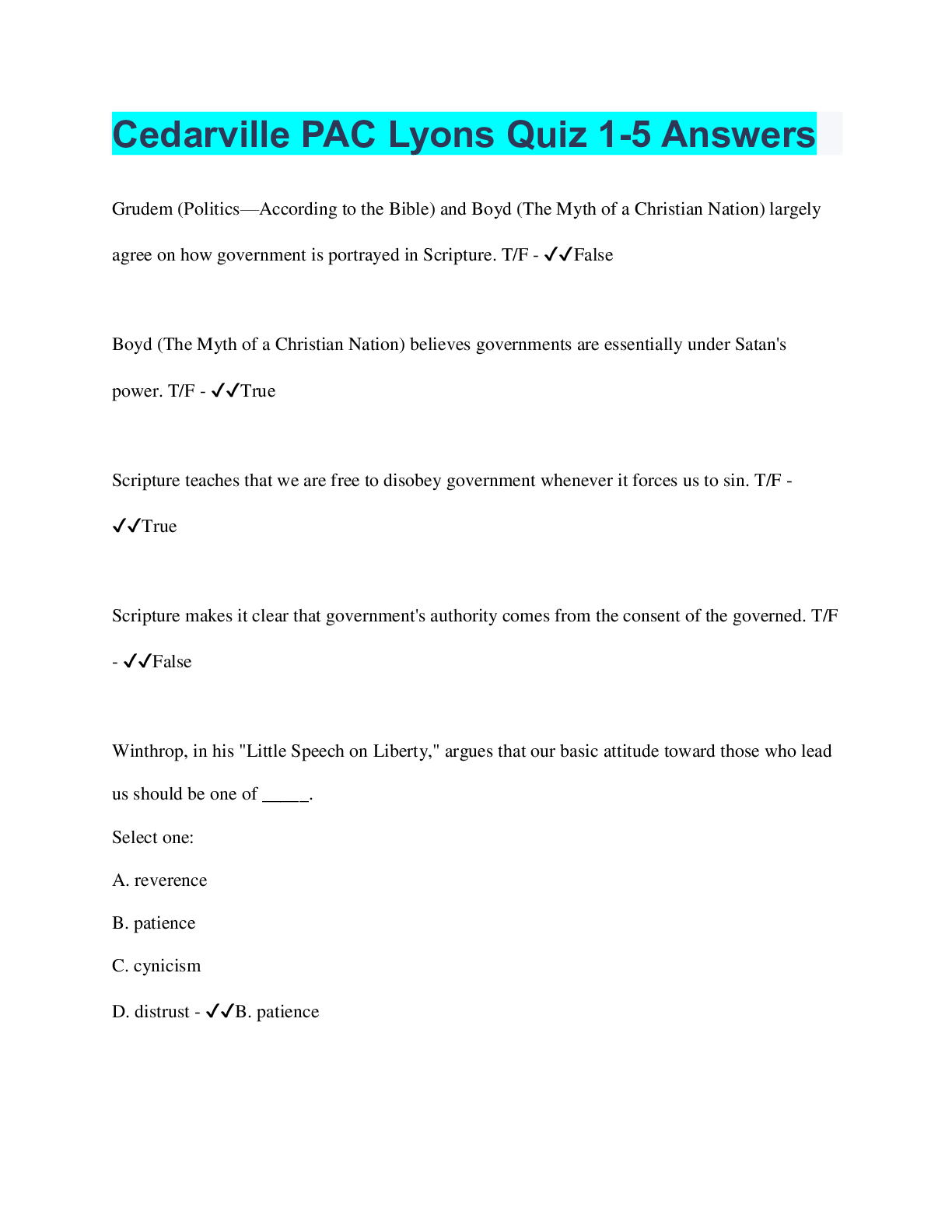
Cedarville PAC Lyons Quiz 1-5 Answers
Grudem (Politics—According to the Bible) and Boyd (The Myth of a Christian Nation) largely
agree on how government is portrayed in Scripture. T/F - ✔✔False
Boyd (The Myth of a Christian Nation) believes governments are essentially under Satan's
power. T/F - ✔✔True
Scripture teaches that we are free to disobey government whenever it forces us to sin. T/F -
✔✔True
Scripture makes it clear that government's authority comes from the consent of the governed. T/F
- ✔✔False
Winthrop, in his "Little Speech on Liberty," argues that our basic attitude toward those who lead
us should be one of _____.
Select one:
A. reverence
B. patience
C. cynicism
D. distrust - ✔✔B. patience
Winthrop's "Little Speech on Liberty" stresses that those who serve in elected positions are
fundamentally unlike those they represent. T/F - ✔✔False
In his "Little Speech on Liberty," John Winthrop argues that civil liberty is the natural ability to
do whatever we wish and only rarely should government be able to limit this kind of liberty. T/F
- ✔✔False
According to Scripture, Christians are required to obey government unless government forces us
to sin. T/F - ✔✔True
Both Jefferson and Locke think popular consent is a fundamental aspect of good government. -
✔✔True
Locke believes that citizens give up no rights or powers when they enter into a governmental
structure. T/F - ✔✔False
Boucher ("On Civil Liberty...") thinks a government seeking the public good must be based on
the consent of the governed. T/F - ✔✔False
Jefferson argues in the Declaration that citizens have the right to alter or abolish government
when it fails to protect rights and liberties. T/F - ✔✔True
The document explaining the ideas of the Constitution and urging its ratification is the...
Select one:
A. Mayflower Compact.
B. Federalist Papers.
C. Anti-Federalist Papers.
D. Declaration of Independence.
E. Declaration of Conscience. - ✔✔B. Federalist Papers.
In Federalist No. 10, James Madison argued for what idea?
Select one:
A. America was not diverse enough to prevent powerful interest groups from exercising too
much political power.
B. Government is most dangerous when a single group is powerful enough to gain full political
control.
C. Interest groups should be heavily regulated in America.
D. Monarchies are preferable to democracies. - ✔✔B. Government is most dangerous when a
single group is powerful enough to gain full political control.
The principle of checks and balances, as discussed in Federalist #51, is based on the notion that...
Select one:
A. leaders are the trustees of the people.
B. legislators and executives cannot be trusted, but judges are trustworthy.
C. power and ambition must be used to offset power and ambition.
D. a weak government is always preferable to a strong government.
E. all legislative and executive action should be controlled through judicial power. - ✔✔C.
power and ambition must be used to offset power and ambition.
In Federalist 10, Madison argues that a successful government will heavily regulate people to
limit their freedom to form groups. T/F - ✔✔False
In Federalist 51, Madison suggests that human beings are "good" enough to be trusted with
significant political power. T/F - ✔✔False
Montezuma, in his satirical Anti-Federalist paper, argues that the new Constitution...
Select one:
A. gives too much power to state governments.
B. is not democratic enough because only the House is popularly elected.
C. will keep elected officials too connected to those who vote for them, probably at the expense
of the country.
D. All of the above are correct. - ✔✔B. is not democratic enough because only the House is
popularly elected.
Brutus, in his Anti-Federalist paper, argues that the new Constitution should contain of a bill of
rights. T/F - ✔✔True
Cato, in his Anti-Federalist Paper, argues against _____ and his _____.
Select one:
A. Montesquieu; notion of separation of powers
B. Madison; belief that America's size and diversity would benefit the new government
C. Montezuma; idea that the national political culture would destroy representation
D. Jefferson; understanding of social contract theory - ✔✔B. Madison; belief that America's size
and diversity would benefit the new government
[Show More]


![Preview of [SOLVED] HIEU 201 / HIEU201 Chapter 2 Quiz (LATEST 2022)](https://scholarfriends.com/storage/HIEU_201_Chapter_2_Quiz.png)
![Preview of [SOLVED] HIEU 201 / HIEU201 Chapter 8 Quiz (LATEST 2022)](https://scholarfriends.com/storage/HIEU_201_Chapter_8_quiz.png)


![Preview of [SoIved] Liberty University HLTH 640 quiz 1](https://scholarfriends.com/storage/Liberty-University-GLST-650-EXAM-3.png)


.png)


.png)

.png)
.png)