SERIES 7 – DEBT Test Questions
U.S. Government debt is sold by _____________ bidding at a weekly auction conducted by the
_________________ where ____________ are sold. - ✔✔Sold by COMPETITIVE bidding at a
weekly auct
...
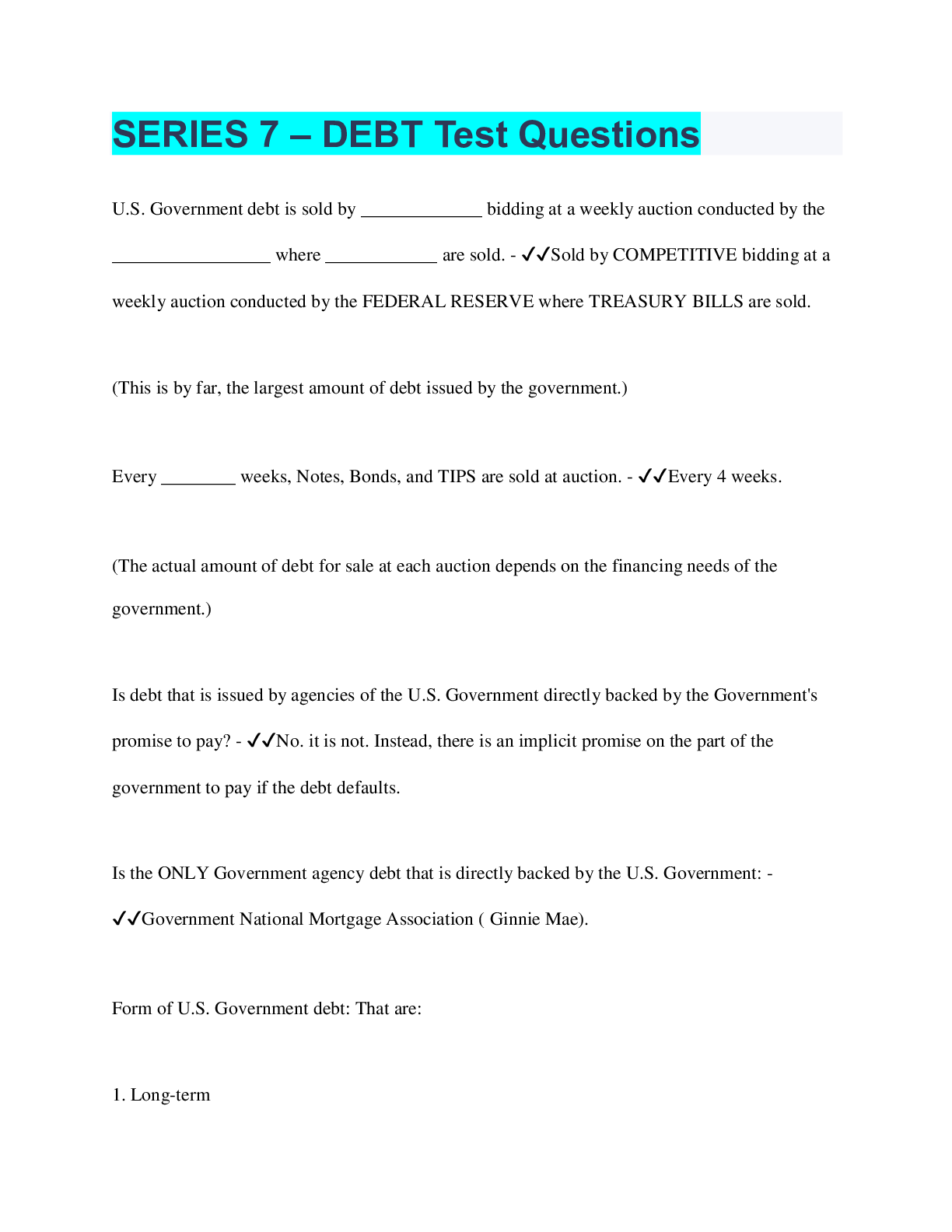
SERIES 7 – DEBT Test Questions
U.S. Government debt is sold by _____________ bidding at a weekly auction conducted by the
_________________ where ____________ are sold. - ✔✔Sold by COMPETITIVE bidding at a
weekly auction conducted by the FEDERAL RESERVE where TREASURY BILLS are sold.
(This is by far, the largest amount of debt issued by the government.)
Every ________ weeks, Notes, Bonds, and TIPS are sold at auction. - ✔✔Every 4 weeks.
(The actual amount of debt for sale at each auction depends on the financing needs of the
government.)
Is debt that is issued by agencies of the U.S. Government directly backed by the Government's
promise to pay? - ✔✔No. it is not. Instead, there is an implicit promise on the part of the
government to pay if the debt defaults.
Is the ONLY Government agency debt that is directly backed by the U.S. Government: -
✔✔Government National Mortgage Association ( Ginnie Mae).
Form of U.S. Government debt: That are:
1. Long-term
2. Issued with maturities of 30 years
3. Quoted as a percentage of par
4. Quoted in minimum increments of 1/32nd's
5. Issued in minimum denominations of $ 100
6. Pay interest semi-annually
7. Are non-callable - ✔✔Treasury Bond
What type of risk do STRIPS avoid? - ✔✔Reinvestment Risk
What type of risk do TIPS avoid? - ✔✔Purchasing Power Risk
Form of U.S. Government debt. That is:
1. A zero-coupon treasury obligation
2. Are sold at a significant discount to face value
3. Final principal payment occurs at maturity
4. Mature at par
5. Offer NO interest payments - ✔✔Treasury STRIPS
This investment, is designed for pension fund managers who want a safe, long term investment
and who do not want to worry about having to reinvest semi-annual interest payments that could
be subject to reinvestment risk ( if market interest rates fall during this time period). -
✔✔Treasury STRIPS
Type of U.S. Government debt. That are:
1. Have a fixed interest rate over the life of the bond
2. The principal amount is adjusted every 6 months by an amount equal to the change in the
Consumer Price Index.
3. Pays interest semi-annually
4. The interest amount ( the fixed rate X the adjusted principal amount) will increase if the
principal amount is adjusted upwards due to inflation
5. And, the interest amount, will decrease if the principal amount is decreased due to deflation.
( So, the interest payments adjust to inflation.)
6. If the principal amount is adjusted upwards due to inflation, the bondholder receives the
higher amount at maturity.
7. If the principal amount is decreased due to deflation, the bondholder will always receive par at
maturity.
8. Thus, is protected from purchasing power risk.
9. Have a lower interest rate than similar maturity regular Treasury issues because of this
inflation protection feature.
10. Your return each year will be the "real interest rate" plus an additional return equal to that
year's inflation rate. - ✔✔TIPS ( Treasury Inflation Protected Security)
TIPS Example:
If you buy a 3% TIPS, and say, inflation rises to 1% in 2018, the TIPS return for that year will be
3% real rate + the 1% inflation rate for that year = 4% total return.
( The 3% us received as interest, while the inflation component is added to the principal amount
of the bond.) - ✔✔TIPS Example and Explanation
Thus, as inflation rises. the return rises. and the TIPS price will not fall.
Type of U.S. Government treasury debt security. That are:
1. Intermediate-term securities
2. Issued with maturities ranging from over 1 year to 10 years.
3. Issued in minimum denominations of $100 par value
4. Pay interest semi-annually
5. non-callable
6. Quoted as a percentage of par
7. Quoted in 32nds. - ✔✔Treasury Notes
type of U.S. Government debt. That are:
1. Short-term securities
2. Issued with 1, 3, 6 and 12 month maturities
3. Maturities should also be known as 4, 13, 26, and 52 weeks.
4. Issued at a discount to par
5. The interest earned is considered to be the interest income
6. Mature at par
7. Quoted on a discount yield basis ( Yield Basis Quote) - ✔✔Treasury Bills
Type of U.S. Government treasury security. That are:
1. Very short-term
2. Typical maturities range from 5 days to 6 months
3. Sold at auction on an "as needed" basis when the Treasury is running low on cash
4. They are used by the Treasury to smooth our its cash flow needs.
5. Are sold in $100 minimum amounts
6. Pay a slightly higher interest rate than equivalent maturity T-Bills sold on a regular auction
schedule - ✔✔Cash Management Bill (CMB)
Are "savings bonds" issued by the U.S. Government with:
1. They do not trade
2. Are issued by the Treasury and redeemed by the Treasury ( a bank can act as an agent for the
Treasury issuing and redeeming these bonds)
3. A minimum purchase amount of $25 ( or more). This is the face value of the bond, and any
interest earned will be added to the bond's value.
4. The interest rate is set at issuance.
5. Interest is "earned" monthly and credited to the principal amount every 6 months.
6. These bonds have no stated maturity
7. The holder can redeem at any time, however interest is only credited to the bonds for 30 years.
8. No physical certificates are issued, these bonds are issued in electronic form. - ✔✔Series EE
Bonds
Unlike Treasuries which are sold at auction, Government agency obligations are offered by a
________ of dealers, mainly large commercial banks and brokerage firms. They typically yield
____% more than equivalent maturity Treasuries, because they do not have a direct U.S.
Government guarantee. - ✔✔Selling group of dealers
They typically yield 0.25% more than equivalent maturity Treasuries.
The selling group of dealers quote agencies on what basis? - ✔✔"Yield Spread Basis"
Which of the following statements are TRUE about CMOs in a period of rising interest rates?
I CMO prices fall slower than similar maturity regular bond prices
II CMO prices fall faster than similar maturity regular bond prices
III The expected maturity of the CMO will lengthen due to a slower prepayment rate than
expected
IV The expected maturity of the CMO will lengthen due to a faster prepayment rate than
expected
A. I and III
B. I and IV
C. II and III
D. II and IV - ✔✔C. II and III
When interest rates rise, mortgage backed pass through certificates fall in price - at a faster rate
than for a regular bond. This is true because when the certificate was purchased, assume that the
expected life of the underlying 15 year pool (for example) was 12 years. Thus, the certificate was
priced as a 12 year maturity. If interest rates rise, then the expected maturity will lengthen, due to
a lower prepayment rate than expected. If the maturity lengthens, then for a given rise in interest
rates, the price will fall faster.
Which of the following statements are TRUE regarding a CMOs maturity when interest rates rise
and fall? - ✔✔When interest rates rise, maturities will lengthen
When interest rates fall, maturities will shorten
Which of the following statements regarding collateralized mortgage obligations are TRUE?
I Each tranche has a different level of market risk
II Each tranche has a different level of credit risk
III Each tranche has a different yield
IV Each tranche has a different expected maturity
A. I and II only
B. III and IV only
C. I, III, IV
D. I, II, III, IV - ✔✔C. I, III, IV
CMO divides the cash flows from underlying mortgage backed pass-through certificates into
"tranches." Each tranche, in effect, represents a differing expected maturity, hence each tranche
has a different level of market risk. Since each tranche represents a differing maturity, the yield
on each will differ. New CMOs have special classes of tranches called PAC (Planned
Amortization Class) and TAC (Targeted Amortization Class) tranches. These tranches are given
a greater certainty of repayment at the projected date, by allocating earlier than expected
repayments to so-called "companion" tranches, before prepayments are applied to these tranches.
Credit risk for CMO tranches is the same for all tranches, since it is based on the quality of the
underlying mortgage backed securities held in trust.
What is true regarding collateralized mortgage obligation tranches? - ✔✔Each tranche has a
different level of market risk
and
Each tranche has a different yield
Which of the following statements are TRUE regarding CMO "Planned Amortization Classes"
(PAC Tranches) - ✔✔PAC tranches reduce prepayment risk to holders of that tranche
and
Principal repayments made later than expected are applied to the PAC prior to being applied to
the Companion tranche
When compared to plain vanilla CMO tranches, Planned Amortization Classes have: - ✔✔Lower
prepayment risk
Which CMO tranche has the least certain repayment date?
A. Planned Amortization Class
B. Plain Vanilla
C. Companion Class
D. Targeted Amortization Class - ✔✔C. Companion Class
Companion classes are "split off" from the Planned Amortization Class (PAC) and act as buffers
absorbing prepayment and extension risk prior to this risk being applied to the PAC tranche. The
PAC, which is relieved of these risks, is given the most certain repayment date. The Companion,
which absorbs these risks first, has the least certain repayment date. A Targeted Amortization
Class (TAC) is like a PAC, but is only buffered for prepayment risk by the Companion; it is not
buffered for extension risk.
Which of the following statements are TRUE when comparing CMO PAC tranches to
Companion tranches?
I Principal repayments made earlier than expected are applied to the PAC before being applied to
the Companion class
II Principal repayments made earlier than expected are applied to the Companion class before
being applied to the PAC
III Principal repayments made later than expected are applied to the PAC before being applied to
the Companion class
IV Principal repayments made later than expected are applied to the Companion class before
being applied to the PAC
A. I and III
B. I and IV
C. II and III
D. II and IV - ✔✔C. II and III
Interest payments on CMOs are made pro-rata to all tranches, but principal repayments that are
made earlier than the PAC maturity are made to the Companion classes before being applied to
the PAC (this would occur if interest rates drop); while principal repayments made later than
anticipated are applied to the PAC maturity before payments are made to the Companion class
(this would occur if interest rates rise). Thus, the PAC is given a more certain repayment date;
while the CMO is given the least certain repayment date.
Which statements are TRUE regarding CMOs?
I PAC yields are higher than Companion class yields
II Companion class yields are higher than PAC yields
III The PAC has a lower level of prepayment and extension risk than the Companion class
IV The Companion class has a lower level of prepayment and extension risk than the PAC
A. I and III
B. I and IV
C. II and III
D. II and IV - ✔✔C. II and III
The PAC tranche is a "Planned Amortization Class". Surrounding this tranche are 1 or 2
Companion tranches. Interest payments are still made pro-rata to all tranches (like plain vanilla
CMOs), but principal repayments made earlier than that required to retire the PAC at its maturity
are applied to the Companion class; while principal repayments made later than expected are
applied to the PAC maturity before payments are made to the Companion class. Thus, the PAC
class is given a more certain maturity date; while the Companion class has a higher level of
prepayment risk if interest rates fall; and a higher level of so-called "extension risk" - the risk
that the maturity may be longer than expected, if interest rates rise. Thus, because the PAC has
lowered prepayment and extension risk, its yield will be lower than the surrounding Companion
classes.
Which is a Targeted Amortization Class (TAC)? - ✔✔TAC Facts:
1. A TAC is a variant of a PAC that has a higher degree of extension risk
2. TAC tranches protect against prepayment risk
3. TAC tranches do not protect against extension risk
A Targeted Amortization Class (TAC) is a variant of a PAC. A PAC offers protection against
both prepayment risk (prepayments go to the Companion class first) and extension risk (later
than expected payments are applied to the PAC before payments are made to the Companion
class). A TAC bond protects against prepayment risk; but does not offer the same degree of
protection against extension risk. A TAC bond is designed to pay a "target" amount of principal
each month. If prepayments increase, they are made to the Companion class first. However, if
prepayment rates slow, the TAC absorbs the available cash flow, and goes in arrears for the
balance. Thus, average life of the TAC is extended until the arrears is paid.
Therefore, both PACs and TACs provide "call protection" against prepayments during period of
falling interest rates. TACs do not offer the same degree of protection against "extension risk" as
do PACs during periods of rising interest rates - hence their prices will be more volatile during
such periods.
How does Prepayment and Extension risk of a Planned Amortization Class (PAC) compare to a
CMO Targeted Amortization Classes (TACs) have: - ✔✔TACS have: The same level of
prepayment risk but a higher level of extension risk than a Planned Amortization Class
When comparing a CMO Planned Amortization Class (PAC) to a CMO Targeted Amortization
Class (TAC), which statements are TRUE?
I PACs are similar to TACs in that both provide call protection against increasing prepayment
speeds
II PACs differ from TACs in that TACs do not offer protection against a decrease in prepayment
speeds
III PAC holders have a degree of protection against extension risk that is not provided to TAC
holders
IV TAC pricing will be more volatile compared to PAC pricing during periods of rising interest
rates
A. I only
B. II and III only
C. I, II, III
D. I, II, III, IV - ✔✔D. I, II, III, IV
A Targeted Amortization Class (TAC) is a variant of a PAC. A PAC offers protection against
both prepayment risk (prepayments go to the Companion class first) and extension risk (later
than expected payments are applied to the PAC before payments are made to the Companion
class). A TAC bond protects against prepayment risk; but does not offer the same degree of
protection against extension risk. A TAC bond is designed to pay a "target" amount of principal
each month. If prepayments increase, they are made to the Companion class first. However, if
prepayment rates slow, the TAC absorbs the available cash flow, and goes in arrears for the
balance. Thus, average life of the TAC is extended until the arrears is paid.
Therefore, both PACs and TACs provide "call protection" against prepayments during period of
falling interest rates. TACs do not offer the same degree of protection against "extension risk" as
do PACs during periods of rising interest rates - hence their prices will be more volatile during
such periods.
Which statements are TRUE regarding Z-tranches?
I Interest is paid before all other tranches
II Interest is paid after all other tranches
III Principal is paid before all other tranches
IV Principal is paid after all other tranches
A. I and III
B. I and IV
C. II and III
D. II and IV - ✔✔D. II and IV
A Z-tranch is a "zero" tranche that receives no payments, either interest or principal, until all
other tranches before it are paid off. It acts like a long-term zero coupon bond
A floating rate CMO tranche is MOST similar to a:
A. zero coupon bond
B. step up step down bond
C. discount bond
D. premium bond - ✔✔B. step up step down bond
A floating rate CMO tranche has an interest rate that varies, tied to the movements of a
recognized interest rate index, like LIBOR. Therefore, as interest rates move up, the interest rate
paid on the tranche steps up as well; and when interest rates drop, the interest rate paid on the
tranche steps down down as well. There is usually a cap on how high the rate can go and a floor
on how low the rate can drop. Because the interest rate moves with the market, the price stays
close to par - as is the case with any variable rate security.
Which statements are TRUE about PO tranches?
I Payments are larger in the early years
II Payments are smaller in the early years
III Payments are larger in the later years
IV Payments are smaller in the later years
A. I and III
B. I and IV
C. II and III
D. II and IV - ✔✔C. II and III
The best answer is C.
A PO is a Principal Only tranche. This is a tranche that only receives the principal payments
from an underlying mortgage, and it is created with a corresponding IO (Interest Only) tranche
that only receives the interest payments from that mortgage. The principal portion of a fixed rate
mortgage makes smaller payments in the early years, and larger payments in the later years.
Because of this payment structure, it is most similar to a long-term bond, which pays principal at
the end of its life. These are issued at a deep discount to face.
Its price moves just like a conventional long term deep discount bond. When market interest
rates rise, the rate of prepayments falls (extension risk) and the maturity lenghtens. Because the
principal is being paid back at a later date, the price falls. Conversely, when market interest rates
fall, the rate of prepayments rises (prepayment risk) and the maturity shortens. Because the
principal is being paid back at an earlier date, the price rises.
Which statements are TRUE about IO tranches?
I Payments are larger in the early years
II Payments are smaller in the early years
III Payments are larger in the later years
IV Payments are smaller in the later years
A. I and III
B. I and IV
C. II and III
D. II and IV - ✔✔B. I and IV
An IO is an Interest Only tranche. This is a tranche that only receives the interest payments from
an underlying mortgage, and it is created with a corresponding PO (Principal Only) tranche that
only receives the principal payments from that mortgage. The interest portion of a fixed rate
mortgage makes larger payments in the early years, and smaller payments in the later years.
These are issued at a discount to face and each interest payment made brings the "notional
principal" of the bond closer to par. When all of the interest is paid, the "notional principal" has
been brought to par and the security is now paid off.
The price movements of IOs are counterintuitive! Unlike regular bonds, where when interest
rates rise, prices fall, with an IO, when interest rates rise, prices rise! This occurs because when
market interest rates rise, the rate of prepayments falls (extension risk) and the maturity
lengthens. Because interest will now be paid for a longer than expected period, the price rises.
Conversely, when interest rates fall (prepayment risk) the principal is being paid back at an
earlier than expected date, so less interest is being received and the price falls (if interest rates
fall drastically, the holder might get less interest back than what was originally invested).
Which statements are TRUE about IO tranches?
I When interest rates rise, the price of the tranche falls
II When interest rates rise, the price of the tranche rises
III When interest rates fall, the price of the tranche falls
IV When interest rates fall, the price of the tranche rises
A. I and III
B. I and IV
C. II and III
D. II and IV - ✔✔C. II and III
Which CMO tranche will be offered at the highest yield?
A. Plain vanilla
B. Targeted amortization class
C. Planned amortization class
D. Companion - ✔✔D. Companion
Companion tranches are the "shock absorber" tranches, that absorb prepayment risk out of a
TAC (Targeted Amortization Class) tranche; or both prepayment risk and extension risk out of a
PAC (Planned Amortization Class) tranche. Because the companion absorbs both of these risks,
it has the greatest risk and trades at the highest yield. Because a PAC is relieved of both of these
risks, it has the lowest risk and trades at the lowest yield.
CDO tranches are:
I all rated AAA
II rated based on the credit quality of the underlying mortgages
III can be backed by sub-prime mortgages
IV cannot be backed by sub-prime mortgages
A. I and III
B. I and IV
C. II and III
D. II and IV - ✔✔C. II and III
CDOs - Collateralized Debt Obligations - are structured products that invest in CMO tranches
(and they can also invest in other debt obligations that provide cash flows). They are used to
create tranches with different risk/return characteristics - so a CDO will have higher risk tranches
holding lower quality collateral and lower risk tranches holding higher quality collateral.
The housing bubble that ended badly in 2008 with a market crash was fueled by massive
issuance of sub-prime mortgages to unqualified home buyers, that were then packaged into
CDOs and sold to unwitting institutional investors who relied on the credit rating assigned by
S&P or Moodys. These credit ratings agencies really did not understand the complex structure of
CDOs and how risky their collateral was (sub-prime mortgage loans that were often "no
documentation liar loans"). The CDO market collapsed with the housing crash in 2008-2009 and
has still not recovered (as of 2018).
A structured product that invests in tranches of private label subprime mortgages is a:
A. CMO
B. CDO
C. CMB
D. CAB - ✔✔B. CDO
CDOs - Collateralized Debt Obligations - are structured products that invest in CMO tranches
(and they can also invest in other debt obligations that provide cash flows). They are used to
create tranches with different risk/return characteristics - so a CDO will have higher risk tranches
holding lower quality collateral and lower risk tranches holding higher quality collateral.
Which of the following statements are TRUE regarding the trading of government and agency
bonds?
I The securities are quoted by dealers in 1/8ths
II The securities are quoted by dealers in 1/32nds
III The trading market for governments and agencies is active
IV The trading market for governments and agencies is inactive
A. I and III
B. I and IV
C. II and III
D. II and IV - ✔✔C. II and III
The government obligation trading market is the deepest and most active market in the world.
Due to the great trading activity, dealers trade the securities at very narrow spreads, quoting them
in 32nds (as opposed to corporate securities that are quoted in 1/8ths).
Which statements are TRUE regarding the actions of the Federal Reserve in the trading of U.S.
Government Debt?
I The Federal Reserve acts as a dealer
II The Federal Reserve does not act as a dealer
III The Federal Reserve deals directly with primary dealers
IV The Federal Reserve does not deal directly with primary dealers
A. I and III
B. I and IV
C. II and III
D. II and IV - ✔✔A. I and III
The Federal Reserve designates a dealer as a "primary" dealer - meaning one entitled to trade
with the Federal Reserve trading desk. The Federal Reserve designates a dealer as primary after
the firm demonstrates over many years its capacity to purchase Treasury securities at the weekly
auction and to make an orderly trading market in these issues. The rest of the government dealers
are termed "secondary" dealers. They do not enjoy a special relationship with the Federal
Reserve.
The Federal Reserve itself is a daily trading partner with the primary dealers. The Federal
Reserve maintains a large inventory of Treasury securities (so it is a dealer) and trades them with
the primary dealers to control credit availability. If the Fed wants to loosen credit, it buys
Treasury securities from the primary dealers, giving them cash to lend out - and this lowers
market interest rates. If the Fed wants to tighten credit, it sells Treasury securities to the primary
dealers, draining them of cash, so fewer loans can be made - and this raises market interest rates.
The largest participants in the trading of U.S. Government debt include:
I Domestic money center banks
II Foreign money center banks
III Domestic Broker-Dealers
IV Foreign Broker-Dealers
A. I and II only
B. III and IV only
C. I and III only
D. I, II, III, IV - ✔✔D. I, II, III, IV
Trading of government and agency securities takes place in the over-the-counter market. The
participants include large commercial banks, foreign banks, U.S. Government securities dealers,
full service broker firms, and the Federal Reserve.
The Federal Reserve Board is:
I a primary purchaser of Treasury securities
II not a primary purchaser of Treasury securities
III an active participant in the secondary market for Treasury securities
IV not an active participant in the secondary market for Treasury securities
A. I and III
B. I and IV
C. II and III
D. II and IV - ✔✔C. II and III
The Federal Reserve Board is not a primary purchaser of Treasury securities - it does not bid at
the weekly Treasury auction - only the primary dealers are required to bid. However, it does
trade them in the secondary market to influence the availability of credit.
The Federal Reserve would permit all of the following to be "primary" U.S. Government
securities dealers EXCEPT:
A. Foreign broker-dealers
B. Thrift institutions
C. Commercial banks
D. Domestic broker-dealers - ✔✔B. Thrift institutions
The Federal Reserve allows commercial banks (such as Citibank and J.P. Morgan Chase);
domestic broker-dealers (such as Goldman Sachs); and foreign broker-dealers (such as Daiwa
Securities and Nomura Securities) and foreign banks such as Royal Bank of Scotland; to be
primary dealers. Thrift institutions are not permitted to be primary dealers. Their focus is on
obtaining deposits that are then used to make mortgages to homeowners.
___________ designates a dealer as a "primary" dealer - meaning one entitled to trade with the
Federal Reserve trading desk. There are about 20 primary dealers (such as Cantor Fitzgerald,
Nomura Securities, Citibank, Goldman Sachs, Royal Bank of Scotland, etc.) The rest of the
government dealers are termed "secondary" dealers. They do not enjoy a special relationship
with the Federal Reserve. - ✔✔The Federal Reserve
Yields on 3 month Treasury bills have declined to 1.84% from 2.21% at the prior week's
Treasury auction. This indicates that:
A. Treasury bill prices are falling
B. market interest rates are falling
C. demand for Treasury bills is weakening
D. the Federal Reserve may have to loosen credit - ✔✔B. market interest rates are falling
If Treasury bill yields are dropping at auction, then interest rates are falling and debt prices must
be rising.
Which statements are TRUE regarding Government National Mortgage Association passthrough certificates?
I GNMA securities are insured by the FDIC
II Dealers typically quote GNMA securities at 50 basis points over equivalent maturity U.S.
Government Bonds
III Credit risk for GNMAs is the same as for equivalent maturity U.S. Government Bonds
IV Reinvestment risk for GNMAs is the same as for equivalent maturity U.S. Government Bonds
A. I and II only
B. III and IV only
C. II and III only
D. I, II, III, IV - ✔✔C. II and III only
GNMA securities are not insured by the Federal Deposit Insurance Corporation (making Choice
I incorrect) - they are guaranteed by the U.S. Government (making Choice III correct). Dealers
typically quote agency securities, including Ginnie Maes, on a basis point differential to
equivalent maturing U.S. Governments. A typical quote is 50 basis points above the yield on the
same maturity U.S. Government issue. Please note, that dealers also quote agency securities on a
percentage of par basis in 32nds, but this is not given as a choice in the question. Reinvestment
risk is greater for Ginnie Maes than for U.S. Government bonds. Ginnie Mae holders receive
monthly payments that must be continuously reinvested while T-Bond holders only receive
payments every 6 months that must be reinvested. The greater the frequency of receipt of
payments that must be reinvested, the greater the reinvestment risk.
Trades of all of the following securities settle in Fed Funds EXCEPT:
A. U.S. Government bonds
B. U.S. Agency bonds
C. GNMA Pass-Through certificates
D. General Obligation bonds - ✔✔D. General Obligation bonds
Corporate and municipal bond trades settle in clearing house funds. These are funds payable at a
registered clearing house in three business days. These trades are settled through NSCC - the
National Securities Clearing Corporation.
U.S. Government and agency bond trades settle in Federal Funds, which are good funds the
business day of the funds transfer (next business day for regular way settlement of government
securities). Ginnie Mae Pass-Through certificates are U.S. Government guaranteed, so trades
settle in Fed Funds. These trades are settled through GSCC - the Government Securities Clearing
Corporation.
A customer buys a U.S. Government bond on Friday, June 14th in a regular way trade. The trade
settles on:
A. Friday, June 14th
B. Saturday, June 15th
C. Monday, June 17th
D. Tuesday, June 18th - ✔✔C. Monday, June 17th
Trades of U.S. Government securities settle "regular way" the next business day in Fed Funds.
The purchase of a U.S. Government bond on Friday, June 14th would settle on Monday, June
17th.
A customer buys 5M of 3 1/2% Treasury Bonds at 101-16. How much will the customer receive
at each interest payment?
A. $17.50
B. $35.00
C. $87.50
D. $175.00 - ✔✔C. $87.50
"5M" means that 5-$1,000 bonds are being purchased (M is Latin for $1,000). Annual interest on
the bonds is 3.5% of $5,000 face amount equals $175.00. Since interest is paid semi-annually,
each payment will be for $87.50.
Notice that the fact that the bond is trading at a premium is irrelevant - the interest payment is
based on the stated interest rate times par value.
An investor buys an 4.25% Treasury Bond, paying interest on February 1st and August 1st, on
Friday, May 18th, in a cash settlement. How many days of accrued interest are due from buyer to
seller? (This is not a leap year.)
A. 104
B. 105
C. 106
D. 107 - ✔✔C. 106
Treasury Bonds accrue interest on an actual day month/actual day year basis. The last interest
payment was made on February 1st. Interest accrues up to, but not including settlement. Since
this is a cash settlement on Friday, May 18th, the trade settles that day. The accrued interest due
is:
February: 28 days
March: 31 days
April: 30 days
May: 17 days
106 days Total Accrued Interest Due
Which of the following trade "and interest" ?
I Treasury Bills
II Treasury Notes
III Treasury Bonds
IV Municipal Bonds
A. I only
B. III and IV only
C. II, III, IV
D. I, II, III, IV - ✔✔C. II, III, IV
Original issue discount obligations (i.e. T-Bills) trade "flat" - without accrued interest. Every day
the issue is held, its value increases towards the redemption price of par. This increase in value is
the interest income earned on the obligation. Obligations issued at par make periodic interest
payments. They trade "and interest" - with accrued interest. These include Treasury Notes,
Treasury Bonds, and Municipal Bonds.
All of the following trade "and interest" EXCEPT:
A. Treasury Bills
B. Treasury Notes
C. Treasury Bonds
D. Corporate Bonds - ✔✔A. Treasury Bills
Original issue discount obligations trade "flat" - without accrued interest. Every day the issue is
held, its value increases towards the redemption price of par. This increase in value is the interest
income earned on the obligation. Obligations issued at par make periodic interest payments.
They trade "and interest" - with accrued interest. These include Treasury Notes, Treasury Bonds,
Corporate Bonds, and Municipal Bonds.
A 5 year 3 1/2% Treasury Note is quoted at 101-4 - 101-8. The note pays interest on Jan 1st and
Jul 1st. All of the following statements are true regarding this trade of T-Notes EXCEPT:
A. interest accrues on an actual day month; actual day year basis
B. the yield to maturity will be higher than the current yield
C. the trade will settle in Fed Funds
D. the trade will settle next business day if performed "regular way" - ✔✔B. the yield to
maturity will be higher than the current yield
Because these T-Notes are trading at a premium, the yield to maturity will be lower than the
current yield. The current yield does not factor in the loss of the premium over the life of the
bond, whereas yield to maturity does. Government bond trades settle next business day; accrued
interest is computed on an actual month/actual year basis; and trades settle through the Federal
Reserve system in "Fed Funds."
An investor in 30 year Treasury Bonds would be most concerned with:
A. credit risk
B. purchasing power risk
C. marketability risk
D. call risk - ✔✔B. purchasing power risk
The primary risk associated with holding long term U.S. Government obligations is "purchasing
power" risk. This is the risk that inflation reduces the value of future interest payments and the
principal repayment yet to be received in the future.
Which security has, as its return, the "pure" interest rate?
A. Treasury Bill
B. Treasury Note
C. Treasury Bond
D. Treasury STRIP - ✔✔A. Treasury Bill
Treasury securities are the safest investment - they have virtually no credit risk (default risk) and
almost no marketability risk. They do have purchasing power risk (the risk of inflation eroding
real returns), but this is only an issue for long-term maturities. Short-term Treasury Bills have
almost no purchasing power risk as well, so they are considered to be a "risk-free" security.
The "pure" interest rate is one that is free of any investment risks - it is the "pure" cost of
borrowing without any "risk premium" added to the interest rate. Thus, the interest rate on a
short-term T-Bill is the "pure" interest rate - the same thing as the risk-free rate of return.
A 5 year $1,000 par 3 1/2% Treasury Note is quoted at 101-4 - 101-8. The note pays interest on
Jan 1st and Jul 1st. A customer buys 1 note at the ask price. What is the current yield,
disregarding commissions? - ✔✔Answer: 3.46%
The customer buys the bonds at 101 and 8/32s = 101.25% of $1,000 = $1,012.50. The formula
for current yield is:
Annual Income / Market Price = Current Yield
$35
_________________________ = 3.46%
$1,012.50
Which risk is NOT applicable to Ginnie Mae Pass Through Certificates?
A. Purchasing power risk
B. Risk of early prepayment of mortgages if interest rates fall
C. Risk of default if homeowners do not make their mortgage payments
D. Risk of loss of principal if interest rates rise - ✔✔C. Risk of default if homeowners do not
make their mortgage payments
Ginnie Maes are guaranteed by the U.S. Government so there is no risk of default. Ginnie Mae is
authorized to raid the U.S. Treasury to make up any payment shortfalls, if required. The holder
of a certificate is subject to potential loss of principal if interest rates rise, and to loss of interest
income if mortgages are prepaid early (these prepayments are passed on to the certificate
holders).
Which of the following risks are applicable to Ginnie Mae Pass Through Certificates?
I Purchasing power risk
II Risk of early prepayment of mortgages if interest rates fall
III Risk of default if homeowners do not make their mortgage payments
IV Risk of loss of principal if interest rates rise
A. III only
B. I, II, III
C. I, II, IV
D. I, II, III, IV - ✔✔C. I, II, IV
CMO investors are subject to which of the following risks?
I Default risk
II Extended maturity risk
III Prepayment risk
IV Interest rate risk
A. I and II only
B. III and IV only
C. II, III, IV
D. I, II, III, IV - ✔✔C. II, III, IV
CMO investors have almost no default risk, since the underlying mortgages are usually implicitly
backed by the U.S. Government. CMO tranch holders are subject to extension risk - the risk that
the expected life of the tranch becomes much longer due to a rise in interest rates causing
homeowners to keep their existing mortgages longer than expected. CMO tranch holders are
subject to prepayment risk - the risk that the expected life of the tranch becomes much shorter
due to a decline in interest rates causing homeowners to refinance and prepay their existing
mortgages earlier than expected. The purchaser of a CMO tranch is subject to interest rate risk -
if interest rates go higher, then the value of the tranch will decline.
Collateralized mortgage obligation tranches that are available to the public are generally rated: -
✔✔AAA
CMO tranches are generally AAA rated (or have an implied AAA rating because the tranches are
backed by GNMA, FNMA or Freddie Mac pass-through certificates). There is no such thing as
an AAA+ rating; AAA is the highest rating available. Also note that even though Standard and
Poor's downgraded Treasury Debt to an AA+ rating in the summer of 2011, Moody's and Fitch's
retained their AAA ratings. For the exam, these securities are still rated AAA.
20 Basis points equals:
A. .002%
B. .02%
C. .2%
D. 2% - ✔✔C. .2%
Since 1 Basis Point = .01% = $.10, 20 Basis Points = .20% = $2.00.
A government securities dealer quotes a 3 month Treasury Bill at 5.00 Bid - 4.90 Ask. A
customer who wishes to sell 1 Treasury Bill will receive:
A. a dollar price quoted to a 4.90 basis
B. a dollar price quoted to a 5.00 basis
C. $4,900
D. $5,000 - ✔✔B. a dollar price quoted to a 5.00 basis
Treasury Bills are quoted on a yield basis. From the basis quote, the dollar price is computed. A
customer who wishes to sell will receive the "Bid" of 5.00. This means that the dollar price will
be computed by deducting a discount of 5.00 percent from the par value of $100.
A 5 year 3 1/2% Treasury Note is quoted at 98-4 - 98-9. The note pays interest on Jan 1st and Jul
1st. A customer buys 5M of the notes. Approximately how much will the customer pay,
disregarding commissions and accrued interest?
A. $4,906.25
B. $4,914.06
C. $4,920.00
D. $4,945.00 - ✔✔B. $4,914.06
"5M" means that the customer is buying $5,000 par value of the notes (M is Latin for $1,000). A
customer will buy at the ask price, which is 98 and 9/32nds = 98.28125% of $5,000 par =
$4,914.06.
CMOs are often quoted on a yield spread basis to similar maturity:
A. U.S. Government bonds
B. Corporate bonds
C. Municipal bonds
D. Any of the above - ✔✔A. U.S. Government bonds
Often CMO tranches are quoted on a "yield spread" basis to equivalent maturing Treasury issues,
since these are the "benchmark issues" against which yields for other debt instruments are
measured.
A $1,000 par Treasury Note is quoted at 100-2 - 100-7. The spread is:
A. 5 basis points
B. $.015625 per $1,000
C. $.15625 per $1,000
D. $1.5625 per $1,000 - ✔✔D. $1.5625 per $1,000
The spread between the bid and ask is 5/32nds. Remember, government and agency securities
are quoted in 32nds (with the exception of T-Bills, quoted on a yield basis). 5/32nds = .15625%
of $1,000 par = $1.5625.
The interest income earned from which of the following is subject to state and local tax?
I Federal Farm Credit Funding Corporation Note
II Real Estate Investment Trust
III Ginnie Mae Certificate
IV Fannie Mae Certificate
A. I only
B. III and IV only
C. II, III, IV
D. I, II, III, IV - ✔✔C. II, III, IV
The interest income on U.S. Government obligations and most agency obligations is subject to
Federal income tax but is exempt from state and local tax. This is the tax status for Federal Farm
Credit Funding Corporation notes. However, the interest income on mortgage pass through
certificates issued by Fannie Mae and Ginnie Mae is fully taxable. Income from REITs, since
they are corporate securities, is fully taxable as well.
Which of the following statements are TRUE about the taxation of interest on securities issued
by the Federal Farm Credit Banks Funding Corporation?
I Interest is exempt from state and local taxes
II Interest is subject to state and local taxes
III Interest is exempt from Federal tax
IV Interest is subject to Federal tax
A. I and III
B. I and IV
C. II and III
D. II and IV - ✔✔B. I and IV
Federal Farm Credit Banks Funding Corporation does not issue pass-through certificates. Interest
received gets the same tax treatment as Treasury issues. Interest on Federal Farm Credit issues is
subject to federal income tax but exempt from state and local tax.
Which of the following statements are TRUE about Treasury Receipts?
I The interest income on the Receipts is subject to Federal income tax each year
II The interest income on the Receipts is exempt from Federal income tax
III An investment in Treasury Receipts is free from reinvestment risk
IV An investment in Treasury Receipts is subject to reinvestment risk
A. I and III
B. I and IV
C. II and III
D. II and IV - ✔✔A. I and III
Treasury Receipts are a zero-coupon obligations that must be accreted annually for tax purposes.
The annual accretion amount is subject to Federal income tax each year, as the underlying
securities are U.S. Governments. Each receipt is, essentially, a zero-coupon obligation, that is
purchased at a discount, and which is redeemable at par at a pre-set date. Since semi-annual
interest payments are not received, there is no reinvestment risk. The implicit rate of return is
locked-in when the security is purchased.
Interest income received from a collateralized mortgage obligation is:
A. subject to both Federal and State and Local income tax
B. exempt from Federal income tax, but subject to State and Local tax
C. subject to Federal income tax, but exempt from State and Local tax
D. exempt from both Federal and State and Local income tax - ✔✔A. subject to both Federal
and State and Local income tax (As well as Local income tax)
The securities underlying CMOs are GNMA or FNMA mortgage backed pass-through
certificates. The interest on these securities is subject to both Federal, State and Local income
tax; hence CMOs are taxed in the same manner.
If the principal amount of a Treasury Inflation Protection Security is adjusted upwards due to
inflation, the adjustment amount is:
A. not taxable
B. taxable in that year as interest income received
C. taxable in that year as long term capital gains
D. taxable at maturity - ✔✔B. taxable in that year as interest income received
If the principal amount of a Treasury Inflation Protection Security is adjusted upwards due to
inflation, the adjustment amount is taxable in that year as ordinary interest income. Conversely,
if the principal amount of a Treasury Inflation Protection Security is adjusted downwards due to
deflation, the adjustment is tax deductible in that year against ordinary interest income.
(TIPS are usually purchased in tax qualified retirement plans that are tax-deferred. This avoids
having to pay tax each year on the upwards principal adjustment.)
If a callable bond is purchased at a premium , and is then called at par which of the following is
true? - ✔✔The yield to call is lower than the nominal yield.
[Show More]