Rasmussen CANS Exam 2
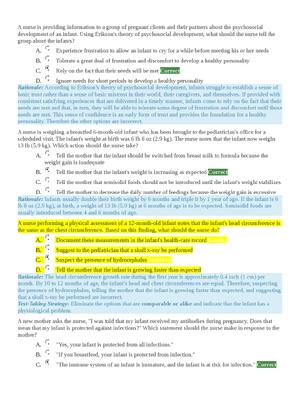
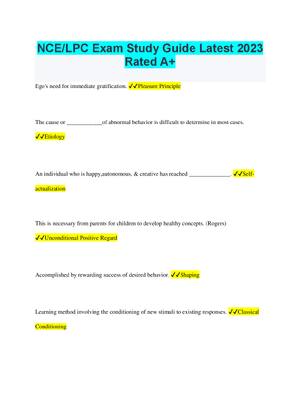
Which of the following is an example of civil law? - ✔✔Child custody case
The nurse practice act of a state defines the scope and responsibilities of nursing practice in that
state. Which of the
...
Rasmussen CANS Exam 2
Which of the following is an example of civil law? - ✔✔Child custody case
The nurse practice act of a state defines the scope and responsibilities of nursing practice in that
state. Which of the following is true regarding nurse practice acts? - ✔✔They determine the
educational requirements for licensure.
Which of the following falls under the jurisdiction of the state board of nursing? - ✔✔Approving
or reject applications for new nursing education programs
The most common reason that nurses are disciplined by the state board of nursing is -
✔✔practicing while impaired
What is the primary function of the National Council of State Boards of Nursing (NCSBN)? -
✔✔Developing the NCLEX-RN® and NCLEX-PN® licensing examinations
Which of the following actions by the nurse constitutes professional malpractice? - ✔✔Placing
the head of the bed flat when a patient is receiving a tube feeding, causing the patient to aspirate
(inhale the feeding in the lung)
The nurse forgets to give the patient a dose of antibiotic. Later in the shift, the patient goes into
cardiac arrest and dies. What element is lacking to support malpractice? - ✔✔proximate cause
Analysis of cases of reported negligence from 1995 to 2001 demonstrated that the majority of
cases occurred in which patient care setting? - ✔✔acute care
A competent resident in a long-term care facility refuses an ordered antidepressant medication.
The nurse believes the patient needs the medication because he is clearly showing signs of
depression and dissolves the medication in juice without telling the patient. This illustrates
negligence by failure to - ✔✔communicate with the patient
A nursing student got a thank-you card from a patient's family and had another student take a
photo of the student with the family. The student asks the nursing instructor if it would be alright
to post the photo on Facebook. Which response by the instructor is best? - ✔✔"No, posting
pictures of patients and families on social media sites is not acceptable"
The nurse giving medications to a pediatric patient notes that an order for a medication is
considerably larger than the usual dose. She looks up the medication in a pharmacology book
and finds she is correct about the dosage. Which action should the nurse take? - ✔✔Notifying
the physician of her findings before giving the medication
Which of the following nursing responsibilities can never be delegated? - ✔✔accountability
The RN asked a nursing assistant to monitor several postoperative patients. Which of the
following instructions to the nursing assistant demonstrate appropriate delegation? - ✔✔"Record
the urine output, and report to me if they have not voided within 4 hours."
The RN delegates changing a sterile dressing over a central line to a licensed practical/vocational
nurse (LPN/LVN). The LPN/LVN contaminated the site during the dressing change, and an
infection developed in the patient. Which of the following statements is true? - ✔✔The RN is
ultimately responsible for acts he or she delegates.
Which of the following is a legitimate defense to a charge of assault and battery? - ✔✔informed
consent
In which of the following situations should the legality of an informed consent be questioned? -
✔✔Patient who received a preoperative dose of Demerol before giving consent
Which of the following is a nursing responsibility regarding informed consent? - ✔✔Serving as a
witness, ensuring that the patient does not feel coerced into a decision
Which of the following actions is acceptable as an exception to a nurse's obligation regarding
confidentiality? - ✔✔Reporting certain diseases to public health authority
Which patient rights are guaranteed by HIPAA? - ✔✔Patients are protected against medical
records being indiscriminately shared.
A child is tested for genetic abnormalities. After the test results are delivered from the
laboratory, a representative of the parents' medical insurance company calls the nurse's station
and asks for the results of the tests. The nurse's best response to this request is to - ✔✔refuse to
give the information
The Patient Self-Determination Act of 1991, as implemented today, is known as providing -
✔✔advance directives
Which of the following puts the nurse at increased risk for legal action? - ✔✔Not assessing a
patient who is complaining of pain
Which of the following chart entries represents a pitfall in documentation? - ✔✔Patient
demanding and difficult to please
The quality of nursing care is judged by whether nursing actions meet the standard of care.
Which of the following is an example of meeting the standard of care? - ✔✔Demonstrating the
use of the nursing process when charting
Which of the following is an important step in preventing legal action against the nurse? -
✔✔Develop caring, therapeutic relationships with patients.
The American Nurses Association (ANA) published a guide for state nurses associations seeking
to revise their nurse practice acts. According the ANA, which of the following should be
included in these revisions? (Select all that apply.) - ✔✔a. Differentiation between advanced and
generalist nursing practice
b. Authority for boards of nursing to oversee UAP
d. Authority for boards of nursing to regulate prescription writing by advanced practice nurses
e. Nurses' responsibility for delegating to LPN/LVNs
The central question in any charge of malpractice is whether the prevailing standard of care was
met. Which of the following are considered part of the standard of nursing care? (Select all that
apply.) - ✔✔a. Basic prudent nursing care is a standard.
d. Standards are based on the ethical principle of nonmaleficence.
e. National standards of nursing practice are standards for all nurses.
For a nursing malpractice action, essential characteristics of negligence must be present. Which
of the following constitute these essential characteristics? (Select all that apply.) - ✔✔a. The
nurse assumed the responsibility for the patients care.
b. The nurse is found to have failed to meet the standard of care.
c. The harm to the patient must be shown to have been caused by the failure to meet the standard
of care.
d. Harm to an individual has occurred.
The nurse receives reports on the following patients at the beginning of the shift. Which of the
following care activities could be delegated to a nursing assistant? (Select all that apply.) - ✔✔a.
Ambulating a patient who had an emergency appendectomy 8 hours ago, has stable vital signs,
and needs to ambulate for the second time
b. Assisting a patient who was in an automobile accident and whose right arm and leg are in
traction with bathing
c. Feeding a patient recovering from a stroke resulting in difficulty holding a spoon
d. Taking vital signs, including blood pressure, for a patient with newly diagnosed diabetes and a
history of hypertension
Systems Theory - ✔✔a change in one part of the system results in changes in other parts
Acute illness - ✔✔ILLNESS IS A PERSONAL EXPERIENCE.
Severe symptoms that are relatively short lived
Chronic illness - ✔✔develops gradually, requires ongoing medical attention, and may continue
for the duration of the individual's life
Most expensive for health care in US
Modeling - ✔✔Children learn by observing adults respond to illness
Stoicism - ✔✔indifference to sensation. should not be confused with strength of character
Five Attributes and Expectations of the Sick Role (Parsons, 1964) - ✔✔1. Is exempt from social
responsibilities
2. Cannot be expected to care for himself or herself
3. Should want to get well
4. Should seek medical advice
5. Should cooperate with the medical experts
Stages of acute illness - ✔✔1. disbelief or denial
2. Irritability and anger
3. Attempts to gain control
4. Depression and despair
5. Acceptance and participation
Cultural competence - ✔✔It is having the attitudes, knowledge, and skills necessary for
providing quality care to diverse populations
Internal Influences on Illness Behavior - ✔✔Dependence/independence needs
Coping ability
Hardiness
Learned resourcefulness
Resilience
Spirituality
coping ability - ✔✔The strategies a person uses to assess and manage demands
Resourcefulness - ✔✔the use of cognitive skills that one uses to adapt to the world around him,
often in very creative ways
Spirituality - ✔✔belief in a higher power, interconnectedness among living beings, and
awareness of life's purpose and meaning
External influences on Illness Behaviors - ✔✔past experiences and culture
Culture - ✔✔a pattern of learned behavior and values that are reinforced through social
interactions, shared by members of a particular group, and transmitted from one generation to the
next.
Ethnocentrism - ✔✔inclination to view one's own cultural group as the standard by which to
judge the value of other cultural groups
Nursing implication - ✔✔A nurse who identifies how personal beliefs and expectations can
influence care is better able to recognize and deal with prejudices that may impede patient care.
Stress - ✔✔the non-specific response of the body to any demand made on it
External stressors - ✔✔heat, cold, noise, malfunctioning equipment, organizational rules and
expectations
Interpersonal stressor - ✔✔demands made by others and conflicts with others
Internal stressor - ✔✔placing unrealistic expectations on oneself
Impact of illness on patients - ✔✔guilt, anger, anxiety
mild anxiety - ✔✔Increased alertness, increased ability to focus, improved concentration,
expanded capacity for learning
moderate anxiety - ✔✔able to concentrate on only one thing at a time. Increased body
movement, rapid speech, and a subjective awareness of discomfort
severe anxiety - ✔✔Thoughts are scattered. May not be able to communicate verbally and there
is considerable discomfort accompanied by purposeless movements like hand wringing and
pacing
Panic level of anxiety - ✔✔completely disorganized and loses the ability to differentiate between
reality and unreality.
Barriers to learning - ✔✔anxiety, physiologic factors (visual & hearing deficits), culture and
meaning of illness, lack of motivation and readiness, setting (private, comfortable, & free of
distractions)
What level is nursing managed at? - ✔✔State level
3 branches of government - ✔✔Executive (presidential), Legislative (Senate & House of
Representatives), Judicial (Federal court & Supreme court)
Common law - ✔✔Delusional, judge's rulings become law
Statutory law - ✔✔Established through formal legislative processes
Administrative Law - ✔✔Delegated authority to government agencies
Civil law - ✔✔recognized and enforces the rights of individuals in disputes over legal rights or
duties of individuals in relation to one another
(person vs person)
Another name for civil law - ✔✔torts
Consequences of civil law - ✔✔financial
Criminal law - ✔✔involves public concerns regarding an individual's unlawful behavior that
threatens society
(person vs law)
Consequences of criminal law - ✔✔financial and incarceration
Purpose of licensing - ✔✔protect public health, safety, and welfare
Nursing Practice Act - ✔✔defines and controls nursing
State Board of Nursing - ✔✔Regulatory bodies by which nursing practices acts are administered
and enforced
1996 ANA Model Practice Act - ✔✔encourages consideration of the many issues inherent in a
nursing practice act and the political realities of state legislature and regulatory processes.
Executive branch of state board of nursing - ✔✔authority to administer the nursing practice act
Legislative branch of state board of nursing - ✔✔Authority to adopt rules necessary to
implement the act
Judicial branch of state of board of nursing - ✔✔authority to deny, suspend, or revoke a license
or to discipline a licensee or to deny an application for licensure
Mandatory law - ✔✔requires any person who practices the occupation or profession to be
licensed
Permissive law - ✔✔protects and limits the use of the title granted in the law but does not
prohibit persons from practicing the occupation/profession if they do not use the title
Licensure by endorsement - ✔✔RNs may practice in different states without repeating the
licensing examination
Nurse licensure compact - ✔✔Nurses licensed in a compact state can practice in their own state
and in any other compact state without applying for licensure by endorsement.
Commission - ✔✔doing something that should not have been done
Omission - ✔✔failing to do things that should have been done
Plantiff - ✔✔person making the complaint
Defendent - ✔✔the nurse or the hospital representing them (defending themselves)
reasonably prudent person - ✔✔describes a nonexistent, hypothetical person who is put forward
as the community ideal of what would be considered reasonable behavior
Two requirements of malpractice action - ✔✔-has specialized knowledge and skills
-causes the plaintiff's (patient's) injury through the practice of that specialized knowledge and
skill
4 elements of a cause of action for negligence - ✔✔1. Nurse has assumed the duty of care.
2. Nurse breached the duty by failing standard of care.
3. This failure was the proximate cause of the injury.
4. The injury is proven.
Captain of the Ship Doctrine - ✔✔implies that the physician is ultimately in charge of all patient
care and thus should be responsible financially
Major conditions of informed consent - ✔✔1. Consent must be voluntary
2. Consent must be given by an individual with capacity and competence to understand
3. Patient must be given enough information
Assault - ✔✔threat or an attempt to make bodily contact with another person without the
person's consent
Battery - ✔✔the assault carried out; the impermissible, unprivileged touching of one person by
another
[Show More]