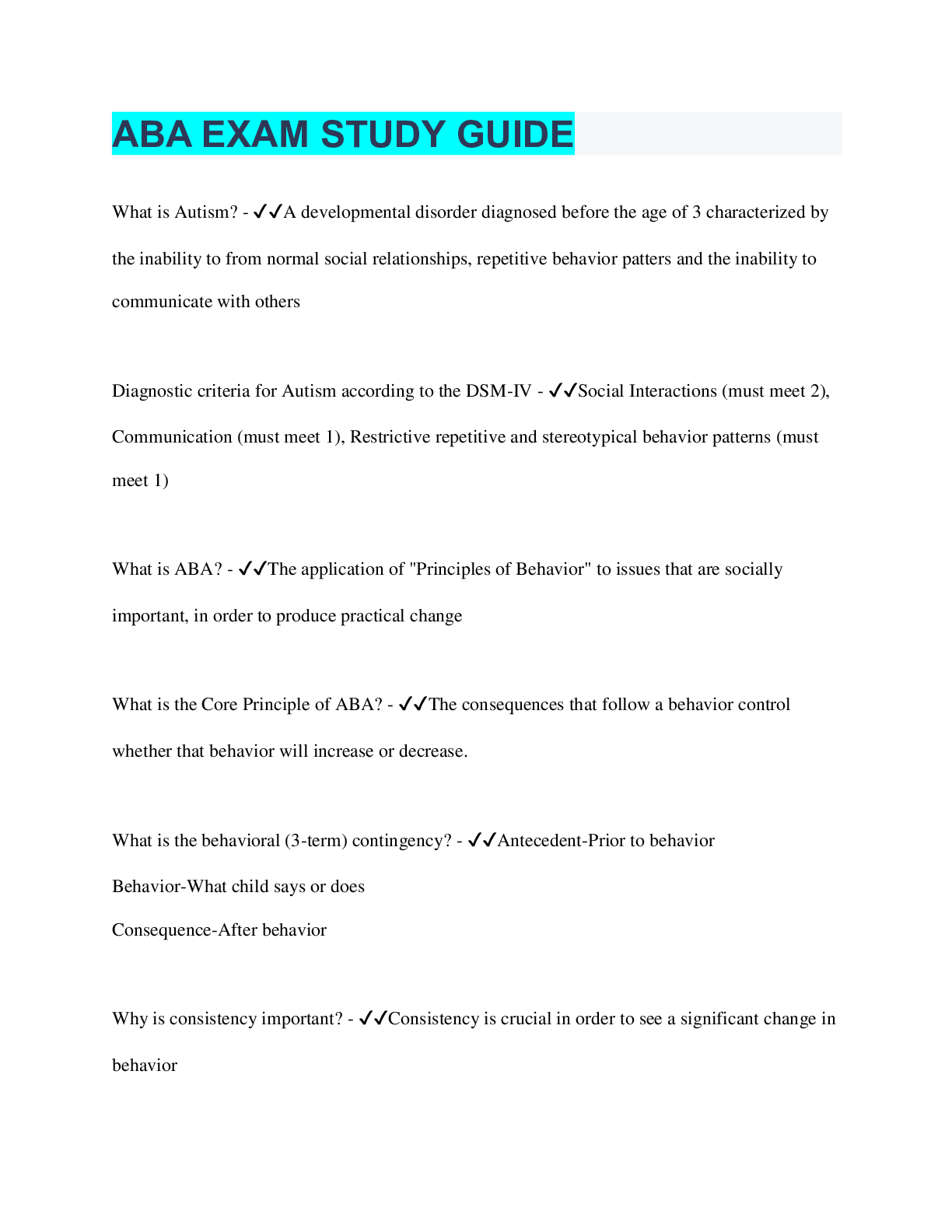
ABA EXAM STUDY GUIDE
What is Autism? - ✔✔A developmental disorder diagnosed before the age of 3 characterized by
the inability to from normal social relationships, repetitive behavior patters and the inability to
comm
...
ABA EXAM STUDY GUIDE
What is Autism? - ✔✔A developmental disorder diagnosed before the age of 3 characterized by
the inability to from normal social relationships, repetitive behavior patters and the inability to
communicate with others
Diagnostic criteria for Autism according to the DSM-IV - ✔✔Social Interactions (must meet 2),
Communication (must meet 1), Restrictive repetitive and stereotypical behavior patterns (must
meet 1)
What is ABA? - ✔✔The application of "Principles of Behavior" to issues that are socially
important, in order to produce practical change
What is the Core Principle of ABA? - ✔✔The consequences that follow a behavior control
whether that behavior will increase or decrease.
What is the behavioral (3-term) contingency? - ✔✔Antecedent-Prior to behavior
Behavior-What child says or does
Consequence-After behavior
Why is consistency important? - ✔✔Consistency is crucial in order to see a significant change in
behavior
What is a Discrete Trial? - ✔✔Has a definite beginning and end. Is not synonymous with ABA
and has three components Antecedent, Response, and Consequence.
-Two types of the antecedent within DTT are the Establishing Operations(EO) and
Discriminative Stimulus(SD)
Why do we use DTT? - ✔✔-A high number of DTs can be presented in a therapy session
-Lets the child know they're expected to response
-Lets the child know if their response is correct
-Assists the therapist in maintaining consistency
-Easy to take data and assess progress
What are the appropriate techniques for presenting SDs? - ✔✔1) Be sure to gain childs attention
2) Avoid presenting the childs name with the SD
3) Avoid presenting SDs without giving consequence
4) Change the target SD ONLY when instructed by, by supervisor
5) Initially should be clear and concise
6) The child should respond only after the SDs presented
What is the Response(R)? - ✔✔The specific instance of the particular behavior, which also
consists of 3 categories, correct, incorrect and no response
3 Categories of Responses - ✔✔1) Correct-When the child responds to a particular with the
target response
2) Incorrect-Response that is different from the target response
3) No Response- No reaction at all
What are the guidelines for responses? - ✔✔-Therapist must be consistent about what is a
"correct response"
-Be sure extraneous behavior is absent
-Limit the time between the SD and Response to no more than 3 seconds
What is Reinforcement? - ✔✔The procedure of providing consequences for a behavior that
increases or maintains the strength of that behavior.
Guidelines for delivering reinforces? - ✔✔-Limit free access to potential reinforces and instead
deliver reinforces contingent upon target behavior
-Conduct preferred assessments frequently
-Deliver the reinforcer within one-half second of the target response
-Reinforcers used should be easy to present and removed
-Establish conditioned reinforcers
-Provide frequent reinforcement for appropriate behavior throughout the session or day
-Needs to be easy to give and easy to be taken away
What is Schedule of Reinforcement? - ✔✔Establishes the probability that a specific behavior
will produce reinforcement
Two Basic schedules of reinforcement - ✔✔Continuous reinforcement-Every occurrence
Intermittent Reinforcement-Some occurrences of behavior but not all
What is Error Correction? - ✔✔Error correction procedures typically include a prompt and may
include an "informational" no
How long should the Inter-Trial Interval be? - ✔✔Long enough to ensure that each trial is
distinct, but not so long that you loose the child's attention, no longer then 2 seconds
What are the types of prompt fading terms? - ✔✔-Physical prompt
-Model-The therapist teaches and child mimics
-Echoic-therapist says the target response word for word
-Direct prompt-Therapist tells the child what to do/demand
-Textual prompt-written target response
-Gestural prompt-involves pointing, tapping to get target response
-Proximity prompt-position
-Voice Inflection prompt-raising or lowering voice to indicate target response
-Stimulus manipulation-making changes to take material to get correct response
What are prompts and prompt fading? - ✔✔A stimulus that is presented in addition to the target
SD that evokes the target, or correct response
What is prompt fading? and how to fade? - ✔✔A stimulus that is temporarily required to evoke
the target response
Prompt fading terms=Full prompt-The use of entire prompt
Partial prompt-Limited use of the prompt
What is Discrimination Training? - ✔✔Process of reinforcing a target response only when to
target antecedent, or SD, is present
What are the 2 types of Discrimination Training? - ✔✔Simultaneous Discrimination TrainingChild must respond to a field of stimuli
Successive Discrimination Training-No field of stimuli
Acquisition Item/Target - ✔✔Used to describe the SD response that you're currently teaching
Mastered Target - ✔✔SD response relationship that the child has already learned or mastered
Distracter Item - ✔✔Additional items that are NOT targets used in simultaneous presentation
procedures to teach discrimination
Distracter Trials - ✔✔Additional trials that do not include the acquisition target, used to teach a
discrimination
Mass Trial - ✔✔The repeated presentation of one SD across consecutive trials
Random Rotation - ✔✔Used to ensure that a child can discriminate between 2 or more SDs/
involves SDs in random order
Mastery - ✔✔An objective method of determining when a child has learned something; also has
to make an 80-100% accuracy in 2 or more sessions to be mastered
7-Step Process
Simultaneous Discrimination Training - ✔✔Step 1-Mass trial target 1, alone
Step 2-Mass trial 1, with 1-2 unknown distracter items
Step 3-Mass trial target 2, alone
Step 4-Mass trial target 2, with 1-2 unknown distracter items
Step 5-Mass trial target 1, with trial 2 known distracter present
Step 6-Mass trial target 2, with 1 unknown stimulus present
Step 7-Randomly rotate target 1 and target 2
4-Step Process - ✔✔Step 1-Mass trial current trial, alone
Step 2-Mass trial current target, with 1-2 unknown distracter items
Step 3-Mass trial current target with 1 or more known distracter items
Step 4-Randomly rotate the current target with previously mastered targets
3-Step Process - ✔✔Step 1-Mass trial target 1, alone
Step 2-Mass trial target 2, alone
Step 3-Randomly rotate targets 1 and 2
2-Step Process - ✔✔Step 1-Mass trial the current trial target
Step 2-Randomly rotate the current target with previously mastered targets
When are most-to-least prompting and error correction procedures incorporated within
discrimination training? - ✔✔Use most-to-least prompting when:
Early stages of learning
When child's response is 0-79% correct
From MT(mass trials) through RR(random rotation)
If prompt is required in RR, use last effective prompt then fade
If prompt is required in ET(expanded trials) or GRR(graduated random rotation), the use last
effective prompt and fade
Use an error correction procedure when:
Later stages of learning
No, no, prompt, repeat
Least to effective prompts
Child responds correctly, 80% during Random Rotation
What is shaping? - ✔✔One systematically reinforces successive approximations of a target
behavior while extinguishing previous approximations
What is chaining? - ✔✔Breaking down a complex behavior into small teachable tasks
-Linking of simple responses together in a specific sequence
Types of Chaining Procedures: - ✔✔Forward Chaining-Begin with the initial SD Response
component, then continue forward through the remaining components
Backward Chaining-Begin with the final or last SD response component, then move backwards
through the remaining component
Total Task Analysis-All of the SD-Response components of the chain are taught during every
learning trial
What is the Function of Behavior? - ✔✔The consequence that is maintaining the behavior
What are the four Basic Functions of Behavior - ✔✔Social Positive-Problem behavior is
strengthened when someone delivers a positive reinforcer
Common forms of Social Positive Reinforcement include:
Attention-vocal reprimands, lectures, physical attentions, facial expressions
Social Negative-Problem behavior is strengthened when someone removes or delays an aversive
stimulus following an occurrence of the problem behavior
Common forms of Social Negative Reinforcement include:
Escaping from demands-chores, completing self help activities
Escape from sensory stimulus-loud sounds, tickles, smell or taste
Escape from aversive setting-school, church, library
Automatic Positive-Problem behavior itself produces preferred sensory stimuli
Common forms of Automatic Positive Reinforcement include:
Reinforcing sensory stimulus
Automatic Negative-Problem behavior removes sensory stimuli
Common forms of Automatic Negative Reinforcement include:
Relief from a painful stimulus-headache, toothache,stomachache
Escape from something disliked-sight,sound,smell or unwanted
What are Antecedent Based Interventions? - ✔✔An intervention designed to prevent the problem
behavior from occurring by eliminating the SD or EOs that are evoking the problem behavior
Types of Antecedent Based Interventions: - ✔✔1.Non-contingent Reinforcement-the delivery of
functional reinforces on a time based schedule
2.Demand fading-The gradual increase in demand requirements before providing a functional
reinforcer
3.Task Modification-Involves changing some aspect of the task, so the task is less adversive to
the child
4.Behavioral Momentum-The presentation of several High Probability (does NOT evoke
problem behavior) demands to a single Low Probability demand, resulting in an increased
likelihood that the Low Probability (evokes problem behavior) demand will occur
What are Consequence Based Interventions? - ✔✔Designed to weaken the problem behavior in
eliminating the reinforcer, maintaining the problem behavior and providing an aversive
consequence contingent on the occurrence of the problem behavior
Types of Consequence Based Interventions - ✔✔1.Extinction-Focus on eliminating the
maintaining reinforcer
The process in which previously reinorced behavior no longer results in reinforcing
consequences and therefore stops occurring
Characteristics of Extinction
Gradual decrease in problem behavior-may take weeks
Spontaneous recovery-reinforced behavior is strengthened
Extinction Burst-Problem behavior has to get worse before it can get better
Examples of Extinction:
Planned Ignoring-Ignoring the attention maintained behavior when it happens
Escape Extinction-Social + and Escape is NOT allowed
Sensory Extinction/Response Blocking-Automatic +/- and is maintained by pleasant smell of
markers example
2.Response Cost-Response reduction procedure: Focus on providing aversive consequences
A response reduction procedure in which behavior is weakened by the removal of a specified
amount of a reinforcer, contingent upon occurrence of the problem behavior
3.Time Out-Response reduction procedure: Focus on providing aversive consequences
A response reduction procedure in which behavior is weakened by the brief removal of all
sources of Social Positive Reinforcement contingent upon the occurrence of problem behavior
Three Types of Time Out: - ✔✔1.Non-Exclusionary-Leaving the child in the room where
problem behavior occurred, but removing the child form any ongoing activities as well as other
positive reinforcers
2.Exclusionary-Removing the child from the room where problem behavior occurred, and taking
the child to another lace for a brief period of time
3.Seclusionary-IS NEVER USED AT CARD
What are Replacement Behavior Based Interventions? - ✔✔Designed to teach the child an
appropriate substitute for problem behavior by eliminating reinforcement or the problem
behavior and providing reinforcement for a replacement behavior
Three Types of replacement behavior based interventions - ✔✔1.Differetioal Reinforcement of
other behavior (DRO)
-The delivery of reinforcers on an interval schedule, contingent on the absence of the problem
behavior
-With DRO, a specific replacement behavior is not identified; rather any appropriate behavior
other than the problem behavior is reinforced
-Gradually decreases the time until the behavior becomes normal again
-In DRO, during a specified period of time, if the problem behavior occurs, reinforcement is
withheld
-If the problem behavior doesn't occur, reinforcement is provided
-Reinforcement is provided at the beginning/middle/end of the interval as long as appropriate
behavior is occurring
2.Differetioal Reinforcement of alternative behavior (DRA)
-The delivery of reinforcers contingent on an alternative response
-A specific replacement behavior is identified
-Only that specific behavior is reinforced
-DRA involved delivery of a reinforcer for an alternative response and extinction for a problem
behavior
Types of responses reinforced in DRA procedures:
Alternative Response-A specific desirable behavior that is reinforced by either the functional or
competing reinforcer
-It does not involve requesting the reinforcer and is not incompatible with the problem behavior
Communicative Response-When the child requests access to the reinforcer maintaining the
problem behavior
-Specifies the functional reinforcer
Incompatible Response-A specific desirable behavior that is physically incompatible with the
problem behavior, so that both responses cannot occur at the same time
3.Differetioal Reinforcement of Low Rate behavior (DRL)
-When Behaviors are functional but client is making it dysfunctional
-Not trying to eliminate just lower the frequency of the behavior
-Reinforcement is provided when the problem behavior occurs less/more frequently
-Reinforcement is/is not provided when the problem behavior occurs at a high rate
DRL DOES NOT eliminate the behavior rather reduces the frequency/rate of occurrence of the
behavior
When should you report child abuse? - ✔✔Report immediately to CARD BUT if you cannot
reach a supervisor you MUST report to the child abuse hottline/department of children's services
within 36 hours
Confidentiality - ✔✔Information cannot be disclosed without written consent
Examples of situations in which confidentiality must be maintained:
Leaving messages
Say "CARD" instead of Center for Autism and Related Disorders
School Shadowing
Note taking and data should be taken discretely
NEVER reveal the child's diagnoses to anyone
Requests for records or materials
DO NOT COPY or duplicate records of any kind without the parents written consent
Dual Relationships - ✔✔Any relationship, other than a therapeutic one between a practitioner
and a client
They are against company policy, dual relationships are NEVER appropriate
What constitutes a duel relationship?
Sexual relationships
Friendships
Outside employment (Babysitting is a NO)
Accepting money or gifts
Any form of barter
Parent of client is your doctor, dentist, etc.
Aversive Stimuli - ✔✔-CARD does NOT use or support the use of aversive stimuli
Examples of Aversive Stimuli:
Physical: Corporal punishment, spanking, shock therapy, etc.
Emotional: Provoking negative emotions (sad, scared, embarrassed, nervous, etc.) by the
presentation of certain stimuli
[Show More]