Architecture Appreciation Test 2
1. The planes crash into the buildings, damaging or destroying many outer columns. Some
interior columns are also damaged, but the buildings still stand.
2. Fire erupts instantly and i
...
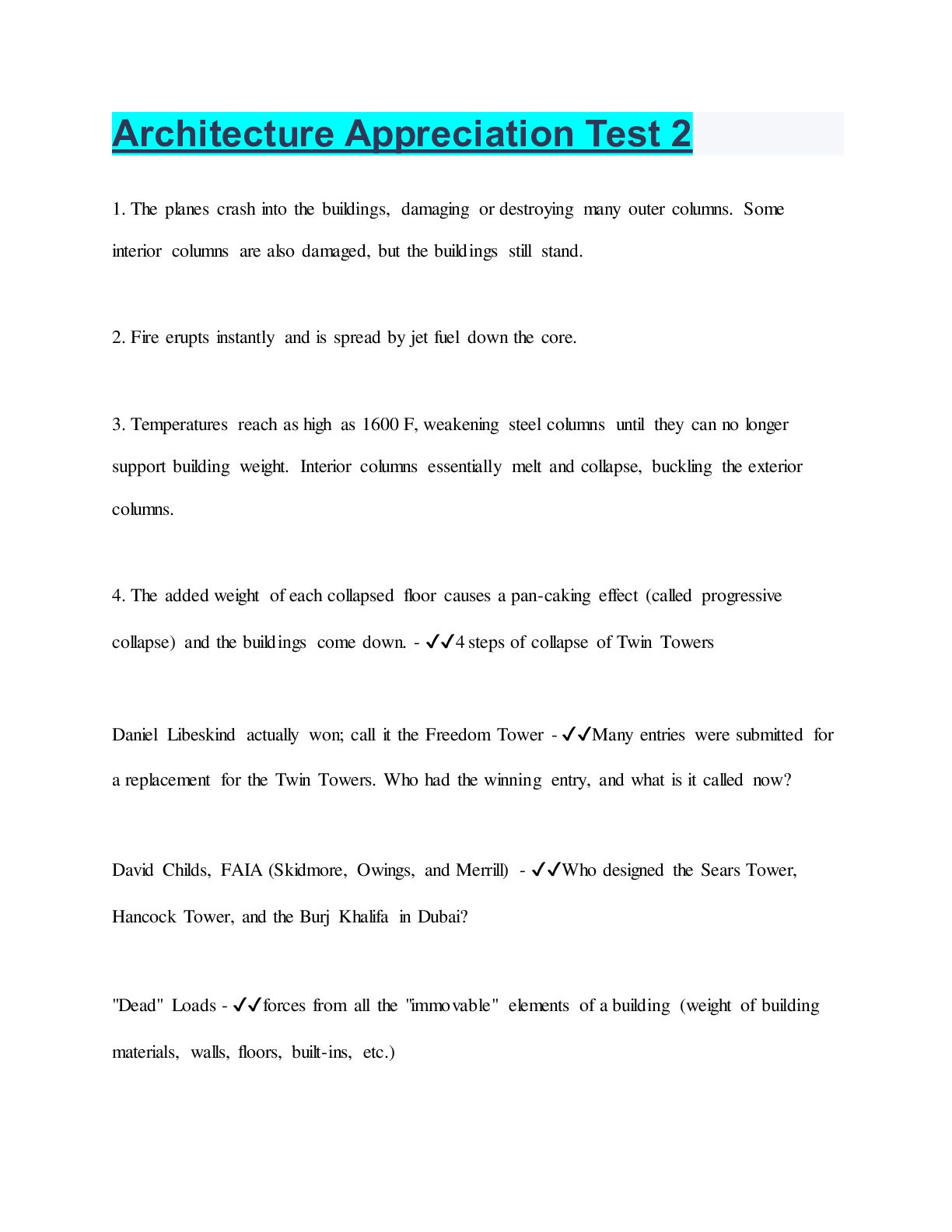
Architecture Appreciation Test 2
1. The planes crash into the buildings, damaging or destroying many outer columns. Some
interior columns are also damaged, but the buildings still stand.
2. Fire erupts instantly and is spread by jet fuel down the core.
3. Temperatures reach as high as 1600 F, weakening steel columns until they can no longer
support building weight. Interior columns essentially melt and collapse, buckling the exterior
columns.
4. The added weight of each collapsed floor causes a pan-caking effect (called progressive
collapse) and the buildings come down. - ✔✔4 steps of collapse of Twin Towers
Daniel Libeskind actually won; call it the Freedom Tower - ✔✔Many entries were submitted for
a replacement for the Twin Towers. Who had the winning entry, and what is it called now?
David Childs, FAIA (Skidmore, Owings, and Merrill) - ✔✔Who designed the Sears Tower,
Hancock Tower, and the Burj Khalifa in Dubai?
"Dead" Loads - ✔✔forces from all the "immovable" elements of a building (weight of building
materials, walls, floors, built-ins, etc.)
"Live" Loads - ✔✔forces from all the "movable" elements of a building (people, equipment,
furniture, etc)
Compression - ✔✔Capacity to resit being pushed together
Tension - ✔✔Capacity to resist pulling apart
Post and Beam - ✔✔a structural system that uses two or more uprights or posts to support a
horizontal beam (lintel) that spans the space between them; trabeated system
Frame - ✔✔trabeated; can be made of steel, wood, stucco, etc; light, thin walls
Masonry - ✔✔arcuated; can be made of brick, concrete, stone; heavy, thick walls
Menhirs - ✔✔single stone standing upright
Dolmen - ✔✔several stones supporting a stone slab
Henges - ✔✔circular ditches around which some megalithic monuments are arranged
Cromlech - ✔✔circle of stones
Stonehenge - ✔✔the most famous of Neolithic monuments; built 3000-2100 BC; menhir,
dolmen, henge, and cromlech; trabeation; post and lintels
Remarkable joinery - ✔✔mortise and tenon
step pyramid, bent pyramid, and straight sided pyramid - ✔✔three types of pyramids
step pyramid - ✔✔Djoser's Pyramid; Saqqara, Egypt
bent pyramid - ✔✔Sneferu's South Pyramid; Dahshur, Egypt
straight-sided pyramid - ✔✔Cheop's Pyramid; Giza, Egypt
Ziggurats - ✔✔stepped structures; some of the oldest structures (2125 BC); built from mud
bricks
Great Pyramid
Hanging Gardens of Babylon
The Temple of Artemis at Ephesus (burned down)
The Statue of Zeus (burned down)
Mausoleum of Halicarnassus (destroyed by earthquake)
The Lighthouse of Alexandria (destroyed by earthquake)
The Colossus of Rhodes (destroyed by earthquake) - ✔✔Seven Wonders of the Ancient World
Imhotep: "the one who comes in peace" - ✔✔First recorded architect; born a commoner;
between 2,700 to 2,600 Zoser hired Imhotep to design and build his tomb; translated traditional
building materials of mud, wood, and reeds into stone; astronomer, magician, and doctor; later
worshipped by the Egyptians as a god
Egyptian Pyramids - ✔✔tombs for kings built on West Bank of Nile River; covered in reflective
limestone (quarried/east bank); gold veneer found at top; thought king would walk on sun rays to
eternity (if king lives forever, the people do too); sealed the tomb, not a public space or place;
sculptural objects on the landscape; represent rays of the sun (RA the sun god)
Post-Pyramids - ✔✔After pyramids were looted, Kings built into the side of the mountain;
Mortuary Temple of Queen Hatshepsut
Hypostyle hall - ✔✔Large space with a flat roof supported by rows of columns; Temple at
Karnac
Temples - ✔✔Pyramids in Central America were used as __________.
Palace at Knossos - ✔✔Minoan; 1700-1380 BCE
The Lion Gate; Mycenae, ca. 1300 BC; Precursor to Greek Architecture - ✔✔Forerunner to post
and beam (trabeated system)
Lion's Gate - ✔✔- The sense of Structure was an inheritance from the Neolithic period
- Lion element borrowed from Egypt, but it is now more organic
- Post and lintel
- Greeks will refine post and lintel triangular relief
- Walls are narrow to help defend against attackers
Greek Architecture - ✔✔Classical (Latin: elite)
Language - ✔✔Greeks were united by ______________.
Private property, individual freedom (less than 35% of the population), and "democracy" -
✔✔Greeks were founded on:
Colonnade - ✔✔a series of regularly spaced columns supporting an entablature and usually one
side of a roof
Gods - ✔✔Temples housed ______________.
Non-greeks with their vivid colors and the fact that they could be seen from a great distance -
✔✔Temples were built to impress ___________ with ___________.
Three styles - ✔✔How many styles of orders are there?
Doric Order - ✔✔oldest, simplest, most massive of the orders; columns placed close together;
often no bases; plain capitals; entablatures have metopes and triglyphs
Ionic Order - ✔✔Developed in Ionian islands; characterized as delicate order "female";
contrasted with "male" Doric order; used for smaller buildings and interiors; easily recognizable
by Volutes on Capital (based on nautilus shells or animal horns)
Corinthian Order - ✔✔Variation of Ionic Order; same as ionic except a new type of capital;
capital is more ornate-acanthus leaves; often found on interiors
Temple of Athena Nike - ✔✔Perfection of Ionic Order
Entasis - ✔✔the slight convex bulge given to a column to offset the optical illusion that it is
thinner in the middle
The Acropolis - ✔✔Located in Athens, Greece
agora - ✔✔open meeting place or market
The Parthenon - ✔✔refined perfection of Doric order; a supreme example of classical
architecture; reputation of being the most perfect Doric temple ever built; dedicated to Athena
Cella - ✔✔the principal chamber or enclosed part of a classical temple
Elgin Marbles - ✔✔Lord Elgin purchased these from the Turks; they are in the British Museum
in London
The Erechtheion - ✔✔an ancient Greek temple on the north side of the Acropolis of Athens in
Greece which was dedicated to both Athena and Poseidon; 421-407 BC
Caryatids - ✔✔a sculptured female figure used as a column
Atlas - ✔✔a sculptured male figure used as a column
Greek Revival Style - ✔✔Minard Lefever
Asher Benjamin
Details - ✔✔Plan books show ________.
Greeks: made objects in the landscape (balance, harmony, refinement of form, NOT structural
innovation), Post and Beam
Romans (Europeans): conquered the Greeks; Etruscans brought Classical architecture to Roman
Empire 1/5 of the world was under Roman rule; made spaces and images in context; made
innovations in construction and technology; the Arch: vault, dome concrete - ✔✔Greeks VS
Romans
Tuscan Order - ✔✔unlike Doric, supports an entablature w/ no decoration (wooden temple w/
pitched roof)
Composite Order - ✔✔combination of Ionic and Corinthian orders, capital combines acanthus
leaves with volute scrolls
barrel vault - ✔✔extending arch along its depth
groin vault - ✔✔intersecting of two barrel vaults; opens a space in 4 directions; used to create
interiors (gyms, baths, etc); Roman
Pont du Gard - ✔✔Nimes, France
20-16 BC
Maison Carree - ✔✔Nimes, France
10 CE
Coliseum in Rome - ✔✔completed around 80 ACE, seats 50k, orders differ by levels
Pantheon - ✔✔pediment (triangle shape over colonnade) and portico
portico - ✔✔a colonnaded space forming an entrance or vestibule
Hadrian - ✔✔"Romanized" and organized the empire; built bridges, roads, and Hadrians Wall
across Britain
Constantine I - ✔✔A.D. 306-337; edict of Milan 313 AD; proclaimed tolerance of all religions
(gave authority to build churches)
timber-roofed basilicas - ✔✔Early Chrisitan churches were based on ___________.
Apse - ✔✔semi circular projection, containing an altar
Nave - ✔✔space beyond the transept crossing toward the west or "front" of the church
Transept - ✔✔the two arms in a "Latin cross" plan
Aisle - ✔✔the portion of a basilica flanking the nave and separated from it by a row of columns
or piers
Byzantium - ✔✔the eastern portion of the Roman empire
Constantinople - ✔✔The capital of the Byzantine Empire; named after ruler Constantine; now
Istanbul, Turkey
Pendentives - ✔✔A spherical triangle forming the transition from the circular plan of a dome to
the polygonal plan of its supporting structure
Hagia Sophia - ✔✔dome covered in mosaics, appeared to be floating, fell due to an earthquake
S. Miniato al Monte - ✔✔Florence, Italy
1062-1090
Pisa Cathedral and Campanile - ✔✔Pisa, Italy 1063, 1089-1272
Ornament - ✔✔Like the Greeks, structure for gothic is ____________.
Gothic structures - ✔✔introduced the pointed arch
English Gothic - ✔✔straight cathedral
French Gothic - ✔✔curved cathedral
Notre Dame de Paris - ✔✔Gothic cathedral in Paris; 1163-1250
Chartres Cathedral - ✔✔pilgrimage church; 1130-1260
[Show More]

.png)
.png)


![Preview of Prestressed Concrete, 5th Edition, By Warner Foster, Kilpatrick Gravina [PDF] [eBook]](https://scholarfriends.com/storage/eBook for Prestressed Concrete, 5th Edition, By Warner Foster, Kilpatrick Gravina.png)


![Preview of eBook [PDF] The Architecture of Disability: Buildings, Cities, and Landscapes Beyond Acces](https://browseimages.nyc3.digitaloceanspaces.com/paper-images/2025/Apr/12/1sqZ8jhe2025-04-12-09-1467faad88cd35c.png)
![Preview of eBook [PDF] Case Studies in Parametric Design: A Guide to Visual Scripting in Architecture](https://browseimages.nyc3.digitaloceanspaces.com/paper-images/2025/Apr/12/U5HZZLnY2025-04-12-05-3067f9d04fec77b.png)
![Preview of eBook [PDF] Light, Nature, Architecture: A Guide to Holistic Lighting Design 1st Edition |](https://browseimages.nyc3.digitaloceanspaces.com/paper-images/2025/Apr/12/b3rshZtz2025-04-12-04-2467f9c0e5b147b.png)