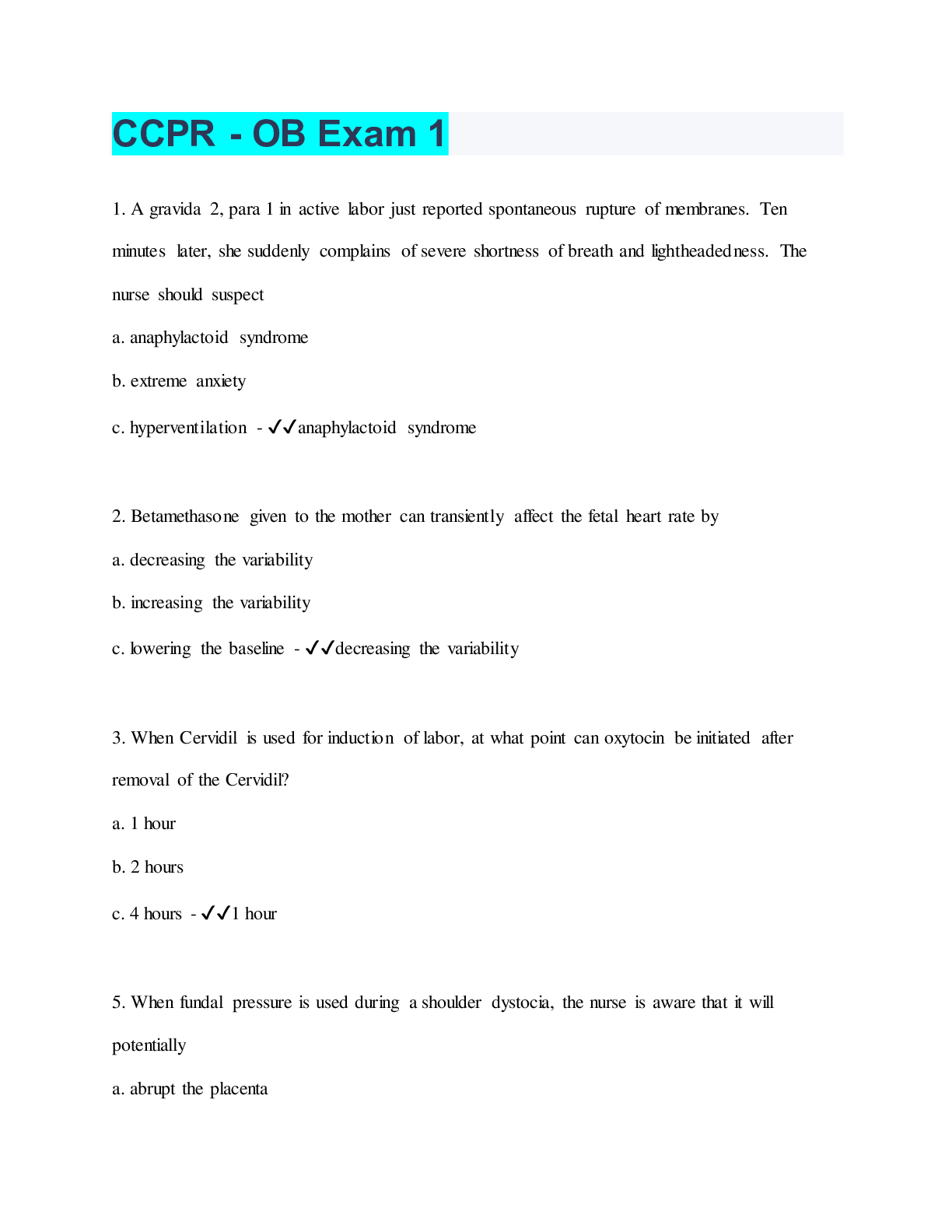
CCPR - OB Exam 1
1. A gravida 2, para 1 in active labor just reported spontaneous rupture of membranes. Ten
minutes later, she suddenly complains of severe shortness of breath and lightheadedness. The
nurse should sus
...
CCPR - OB Exam 1
1. A gravida 2, para 1 in active labor just reported spontaneous rupture of membranes. Ten
minutes later, she suddenly complains of severe shortness of breath and lightheadedness. The
nurse should suspect
a. anaphylactoid syndrome
b. extreme anxiety
c. hyperventilation - ✔✔anaphylactoid syndrome
2. Betamethasone given to the mother can transiently affect the fetal heart rate by
a. decreasing the variability
b. increasing the variability
c. lowering the baseline - ✔✔decreasing the variability
3. When Cervidil is used for induction of labor, at what point can oxytocin be initiated after
removal of the Cervidil?
a. 1 hour
b. 2 hours
c. 4 hours - ✔✔1 hour
5. When fundal pressure is used during a shoulder dystocia, the nurse is aware that it will
potentially
a. abrupt the placenta
b. assist the provider with delivery of the shoulders
c. impact the fetal shoulder - ✔✔c. impact the fetal shoulder
6. A postpartum mother who would like to breastfeed her baby is diagnosed with Hepatitis B
surface-antigen positive. What is the recommendation regarding breastfeeding for this mother?
a. Administer HBIG and hepatitis B vaccine to the newborn and then allow breastfeeding
b. Breastfeeding is absolutely contraindicated
c. Pump and discard milk for 1 week following vaccine administration to the newborn - ✔✔a.
Administer HBIG and hepatitis B vaccine to the newborn and then allow breastfeeding
7. Stimulation of the sympathetic nervous system causes the fetal heart rate to
a. decrease
b. increase
c. remain the same - ✔✔increase
8. A patient at 37 weeks gestation arrives to labor and delivery from the emergency room after
admission for severe gastric discomfort with nausea and vomiting. Her blood pressure is 156/100
mmHg. She complains of blurred vision. These findings are consistent with a diagnosis of
a. gestational hypertension
b. preeclampsia
c. preeclampsia with severe features - ✔✔preeclampsia with severe features
9. What maternal disease results in damage to the fetal heart conduction system?
a. Alpha thalassemia major
b. Rh isoimmunization
c. Systemic lupus erythematosus - ✔✔Systemic lupus erythematosus
10. The most appropriate instruction to give parents about what breastfeeding frequency to
expect during the first few weeks after birth is
a. cluster feedings with 8 to 12 feedings in 24 hours
b. regularly spaced feedings every 2 to 3 hours
c. six to eight feedings in 24 hours with a longer stretch of sleep during the night - ✔✔a. cluster
feedings with 8 to 12 feedings in 24 hours
11. A woman at 28 weeks gestation reports to the labor and delivery with painless vaginal
bleeding that started this morning. The nurse's first step in caring for this woman is to determine
a. cervical dilation
b. placental location
c. rupture of membranes - ✔✔b. placental location
12. A series of sine waves with similar duration and amplitude develop on the electronic fetal
monitor 10 minutes after stadol (butorphanol) is administered to a patient with previously normal
tracings. The appropriate response to this fetal heart rate pattern would be to
a. administer oxygen
b. continue to observe
c. prepare for cesarean delivery - ✔✔b. continue to observe
13. Increased perfusion of the newborn liver is initiated by closure of the
a. ductus arteriosus.
b. ductus venosus.
c. foramen ovale. - ✔✔b. ductus venosus.
14. Following premature rupture of membranes, a woman at 33 weeks gestation is placed on a
fetal heart rate monitor. The fetal heart rate is persistently 175 bpm. This is most likely consistent
with
a. immature fetal CNS integrity
b. maternal anxiety
c. uterine infection - ✔✔c. uterine infection
15. A patient is examined and found to have a tender, red area in one breast that feels small and
hard, similar to a pea just under the skin. The expected management for this patient is
a. antibiotics for 7 days
b. cabbage leaves applied to the breast
c. gentle massage to relieve the lump - ✔✔c. gentle massage to relieve the lump
16. According to the gate control theory relieving pain with massage, heat and cold acts by
a. blocking the capacity of nerve pathways to transmit pain
b. diverting the pathways to areas of spinal cord decreasing sensation
c. stimulation of mu and kappa receptors - ✔✔a. blocking the capacity of nerve pathways to
transmit pain
17. The phase of labor that distraction techniques are most likely to be effective is
a. active
b. latent
c. transition - ✔✔b. latent
18. A gravida 1 para 0 is in spontaneous labor at 40 weeks after an uncomplicated pregnancy.
She is 5 centimeters dilated, completely effaced with the vertex at -2 station. The above tracing is
obtained following the artificial rupture of the membranes (AROM). -- After maternal
repositioning, the next step in management is to:
a. Administer terbutaline
b. Initiate an amnioinfusion
c. Perform a vaginal exam - ✔✔c. Perform a vaginal exam
19. The recommended method to reduce the incidence of nonreactive nonstress tests is
a. fetal manipulation
b. ingestion of orange juice
c. vibroacoustic stimulation - ✔✔c. vibroacoustic stimulation
20. A woman is 12 hours postpartum and has a white blood cell count of 25,000μL. This
indicates
a. dehydration and a need to force fluids
b. in the expected range at this time
c. infection and a need for antibiotics - ✔✔b. in the expected range at this time
21. The cardinal symptom of cholestasis of pregnancy is
a. diaphoresis
b. nausea and vomiting
c. pruritus - ✔✔c. pruritus
22. When the chorionic villi attach directly to the myometrium of the uterus, this represents
a. early stage placenta previa
b. placenta accreta
c. retained placenta - ✔✔b. placenta accreta
23. After the last dose of misoprostol (Cytotec), oxytocin administration should be delayed for at
least
a. 30-60 minutes
b. 4 hours
c. 6-12 hours - ✔✔b. 4 hours
24. The pushing technique that a woman in second stage should be encouraged to use is
a. Alternating between open and closed-glottis pushing
b. Closed glottis pushing while holding her breath to the count of 10
c. Open-glottis pushing for 6-8 seconds with 3 to 4 pushes per contraction - ✔✔c. Open-glottis
pushing for 6-8 seconds with 3 to 4 pushes per contraction
25. To avoid a precipitous drop in intra-abdominal pressure, during catheterization of a
postpartum patient's bladder, what is the maximum amount of urine that should be removed at
one time?
a. 500 ml
b. 800 ml
c. 1000 ml - ✔✔b. 800 ml
26. A prolonged second stage in a primigravida with regional anesthesia is defined as a lack of
continuing progress and a second stage duration of greater than
a. 1 hour
b. 2 hours
c. 3 hours - ✔✔c. 3 hours
27. Dinoprostone (Cervidil) is being utilized for cervical ripening. The nurse should know the
Cervidil should be removed
a. in 12 hours or the onset of uterine contractions
b. in 24 hours after insertion
c. when it is time to administer oxytocin - ✔✔a. in 12 hours or the onset of uterine contractions
28. In 2006 when the Centers for Disease Control revised HIV testing and counseling guidelines,
which of the following reflects the change for pregnant women?
a. Formal pretest education and counseling for any pregnant women before the HIV test is
performed
b. Routine testing for each pregnant woman unless she specifically declines
c. Uniform HIV testing requirements for a pregnant woman in any state - ✔✔b. Routine testing
for each pregnant woman unless she specifically declines
29. Fluid balance should be monitored in the preeclamptic woman on magnesium sulfate therapy
because there is an increased risk for
a. acute renal failure
b. congestive heart failure
c. pulmonary edema - ✔✔c. pulmonary edema
30. The relation of the fetal body parts to one another is called fetal
a. attitude
b. lie
c. presentation - ✔✔a. attitude
31. A woman is admitted to labor and delivery with moderate uterine pain without bleeding. On
examination, the uterus has high tonicity and the uterine contraction tracing shows increased
resting tone. The most likely cause is
a. placental abruption
b. placenta previa
c. uterine rupture - ✔✔a. placental abruption
32. When differentiating false labor from true labor, a finding that would suggest a woman is in
true labor is if after 1-2 hours of walking which of the following occurs?
a. Back pain radiating to the abdomen
b. Cervix is soft and closed
c. Contractions lessen some with walking - ✔✔a. Back pain radiating to the abdomen
33. A woman is pregnant with twins and had an ultrasound diagnosis of monochorionicity.
Compared to dichorionicity, risk of an adverse outcome is
a. higher
b. lower
c. similar - ✔✔a. higher
34. A newly pregnant woman who is morbidly obese has a strong family history of type 2
diabetes. The recommended time for this woman's initial glucose screen is
a. as soon as possible
b. at 36 weeks gestation
c. between 24 and 28 weeks gestation - ✔✔a. as soon as possible
35. A Bishop score of 4 indicates
a. a favorable cervix
b. an intermediate cervix
c. an unfavorable cervix - ✔✔c. an unfavorable cervix
36. During auscultation of the fetal heart rate, the nurse notes a gradual decrease in the fetal heart
rate after a contraction that lasts 60 seconds. The appropriate documentation of this finding is
that after a contraction, there is a
a. decrease in the fetal heart rate after a contraction
b. late deceleration
c. variable deceleration - ✔✔a. decrease in the fetal heart rate after a contraction
37. Which one of the following women is the best candidate for a vaginal birth after cesarean?
a. A gravida 2 para 1 who had a cesarean for labor dystocia prior to 5 centimeters dilation
b. A gravida 3, para 2 who had a cesarean for fetal heart rate issues with her first baby and a
cesarean for breech presentation with her second baby
c. A gravida 3, para 2 who had a vaginal delivery with her first pregnancy and a cesarean for
breech with her second baby - ✔✔c. A gravida 3, para 2 who had a vaginal delivery with her
first pregnancy and a cesarean for breech with her second baby
38. What is the pattern in the above fetal heart rate tracing?
a. acceleration
b. late deceleration
c. prolonged acceleration - ✔✔c. prolonged acceleration
39. A predisposing factor to breech presentation is
a. android pelvis
b. multifetal pregnancy
c. primiparity - ✔✔b. multifetal pregnancy
40. A maternal contraindication to breastfeeding is
a. hepatitis A
b. group B streptococcus
c. HTLV-1(human T-cell leukemia virus, type 1) - ✔✔c. HTLV-1(human T-cell leukemia virus,
type 1)
41. An Rh negative woman at 36 weeks has an external version. She should
a. not receive Rh D immunoglobulin (Rhogam)
b. receive Rh D immunoglobulin (Rhogam)
c. only receive Rh D immunoglobulin (Rhogam) if spotting after procedure - ✔✔b. receive Rh D
immunoglobulin (Rhogam)
42. Fentanyl requires more frequent dosing for management of labor pain because
a. it has a shorter duration of action
b. multiple smaller doses over time decrease the incidence of side effects
c. the peak effect time lengthens with subsequent doses - ✔✔a. it has a shorter duration of action
43. Which one of the following tachyarrhythmias can result in fetal hydrops?
a. Persistent supraventricular tachycardia
b. Premature atrial contractions
c. Sinus tachycardia - ✔✔a. Persistent supraventricular tachycardia
44. A pregnant woman at 24 weeks gestation is an elementary school teacher. She states there is
an episode of Fifth Disease in the school. This patient is at risk for acquiring
a. Cytomegalovirus
b. Parvovirus B19
c. Varicella Zoster - ✔✔b. Parvovirus B19
45. Guidelines from the Centers for Disease Control (CDC) regarding tetanus toxoid, reduced
diphtheria toxoid, and a-cellular pertussis (Tdap) for a postpartum patient who had a tetanus
booster 2 years ago would be to
a. administer before discharge
b. administer in 2 years.
c. needs no further boosters - ✔✔a. administer before discharge
46. Therapeutic touch is based on the theory that
a. application of pressure to extremities will direct the body
b. natural endorphin release will be induced by massaging the body
c. well-being can be promoted by uniting the energy fields of the care giver and the patient -
✔✔c. well-being can be promoted by uniting the energy fields of the care giver and the patient
47. A cause of physiological jaundice can be a result of
a. decreased amounts of bilirubin delivered to the liver
b. delayed cord clamping
c. increased intestinal motility - ✔✔b. delayed cord clamping
48. The color of nitrazine paper most indicative of ruptured membranes is
a. blue
b. green
c. yellow - ✔✔a. blue
49. The above tracing is that of a 39½ week gestation gravida 3, para 2 who is currently 6 cm,
90%, -1, who received an epidural test dose 10 minutes ago. FHR baseline is 150. — The most
likely cause of these decelerations is
a. a short umbilical cord
b. fetal metabolic acidosis
c. maternal hypotension - ✔✔c. maternal hypotension
50. A fetal heart rate baseline of 140 with moderate variability, no accelerations and no
decelerations is a NICHD category
a. I
b. II
c. III - ✔✔a. I
51. The fetal heart tones of a baby in the ROP position, would best be heard over which area of
the mothers abdomen?
a. A (low midline)
b. B (low right)
c. C (low left) - ✔✔b. B (low right)
52. Compared to non-pregnant values, the maternal arterial carbon dioxide (pCO₂) during
pregnancy is
a. decreased
b. increased
c. the same - ✔✔a. decreased
53. A 39 week gestation primigravida has had regular contractions for the past 48 hours. She has
remained 1 centimeter dilated since the onset of contractions. She is exhausted, uncomfortable
and unable to sleep. Which medication is recommended for therapeutic rest?
a. Fentanyl
b. Morphine
c. Stadol - ✔✔b. Morphine
54. pH 7.0 pCO2 80 mmHg pO2 21 mmHg HCO3 21.3 mm/L B.D. 6 mm/L The umbilical cord
blood values above reflect
a. metabolic acidemia
b. normal values
c. respiratory acidemia - ✔✔c. respiratory acidemia
55. Which statement describes normal uterine activity?
a. Frequency of 1-1/2 to 2 minutes
b. Intensity of 90 mmHg early in labor
c. Resting tone less than 20-25 mmHg - ✔✔c. Resting tone less than 20-25 mmHg
56. A negative fetal fibronectin test at 30 weeks indicates
a. a need for further testing
b. increased risk for delivery
c. risk of delivery is very low for the next 7-14 days - ✔✔c. risk of delivery is very low for the
next 7-14 days
57. The uterine incision which has the highest risk of heavy blood loss and repair difficulty is
a. lower uterine segment transverse (Kerr)
b. lower uterine segment vertical (Sellheim)
c. upper uterine segment vertical (Classic) - ✔✔c. upper uterine segment vertical (Classic)
58. A patient diagnosed with a postpartum infection states she does not have any pain but seems
confused and agitated. Her vital signs are as follows: Temperature 99.9°F; BP 98/50; Pulse 125,
urinary output is decreased. The most likely diagnosis is
a. pulmonary embolism
b. septic shock
c. thromboembolism - ✔✔b. septic shock
59. The cervical dilation in the above multigravida labor cure is interpreted as
a. Arrest of dilation
b. Normal labor progress
c. Protracted active phase - ✔✔c. Protracted active phase
60. Following delivery the insulin requirement for most diabetic breastfeeding women is
a. decreased
b. increased
c. the same as for bottlefeeding diabetics - ✔✔a. decreased
61. Pitocin dosages during labor induction should be documented in
a. mU/per minute
b. ml/min
c. cc/hour - ✔✔a. mU/per minute
62. Cordocentesis is more commonly used to detect fetal
a. anemia
b. metabolic disorders
c. pH and PO2 - ✔✔a. anemia
Cordocentesis is usually done when diagnostic information can not be obtained through
amniocentesis, CVS, or ultrasound, or if the results of these tests were inconclusive.
Cordocentesis is performed after 17 weeks into pregnancy
Cordocentesis detects chromosome abnormalities (i.e. Down syndrome) and blood disorders (i.e.
fetal hemolytic disease.)
Malformations of the fetus
Fetal infection (i.e. toxoplasmosis or rubella)
Fetal platelet count in the mother
Fetal anemia
Isoimmunisation
63. A postpartum patient has a spinal headache. The nurse knows that this can occur as a
consequence of epidural anesthesia due to
a. injured nerve pathways
b. leakage of fluid at the puncture site
c. too rapid administration - ✔✔b. leakage of fluid at the puncture site
64. Ten minutes after placement of an epidural, maternal blood pressure decreases by 20%. After
performing IV hydration and lateral positioning, what should be the nurses next intervention?
a. Administer ephedrine
b. Discontinue the epidural
c. Prepare for a cesarean section - ✔✔a. Administer ephedrine
65. Forty-eight hours after a woman's cesarean birth, the nurse notes that the woman's left calf
and foot are cool and pale. The left pedal pulse is diminished and there is decreased capillary
refill. The Homan's sign is negative bilaterally. She reports some tenderness in the left calf. The
most appropriate initial response to these findings would be to
a. administer pain Warfarin
b. apply elastic stockings
c. place on bedrest with elevation of left leg - ✔✔c. place on bedrest with elevation of left leg
66. Which maternal age is at greatest risk of a labor dystocia
a. 16
b. 28
c. 36 - ✔✔c. 36
68. A sign of deteriorating status in a pregnancy complicated by hypertension is increased
a. albumin
b. plasma colloid pressure
c. serum creatinine - ✔✔c. serum creatinine
69. A woman is receiving steroids at 36 weeks gestation for immune thrombocytopenia (ITP).
She needs to be followed closely for
a. increased risk of infection
b. hypoglycemia
c. hypertension - ✔✔Priority is c. hypertension! Early detection of HELLP
NOT a. increased risk of infection, though perhaps this is a SE of steroids.
70. The lochia that is pink or brown in color and occurs between 3 and 10 days postpartum is
a. alba
b. rubra
c. serousa - ✔✔c. serousa
71. A primigravida admitted for induction at 39 weeks gestation for preclampsia. She is not
receiving any medication. On admission, her blood pressure is 157/91 and the FHR tracing is
above. -- The decelerations in this tracing are (somewhat abrupt, but >30 sec onset to nadir, nadir
after peak of ctx):
a. early
b. late
c. variable - ✔✔b. late
67. Continued increases in oxytocin rates over a prolonged period of time have what effect on
oxytocin receptor sites?
a. desensitization
b. multiplication
c. up-regulation - ✔✔a. desensitization
73. During a shoulder dystocia, the provider has the nurse place the patient on all fours to
facilitate delivery. Which of the following maneuvers would the provider request?
a. Gaskin
b. Woods
c. Zavanelli - ✔✔a. Gaskin
72. The Ferguson reflex is the result of
a. cytokine release
b. prostaglandin release from the membranes
c. stretching of pelvic floor muscles - ✔✔c. stretching of pelvic floor muscles
75. A young woman at 38 weeks gestation is brought to the hospital via ambulance after having
seizures at home. She has been given phenobarbital, labetelol and magnesium sulfate. -- Fetal
scalp stimulation is performed in panel 28345. The response of the fetus indicates.
a. indeterminate acid-base status
b. metabolic acidemia
c. respiratory acidosis - ✔✔a. indeterminate acid-base status
76. At 39 weeks gestation, a gravida 1, para 0 is admitted for an elective induction of labor. Her
vaginal exam shows her to be 2 cm dilated, 50% effaced and a -3 station. The provider performs
an artificial rupture of membranes and goes back to the office. Two minutes later, there is a
prolonged fetal heart rate deceleration. The nurse's initial response to this situation is to
a. call the provider
b. initiate an IV fluid bolus
c. perform a vaginal exam - ✔✔c. perform a vaginal exam
77. The tracing above is a gravida 2, para 1 at 39 weeks gestation with internal monitoring. Her
last cervical exam 30 minutes ago showed that she was 6 cm, 100%, and -1 station. — Given the
patient's phase of labor, the peak pressure of these contractions is
a. normal
b. too high
c. too low - ✔✔b. too high
74. The release of catecholamines during labor can result in a
a. longer dysfunctional labor
b. more rapid second stage
c. stronger contraction pattern - ✔✔a. longer dysfunctional labor
78. Halogenated agents used for general anesthesia can result in a uterine tone that is
a. decreased
b. increased
c. tetanic - ✔✔a. decreased
79. Which finding of this tracing rules out fetal metabolic acidemia at this time?
a. Baseline FHR
b. Decelerations
c. Variability - ✔✔c. Variability
81. When a fetus is in the occiput posterior position, the position that is most helpful in
facilitating rotation is
a. hands and knees
b. lithotomy
c. semi-fowlers - ✔✔a. hands and knees
80. According to the ACOG guidelines for continuous electronic fetal monitoring, a patient
without complications in the active phase of labor should have the fetal heart rate assessed every
a. 15 minutes
b. 30 minutes
c. 60 minutes - ✔✔b. 30 minutes
83. Group B streptococcus (GBS) and what other organism are currently the most common
pathogens seen with neonatal sepsis?
a. Chlamydia
b. E. coli
c. Klebsiella (enterobacteria species) - ✔✔b. E. coli
84. The disease that is passed through the feces of infected cats is
a. cytomegalovirus
b. parvovirus
c. toxoplasmosis - ✔✔c. toxoplasmosis
85. Which one of the following women fits the definition of preterm labor?
a. A 36 week gestation multigravida who is admitted with regular contractions and who is 3
centimeters dilation
b. A 19 week gestation primigravida who has dilated from 2 cm to 4 cm in the last hour
c. A 28 week gestation multigravida with regular contractions and no cervical change - ✔✔a. A
36 week gestation multigravida who is admitted with regular contractions and who is 3
centimeters dilation
82. A term 3000 gram neonate born to a mother whose HBsAg status is unknown should have
a. hepatitis B vaccine and HBIG administered only after the mothers status known
b. the first dose of Hepatitis B vaccine within the first 12 hours after birth
c. the same schedule as a neonate born to an HBsAg negative mother - ✔✔b. the first dose of
Hepatitis B vaccine within the first 12 hours after birth
86. The decelerations per the NICHD terminology in the tracing shown are defined as
a. early
b. late
c. variable - ✔✔a. early
87. The second stage position that can increase the pelvic diameter as much as 28 to 30% is
a. knee-chest
b. semi-fowlers
c. squatting - ✔✔c. squatting
89. A pregnancy is classified as post term beginning at
a. 41 weeks and 1 day
b. 41 weeks and 6 days
c. 42 weeks and 0 days - ✔✔c. 42 weeks and 0 days
88. A provider asks a nurse to obtain a signature on informed consent for surgery. The nurse's
responsibility in this situation is to
a. determine if patient was advised of the reasons, risks and benefits of the surgery
b. clarify any last minute questions for the patient about the surgery
c. insure at least two unbiased witnesses are present when the patient signs the form - ✔✔a.
determine if patient was advised of the reasons, risks and benefits of the surgery
91. When a pattern of coupling and tripling of contractions is occurring the oxytocin dose should
be
a. decreased
b. increased
c. maintained - ✔✔a. decreased
90. The maternal anemia that can result in painful vasoocclusive episodes is
a. folic acid anemia
b. iron deficiency anemia
c. sickle cell anemia - ✔✔c. sickle cell anemia
93. In order to decrease the effect of IV narcotics on the fetus, the nurse should administer them
at what point in the contraction pattern?
a. After
b. Before
c. During - ✔✔c. During
92. A contraindication to the use of Dinoprostone (Cervidil) would be
a. A patient with six or more previous term pregnancies
b. Category 1 tracing with occasional contractions
c. Postdate pregnancy with a bishop score of 5 - ✔✔a. A patient with six or more previous term
pregnancies
95. The tracing above is the final 20 minutes of a nonstress test for a 37 week gestation fetus. No
decelerations have been noted. This test would be interpreted as
a. equivocal
b. nonreactive
c. reactive - ✔✔c. reactive
96. During labor, a woman in pain complains of dizziness, light-headedness, and numbness and
tingling in her lips. The most likely cause of these symptoms is
a. carbon dioxide retention
b. excessive anxiety
c. hyperventilation - ✔✔c. hyperventilation
94. A woman at term is in labor and exhibits recurrent variable decelerations with moderate
variability and meconium stained amniotic fluid. An amnioinfusion is ordered with the goal of
a. improving placental circulation
b. thinning of the meconium
c. relieving umbilical cord compression - ✔✔c. relieving umbilical cord compression
98. A placenta in which the umbilical blood vessels are separated when they leave the placenta
and not protected with Wharton Jelly is what placenta variation?
a. Battedore
b. Circumvallate
c. Velamentous - ✔✔c. Velamentous
99. On admission to the labor unit, a woman's deep tendon reflexes are assessed at 4+.
Intravenous magnesium sulfate is initiated. At her next assessment her reflexes are assessed as
absent with respiratory rate 10. Which of the following actions should be taken?
a. Increase the magnesium sulfate per protocol
b. No action should be taken at this time
c. Stop the magnesium sulfate and notify the provider - ✔✔c. Stop the magnesium sulfate and
notify the provider
100. The baseline of the term fetus in the above tracing (marked variability) is
a. 120
b. 120-150
c. indeterminate - ✔✔c. indeterminate
97. Immediately following an emergency cesarean delivery for placental abruption, a woman
begins to exhibit epistaxis and bleeding from her intravenous site. This clinical presentation is
suggestive of
a. antithrombin III elevation
b. disseminated intravascular dissemination
c. Factor V Leiden - ✔✔b. disseminated intravascular dissemination
102. The medication that is contraindicated in women with a cardiac condition is
a. hydralazine
b. oxytocin
c. terbutaline - ✔✔c. terbutaline
103. The recommendation regarding the administration of Narcan (naloxone) to the newborn
with respiratory depression secondary to maternal administration of narcotics is to
a. administer at 15 minutes after birth
b. administer as soon as possible
c. avoid administration - ✔✔c. avoid administration
104. Oligohydramnios is diagnosed when a biophysical profile shows an amniotic fluid index
(AFI) of
a. 4 cm
b. 6 cm
c. 8 cm - ✔✔a. 4 cm
101. The time during labor and birth that is of greatest risk for woman with a cardiac condition is
a. active phase of labor
b. second stage of labor
c. immediately after birth - ✔✔c. immediately after birth
106. The metabolic state of pregnancy is described as a chronic
a. respiratory acidosis
b. respiratory alkalosis
c. mixed acidosis - ✔✔b. respiratory alkalosis
UpToDate: ...respiratory tract changes during pregnancy result in a compensated respiratory
alkalosis, with a higher PO2 and a lower PCO2 than in the nonpregnant state. The lower PCO2 is
thought to provide a diffusion gradient that may facilitate the fetus' ability to eliminate waste
from aerobic metabolism.
non-pregnant range: PaCO2: 38 to 42 mm Hg pH: 7.38 to 7.42. SaO2: 94% to 100%; HCO3: 22
to 28 mEq/L
pregnant range: PaCO2: lower limit normal 30, pH: 7.4-7.47; PaO2 increases, HCO3: lower limit
normal: 20
- values consistent with hyperventilation; apparent hyperventilation; but nL in pregnancy.
107. In the multigravida with an epidural no maternal or fetal contraindications, pushing efforts
may be delayed up to
a. 30 minutes
b. 1 hour
c. 2 hours - ✔✔b. 1 hour
108. Use of stirrups during delivery can cause straining of pelvic ligaments due to
a. immobilization
b. poor positioning
c. pushing - ✔✔b. poor positioning
109. After a massive hemorrhage of 2000cc blood loss a woman presents to the clinic on day 5
postpartum verbalizing her milk has not come in. You should suspect
a. Exhaustion and fatigue
b. Endometritis
c. Sheehan's syndrome - ✔✔c. Sheehan's syndrome
105. The type of neonatal jaundice caused by inadequate breast milk intake is
a. breastfeeding jaundice
b. breastmilk jaundice
c. physiological jaundice - ✔✔a. breastfeeding jaundice
111. In twin-to-twin transfusion, the recipient twin is
a. cyanotic
b. pale
c. plethoric - ✔✔c. plethoric
112. A 36 hour old breastfeeding infant has nursed 8 times in the last 24 hours on one breast each
feeding. The infant demonstrated rhythmic sucking with audible swallowing during feedings.
The infant has had 2 wet diapers and 2 moderate-sized green bowel movements. This assessment
indicates that the infant is
a. exhibiting signs that require further evaluation
b. feeding well and as expected for this age
c. nursing fair but in need of supplementation - ✔✔b. feeding well and as expected for this age
113. Which of the following is contraindicated for use with a patient with uterine atony who has
preexisting hypertension?
a. 15 Methyl prostaglandin F2 alpha (Hemabate)
b. Methylergonovine (Methergine)
c. Misoprostol (Cytotec) - ✔✔b. Methylergonovine (Methergine)
110. Which one of the following infections does not cross the placenta?
a. Neisseria gonorrhea
b. HIV
c. Syphilis - ✔✔a. Neisseria gonorrhea
115. The most accurate dating of a pregnancy by ultrasound is
a. 1st trimester evaluation of the crown-rump length
b. 2nd trimester of the bi-parietal diameter (BPD), femur length and abdominal circumference
c. 3rd trimester biophysical profile - ✔✔a. 1st trimester evaluation of the crown-rump length
116. The infectious organism strongly associated with a risk of spontaneous perterm birth is
a. bacterial vaginosis
b. chlamydia
c. trichomoniasis - ✔✔a. bacterial vaginosis
114. A woman is admitted to labor and delivery with a diagnosis of placenta abruption. The test
that determines the presence of a fetomaternal hemorrhage is
a. Coagulation panel
b. Coombs
c. Kleihauer-Betke - ✔✔c. Kleihauer-Betke
118. Compared to a midline episiotomy, blood loss from a mediolateral episiotomy is
a. greater
b. less
c. similar - ✔✔a. greater
119. During a precipitous labor and imminent birth, the initial action by the attending nurse is to
a. break the bed in preparation for delivery of the newborn
b. notify the provider to come immediately to deliver the newborn
c. prepare to deliver the newborn - ✔✔c. prepare to deliver the newborn
120. The transition phase of labor is characterized by maternal
a. alertness and seriousness
b. excitement and anticipation
c. panic and fear - ✔✔c. panic and fear
117. Internal rotation of the head generally occurs in
a. mid-pelvis
b. pelvic entry
c. posterior pelvis - ✔✔a. mid-pelvis
122. The most common fetal malposition is
a. mentum
b. occiput posterior
c. transverse - ✔✔b. occiput posterior
123. Quad screening compared to alphafetoprotein testing can better detect
a. metabolic disorders
b. open neural tube defects
c. trisomies - ✔✔c. trisomies
124. The current recommendation regarding timing of prophylactic antibiotics for a cesarean
section is
a. after placenta delivery
b. immediately after cord clamping
c. within 60 minutes prior to the start of the cesarean - ✔✔c. within 60 minutes prior to the start
of the cesarean
125. The cervix of a labor patient is dilated to 3 centimeters. She would be in what phase of
labor?
a. active phase of labor
b. latent phase of labor
c. transition phase of labor - ✔✔b. latent phase of labor
121. A 21 year old, 32 week gestation, gravida 4, para 0 with no prenatal care is admitted with
complaints of unremitting abdominal pain and bright red vaginal bleeding. Her abdomen
palpates board-like and rigid. This history is suspicious of the use of
a. cocaine
b. ecstasy
c. marijuana - ✔✔a. cocaine
126. The NICHD definition of uterine tachysystole is a contraction frequency averaged over 30
minutes of greater than
a. 4 contractions in 10 minutes
b. 5 contractions in 10 minutes
c. 6 contractions in 10 minutes - ✔✔b. 5 contractions in 10 minutes
127. When a systemic analgesic is administered to the mother during labor, compared to the
brain of a nonhypoxic fetus, the brain of a hypoxic fetus will receive a
a. larger amount of the drug
b. lesser amount of the drug
c. similar amount of the drug - ✔✔a. larger amount of the drug
128. During a shoulder dystocia, one maneuver that a nurse may use to help relieve the stuck
shoulder is
a. fundal pressure
b. rubin technique
c. suprapubic pressure - ✔✔c. suprapubic pressure
129. On a vaginal exam the nurse determines her patient is 7 cm dilated. She also notes the
cervix is well applied posteriorly, but that cervix is not as well applied anteriorly with a slight
gap along the vertex. She should suspect that the fetal position is
a. OA
b. OP
c. transverse - ✔✔b. OP
131. The infant of a mother with an untreated Chlamydia infection during pregnancy is at risk to
develop
a. anemia
b. microcephaly
c. ophthalmia neonatorum - ✔✔c. ophthalmia neonatorum
132. For the majority of women with epilepsy, seizure frequency during pregnancy will be
a. decreased
b. increased
c. similar to non-pregnant state - ✔✔c. similar to non-pregnant state
133. The most common side effect of prostaglandin administration for cervical ripening is
a. Maternal fever
b. Nausea and vomiting
c. Tachysystole - ✔✔!c. Tachysystole!
Also a SE but less common:
a. Maternal fever
134. Appropriate teaching about breast engorgement for a non-breastfeeding mother is to
a. bind the breasts to minimize breast engorgement
b. express breasts to comfort until engorgement subsides
c. wear a 24-hour support bra for comfort - ✔✔c. wear a 24-hour support bra for comfort
135. Mei Lin, a Chinese woman gave birth to her first child by cesarean section 12 hours prior.
She grimances when getting out of bed, but hasn't asked for anything for pain. Based on
information about the Asian American culture, the nurse should
a. administer pain medication on regular schedule without asking her
b. assume if she's uncomfortable she will ask for medication
c. offer pain medication when due since they tend to be stoic and may not ask - ✔✔c. offer pain
medication when due since they tend to be stoic and may not ask
136. A G2P1 at 34 weeks gestation with a history of lupus was in for a routine prenatal visit.
FHT's were ausculated at 60. She was sent to labor/delivery for further evaluation. the above
strip (hr baseline 60 bpm) suggests that the fetus has
a. a complete heart block
b. premature atrial contractions
c. sinus bradycardia - ✔✔a. a complete heart block
137. The fetus of a woman with hypothyrodism is at increased risk for
a. Euthryoid
b. Neurologic abnormalities
c. Hypoglycemia - ✔✔b. Neurologic abnormalities
138. Baroreceptors respond mainly to changes in
a. blood pressure
b. hormonal changes
c. oxygen and carbon dioxide levels - ✔✔a. blood pressure
139. The above tracing is of a gravida 2, para 1 at 40 weeks who is receiving augmentation. The
initial intervention for this tracing (prolonged decels, tachysystole, complete cervix is to
a. administer IV fluids
b. apply oxygen by face mask
c. discontinue oxytocin - ✔✔c. discontinue oxytocin
140. Just prior to hospital dismissal a postpartum patient is crying, still in her nightgown at 1pm
and states she is overwhelmed from nursing the baby all of the time. Physical assessments of the
mother and baby are normal. The nurse knows that this is a manifestation of postpartum
a. blues
b. depression
c. psychosis - ✔✔a. blues
141. At 32 weeks, a prenatal patient reported decreased fetal movement. A non-stress test is
reported as non reactive. Which of the following is appropriate for this patient?
a. Admission to the labor unit for an expedited delivery
b. Biophysical profile
c. Keeping a fetal movement record and return in 24 hour - ✔✔b. Biophysical profile
130. A patient's record states her pregnancy history is 1 term pregnancy, 1 miscarriage at 10
weeks, twins at 35 weeks with one who died soon after birth. Which of the following accurately
portrays her pregnancy history?
a. Gravida 2 Para 2101
b. Gravida 3 Para 3011
c. Gravida 3 Para 1212 - ✔✔c. Gravida 3 Para 1212
143. Hydramnios is common in which condition?
a. Down Syndrome
b. Fetal urinary tract defects
c. twin-to-twin transfusion
... do they mean POLYhydramnios? - ✔✔a. Down Syndrome
142. At 36 weeks gestation, an ultrasound reveals a velamentous cord insertion. Based upon this
knowledge, the nurse is aware this fetus is at higher risk for a
a. hemorrhage
b. prolapsed cord
c. true knot - ✔✔a. hemorrhage
145. Attempting a vacuum assisted delivery should be terminated if the vacuum device pops off
the fetal scalp more than how many times?
a. 1
b. 3
c. 5 - ✔✔b. 3
144. A neonate has scrotal swelling which is soft, non-tender and transilluminates. There are no
palpable masses. The most likely diagnosis is
a. cryptorchidism
b. hydrocele
c. hypospadias - ✔✔b. hydrocele
147. On admission to the labor and delivery unit, a patient inquires if her history of herpes
simplex virus will prevent a vaginal delivery. The nurse knows that if the patient has no apparent
lesions, the recommendation is to
a. allow vaginal delivery
b. delivery by cesarean
c. preform cultures to determine route of delivery - ✔✔a. allow vaginal delivery
146. A patient is being induced and is at an oxytocin level of 24 mU/min. She reports nausea and
vomiting, feels her heart beating rapidly, feeling faint and has a headache. She most likely is
experiencing
a. an infectious process
b. anxiety from labor
c. water intoxication - ✔✔c. water intoxication
149. A woman with a macrosomic fetus is at risk for a(n)
a. amniotic fluid embolism
b. dysfunctional labor
c. compound presentation - ✔✔b. dysfunctional labor
150. The first Leopold's maneuver assists in identifying the fetal
a. attitude
b. position
c. presentation - ✔✔c. presentation!
does NOT determine position! (i.e. LOA, ROA, OP)
151. The frequency of fetal heart rate assessments for a low risk woman in second stage labor on
pitocin is every
a. 5 minutes
b. 15 minutes
c. 30 minutes - ✔✔a. 5 minutes
This is poorly worded because 15 minutes is also technically correct during 2nd stage passive
fetal descent (laboring down) (with pitocin, guidelines are 1st stage[15min, 15min, 15min], 2nd
stage [15min, 5min])
148. Beta-sympathomimetic drugs decrease the frequency and intensity of uterine contractions
by
a. desensitization of beta 2 receptor activity
b. enhancing of beta 2 receptor inhibitory action
c. stimulating beta 2 receptor action - ✔✔c. stimulating beta 2 receptor action
153. A woman in labor with a known history of drug abuse. Should not be given which narcotic
drug?
a. Butorphanol (Stadol)
b. Fentanyl (Sublimdze)
c. Morphine Sulfate - ✔✔a. Butorphanol (Stadol)
... WTF? Fentanyl? Why stadol? -> Because it is a partial agonist that blocks some receptor sites
without stimulating them, it can precipitate withdrawal among those addicted to full-agonist
opiates.
154. A main tenet of evidence based practice is
a. a legal protection for medical and nursing providers
b. standardization of what is professional competence
c. translation of best available information into clinical guidelines - ✔✔c. translation of best
available information into clinical guidelines
155. In the low-risk patient who is being monitored in the active stage of labor using
auscultation, the fetal heart rate should be assessed every
a. 5 minutes
b. 15 minutes
c. 60 minutes - ✔✔b. 15 minutes
True guidelines say 15-30 in this stage (6-10cm), but that is not given so 15 min is best option.
Hourly (<4cm), 30min(4-5cm), 30min(6-10cm), 15min (laboring down), 15min (pushing),
156. At birth, the newborn is noted to have absent breath sounds on the left with heart sounds
shifted to the right. The abdomen is noted to be scaphoid, and ventilation is difficult. The most
likely diagnosis is
a. congenital pneumothorax
b. diaphragmatic hernia
c. transposition of the great vessels - ✔✔b. diaphragmatic hernia
157. The above pattern (120 baseline, no accels, no decels, 5bpm amplitude variability) reflects
a. fetal deceleration
b. minimal variability
c. one acceleration - ✔✔b. minimal variability
158. The umbilical vein carries
a. carbon dioxide from the fetus back to the placenta
b. deoxygenated blood from the fetus to the placenta
c. oxygenated blood from the placenta to the fetus - ✔✔c. oxygenated blood from the placenta to
the fetus
152. A woman in labor is having contractions about every two to three minutes. She is 7-8 cm
dilated, 100% effaced, and at +1 station. These findings are most consistent with what stage of
labor?
a. First
b. Second
c. Third - ✔✔a. First
160. The half-life of pitocin (oxytocin) is how minutes
a. 5-7
b. 10-12
c. 15-20 - ✔✔1-6 minutes! Answer given by CCPR is WRONG
b. 10-12
161. The recommended initial intravaginal dose of misoprostol (cytotec) for cervical ripening is
a. 25 micrograms
b. 50 micrograms
c. 100 micrograms - ✔✔a. 25 micrograms
159. The interactive process of the father with the newborn is termed
a. attachment
b. claiming
c. engrossment - ✔✔c. engrossment
162. During pregnancy cardiac output increases by what percent?
a. 5-25%
b. 30-50%
c. 60-70% - ✔✔b. 30-50%
163. According to NICHD definitions what type of pattern is noted on this tracing (120 baseline,
mod. var., no decels, two accels)?
a. accelerations
b. late decelerations
c. variable decelerations - ✔✔a. accelerations
164. One sign that suggests placental separation is
a. downward movement of the uterus in the abdomen
b. lengthening of the umbilical cord
c. uterus changes shape from a globe to a disk - ✔✔b. lengthening of the umbilical cord
165. A reliable method for confirming the presence of an irregular fetal heart rhythm is a(n)
a. doppler device
b. external electronic fetal monitor
c. fetoscope - ✔✔c. fetoscope
167. The type of forceps used during a vaginal breech birth is
a. Kielland
b. Piper
c. Simpson - ✔✔b. Piper
168. The concept of nursing negligence requires that
a. an intentional harmful act is committed.
b. an injury occurred to the patient.
c. the harmful action is outside the scope of practice. - ✔✔b. an injury occurred to the patient.
169. When using electronic fetal monitoring in the second stage of labor, the high-risk patient
who is actively pushing should be assessed every
a. 5 minutes
b. 10 minutes
c. 15 minutes - ✔✔a. 5 minutes
170. When fetal heart tones are heard above the umbilicus and the fetal head is palpated in the
upper part of the uterus, this is consistent with
a. breech presentation
b. brow presentation
c. occiput posterior position - ✔✔a. breech presentation
171. Nifedipine (Procardia) for tocolysis in preterm labor should be given cautiously with which
other drug?
a. Indocin
b. Magnesium sulfate
c. Terbutaline - ✔✔b. Magnesium sulfate, because CAN'T be given AT ALL with Indocin
"There is a potential theoretical interaction between magnesium sulphate and nifedipine of
hypotension and neuromuscular blockade effects, although this is seldom reported in clinical
practice (Snyder & Cardwell 1989; Ben-Ami 1994). Regular monitoring of the mother is
recommended as detailed in individual obstetric unit protocols. If hypotension occurs, nifedipine
and magnesium sulphate administration should cease and the woman reviewed by a medical
practitioner."
http://www.medscape.com/viewarticle/484260
172. A biophysical score of 6 with normal fluid is considered
a. abnormal
b. normal
c. equivocal - ✔✔c. equivocal
A total score of 8 or 10 is normal, a score of 6 is considered equivocal, and a score of 4 or less is
abnormal. Regardless of the score, if oligohydramnios (AFI <5 cm or a largest vertical pocket of
amniotic fluid <2 cm), further evaluation is warranted.
2 or 0 points each are given for NST, fetal movement, fetal tonus, practice breathing, and AFV
173. Mechanical dilators open the cervix by stimulating the release of
a. endogenous prostaglandins
b. oxytocin
c. progesterone - ✔✔a. endogenous prostaglandins
174. An umbilical cord blood gas (artery) reveals the following: pH 7.29; PO2: 22 mm/Hg;
PCO2: 47 mm/Hg; Base excess -4; This represents
a. a normal value
b. metabolic acidosis
c. respiratory acidosis - ✔✔a. a normal value
Normal ranges: pH: 7.18-7.42, of pCO₂was 33.44-66.56 mmHg (35-45 nL Adults), and of
HCO₃was 15.60-30.70 mEq/L (22-28 nL adults)
175. According to the NICHD definitions, which one of the following decelerations must drop
by at least 15 beats per minute?
a. early
b. late
c. prolonged - ✔✔c. prolonged
"Based on visual assessment, a prolonged deceleration is defined as a decrease in fetal heart rate
below the baseline. The decrease in the fetal heart rate is 15 beats per minute or more and lasts
for at least 2 minutes but less than 10 minutes from onset to return to
baseline. "
Nifedipine protocol - ✔✔The recommended protocol: 20 mg PO stat, then 20 mg PO after 30
minutes if contractions persist, then 20 mg PO every 3-8 hours X 48-72 hours as indicated. Max
dose 160 mg/day. After 72 hours, if required, patients can have maintenance long-acting 30-60
mg qday. Contraindications: hypotension, hepatic dysfunction, concurrent use of beta-mimetics,
transdermal nitrates, other antihypertensive medication. Hypotension can occur with concurrent
use of magnesium. Common SEs: hypotension (minimal nLy), dizziness, nausea, tachycardia,
palpitations, flushing, headaches. HR and BP q30 minutes x first hour, hourlyx24 hours, then q 4
hours.
Tocolytics considerations - ✔✔Nifedipine best
http://www.medscape.com/viewarticle/484260
Several classes of medications are used for tocolysis, including beta-adrenergic agents (terb,
ritodrine), calcium channel blockers (nifedipine), prostaglandin synthetase inhibitors
(indomethacin), and magnesium sulfate.
Efficacy in delaying delivery for 24-48 hours has been shown with beta-adrenergic agents, such
as ritodrine; however, they cause unpleasant maternal side effects, such as palpitations, and can
cause pulmonary edema, myocardial ischemia, and arrhythmia.
Magnesium sulfate is also commonly used, and has similar efficacy to terbutaline. It is better
tolerated, but the patient must be monitored for toxic effects, such as respiratory depression or
even cardiac arrest, which can occur at supertherapeutic levels. Common maternal side effects
include flushing, nausea, headache, drowsiness, and blurred vision. Magnesium crosses the
placenta and can cause respiratory and motor depression of the neonate.
Indomethacin has also been shown to have efficacy similar to that of ritodrine. It is associated
with infrequent maternal side effects, but it readily crosses the placenta and can cause
oligohydramnios if used for more than 48 hours. Usually the amniotic fluid reaccumulates, but
persistent fetal anuria, renal microcystic lesions, and neonatal death have been reported.
Indomethacin can also cause premature closure or constriction of the ductus arteriosus, which
can lead to persistent fetal circulation after birth. This effect is more common after 32 weeks'
gestation, so it is recommended that therapy should be discontinued by 32 weeks.
Calcium channel blockers reduce calcium influx into cells, reducing muscle contractility.
Nifedipine has been used in the majority of studies. A 2002 meta-analysis reviewed 12
randomized-controlled studies involving 1029 women and found that nifedipine is more effective
than ritodrine and is clearly safer. Because each individual trial has been small, this is the best
evidence to date that nifedipine can be used for tocolysis. The investigators found a reduced risk
of delivery within 7 days and at less than 34 weeks' gestation. Cessation of treatment due to
adverse reaction occurred in 1 of 419 patients, vs 29 of 414 with other tocolytics. The nifedipinetreated neonates also had decreased risk of respiratory distress syndrome, necrotizing
enterocolitis, and intraventricular hemorrhage.
AWHONN guidelines for auscultation, low-risk, no pitocin - ✔✔Latent labor, <4cm: At least
hourly
Latent labor, 4-5cm: 30-15 minutes
Active labor, >6cm: 30-15 minutes
2nd stage, passive descent (laboring down): q15 minutes
2nd stage, active pushing: 15-5 minutes
AWHONN guidelines for EFM, low-risk, no pitocin - ✔✔Latent labor, <4cm: At least hourly
Latent labor, 4-5cm: 30 minutes
Active labor, >6cm: 30 minutes
2nd stage, passive descent (laboring down): 15 minutes
2nd stage, active pushing: 15 minutes
AWHONN guidelines for EFM, low risk or risk-factors, with pitocin - ✔✔Latent labor, <4cm:
15 minutes
Latent labor, 4-5cm: 15 minutes
Active labor, >6cm: 15 minutes
2nd stage, passive descent (laboring down): 15 minutes
2nd stage, active pushing: 5 minutes
AWHONN guidelines for EFM, risk factors, no pitocin - ✔✔Latent labor, <4cm: *30* minutes
Latent labor, 4-5cm: 15 minutes
Active labor, >6cm: 15 minutes
2nd stage, passive descent (laboring down): 15 minutes
2nd stage, active pushing: 5 minutes
166. When performing chest compressions during neonatal resuscitation, the number of
compressions should be at what rate per minute?
a. 80
b. 90
c. 100 - ✔✔b. 90
[Show More]






![Preview of AORN PERIOP 101 FINAL EXAM 2026 QUESTIONS AND VERIFIED ANSWERS [LATEST UPDATE]](https://browseimages.nyc3.digitaloceanspaces.com/paper-images/2026/04/07/sGJvJ3aH2026-04-07-04-5869d464cbba16f.png)