BTEC BUSINESS UNIT 3: FORMULAS Exam 36 Questions with Answers
Net Cash Flow (Cash Flow Forecast) - CORRECT ANSWER = Total Income (inflows) - Total Expenses (Outflows)
Closing Balance (Cash Flow Forecast) - CORREC
...
BTEC BUSINESS UNIT 3: FORMULAS Exam 36 Questions with Answers
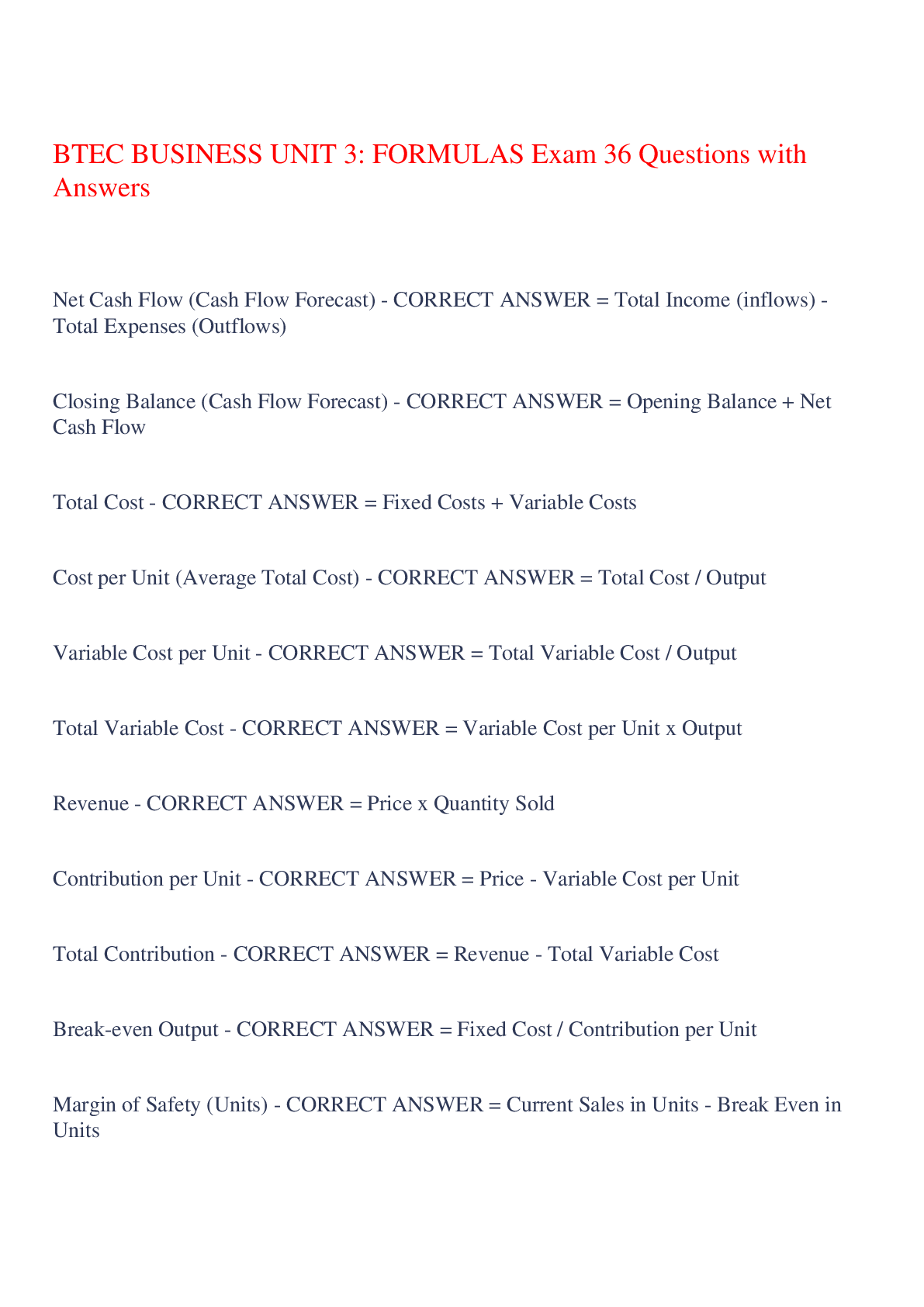
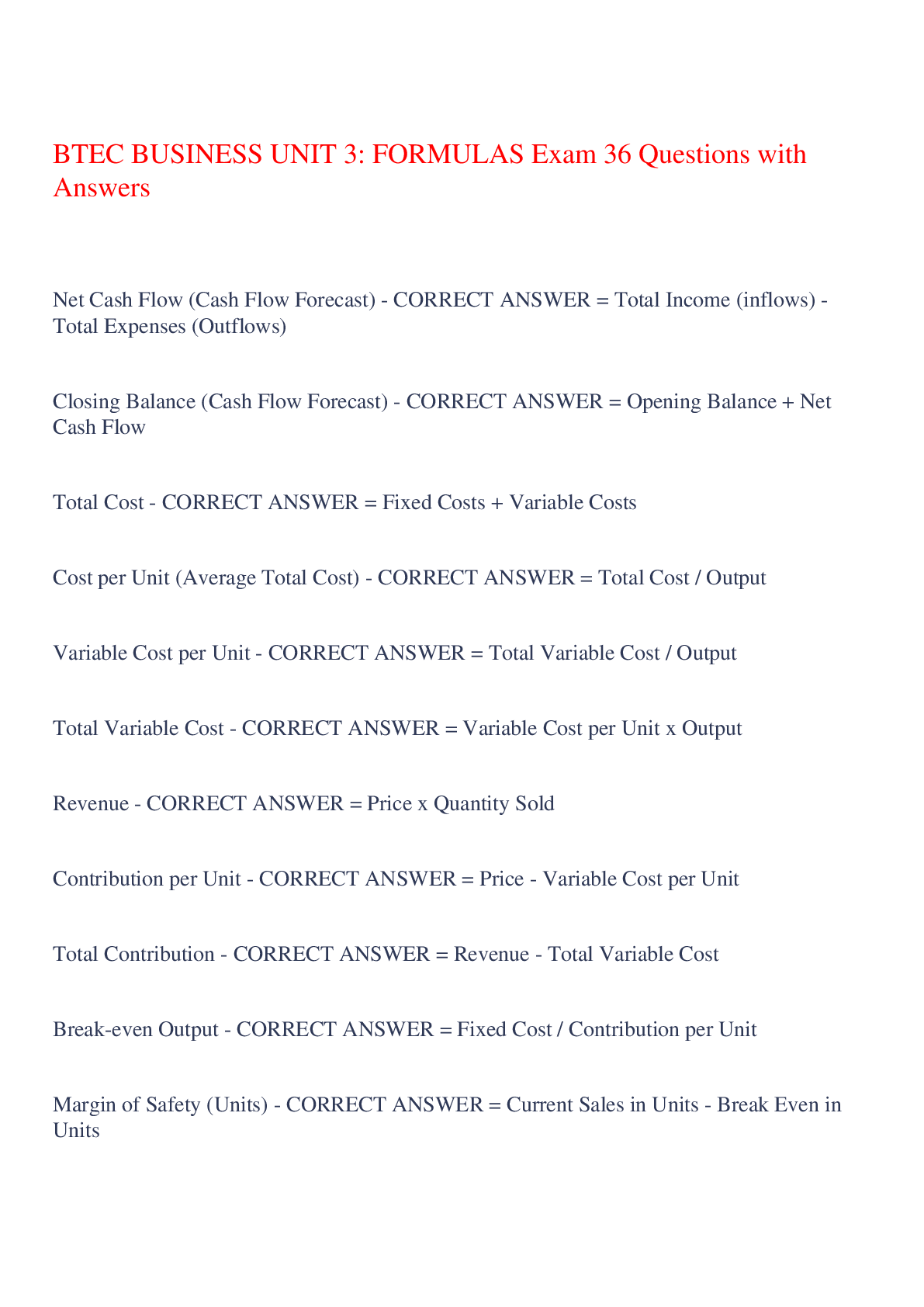
Net Cash Flow (Cash Flow Forecast) - CORRECT ANSWER = Total Income (inflows) - Total Expenses (Outflows)
Closing Balance (Cash Flow Forecast) - CORRECT ANSWER = Opening Balance + Net Cash Flow
Total Cost - CORRECT ANSWER = Fixed Costs + Variable Costs
Cost per Unit (Average Total Cost) - CORRECT ANSWER = Total Cost / Output
Variable Cost per Unit - CORRECT ANSWER = Total Variable Cost / Output
Total Variable Cost - CORRECT ANSWER = Variable Cost per Unit x Output
Revenue - CORRECT ANSWER = Price x Quantity Sold
Contribution per Unit - CORRECT ANSWER = Price - Variable Cost per Unit
Total Contribution - CORRECT ANSWER = Revenue - Total Variable Cost
Break-even Output - CORRECT ANSWER = Fixed Cost / Contribution per Unit
Margin of Safety (Units) - CORRECT ANSWER = Current Sales in Units - Break Even in Units
Margin of Safety (Value) - CORRECT ANSWER = Current Revenue - Revenue at Break-even
Profit - CORRECT ANSWER = Revenue - Total Cost
Profit (Contribution Method) - CORRECT ANSWER = [(Price - VC per unit) x Quantity Sold] - Fixed Costs
Cost of Goods Sold (Cost of Sales) - CORRECT ANSWER = Opening Inventories + Purchases - Closing Inventories
Gross Profit (Statement of Comprehensive Income) - CORRECT ANSWER = Revenue - Cost of Goods Sold
Net Profit (Statement of Comprehensive Income) - CORRECT ANSWER = Gross Profit - Expenses
Profit for the Year (Statement of Comprehensive Income) - CORRECT ANSWER = Gross Profit - Expenses + Other Income
Straight-Line Depreciation Method - CORRECT ANSWER = (Asset Purchase Price - Estimated Resale Value) / Expected Useful Life of Asset in Years
Declining Balance Depreciation Method - CORRECT ANSWER = Asset Value x % for Depreciation
e.g. if 15% = Asset Value x 0.15
Depreciation: Carrying Amount - CORRECT ANSWER = Cost (Book Value) of Asset - Annual Depreciation
Net Current Assets (Statement of Financial Position) - CORRECT ANSWER = Current Assets - Current Liabilities
Current Assets (Statement of Financial Position) - CORRECT ANSWER = Cash + Receivables + Inventories + Prepayments
Current Liabilities (Statement of Financial Position) - CORRECT ANSWER = Trade Payables + Overdraft + Accruals
Net Assets (Statement of Financial Position) - CORRECT ANSWER = Non-Current Assets + Net Current Assets - Long-term Liabilities
Closing Capital or Capital Employed (Statement of Financial Position) - CORRECT ANSWER = Opening Capital + Retained Profit (or Profit for the Year) - Drawings
Gross Profit Margin (Profitability Ratio) - CORRECT ANSWER (Gross Profit / Revenue) x 100%
Profit Margin (Profitability Ratio - CORRECT ANSWER (Profit / Revenue) x 100%
Return on Capital Employed or ROCE (Profitability Ratio) - CORRECT ANSWER = (Profit / Capital Employed) x 100%
Mark-up (Profitability Ratio) - CORRECT ANSWER = (Revenue / Cost of Sales) x 100%
Current Ratio (Liquidity Ratio) - CORRECT ANSWER = Current Assets / Current Liabilities
Liquid Asset or Acid Test Ratio (Liquidity Ratio) - CORRECT ANSWER = (Current Assets - Inventory) / Current Liabilities
Trade Receivable Days (Efficiency Ratio) - CORRECT ANSWER = (Trade Receivables / Credit Sales) x 365 days
Trade Payable Days (Efficiency Ratio) - CORRECT ANSWER = (Trade Payables / Credit Purchases) x 365 days
Inventory Turnover (Efficiency Ratio) - CORRECT ANSWER = (Average Inventory / Cost of Sales x 365 days
Average Inventory - CORRECT ANSWER = (Opening Inventory + Closing Inventory) / 2
[Show More]