MGT330 WEEK 5 FINAL EXAM
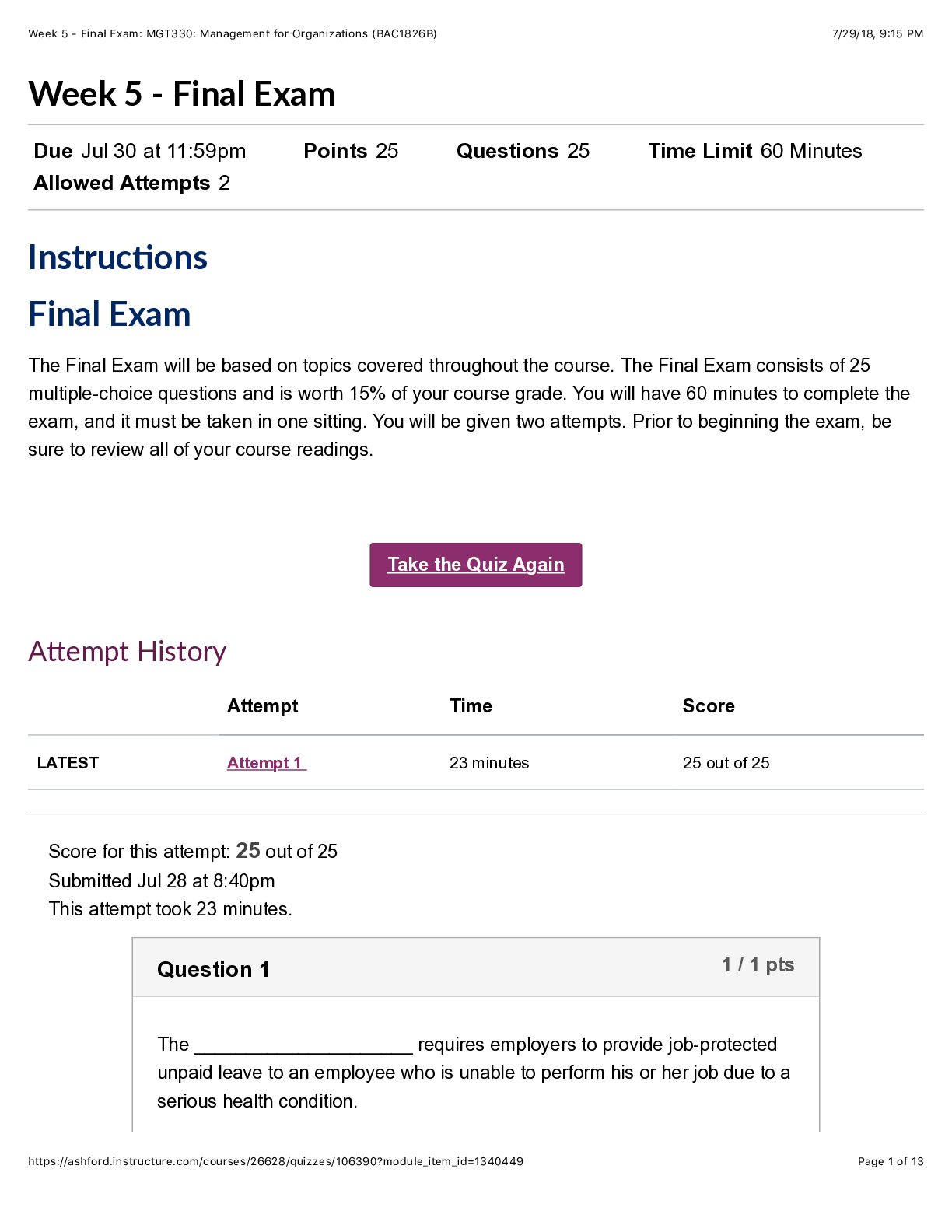
Question 1
1 / 1 pts
Internal sourcing and external sourcing are part of the process of __________________.
recruiting
employee orientation
employee selection
job design
Question 2
...
MGT330 WEEK 5 FINAL EXAM
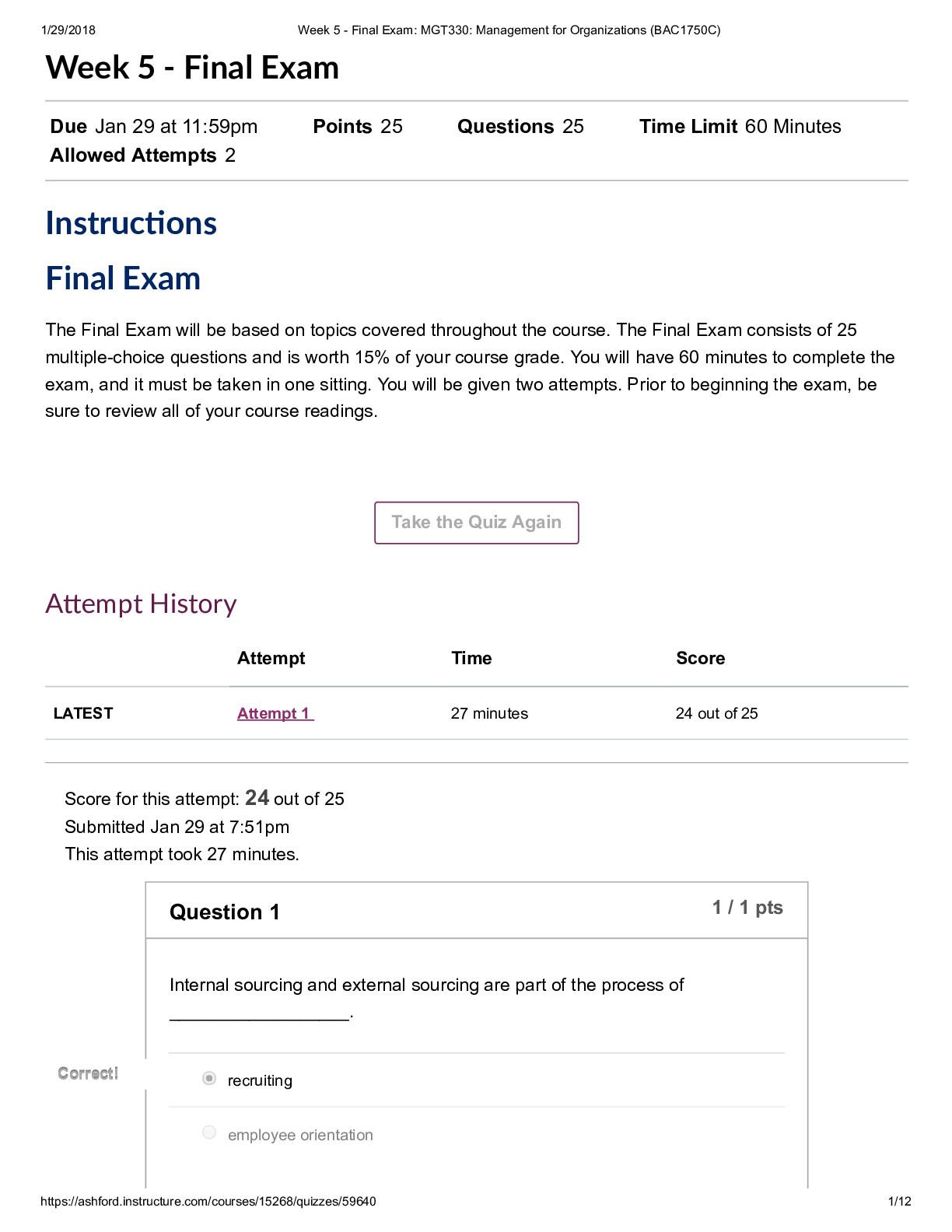
Question 1
1 / 1 pts
Internal sourcing and external sourcing are part of the process of __________________.
recruiting
employee orientation
employee selection
job design
Question 2
1 / 1 pts
Which of the following methods constitute on-the-job training methods?
demonstration; apprenticeship; and sink-or-swim
simulation; film and classroom; and vestibule
demonstration; film and classroom; and sink-or-swim
sink-or-swim; vestibule; and apprenticeship
Question 3
1 / 1 pts
Which of the following is NOT a step in the process of employee selection?
initial screening
job design
contacting references
final interview
Question 4
1 / 1 pts
Which of the following laws give workers the right to join a union without fear of discrimination or
retribution?
The Norris–LaGuardia Act of 1932
The Wagner Act of 1935
The Taft-Hartley Act of 1948
The Landrum-Griffin/Labor-Management Reporting and Disclosure Act of 1959
Question 5
1 / 1 pts
Which of the following scenarios describes the 360-degree assessment technique?
David’s performance is evaluated by his work over the last calendar year.
David’s performance is evaluated using a BARS scale.
David’s performance is evaluated based on the areas in which he has made the most progress.
David’s performance is evaluated by peers, subordinates, customers, and himself.
Question 6
1 / 1 pts
Employee inventories and skills inventories are strategies for __________________.
job design
promoting from within
external recruiting
human resource planning
Question 7
1 / 1 pts
Vanessa starts her new job as a marketing strategist for Orion Food and Beverage today. As part of her
orientation, she is told to study the position duties on her own, and she uses an online training manual
to familiarize herself with company processes. What kind of employee training method is Vanessa most
likely engaged in?
film and classroom
simulation
vestibule
demonstration
Question 8
1 / 1 pts
What is unique about staffing practices at the online shoe company Zappos?
New hires are trained by employees of other successful shoe companies.
Employees are trained to do every job in the company.
Trainees are offered up to $2,000 to quit the company at any time.
The CEO personally trains every single employee.
Question 9
1 / 1 pts
Job description involves ___________; job specification involves _____________.
an applicant’s required skills and experience; the company’s need for the position.
what a job entails; an applicant’s required skills and experience.
what a job entails; the company’s need for the position.
an applicant’s required skills and experience; what a job entails.
Question 10
1 / 1 pts
The __________ dictates that leaders should adapt their style in response to how prepared their
audience is to follow them.
Hersey and Blanchard Situational Leadership Model
Fiedler Contingency Model
Attribution Model
University of Michigan Leadership Model
Question 11
1 / 1 pts
Which of the following five sources of power or means of influence have French and Raven identified as
available to leaders of organizations?
legitimate, reward, expert, referent, and boundary spanning
reward, coercive, expert, referent, and closeness to production
legitimate, reward, coercive, expert, and referent
legitimate, reward, coercive, referent, and control over policy making
Question 12
1 / 1 pts
Which of the following qualities is NOT part the five-factor model of personality?
agreeableness
extraversion
expertise
emotional stability
Question 13
1 / 1 pts
Yael, a manager at a footwear company, is a production-oriented leader. How would Yael likely fare if
she were to take Fred E. Fiedler’s LPC test?
Yael would likely score high on the test.
Yael would likely score low on the test.
Yael would likely refuse to take the test because she is so production oriented.
Yael would not take the LPC test, because it is not for managers.
Question 14
1 / 1 pts
According to French and Raven, which source of power does NOT have an informal side?
reward
referent
legitimate
expertise
Question 15
1 / 1 pts
Martin is well liked by his peers and influences them using his personality, attitude, and behavior. What
kind of power does Martin most likely have?
legitimate
expertise
coercive
referent
Question 16
1 / 1 pts
Elissa is a mediator whose job is to arbitrate negotiations between unions and corporations. What kind
of power does Elissa have?
boundary-spanning power
referent power
closeness over production
tactical power
Question 17
1 / 1 pts
What is a key difference between managing and leading?
Managers help people do their jobs by problem solving, while leaders help people do their jobs
through planning and budgeting.
Managers help people do their jobs by providing direction, while leaders help people do their jobs
through planning and budgeting.
Managers help people do their jobs by problem solving, while leaders help people do their jobs by
providing direction.
Managers help people do their jobs by providing direction, while leaders help people do their jobs by
accomplishing organizational agendas.
Question 18
1 / 1 pts
Which of the following statements is TRUE about both teams and groups?
Both teams and groups usually have an unlimited number of members.
Teams usually have an unlimited number of members, while groups have between two and 10
members.
Teams usually consist of between two and 10 people, while groups can have unlimited members.
Both teams and groups usually consist of between two and 10 people.
Question 19
1 / 1 pts
What makes communication dynamic?
It is usually exciting, because transmitting messages can be exhilarating.
It is constantly changing, because messages feed other messages.
It is always irreversible, because we cannot take back what we say.
It is usually complex, because messages have many layers of meaning.
Question 20
1 / 1 pts
All of the following factors increase group cohesion EXCEPT
the presence of an outside threat
member interdependence
member heterogeneity
high status
Question 21
1 / 1 pts
Which of the following is NOT a limitation of a virtual team?
It can be expensive to get virtual teams together.
Virtual teams have a difficult time picking up on paraverbal and nonverbal cues.
Virtual teams suffer from reduced socialization.
It can be difficult to schedule virtual team meetings.
Question 22
1 / 1 pts
Which of the following is NOT a category of barriers to interpersonal communication?
individual differences among employees
situational factors, such as outside noise
transmission problems, such as telephone static
informal communication networks, such as the grapevine
Question 23
1 / 1 pts
Whenever Paula works in a group, she gives less effort than when she works individually. What term
best describes this scenario?
groupthink
group cohesiveness
social loafing
sender disability
Question 24
1 / 1 pts
At which stage of a group- or team-building process are conflicts resulting from individual personalities
and roles most likely to arise?
forming
storming
norming
performing
Question 25
1 / 1 pts
According to the text, the difference between a group and a team
relies on which of the following ideas?
Team members share a common commitment, while group members solely share common norms and
an identity.
Teams go through different phases of development, while groups remain static over the course of time.
Groups go through different phases of development, while teams remain static over the course of time.
Teams should be formed with 10 members or less, while groups have an unlimited number of
members.
Quiz Score: 25 out of 25
[Show More]





.png)
.png)