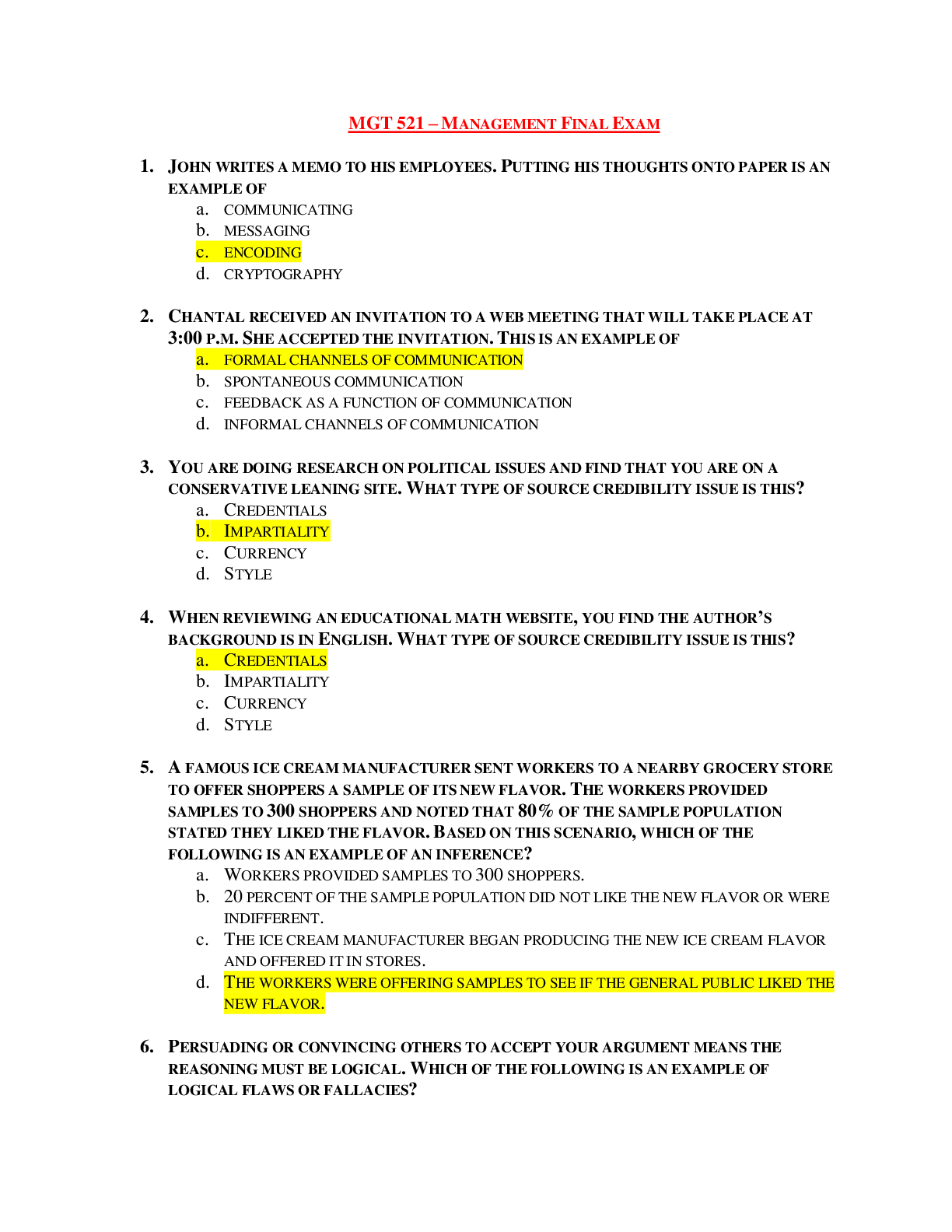
MGT 521 – MANAGEMENT FINAL EXAM
1. JOHN WRITES A MEMO TO HIS EMPLOYEES. PUTTING HIS THOUGHTS ONTO
PAPER IS AN EXAMPLE OF
a. COMMUNICATING
b. MESSAGING
c. ENCODING – IS TRANSLATING A MESSAGE INTO UNDERSTANDABLE SYMBO
...
MGT 521 – MANAGEMENT FINAL EXAM
1. JOHN WRITES A MEMO TO HIS EMPLOYEES. PUTTING HIS THOUGHTS ONTO
PAPER IS AN EXAMPLE OF
a. COMMUNICATING
b. MESSAGING
c. ENCODING – IS TRANSLATING A MESSAGE INTO UNDERSTANDABLE SYMBOLS OR LANGUAGE. (CH 15, PG. 479).
d. CRYPTOGRAPHY
2. CHANTAL RECEIVED AN INVITATION TO A WEB MEETING THAT WILL TAKE
PLACE AT 3:00 P.M. SHE ACCEPTED THE INVITATION. THIS IS AN EXAMPLE
OF
a. FORMAL CHANNELS OF COMMUNICATION – FOLLOW THE CHAIN OF COMMAND & ARE RECOGNIZED AS
OFFICIAL (CH11,P.482)
b. SPONTANEOUS COMMUNICATION
c. FEEDBACK AS A FUNCTION OF COMMUNICATION
D. INFORMAL CHANNELS OF COMMUNICATION - develop outside the formal structure and do not
follow the chain of command—they skip management levels and cut across lines of authority. Two types of informal
channels are (1) the grapevine and (2) management by wandering around.(CH11,p.482)
3. YOU ARE DOING RESEARCH ON POLITICAL ISSUES AND FIND THAT YOU ARE
ON A CONSERVATIVE LEANING SITE. WHAT TYPE OF SOURCE CREDIBILITY
ISSUE IS THIS?
a. CREDENTIALS
b. IMPARTIALITY - (CH16)
c. CURRENCY
d. STYLE
4. WHEN REVIEWING AN EDUCATIONAL MATH WEBSITE, YOU FIND THE
AUTHOR’S BACKGROUND IS IN ENGLISH. WHAT TYPE OF SOURCE
CREDIBILITY ISSUE IS THIS?
a. CREDENTIALS – (CH7)
b. IMPARTIALITY
c. CURRENCY
d. STYLE
5. A FAMOUS ICE CREAM MANUFACTURER SENT WORKERS TO A NEARBY
GROCERY STORE TO OFFER SHOPPERS A SAMPLE OF ITS NEW FLAVOR. THE
WORKERS PROVIDED SAMPLES TO 300 SHOPPERS AND NOTED THAT 80% OF
THE SAMPLE POPULATION STATED THEY LIKED THE FLAVOR. BASED ON
THIS SCENARIO, WHICH OF THE FOLLOWING IS AN EXAMPLE OF AN
INFERENCE?
a. WORKERS PROVIDED SAMPLES TO 300 SHOPPERS.
b. 20 PERCENT OF THE SAMPLE POPULATION DID NOT LIKE THE NEW FLAVOR OR WERE
INDIFFERENT.
c. THE ICE CREAM MANUFACTURER BEGAN PRODUCING THE NEW ICE CREAM FLAVOR
AND OFFERED IT IN STORES.
d. THE WORKERS WERE OFFERING SAMPLES TO SEE IF THE GENERAL PUBLIC LIKED THE
NEW FLAVOR. (CH7)
6. PERSUADING OR CONVINCING OTHERS TO ACCEPT YOUR ARGUMENT MEANS
THE REASONING MUST BE LOGICAL. WHICH OF THE FOLLOWING IS AN
EXAMPLE OF LOGICAL FLAWS OR FALLACIES?
a. OPPOSING VIEWS ARE CONSIDERED
b. HASTY GENERALIZATION - (CH4)
c. ARGUMENT PRESENTS ALTERNATIVE EXPLANATIONS
d. REASONING FROM SPECIFIC EVIDENCE
7. WHAT IS THE BEST WAY FOR THE CEO TO DEAL WITH MANAGERS IN KEY
POSITIONS WHO CONTINUE TO RESIST A MAJOR CHANGE?
a. MINIMIZE THEIR INTERACTIONS WITH FELLOW EMPLOYEES AND WORK AROUND
THEM
b. REPLACE THEM WITH PEOPLE WHO WILL SUPPORT THE CHANGE
c. GIVE THEM SPACE AND HOPE THEY WILL COME TO SEE WHY THE CHANGE WAS
NECESSARY
d. KEEP INCREASING THE PRESSURE ON THEM TO SUPPORT THE CHANGE -(CH10-12)
8. FINDING A WIN-WIN SOLUTION THAT ALLOWS PARTIES WHO ARE INVOLVED
TO HAVE THEIR GOALS ACHIEVED IS AN EXAMPLE OF
a. ACCOMMODATION
b. COLLABORATION
c. TEAM BUILDING
d. COMPROMISING- (CH13)
9. WHAT IS EMPHASIZED MORE IN ETHICAL LEADERSHIP THEORIES THAN IN
TRANSFORMATIONAL LEADERSHIP?
a. LEADER VALUES – (CH13)
b. LEADER BEHAVIORS
c. LEADER SKILLS
d. LEADER TRAITS
10. ETHICAL BEHAVIOR AND INTEGRITY FOR A LEADER IS MOST LIKELY TO
RESULT IN
a. HIGHER UNIT PERFORMANCE
b. HIGHER PERFORMANCE RATINGS FOR THE LEADER BY BOSSES
c. HIGHER SUBORDINATE SATISFACTION AND TRUST - (CH7)
d. LESS STRESS FOR THE LEADER
11.A COMMON CHARACTERISTIC OF MOST ENTREPRENEURS IS THAT THEY
a. ACCEPT THE RISKS INVOLVED IN STARTING AND MANAGING A BUSINESS – (CH 1)
b. HAVE A HIGH LEVEL OF SCIENTIFIC AND TECHNICAL EXPERTISE
c. POSSESS A GREAT DEAL OF PERSONAL WEALTH
d. HAVE EXPERIENCE IN RUNNING LARGE, COMPLEX ORGANIZATIONS
12.IN ORDER TO MAKE AN INTELLIGENT INVESTMENT DECISION,
ENTREPRENEURS SHOULD
a. LIMIT THEIR OPTIONS TO THOSE BUSINESS INVESTMENTS THAT ARE BACKED BY THE
U.S. GOVERNMENT
b. INVEST IN BUSINESSES THAT HAVE GENERATED A STABLE RATE OF PROFIT FOR AT
LEAST THE PAST TEN YEARS
c. INVEST ONLY IN BUSINESS OPPORTUNITIES WHERE IT IS POSSIBLE TO TAKE AN
ACTIVE ROLE IN MANAGEMENT
d. COMPARES THE RISKS OF POTENTIAL INVESTMENTS TO THEIR EXPECTED PROFITS
AND FIND THE RIGHT BALANCE BETWEEN PROFIT AND RISK- (CH 1)
13.THE CUSTOMERS, EMPLOYEES, STOCKHOLDERS, SUPPLIERS, CREDITORS,
AND OTHERS WHO STAND TO GAIN OR LOSE BY THE POLICIES AND
ACTIVITIES OF A BUSINESS REPRESENT THE FIRM'S
a. MARKET MAKERS
b. ECONOMIC ENVIRONMENT
c. STAKEHOLDERS – (CH3,P. 74)
d. SOCIAL MENTORS
14.WHEN A FIRM MAKES USE OF THE SWOT ANALYSIS, ONE OF ITS
OBJECTIVES IS TO
a. IDENTIFY THE BEST EMPLOYEES TO FILL EACH POSITION WITHIN THE ORGANIZATION
b. SET SPECIFIC SHORT-TERM PERFORMANCE STANDARDS FOR EACH DEPARTMENT
c. EVALUATE THE DESIRABILITY OF ISSUING STOCKS OR BONDS IN THE CURRENT
FINANCIAL CLIMATE
d. IDENTIFY THE THINGS IT DOES WELL AS AN ORGANIZATION AND THE THINGS IT
NEEDS TO IMPROVE – (CH6 , P. 167)
15.THE PROCESS OF RATING AN ORGANIZATION'S PRACTICES, PROCESSES, AND
PRODUCTS AGAINST THE BEST OF THE WORLD IS KNOWN AS
a. WEBWORKING
b. OUTSOURCING
c. BENCHMARKING- (CH2/ DEFINED, CH10).
d. CORE COMPETENCIES
16.COMPANIES BENEFIT TODAY BY INTER-FIRM COOPERATION. ONE OF THE
WAYS THEY COOPERATE IS THROUGH NETWORKING. ANOTHER WAY IS BY
SEEKING TECHNOLOGICAL KNOWLEDGE AND LEARNING NEW PROCESSES
FROM OTHER FIRMS THAT USUALLY FALL OUTSIDE OF THEIR RESPECTIVE
INDUSTRIES. WE CALL THIS
a. COMPETENCY CAPTURING
b. TECHNOLOGY SWAPPING
c. BENCHMARKING (CH2/ DEFINED, CH10).
d. BROADENING THE KNOWLEDGE BASE
17.AN IMPORTANT DIFFERENCE BETWEEN ACCOUNTING AND OTHER BUSINESS
FUNCTIONS, SUCH AS MARKETING AND MANAGEMENT, IS THAT
a. ACCOUNTING FUNCTIONS MUST BE PERFORMED BY AN "OUTSIDER" (RATHER THAN
BY AN EMPLOYEE OF THE BUSINESS) IN ORDER TO AVOID CONFLICTS OF INTEREST
b. ACCOUNTING OFFERS US INSIGHT INTO WHETHER THE BUSINESS IS FINANCIALLY
SOUND – (CH3)
c. ACCOUNTING INVOLVES MAINLY CLERICAL ACTIVITIES AND THUS REQUIRES VERY
LITTLE ANALYSIS
d. ACCOUNTING DEALS EXCLUSIVELY WITH NUMBERS
18.ALTHOUGH ACCOUNTING HAS SEVERAL SPECIFIC USES, THE OVERALL
PURPOSE OF ACCOUNTING CAN BE SUMMARIZED AS
a. TO PROVIDE FINANCIAL INFORMATION THAT IS USEFUL TO DECISION MAKERS
b. TO MEET THE LEGAL REQUIREMENTS OF THE FINANCIAL ACCOUNTING STANDARDS
BOARD (FASB)
c. TO ALLOW THE GOVERNMENT TO TRACK BUSINESS ACTIVITY LEVELS
d. TO COMPUTE THE PROFIT OR LOSS AND DECLARED DIVIDEND OF A BUSINESS FIRM
19.AN IMPORTANT ADVANTAGE THAT KNOWLEDGE TECHNOLOGY HAS OVER
OLDER VERSIONS OF BUSINESS TECHNOLOGY IS THAT IT
a. IS MUCH CHEAPER TO INCORPORATE INTO MOST BUSINESS OPERATIONS
b. DELIVERS TIMELY INFORMATION DIRECTLY TO THE PEOPLE WHO NEED IT
c. ALLOWS BUSINESSES TO LOCATE ANYWHERE AND STILL REACH THEIR CUSTOMERS
d. ELIMINATES THE NEED FOR BUSINESS TO STORE INFORMATION ELECTRONICALLY
20.FIRST ENGINEERING, A LARGE U.S. BASED MECHANICAL ENGINEERING
FIRM, IS CONSIDERING ENTERING THE GLOBAL MARKET. UPON CAREFUL
ANALYSIS OF THE GLOBAL MARKET, THEY WILL FIND THAT GLOBAL TRADE
a. OPPORTUNITIES ARE DIMINISHING
b. IS DOMINATED BY EMERGING, DEVELOPING COUNTRIES
c. IS LIKELY TO BE SEVERELY RESTRICTED IN THE FUTURE BY NONTARIFF TRADE
BARRIERS
d. IS BIG BUSINESS TODAY AND IS EXPECTED TO BE MORE IMPORTANT IN THE FUTURE
21.THE PROCESS OF SETTING UP INDIVIDUAL FUNCTIONAL UNITS OF THE
BUSINESS TO DO SPECIALIZED TASKS IS CALLED
a. DEPARTMENTALIZATION
b. DIVISION OF LABOR
c. JOB SPECIALIZATION
d. DELEGATION OF AUTHORITY
22.THE PROVEN SUCCESS OF JOB SPECIALIZATION LIES IN THE FACT THAT
a. IT LEADS TO GROUPTHINK
b. IT AVOIDS THE PITFALLS OF DIVISION OF LABOR, WHERE WORKERS BECOME
REMOVED FROM THINKING CONCEPTUALLY ABOUT THE BUSINESS
c. IT IS A DETRACTOR TO OTHERS WHO ARE THINKING ABOUT ENTERING YOUR
INDUSTRY BECAUSE IT SUCCESSFULLY CREATES BARRIERS TO ENTRY
d. IT ADDS EFFICIENCY TO THE BUSINESS'S OPERATION BY IDENTIFYING TASKS THAT
SOME DO BETTER THAN OTHERS
23.ECONOMICS IS THE STUDY OF HOW A SOCIETY
a. INVESTS WISELY IN THE STOCK MARKET
b. EMPLOYS RESOURCES TO PRODUCE GOODS AND SERVICES AND DISTRIBUTE THEM
AMONG COMPETING GROUPS AND INDIVIDUALS
c. EMPLOYS STATISTICAL TECHNIQUES TO MAKE PREDICTIONS ABOUT THE EVOLUTION
OF SOCIETY OVER THE LONG RUN
d. GOVERNS ITSELF FOR THE GOOD OF ITS CITIZENS
24.HOW IS IT THAT PEOPLE WORKING IN THEIR OWN SELF-INTEREST PRODUCE
GOODS, SERVICES, AND WEALTH FOR OTHERS?
a. BY TAKING ADVANTAGE OF A VAST SUPPLY OF LABOR, PEOPLE WORKING IN THEIR
OWN SELF-INTEREST COULD HIRE OTHERS AT VERY LOW WAGES.
b. IN ORDER TO EARN MONEY AND PRODUCE GOODS THAT IMPROVE LIVES, SELFDIRECTED GAIN WOULD PROVIDE JOBS, AND SUBSEQUENTLY WAGES FOR OTHERS.
c. THE GOVERNMENT PAYS ENTREPRENEURS IN THE UNITED STATES TO PRODUCE
GOODS, SERVICES, AND WEALTH FOR OTHERS.
d. ENTREPRENEURS TEND TO INCLUDE THEMSELVES IN A GROUP OF PEOPLE WHO NEED
CHARITABLE SUPPORT. A PORTION OF THE ENTREPRENEUR'S PROFIT (AS REQUIRED
BY LAW) GOES TO THE CHARITY OF ONE'S CHOICE TO SUPPORT THE LESS
FORTUNATE.
25.THE ULTIMATE RESOURCE OF A FIRM IS ITS
a. BUSINESS PLAN
b. MARKETING MIX
c. CAPITAL BUDGET
d. EMPLOYEES
26.TODAY, HUMAN RESOURCE MANAGEMENT HAS BECOME SO IMPORTANT
THAT IN MANY FIRMS IT HAS BECOME
a. A FUNCTION PERFORMED BY MANAGERS IN ALL AREAS OF THE ORGANIZATION
b. THE MAIN RESPONSIBILITY OF THE FIRM'S LEGAL STAFF
c. A FUNCTION HANDLED ONLY BY SPECIALISTS IN THE HUMAN RESOURCE
DEPARTMENT
d. FUNCTION HANDLED ONLY BY THE FIRM'S TOP MANAGEMENT
MGT/521 Final Examination Study Guide
This study guide will prepare you for the Final Examination you will complete in Week Six. It contains
practice questions, which are related to each week’s objectives. In addition, refer to each week’s readings
and your student guide as study references for the Final Examination.
Week One: Constructing and Supporting an Argument
Objective: Identify channels for business communications.
1. An informal communication network is typically called a
a. chat network
b. chain
c. contextual system
d. grapevine - is the unofficial communication system of the informal organization,(CH11,P.484).
2. Which channel of communication is lowest in richness?
a. Video conferences
b. E-mail
c. Memos and letters
d. Telephone conversations
3. Jessica needs to describe her vision for an important ad campaign to three of
the new team members. What should Jessica do?
a. Schedule a meeting
b. Send an e-mail
c. Write a memo
d. Publish a formal report
Objective: Evaluate credibility and validity of sources of information.
4. Checking a book’s preface, reading a blurb found on a book jacket cover, and
looking for thumbnail biographies at the beginning and end of a source of
information are all part of
a. evaluating style and tone
b. evaluating credentials
c. evaluating currency
d. evaluating biases
Objective: Develop effective arguments.
5. When you write a paragraph based on _____________, the topic sentence
should clearly summarize the range of evidence you use
a. deduction
b. induction
c. synopsis
d. analysis
Week Two: Values and Managing Others
Objective: Evaluate alignment of personal values and organizational values.
6. Which developmental method is useful for helping managers to understand
their inner feelings and values?
a. outdoor challenge programs
b. personal growth programs
c. mentoring programs
d. multisource feedback workshops
Objective: Determine strategies to promote collaboration.
7. According to Yukl, the difference between exchange and collaboration as an
influence tactic is
a. exchange involves personal trade-offs
b. collaboration involves a joint effort to accomplish the same objective
c. collaboration does not entail problem-solving
d. exchange is a motivator whereas collaboration is not
Objective: Explain ethical decision making in a complex environment.
8. Which condition is likely to encourage ethical behavior in organizations?
a. Strong emphasis on individual productivity
b. Cultural values for obedience to authority
c. Intense competition for valued rewards
d. Cultural values for individual responsibility
9. Which statement about moral development of leaders is correct?
a. Moral development occurs naturally as a person becomes older and more experienced as a
leader
b. Someone at the highest level of moral development will risk social rejection to achieve an
important ethical objective
c. Most people conform to social norms even if they do not have a strong moral self identity
d. The consequences of actions are more important than formal rules and laws for determining
whether a person's behavior will be ethical
10.Which of the following questions will help individuals and organizations when
deciding if their decisions are ethical?
a. Do I feel good about this decision?
b. Is it balanced?
c. Has it been done before?
d. Is there a desirable alternative?
Week Three: Introduction to Business Analysis
Objective: Explain entrepreneurship versus working for others.
11.Shelby recently started selling her invention: A bed that uses magnetic forces
to appear as if it floats in mid-air. Shelby is
a. an arbitrageur
b. an entrepreneur
c. a speculator
d. an account manager
12.Kenya recently quit a job with a large corporation to start her own business.
While she realizes that her decision comes with risk, she is excited for the
chance to be independent and by the challenges of running her own firm.
Kenya is an example of
a. an intrapreneur.
b. an entrepreneur.
c. a venture capitalist.
d. a raconteur.
13.Which of the following entails the greatest amount of risk?
a. Working for the government
b. Working for a large business
c. Working for a small business
d. Starting a business
Objective: Identify wants and needs of various stakeholders.
14.Which of the following is a major role of business managers today in meeting
the wants and needs of the company’s stakeholders?
a. Promoting quality of life
b. Balancing the demands for higher salaries and stockholders’ profits
c. Outsourcing
d. Identifying potential customers
Objective: Conduct SWOT Analysis
15.In performing a SWOT Analysis, which of the following would be considered
as a threat?
a. Falling trade barriers in attractive foreign markets
b. Ability to grow due to increased market demand
c. Vulnerability to recession and business cycles
d. Subpar profitability
Week Four: The Business Environment
Objective: Conduct benchmarking analyses.
16.Bull's-eye, a regional discount retailer, carefully watches and compares its
operation with the operations of its closest rivals. This firm does
a. outsourcing
b. functional positioning
c. core competency ranking
d. competitive benchmarking
Objective: Explain the basic tenets of managerial accounting and financial
accounting.
17.Which of the following is a key step in the accounting cycle?
a. Recording information into journals
b. Collecting data from customers
c. Forecasting expenses and revenues
d. Preparing the advertising message
Objective: Identify the effects of technology utilization on business.
18.A firm would use data mining if it wanted to
a. store copies of crucial data in several different locations to protect against its loss during
disasters such as earthquakes, floods, or terrorist attacks.
b. protect its data from unauthorized outsiders.
c. increase the rate at which information flows through a firm's intranet.
d. discover hidden relationships among the data it accumulates.
19.Free trade means
a. buyers and sellers contract with each other and offer some goods at no cost
b. goods and services can be traded freely across borders without political or economic barriers
c. there is no exchange of currency for these products
d. there is no exchange of currency, but the trading partners determine the value of the product
and perform a bartering process to exchange goods
Objective: Identify the effects of globalization on business.
20.Why does it make sense to trade with other nations?
a. After producing all the product and service its people want and need, a nation can sell the
excess products to the world.
b. Some nations have lots of natural resources and technological know-how. They have an ethical
obligation to offer the rest to other nations.
c. A nation can watch the global market to see which product is bringing the highest price and start
producing and trading that product.
d. A nation will produce what it can produce most efficiently and effectively and buy from other
nations what they can produce most efficiently and effectively.
Week Five: Business Overview
Objective: Identifying methodologies for adapting different types of businesses to changing
markets.
21.Which of the following is true about economies of scale?
a. They are available to small firms but not to large firms due to management inefficiencies.
b. They are achieved when a firm reduces its average cost of production as it produces more.
c. They can be avoided by purchasing supplies and raw materials in large quantities.
d. They help explain the success of small businesses.
22.Which of the following correctly identifies the explanation behind the unity of
command principle of management?
a. Organization design will benefit by the emergence of quick decision-making.
b. Organization design will eliminate systems of hierarchy and chains of command due to their
hindrance of esprit de corps.
c. Organizations that grow will develop several layers of management and the time that it takes to
make a decision will increase.
d. There will be a significant reduction of work force due to specialization and departmentalization.
Objective: Determine the impact of economics on business.
23.For many years, Congressman Ricardo Perez has called for more government
regulation of business. "After all," the Congressman said recently,
"businesspeople are out to make a profit, not to create jobs or serve their
customers. The government must pass more laws to require businesses to
take the interests of consumers and workers into account." From these
comments, it is clear that Congressman Perez
a. agrees with the ideas of Thomas Malthus
b. does not accept the “invisible hand” idea brought forth by Adam Smith
c. is unaware of the fact that most businesses in the United States are owned by the government
d. does not realize that government regulation is already the main determinant of business
decisions in capitalist economies
Objective: Describe the role of human resource management in achieving
business goals.
24.Which of the following is a valid statement about contingent workers?
a. An increasing number of companies are hiring skilled professionals such as accountants as part
of their contingent workforce.
b. Contingent workers are seldom skilled professionals.
c. By law, employers must provide contingent workers the same salary and benefits as permanent
employees.
d. By law, companies cannot hire contingent workers as part of the management team.
25.Which of the following is a challenge that is facing the human resource
managers of today?
a. Too many unemployed scientists and computer engineers
b. An increasing number of Gen Yers in the workforce
c. A shift in employee attitudes toward work
d. An increased demand for uniformity in benefits offered to employees
26.As part of the HR planning process, the manager begins by assessing the
current labor situation at his or her company. Essentially, this means
a. preparing job analyses
b. preparing job descriptions
c. preparing job specifications
d. taking an inventory of current employees and their capabilities.
Week Six: Business Analysis.
Objective: Perform business analyses.
27.During a recession, which of the following statements best describe how a
business is affected?
a. Prices fall, people purchase fewer products, and businesses fail
b. Prices rise and people purchase fewer products
c. Living standards tend to remain about the same
d. More companies seek globalization
28.A SWOT analysis is conducted and some of the details of the analysis include:
many choices for customers, very customer oriented, and repeat customers.
These are all examples of which part of the SWOT analysis?
a. Threats
b. Strengths
c. Opportunities
d. Weaknesses
Objective: Differentiate between strategy and tactics.
29.Which of the following would be considered a strategy?
a. Developing short term actions about what is to be done
b. Explaining why a company exists
c. Determining the major company goals
d. Identifying how a company will achieve goals
30.Which of the following would be considered a tactic?
a. Setting up work schedules
b. Developing budgets
c. Determining quality specifications
d. Creating performance appraisal
27.WHICH OF THE FOLLOWING IS INCLUDED IN PERFORMING A BUSINESS ANALYSIS?
a. HIRING NEW EMPLOYEES
b. ENTERING GLOBAL MARKETS
c. CONDUCTING A SWOT ANALYSIS
d. NETWORKING
28.WHEN THE COMPETITION IS INTENSE AND THE ENVIRONMENT IS CHANGING RAPIDLY, IT IS
ESPECIALLY IMPORTANT TO
a. MAINTAIN A HIGH LEVEL OF EXTERNAL MONITORING
b. HAVE DETAILED PLANS AND OPERATING PROCEDURES
c. INCREASE THE POWER OF THE CHIEF EXECUTIVE
d. STRENGTHEN THE ORGANIZATION CULTURE
29.WHICH OF THE FOLLOWING WOULD BE A CONCERN ADDRESSED IN A
STRATEGIC PLAN?
a. WHICH SPECIFIC JOBS SHOULD BE ASSIGNED TO EACH EMPLOYEE?
b. HOW MUCH OUTPUT SHOULD BE PRODUCED THIS WEEK IN A GIVEN PRODUCTION
FACILITY?
c. WHICH COMPUTER SOFTWARE PACKAGE SHOULD THE FIRM’S HUMAN RESOURCES
OFFICE USE TO MANAGE THE PAYROLL?
d. SHOULD THE FIRM MAKE A LONG-TERM COMMITMENT TO EXPAND INTO NEW
MARKETS?
30.TACTICAL PLANNING IS CONCERNED WITH
a. DETERMINING THE BEST WAY TO COPE WITH AN EMERGENCY SITUATION
b. DEVISING TEMPORARY COURSES OF ACTION TO BE USED IF THE PRIMARY PLANS DO
NOT ACHIEVE THE DESIRED RESULTS
c. DEVELOPING DETAILED STRATEGIES ABOUT WHAT IS TO BE DONE, WHO IS TO DO IT,
AND HOW IT IS TO BE DONE
d. SETTING LONG RUN GOALS THAT WILL GOVERN THE GENERAL COURSE OF THE
ORGANIZATION FOR YEARS
FINAL EXAM POSSIBLE QUESTIONS:
1) ________ IS DEFINED AS A BUSINESS FIRM’S INTENTION, BEYOND ITS LEGAL
AND ECONOMIC OBLIGATIONS, TO DO THE RIGHT THINGS AND ACT IN WAYS
THAT IS GOOD FOR SOCIETY.
A) SOCIAL SCREENING
B) SOCIAL RESPONSIBILITY- is an ethical framework, which suggests that, an entity, be it an organization or individual, has
an obligation to act for the benefit of society at large.
C) SOCIAL OBLIGATION-to act for the benefit of society at large.
D) VALUES-BASED MANAGEMENT – VALUE BASED MANAGEMENT IS THE MGMT APPROACH THAT ENSURES CORPOATIONS
ARE RUN CONSISTENTLY ON VALUE (NORMALLY: MAXIMIZING SHAREHOLDER VALUES).
2) _______ THE BALANCE SCORECARD MEASURES ORGANIZATIONAL
PERFORMANCE AGAINST PREVIOUSLY ESTABLISHED STANDARDS. WHICH OF
THE 4 FUNCTIONS OF MANAGEMENT RELATES MOST CLOSELY TO SETTING
THESE STANDARDS?
A) CONTROLLING
B) LEADING
C) ORGANIZING
D) PLANNING
3) BUDGETS CAN BE USED AS TOOLS WITHIN WHICH 2 FUNCTIONS OF
MANAGEMENT?
A) CONTROLLING AND ORGANIZING
B) PLANNING AND LEADING
C) CONTROLLING AND PLANNING
D) ORGANIZING AND LEADING
4) INDIRA PATEL HAS BEEN WORKING IN HER ORGANIZATION’S COMPUTER SECURITY DEPT,
FOR THE PAST 10 YEARS. IF ANOTHER EMPLOYEE FOLLOWS HER RECOMMENDATIONS IN
GIVEN SITUATIONS, BASED ON HER EXPERTISE IN COMPUTER SECURITY, WHICH SOURSE OF
POWER IS SHE USING?
A) LEGITIMATE POWER
B) COERCIVE POWER
C) EXPERT POWER
D) REFERENT POW
5. IF CAROL REESE IS A CHARISMATIC LEADER, WHICH OF THE FOLLOWING
CHARACTERISTICS IS SHE MOST LIKELY TO POSSESS?
A) AN EXTERNAL LOCUS OF CONTROL
B) A SENSITIVITY
C) A STRONG NEED TO BE IN CONTROL
D) A SENSITIVITY TO ENVIRONMENTAL CONSTRAINTS AND FOLLOWER NEEDS
6. ACCORDING TO THE OHIO STATE STUDIES, WHICH OF THE FOLLOWING DIMENSIONS OF
LEADER BEHAVIOR REFERS TO THE EXTENT TO WHICH A LEADER IS LIKELY TO DEFINE AND
STRUCTURE HIS OR HER ROLE AND THE ROLES OF GROUP MEMBERS TO MEET GOALS?
A) CONSIDERATION STRUCTURE
B) INTELLIGENCE STRUCTURE
C) INITIATING STRUCTURE
D) PSYCHOLOGICAL STRUCTURE
7. ON MONDAY, JIM’S TACO SHOP IDENTIFIED A PROBLEM WITH TAINTED GROUND BEEF
THAT WAS USED TO MAKE TACOS AND NACHO PLATTERS FOR ITS LUNCH CUSTOMER’S. IF THE
STAFF DID NOT IDENTIFY THE PROBLEM UNTIL AFTER THE LUNCH RUSH, WHAT TYPE OF
CONTROL WOULD THIS DEMONSTRATE?
A) FEED FORWARD CONTROL
B) CONCURRENT CONTROL
C) PROACTIVE CONTROL
D) FEEDBACK CONTROL
8. THE _______ DETERMINES THE NUMBER OF LEVELS AND MANAGERS IN AN
ORGANIZATION.
A) CHAIN OF COMMAND
B) SPAN OF CONTROL
C) UNITY OF COMMAND
D) DELEGATION OF AUTHORITY
9. DURING BENCHMARKING, AN ORGANIZATION CAN COMPARE ITS PROCESSES AND
PRODUCTS TO COMPETITORS IN ITS OWN INDUSTRY AND TO NONCOMPETITORS OUTSIDE THE
INDUSTRY. WHAT IS A MAIN BENEFIT OF COMPARING A FIRM’S PERFORMANCE AGAINST AN
ORGANIZATION IT DOES NOT CONSIDER A COMPETITOR?
A) A NON-COMPETITOR MAY ALLOW AN ORGANIZATION TO SEE ITS PRACTICES MORE
READILY THAN A COMPERTITOR IN THE SAME INDUSTRY.
B) A NON-COMPETITOR MAY BE THE WORLD LEADER IN A SPECIFIC PROCESS OR PRACTICE,
AND AN ORGANIZATION CAN LEARN FROM IT.
C) A NON- COMPERTITOR MAY BE EASIER TO FIND AND BENCHMARK, BECAUSE THE TOP
FIRMS IN THE WORLD ARE SO DIVERSE.
D) THERE IS NO BENEFIT TO BENCHMARKING A FIRM AGAINST A NON-COMPETITOR.
10. IF A MANAGER RATIONALIZES THAT HE OR SHE DOES NOT HAVE TIME TO INVESTIGATE
THE SOURCE OF A PROBLEM AND INSTEAD RESORTS TO PUTTING OUT FORES, THE MANAGER
IS MISSING THE USE OF ______.
A) BUREAUCRATIC CONTROL
B) BASIC CORRECTIVE ACTION
C) CONCURRENT CONTROL
D) IMMEDIATE CORRECTIVE ACTION
11. WHICH LEADERSHIP THEORY IS DERIVED FROM THE BELIEF THAT LEADER’S JOB IS TO
REMOVE PITFALLS AND ROADBLOCKS SO FOLLOWERS CAN ACHIEVE THEIR WORK GOALS?
A) CONTINGENCY THEORY
B) FIEDLER’S THEORY
C) LEADER PARTICIPATION MODEL
D) PATH-GOAL THEORY
12. A COMPANY THAT WANTS TO DISTINGUISH ITSELF FROM THE COMPETITION IN THE
MARKETPLACE IS MOST LIKELY USING WHICH OF THE FOLLOWING STRATEGIES?
A) FUNCTIONAL STRATEGY
B) FOCUS STRATEGY
C) DIFFERENTIATION STRATEGY
D) GENERIC STRATEGY
13. WHEN A MANAGER MAKES USE OF A SWOT ANALYSIS, ONE OF HIS OR HER OBJECTIVES IS
TO:
A) SET SPECIFIC SHORT-TERM PERFORMANCE STANDARDS FOR EACH DEPARTMENT
B) FORMULATE APPROPRIATE STRATEGIES TO EXPLOIT STRENGTHS, PROTECT AGAINST
THREATS, AND CORRECT WEAKNESS.
C) EVALUATE THE DESIRABILITY OF ISSUING STOCKS OR BONDS IN THE CURRENT
FINANCIAL CLIMATE.
D) IDENTIFY THE BEST EMPLOYEES TO FILL EACH POSITION IN THE ORGANIZATION.
14. WHAT CAN BE SAID ABOUT A MANAGER WHO BELIEVES SHE WORKED HARD AND MET HER
ORGANIZATIONS PRODUCTIVITY GOALS DESPITE UNFAVORABLE CONDITIONS?
A) SHE HAS AN EXTERNAL LOCUS OF CONTROL
B) SHE HAS HIGH EGO STRENGTH
C) SHE HAS AN INTERNAL LOCUS OF CONTROL
D) SHE HAS LOW EGO STRENGTH
15. WHICH OF THE FOLLOWING IS A CHARACTERISTIC OF MATRIX ORGANIZATION?
(In a matrix structure, an organization combines functional and divisional chains of command in a grid so that there are
two command structures—vertical and horizontal.)
A) IT IS FREE OF INTERNAL AND EXTERNAL BOUNDRIES - there are circumstances in which it makes sense for a
person to communicate with more than one manager (as is true, for instance, with the organizational structure known as the matrix
structure, as we’ll describe).
B) IT HAS FORMAL DEPARTMENTS TO WHICH EMPLOYEES RETURN AFTER COMPLETEING A PROJECT
C) IT CONFORMS TO THE UNITY OF COMMAND PRINCIPLE - in which an employee should report to no more than one manager in order to
avoid conflicting priorities and demands.
D) IT HAS A SINGLE CHAIN OF COMMAND FOR FUNCTIONAL MANAGERS TO REPORT TO.
16. WHICH OF THE FOLLOWING IS A CHARACTERISTIC OF AN ORGANIC ORGANIZATION?
A) NARROW SPAN OF CONTROLS
B) HIGH SPECIALIZATION
C) CROSS-FUNCTIONAL TEAMS
D) RIGID DEPARTMENTALIZATION
17. CONFLICTS CAN BE RESOLVED BY SATISFYING ONE’S NEEDS AT THE EXPENSE OF OTHERS.
THIS CONFLICT-MANAGEMENT TECHNIQUE IS KNOWN AS _____.
A) FORCING
B) AVOIDING
C) COLLABORATING
D) COMPROMISING
18. WHEN PLANNING FOR UNEXPECTED EVENTS, A COMPANY IS USING WHICH OF THE
FOLLOWING TECHNIQUES?
A) CONTINGENCY PLANNING
B) BENCHMARKING
C) FINANCIAL FORECASTING
D) SWOT ANALYSIS
19. MELVIN MANAGES A TEAM OF 10 EMPLOYEES, INCLUDING JANE AND JARED. JARED IS
LEAVING THE ORGANIZATION TO FIND A JOB AS A MANAGER IN ANOTHER FIELD.
MEANWHILE, DUE TO PERFORMANCE ISSUES. MELVIN TERMINATES JANE’S EMPLOYMENT
WITH THE COMPANY. BOTH OF THESE ARE EXAMPLES OF WHAT TYPE OF EMPLOYEE
BEHAVIOR?
A) JOB SATISFACTION
B) EMPLOYEE PRODUCTIVITY
C) ABSENTEEISM
D) TURNOVER
20. SEARCHING FOR NEW IDEAS BEYOND AN ORGANIZATION’S BOUNDRIES AND ALLOWING
CHANGES TO EASILY TRANSFER INWARD AND OUTWARD IS KNOWN AS________.
A) OPEN INNOVATION
B) STRATEGIC PARTNERING
C) KNOWLEDGE MANAGEMENT
D) ORGANIZATIONAL OSMOSIS
21. WHICH BUSINESS PRACTICE WOULD LIKELY ENCOURAGE ETHICAL BEHAVIOR?
A) INTENSE COMPETITION FOR VALUED REWARDS
B) CULTURAL VALUES FOR OBEDIENCE TO AUTHORITY
C) STRONG EMPHASIS ON INDIVIDUALPRODUCTIVITY
D) STRONG EMPHASIS ON LEADING BY EXAMPLE
22. WHY ARE FEEDFORWARD CONTROLS MORE RARELY IMPLEMENTED AS COMPARED TO
OTHER TYPES OF CONTROLS?
A) FEEDFORWARD CONTROLS RESULT IN WASTED TIME & MONEY
B) FEEDFORWARD CONTROLS REQUIRE MANAGERS TO INTERACT DIRECTLY W/ EMPLOYEES.
C) FEEDFORWARD CONTROLS ARE TIME-CONSUMING FOR MANAGERS BECAUSE THEY MUST
CONTINUALLY MONITOR PROGRESS.
D) FEEDFORWARD CONTROLS REQUIRE TIMELY & ACCURATE INFORMATION THAT IS HARD
TO OBTAIN.
23. WHICH OF THE FOLLOWING STATEMENTS IS TRUE ABOUT GROUP DECISION MAKING?
A) IT GENERATES MORE COMPLETE INFORMATION AND KNOWLEDGE.
B) IT IS MOST SUITABLE FOR MATTERS THAT MUST BE CRITICALLY EVALUATED.
C) IT PREVENTS ANY ONE MINORITY FROM DOMINATING OR INFLUENCING THE FINAL
DECISION.
D) IT TAKES LESS TIME TO REACH A SOLUTION THAN IT WOULD AN INDIVIDUAL.
24. IN THE ______APPROACH OF GOING GREEN, ORGANIZATIONS RESPOND TO THE
ENVIRONMENTAL PREFERENCES OF CUSTOMERS.
A) ACTIVIST
B) LEGAL
C) MARKET
D) STAKEHOLDER
25. THOMAS OFTEN ANNOYS HIS COWORKERS W/ HIS TALKATIVENESS AND ASSERTIVE
PERSONALITY. ACCORDING TO THE BIG FIVE MODEL OF PERSONALITY, THOMAS WOULD BE
DESCRIBED AS HIGH IN THE TRAIT OF ________. (CH.11, PG 338)
A) OPENNESS TO EXPRERIENCE - How intellectual, imaginative, curious, and broad-minded one is.
B) EXTRAVERSION- Extroversion. How outgoing, talkative, sociable, and assertive a person is.
C) AGREEABLENESS- How trusting, good-natured, cooperative, and soft-hearted one is.
D) CONSCIENTIOUSNESS - How dependable, responsible, achievement-oriented, and persistent one is.
26. IF A FIRM WANTED TO IDENTIFY HOW MUCH MONEY WAS BEING MADE FOR EACH SALE OF
A GIVEN PRODUCT (ABOVE & BEYOND THE COSTS ASSOCIATED WITH MAKING THAT
PRODUCT), WHAT TYPE OF RATIO WOULD IT USE?
A) LIQUIDITY RATIOS
B) ACTIVITY RATIOS
C) PROFITABILITY RATIOS
D) LEVERAGE RATIOS
27. IT IS CRUCIAL TO DETERMINE AN ACCEPTABLE _____DURING THE COMPARING STEP IN
THE CONTROL PROCESS.
A) WRITTEN REPORT
B) MEASURE OF ORGANIZATIONAL PERFORMANCE
C) IDEAL STANDARD
D) RANGE OF VARIATION
28. AN ORGANIZATION’S _______ GOALS ARE OFFICIAL STATEMENTS OF WHAT AN
ORGANIZATION SAYS ITS GOALS ARE.
A) REAL
B) STATED
C) SYNTHETIC
D) IMPLICIT
29. KELLY IS INTERVIEWING CANDIDATES TO FILL A VACANCY ON HER TEAM. ONE
CANDIDATE HAS A DEGREE FROM A PRESTIGIOUS UNIVERSITY, AND KELLY IS IMPRESSED. IN
SPEAKING W/ HER FELLOW MEMBERS OF THE INTERVIEW PANEL, HOWEVER, KELLY FINDS
THAT NO ONE ELSE ENJOYED THE INTERVIEW W/ THE CANDIDATE, FINDING HER TO BE
POMPOUS, AGGRESSIVE, & SELF-SERVING. IN HER FOCUS ON ONLY THE CANDIDATE’S
EDUCATION, KELLY MAY HAVE FALLEN VICTIM TO _______.
A) STEREOTYPING- is the tendency to attribute to an individual the characteristics one believes are typical of the group to
which that individual belongs. (Ch11, pg 348).
B) THE HALO EFFECT - in which we form an impression of an individual based on a single trait. (ch11,pg 349).
C) ASSUMED SIMILARITY
D) SELECTIVITY
30. WHICH OF THE FOLLOWING STAGES IS WHEN THE GROUP STRUCTURE IS IN PLACE &
ACCEPTED BY THE GROUP MEMBERS?
A) NORMING
B) STORMING
C) PERFORMING
D) ADJOURNING
[Show More]




.png)